What's the difference?
If Holden had a dollar for every time someone had criticised the new and international flavour of Australia’s formerly home-grown hero, it would surely have more than enough spare cash to blow the dust of that vast South Australian factory and restart local Commodore production immediately.
Hell, there’d probably be enough left over to relaunch the Camira while they were at it. And maybe even knock out a new Gemini or two.
So we’re not going to do that again here. The all-new Commodore, in this case the Calais Tourer, is now here - granted having travelled further than the one it replaces - and so we’ll be playing this review with the straightest of bats.
Because the truth is, if you peel the badging - and thus the swirling emotion - off its elongated rump, then you’ll find this German-built Tourer is, really and truly, a very good thing.
Holden's current Astra is the second go the car has had in this country, after first being badged an Opel to the sounds of crickets from the buying public. That hubristic exercise was followed by a brief withdrawal from the Australian market before returning, rather more sensibly badged (and sensibly-priced) as a Holden.
It chugged along quite nicely in 2017. It didn't break any records, no, but regularly broke the 1000 units per month mark to end up with about five percent of the small car market, which it shares with some serious competition from Europe and Japan.
The + in R+ means more safety, but also more money. Safety is good, but do you get anything else for your money?
A best-of-both-worlds option that should have us questioning our SUV obsession, the Calais Tourer delivers plenty of practicality perks and a higher ride height in a dynamic and car-like package. The equipment levels are spot on, including the comprehensive safety package, and it you act smartly, you'll get a hugely long warranty to boot.
It sure is thirsty, though, and we can't help but think plenty of owners would be happier with a smaller, more-efficient engine.
The Astra's biggest problem is probably the Holden badge. Despite the company's best efforts, some buyers are wary of the company's longevity and some of the other cars in the range do the Astra no favours - Trax, Colorado and Barina feel cheap, because they are. The Astra isn't cheaply made and holds up very well in excellent company.
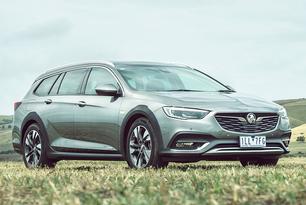
Less an SUV (happily), and more a high-riding wagon, the Calais Tourer borrows a little from the Subaru XV in its exterior design, sporting the same plastic cladding over each wheel arch. Clearly there is a whole heap of shared DNA between the Sportwagon and Tourer, and so it offers similar perks; like its SUV-shaming boot space.
Elsewhere, the Tourer shares the same soft and rounded edges as the rest of the Commodore range, and while it is genuinely quite handsome from most angles, it is at its best viewed front on, where a simple front-end is bookmarked at each corner by a narrow headlight on top, and an encased fog light below. It’s all a touch understated, sure, but it looks sharp in the metal.
Inside, it’s a clean and functional cabin design, with most of the touchscreen functions controlled by a simple row of four horizontal buttons, and with a gloss-black surround encasing the centre console. The thin leather wheel feels lovely under the touch, and the contrasting door trims and soft-touch materials find their way into the backseat, too.
The Astra is a sleek if slightly anonymous-looking thing. Having said that, it's a really nice design that looks more expensive than it is. That's important in this segment. Holden is at pains to tell us it's from Germany (the Astra is manufactured in Poland) and it does look Euro-influenced. Despite its coupe roofline, it's an easy in-and-out proposition but does sit a little lower than, say, an i30.
The odd blacked-out section of the C-pillar takes a bit of getting used to but the sheetmetal is otherwise faultless and well put together.
Inside it's a sea of grey plastic and various shades thereof, but again, it hangs together really well and is a welcome change from the Teutonically angular Golf. The materials are largely reasonable, but for some reason the stalks feel flimsy to touch and use.
The cloth trim is hardy but comfortable and I was grateful for its relative coolness versus what you might expect from the textile leather you're more likely to get at this level.
The Tourer serves up identical storage space to its Sportwagon near-enough twin, with 793 litres of storage (to the roof line) with the rear seats in place, and 1665 litres with the rear seat folded down. That’s about 200 litres more than the regular Commodore hatchback.
Where the Tourer does differ from the Sportwagon is in its exterior dimensions, measuring 5004mm in length (versus 4986mm in the Sportwagon) and 1525mm in height (versus 1483mm). Width and wheelbase are identical, though (1871mm and 2829mm), and so the interior space dimensions - like headroom and legroom - are identical no matter which of the estate-style Commodores you opt for.
The key dimension here, though, is ride height, with the Tourer offering 20mm more ground clearance (42mm greater height overall) than the Sportwagon. That, combined with the on-demand all-wheel-drive system, allows for some light off-roading - though you won’t be conquering Everest.
Up front, expect two cupholders hidden under a gloss-black cover, as well as power and USB connections located in a central cubby. The back seat is home to two extra cupholders hidden in a pulldown divider, and there is room in each of the doors for bottles. The back seat is also home to air vents (but no temperature controls) and two USB charge points located just below the vents.
Riding in the front, there's room aplenty for passengers, with good headroom and a well-designed space to maximise what's available. Rear seat passengers do okay as long as the front occupants are being generous, but the seat itself is comfortable and there's even good headroom, despite the falling roofline.
Only the front scores cupholders, with the rear passengers making do with door pockets that might swallow a small bottle. There isn't an armrest or air vents back there either.
There's somewhere for one front occupant to put their phone, a horizontal slot that doesn't like phones with covers or the larger format iPhones or Androids. If your phone does fit (iPhone Xs do, as it happens), it's useful because it's in your eyeline, although a bit untidy if you're plugged into the USB.
The boot starts at a class-compeititve 360 litres, rising to 1210 when you fold the seats down.
The Calais has long formed the most luxurious rung of the Commodore ladder, and the wagon-ish Tourer is without doubt the most practical version. It will set you back $45,990 ($47,990 drive-away) in the guise we’ve tested here, and $53,990 In Calais V specification.
Not to be sneezed at, then. But it does arrive with plenty of stuff to help justify your investment.
Outside, you’ll find 18-inch alloys, a handsfree auto-opening boot, heated mirrors, keyless entry with push-button start, a remote start function, rain-sensing wipers and automatic headlights with LED DRLs. Inside, expect leather seats that are heated in the front, a leather-wrapped wheel, dual-zone climate control, standard satellite navigation and a wireless charging pad for compatible phones.
On the technology front, an 8.0-inch touchscreen pairs with an eight-speaker stereo, and it’s both Apple CarPlay and Android Auto equipped. There’s also a genuinely impressive standard safety package, too, but we’ll drill down on that under the Safety sub-heading.
The Astra range opens with the R which, typically, you'd expect at the other end of the range with a lot more power, but there you go. You'd think the R+ was even more of a beast, but marketing is an imprecise science... apparently.
R isn't for racing, in our case it was a very bright shade of red. Starting at $23,740 for the auto (you can get a manual for a few bucks less), you get 17-inch alloys, a six speaker stereo, cloth trim, air-conditioning, reversing camera, power windows and mirrors, rear parking sensors, cruise control, auto headlights and wipers, remote central locking and a space-saver spare tyre.
The seemingly tiny screen (it's actually a competitive 7.0-inch unit) runs Holden's 'MyLink' but also has Apple CarPlay and Android Auto. For some reason you have to tell it to use those two useful additions rather than the system picking them up through the USB. Mystifyingly the button is marked 'Projection'. Aside from that, the system works well and sounds alright.
The reversing camera is of limited use - you'll see what's behind you but it's very flattened out and super-grainy.
A really rather good 3.6-litre V6 engine Is parked under the bonnet, feeding 235kW at 6800rpm and 381Nm at 5200rpm to all four wheels as required, thanks to an on-demand all-wheel-drive system. The suspension is tuned specifically for its high-riding antics, too.
The grunt is fed through a nine-speed automatic, and while Holden doesn’t quote a specific zero-to-100km/h time, it’s no slouch from the lights.
The 3.6-litre engine means a braked towing capacity of 2100kg, and an unbraked max of 750kg.
The whole Astra range is turbo, but here in the cheaper seats it's a surprisingly capable 1.4-litre unit with 110kW and a healthy 240Nm. Power finds the road via the front wheels and a six-speed automatic. It's an otherwise unremarkable technical story, with start-stop to help cut fuel use.
The Astra is rated to tow 750kg unbraked and 1200kg braked.
Not so good, I’m afraid. The offical number is on the high-side at 9.1 litres per 100 kilometres on the claimed/combined cycle (though that's less than the equivalent Subaru Outback), but we were averaging a smidge under 14.0L/100km after what was admittedly quite a lot of city driving. Still, that’s high.
Emissions are pegged at 212g/km or C02, and the Tourer’s 61-litre tank will accept cheaper 91RON fuel, or an E10 blend.
Holden claims the Astra will drink standard unleaded at the rate of 5.8L/100km on the combined cycle.
Our time with the car, which was a 70/30 mix of suburban and highway, yielded 8.3L/100km, and it's worth noting it was stinking hot for most of the time, so the air-con had to work hard.
The fuel tank is a little on the small side at 48 litres, between five and 10 litres smaller than some of its competitors, like i30 and Golf.
Really very good. That 3.6-litre engine (why they haven’t offered the Tourer with the smaller and smarter turbo engine is something of a mystery) might be a touch old-school and a touch thirsty, but it’s a rich and powerful thing, and it gives the Calais-stamped Tourer a perky personality that defies its dimensions.
The Calais Tourer was built in Germany, and fitted with an engine and transmission from the USA, before undergoing local tuning here in Australia (think bespoke steering and suspension tunes calibrated both at the company’s testing facility and after a 200,000km test on Aussie roads), and it’s the last of those Dr Frankenstein ingredients that have had the biggest impact here.
The Tourer’s ride is fantastic, perfectly poised between firm composure and everyday comfort, and - like most good wagons - it will honestly leave you wondering why so many people are clamouring aboard the SUV train when you can all the space with better dynamics in a humble estate.
The nine-speed ‘box is smooth and sharp in its operation, too. But the fuel use is a concern. Sure, we spent the bulk of our time in the city, where stop-start traffic naturally uses more fuel. But then, surely so would most owners?
I'm going to get my biggest gripe with the Astra out of the way first - the driving position is rendered awkward by the pedal placement. Every other part of the driving experience is perfectly fine, with good adjustment in the seat and steering wheel but the pedals are Not Right. The transition from accelerator to brake means a big lift of the right foot rather than a sideways shuffle and that gets boring. Perhaps I'm getting old and my knees are weak, but I ended up left-foot braking for a lot of the time.
On with the show. The Astra's 1.4 litre turbo is a punchy thing, more than vaguely reminiscent of Peugeot's excellent 1.2 in the 308. The six-speed auto isn't quite as well sorted, occasionally lurching a bit on light throttle like a dual-clutch. The pay-off for that is crisp shifts and a positive feel for most of the time.
The thing about the Astra is that it really takes it to its competition from behind the wheel. It feels almost as good as a Golf, i30 and arguably is as good as a Mazda3 thanks to its extra torque and better refinement.
It's very quiet, composed and is good fun if you like that sort of thing. Otherwise, it's streets ahead of the Corolla which continues to sell like it's going out of fashion.
You’ve got to hand it to the Lion for the standard safety package here, which includes the Holden Eye camera system as standard, adding auto emergency braking (AEB), lane keep assist, lane departure warning and forward collision warning. You’ll also find semi-autonomous parking, a reversing camera and rear parking sensors.
The Calais Tourer adds blind-sport monitoring and rear cross-traffic alert to that pretty comprehensive package. All of which helps the Commodore range qualify for the maximum five-star ANCAP safety rating.
Finally, you can add six airbags and two ISOFIX attachment points to the mix.
The Astra R+ has six airbags, ABS, stability and traction controls, reversing camera and forward AEB with a delightfully simple yet effective head-up warning.
The Astra range (with the exception of the lowest-spec R) scored a five-star ANCAP safety rating in November 2016.
Holden has recently relinquished the initial warranty offering, now including the Commodore in its seven-year, unlimited-kilometre warranty program, meaning it mixes with the very best in the aftercare business. For now, at least; normally, the Commodore carries the brand's standard three year/100,000km warranty. But be on the lookout for the return of this deal if you miss out this time.
Service intervals are pegged at 12 months or 12,000kms, and the Commodore falls under Holden’s extensive capped-price servicing program, and it will cost between $259 and $359 for each of the first seven annual services.
Holden's three year/100,000km warranty includes roadside assist for the duration. You can also extend the warranty by up to three years or to 175,000km, for an extra cost.
Servicing is scheduled every nine months or 15,000km. Holden calls its fixed-price servicing 'Know Your Price' and it applies for the first six services (63 months or 105,000km). The first four services are set at $249 each, and the final three $309.