What's the difference?
Not many people even know what a Cupra Ateca V is… and this is the second best thing about this small SUV. The first best thing is that Cupra is owned by Volkswagen.
So, this means you can have your mysterious SUV not many other people drive while knowing it’s underpinned by one of the largest car manufacturers in the world which makes cars millions of people drive and one which also has a reputation for high quality vehicles.
The big news here is the Ateca model range has a new and lower entry fee with the arrival of this V grade. See, until now the only Ateca Australians could buy is the high-performance VZx which while really sporty also came with a pretty big price tag.
So, how much is the Ateca V and what do you get for the money? We found this out at the Australian launch along with how practical and safe it is and what it’s like to drive.
Timing is everything.
For instance, with all the bad publicity the man behind the brand is generating, right now might be the perfect time if you’re in the market for a Tesla Model Y alternative.
And that’s especially so if said alternative happens to be around the same price… such as the all-new Cupra Tavascan.
No, not an antacid for relief from indigestion, but the Volkswagen Group’s Spanish brand’s first medium-sized electric SUV.
Is it good enough to catapult Cupra into the big time in Australia?
Time to find out!
The Cupra Ateca V is a much needed more affordable way into this small SUV while still offering a high-end feeling with plenty of standard features. Yes, the V isn't as high-powered as the VZx but it's still great to drive in the city and on the open road. Big on the inside and small on the outside the Cupra Ateca can perform urban and (small) family duties well.
Note: CarsGuide attended this event as a guest of the manufacturer, with accommodation and meals provided.
Like most Cupras, the Tavascan is affordable, stylish, practical, fun to drive and just that little bit different.
And it is clear the Volkswagen Group is trying hard to make the brand a success. That it can bring that formula to the medium EV SUV market with as much aplomb might just be enough to lure more than a few would-be Model Y buyers Barcelona’s way.
Definitely one to strongly consider.
Note: CarsGuide attended this event as a guest of the manufacturer, with travel, accommodation and meals provided.
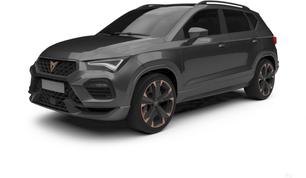
Once you know the Cupra Ateca V is closely related to the Volkswagen Tiguan and Skoda Karoq you can definitely see a resemblance. Still, all three have their own look with the Cupra clearly given the role of being the fierce, sporty one.
While the Ateca V doesn’t have the same menacing styling as the VZx, it’s definitely a seriously sporty looking SUV with its 19-inch alloys, aggressive front bumper, triangular LED running lights and blacked out wing mirrors, roof rails and CUPRA lettering across the tailgate.
The bronze Cupra logo really signals the sporty intent of this brand and I’ve been told on more than one occasion that it looks like a biohazard symbol by people confused by what it is I’m driving. According to Cupra the blade-like design represents “the sense of belonging to a clan”.
Measuring 4381mm long, 1841mm wide and 1625mm tall with 2630mm wheelbase the Ateca V is about 15cm shorter in length than a Tiguan, but as you’ll see in the practicality section the interior dimensions might be larger than you think.
The Ateca V’s cabin is full of dark-coloured materials with black leather upholstered sports seats and steering wheel. In the same way it feels like Batman designed the exterior the interior it has a ‘Made in Gotham City’ feel with a brooding style incorporating high quality textures and surfaces.
Although this mid-sized SUV is full of German VW Group DNA underneath, there are unique Cupra styling elements that do strive to evoke Spanish expression.
Designed in Barcelona, standout points include an insectoid trio of LEDs making up the headlights and tail-lights, an aggressive nose featuring a V-shaped bonnet bulge and lower-bumper treatment, a rising swage line in profile and pronounced rear diffuser.
While we appreciate the Tavascan’s styling flourishes, with the Manga-esque vent ‘eyes’, copper trim and floating wing-look upper dash-pad all gelling together nicely, the unique central spine design looks downmarket if not cheap, with an alien look and sheeny reptilian scale finish. There are too many things going on at once.
Built on the VW Group’s MEB EV architecture, the Cupra shares its platform with the VW ID.4, Skoda Enyaq and Audi Q4 e-tron SUVs within the VW Group, providing a sound engineering base, but also a tall, narrow appearance when seen rear-on.
Maybe that’s why the Tavascan achieves such an impressive drag coefficiency of 0.26.
Dimensions are 4644mm (length), 1861mm (width), 1597mm (height) and 2766mm (wheelbase), while ground clearance is a low 154mm.
For a so-called “Coupe Utility Vehicle” (CUV), all translate to quite acceptable interior space and practicality.
The Ateca V is only about 4.4m long which is a lot shorter than a Kia Sportage, Nissan X-Trail or Subaru Forester, which are truly mid-size SUVs. So, the Ateca is a small SUV but on the larger side compared to say a Volkswagen T-Roc.
Despite its fairly diminutive exterior proportions the Ateca V has excellent storage and is remarkably spacious. If you have a young, small family and want a five-seater SUV big enough for them but small enough to make urban driving easy the Ateca V ticks both boxes.
Up front there are the gigantic door pockets, two cupholders, a decent-sized covered centre console bin and under-dash storage with wireless phone charging and two USB ports.
The second row is incredibly spacious for a small SUV with so much room for me at 189cm tall to sit behind my driving position. Headroom is excellent, too.
There are also cupholders in the fold-down armrest, two USB ports and big door pockets.
The back door apertures are tall and wide which makes getting little kids in and out of their car seats easier for parents.
A 485L cargo capacity is large for the class and under the boot floor is a space-saver spare wheel.
Now, with all that CUV stuff in mind, the Tavascan manages to look and feel sporty whilst also offering a decent level of family friendly functionality.
Wide doors and a high hip point offer easy entry and egress, in a roomy and accommodating cabin, on seats that are brilliantly comfy and supportive – even in the base Endurance. These are of the integrated ‘tombstone’ variety with bolstered sides to help keep you snug and secure. They’re great.
So is the driving position, with its grippy little wheel, readily accessible switchgear (including the knobs on the spokes), clear view of the modestly sized digital instrumentation pod and angled touchscreen.
After all the criticism that the VW Group’s earlier iterations of this system had garnered – including in other Cupras – the Tavascan’s interface proved to be simple to navigate, fast to respond and pleasant to look at.
Furthermore, even with that rising window line, vision out is AOK and ventilation is fine, too.
The aforementioned central spine’s shape appears to come at the expense of storage, as there’s less of it than expected in an EV SUV. The small glovebox is disappointing. We’re not fans of the driver’s door power window switch bank, necessitating a distracting press of a ‘rear’ button to operate the back windows. And one of the test cars suffered from dash squeaks.
Moving on to the rear, with seating for five, there’s actually ample space for people up to about 180cm tall, while all the usual amenities apply, such as vent outlets, a pair of USB-C ports, a folding armrest with cup holders and overhead lighting. Nothing seems to be missing.
However, there is one important thing missing further back.
Yes, the Tavascan’s boot offers a handy 540 litres of cargo capacity, with a low, wide and flat floor capable of swallowing all sorts of stuff. And, of course, the 60/40 rear backrest fold down, boosting those numbers to between 1579L and 1604L depending on specification.
But, as with almost all EVs, there is no spare wheel. The aforementioned tyre mobility kit is bad news if you experience a severe puncture. Even a space-saver spare would be infinitely preferable.
The Ateca model now has a lower priced grade called the V and it lists for $51,990. That’s more than $10K less than the top-of-the-range VZx which has been out for a couple of years and lists for $63,490.
The Ateca V might be less expensive but the features list is still impressive. Coming standard are 19-inch alloy wheels, sports bumpers, LED headlights, running lights and puddle lights. There’s a proximity key and power tailgate with gesture control, too.
Inside black leather upholstery is standard, so are heated front seats and steering wheel, there’s dual-zone climate control, a power driver’s seat, a 9.2-inch media display with wireless Apple CarPlay and Android Auto and wireless phone charging.
As for options, you can have a panoramic sunroof for $1850 and premium metallic paint for $490.
There’s also the optional 'Tech Package' for $2950 bringing a Beats stereo system and a 360-degree camera. But the best thing about the pack is it also adds dynamic chassis control which adds adaptive suspension, so when you select 'Comfort' mode the suspension becomes softer, and in 'Sport' mode the suspension firms for better handling.
Rivals to the Ateca V include the Lexus UX and Volvo XC40 but also its Volkswagen Group cousins such as the Skoda Karoq and VW Tiguan R-Line.
Kicking off from $60,990 (all prices are before on-road costs) in base Endurance grade, this is a single-motor, rear-wheel-drive (RWD) with a usefully larger battery for better range than almost all competitors above as well as below its price point.
There’s also the flagship VZ with dual motors and all-wheel drive (AWD) from $74,490.
Not cheap, then, but the Endurance is highly competitive when you consider how ably the it traverses the axis of price, size and battery capacity.
Consider that while the Cupra does cost more than France’s superb Renault Megane E-Tech from $54,990, as well as the Kia EV5 (from $56,770), Xpeng G6 ($54,800), Smart #3 ($57,900) and BYD Sealion 7 ($54,990), that all hover from around the mid-$55K mark, it is only a tad exxier than the Model Y RWD from $58,900 and closely related Volkswagen ID.4 from $59,990, and cheaper than the equivalent Ford Mustang Mach E ($64,990), Toyota bZ4X ($66,000), Hyundai Ioniq 5 ($69,800), related Skoda Enyaq ($69,990), Subaru Solterra AWD ($69,990) and Kia EV6 ($72,590).
Note, however, that aside from the #3 and EV5, all are slightly larger than the Barcelonan mid-sizer.
Still, the swoopy Tavascan significantly undercuts other, more-premium Euro-branded propositions with a similar propensity for style, like the Polestar 4, BMW iX2, Volvo XC40 and (also related) Audi Q4 e-tron Sportback. All are well north of $75K.
Such pricing is possible partly due to this being the first Cupra – and only the second Volkswagen Group Australia model after the 2004 Polo Classique sedan – to be made in China, as part of a joint venture with JAC. This model is not built anywhere else on the planet.
Base equipment levels, however, are not quite up to Chinese standards.
The Endurance includes auto entry/start, adaptive cruise control, three-zone climate control, sports front seats, a heated steering wheel, a 15-inch touchscreen with a rear camera, wireless Apple CarPlay and Android Auto, 5.3-inch digital instrumentation, wireless phone charging, a quartet of USB-C ports, a hands-free powered tailgate, front and rear parking sensors, and 19-inch alloys.
Cupra reckons the Interior Package for an additional $4500 will be a popular option, since it adds a surround-view camera, microfibre-trimmed, heated and powered front seats with memory, broader ambient lighting, terrific 12-speaker Sennheiser audio, 20-inch wheels and more.
The VZ, meanwhile, features most of the above and then steps up with the second electric motor, AWD, 21-inch alloys, adaptive dampers, a glass roof (thankfully with a sunshade), adaptive matrix LED headlights.
Another $8K buys the Extreme package, bringing Nappa leather upholstery, racier front seats with ventilation, and unique alloys shod with performance tyres.
Sadly, no Tavascan grade comes with a spare wheel, just a tyre mobility kit.
Unsurprisingly, all boast advanced driver-assist tech, such as autonomous emergency braking (AEB) and lane-support systems, along with a handy vehicle exit warning and seven airbags, including a front-centre item. Find out more in the Safety section below.
Nothing too radical in the specification stakes, then. But Cupra reckons the Tavascan will offer one extra-special benefit that no rival can – and that’s Barcelona-bred design flair – when Aussie deliveries commence in May.
Time to take a closer look.
The Ateca V has a 2.0-litre turbo-petrol four-cylinder engine making 140kW and 320Nm. That’s a step down in output compared to the VZx’s 221kW and 440Nm, but the V doesn't feel underpowered.
A seven-speed dual clutch automatic transmission shifts gears lighting fast with the drive going to all four wheels. Yes, it’s all-wheel drive.
Don’t go searching for more boot space under the bonnet – there isn’t any.
Plus, the main electric motor – a permanently excited synchronous unit – is located on the rear axle, driving the rear wheels via a single-speed transmission.
Tipping the scales at 2238kg, the Endurance makes 210kW of power, to offer a power-to-weight ratio of 94kW per tonne, as well as a 0-100km/h sprint time of 6.8 seconds, on the way to a top speed of 180km/h.
Meanwhile, the VZ also has a smaller, asynchronous 80kW/134Nm electric motor over the front axle, channelling up to 30 per cent of the SUV’s total power to the front wheels as traction requires, and upping the combined power maximum to 250kW. Tipping the scales at 2284kg, the VZ offers 109kW/tonne, while the 0-100km/h time slips to 5.5s. Both offer a 545Nm torque maximum.
The 400-volt MEB platform consists of MacPherson-style struts up front and a multi-link rear end. The VZ adds adaptive dampers. Braked towing capacity is 1000kg in Endurance and 1200kg in the VZ.
Cupra says that after a combination of open and urban roads the Ateca V should use 7.1L/100km. That’s not hugely fuel efficient and urban consumption of 8.6L/100km will mean higher fuel bills than a hybrid SUV of this size.
On the launch we saw a fuel consumption average of 7.7L/100km and that’s after city roads, motorways and country roads.
Once we have the Ateca V in our CarsGuide garage we’ll be able to perform a real-world test of its fuel consumption.
The Ateca V has a 55-litre fuel tank and requires 95 RON premium unleaded petrol. Theoretical driving range is around 775km.
The Tavascan employs an 82kWh Lithium-ion battery pack, offering a useable capacity of 77kWh.
Mounted down low in the structure to provide extra rigidity as well as balance, it helps the Cupra achieve a near-ideal 49/51 front/rear weight distribution.
The battery is also separated in 12 removable modules for easier repair and parts replacement.
When the accelerator is lifted or in ‘B’ mode, the electric motor acts as a generator to feed energy back into the battery. Three levels of brake energy recuperation is also available via the steering wheel’s paddle-shifters.
Cupra says that the Endurance RWD offers a WLTP range of 540km, while the circa-60kg heavier VZ AWD drops that to 499km, or 463km with the Extreme Package’s grippy high-performance tyres.
Officially, the combined average energy consumption figures are between 15.2 and 16.0kWh/100km in Endurance and between 16.5 and 16.8kWh/100km in the VZ.
Driving around Adelaide and beyond in the beautiful wine country, we managed between 15.0 and 22kWh/100km, as indicated on the Tavascan’s trip computer, which isn’t too bad.
The Cupra features an AC charging capacity of 11kW and DC charging capacity of 135kW.
Charging from empty to full when plugged in at home or work can take nearly 40 hours, or about 12.5hr with an optional 7.4kW wallbox, while a 10-80 per cent top-up using a standard 50kW fast charger needs about 75 minutes, or under half an hour if you find a super-fast 150kW outlet.
The launch of the Ateca V saw us drive the V and the VZx back-to-back, which highlighted how good the V is for the money when it comes to its on-road performance.
The 2.0-litre engine is superbly responsive with loads of torque for such a small petrol SUV, while the dynamics were equally impressive on winding country roads. Even when those roads occasionally and suddenly turned from bitumen to dirt at 100km/h excellent all-wheel drive traction kept everything under control.
The Ateca V we tested has the optional Tech Package fitted which adds dynamic chassis control and adjusts the suspension in the Comfort drive mode setting to a softer level compared to the firmer level in Sport. The ride in any mode, however, is comfortable with great handling.
As standard the Ateca V is given sports suspension and after a quick sample of the Ateca V with this set-up I also found the ride to be comfortable and composed.
There's good visibility even through the rear window, along with nicely weighted accurate steering and a good pedal feel under my feet make the Ateca V effortless and enjoyable to drive.
Cupra prides itself as a builder of sporty, stylish and offbeat vehicles, and insists that the Tavascan is no exception.
With its design, interior presentation and powertrain supporting such expectations, the acid test is now how the Tavascan performs out on the road.
The really encouraging news is that, on our launch drive experience at least, Cupra’s coupe SUV serves up sportiness and a whole lot more besides.
Let’s start with performance.
Aided by a fine driving position, the Tavascan almost goes out of its way to normalise the EV operating experience, with the now-familiar VW Group column-mounted gear selector being reassuringly straight forward. You’re not left wondering if this thing is even on.
Choose the default Comfort drive setting, and the Cupra whooshes forward with eager yet measured forcefulness, so you’re spared unpleasant jerkiness. Speed builds up quickly and smoothly as the road opens up ahead. So far, so good.
Need extra muscle for overtaking or joining freeway traffic? There’s ample in reserve, revealing the real-world pace and response that even the least-expensive Tavascan offers. The Endurance is a deceptively brisk machine for the money. And that’s before the sportier driving modes are engaged.
Speaking of which, the steering is simply superb, offering sharp yet progressive cornering capabilities. You feel connected to the car, and that translates into very predictable handling and reassuring roadholding. Cupra is starting to shape up as one of our favourite non-German German-owned brands.
But the biggest shock is the Tavascan’s ride quality.
Now, though wearing 19-inch wheels and on steel springs, Cupra’s sporty leanings meant we expected the base grade to ride with tolerable firmness at best.
Instead, over Adelaide’s suburban streets leading into the hills (and then beyond), the suspension provided a sophisticated blend of suppleness and control, ably dealing with the rough stuff without any real abruptness.
Our only note here is that you can hear the suspension working underneath, in an endearingly old-fashioned mechanical way. Odd, but not to a distracting point.
Plus, while there are three levels of regen-braking assistance, we’d like the option of single-pedal driving capability.
Much the same dynamic flair applies to the Interior Package option that swaps out for 20s, except that the ride is clearly just that little bit firmer. But tyre and road drone do seem to drown out the suspension noise at times, but not to any alarming degree. Just in a typically German-engineered vehicle sort of way. No revelations here.
Switching to the VZ is equally revealing.
As you might expect, the extra power and additional (undisclosed) torque from the front electric motor are immediately obvious, elevating its performance significantly. Point, squirt, shoot. This thing really hustles along.
Yet it is the flagship’s balance and control of the chassis that came as a surprise.
Usually, the additional weight of two motors and 21-inch wheels detract from the driving pleasure of many an EV SUV with their shifting mass and heavier feel, but the VZ seemed to contain those tightly, and instead dishes up speed with agility and finesse.
Better still, the top spec’s standard adaptive dampers also seem to help deliver a supple and isolated ride, soaking up bigger potholes and that sort of thing, in a superior way that – we suspect – even the Endurance on 19s likely could not.
Factor in the beautifully nuanced and thoughtfully-tuned driver-assist tech systems, and – after months of driving at-times infuriating SUVs from China – the Chinese-made Tavascan feels anything but rushed or half-baked.
We’re impressed, at least on this first drive.
Ultimately, even after hours and hours behind the wheel, the Tavascan left us wanting more in a good way, not less. That’s a sure sign that the recipe is fundamentally right.
The Cupa Ateca V hasn’t been tested by ANCAP and the Euro Ncap result of five stars (which is the maximum) has now expired because it was so long ago (2016).
Still, while much of the safety tech isn’t as cutting edge as some new SUVs , there’s AEB, adaptive cruise control, lane keeping assistance, rear traffic alert plus front and rear parking sensors.
The airbag count runs to seven, including a front centre bag to minimise head clash injuries in a side-impact.
For child seats there are three anchor points and two ISOFIX mounts in the back.
The Tavascan also delivers an impressive showing on the safety front, scoring a five-star EuroNCAP safety rating.
A whole raft of advanced driver-assist tech is available, including autonomous emergency braking (operable from 5km/h) for pedestrians, cyclists and other vulnerable road users as well as car-to-car, lane departure warning/assist (from 65km/h), rear-cross-traffic alert, blind-spot warning, exiting-vehicle alert tech, adaptive cruise control, a driver-attention monitor and tyre pressure indicators.
There are seven airbags, including dual front, front-side, head and a front-centre item to help mitigate lateral occupant collision injury, as well as rear outboard occupant side and head coverage.
A trio of child-seat anchorage are fitted across the back seat, along with ISOFIX child-seat anchorages in the front passenger seat and two in the rear outboard positions.
The Ateca V is covered by Cupra’s five-year, unlimited-kilometre warranty, with servicing needed every 15,000km or annually.
You can buy a five-year service plan for $1990 - which isn’t overly pricey.
Here’s where the Tavascan loses some steam.
Each Tavascan is covered by a five-year/unlimited-kilometre warranty, which is only average nowadays and below the seven and even 10 years that some other EV brands provide. Free roadside assistance is provided for five years.
Service intervals are every two years or 30,000km, at a listed cost of $485 per visit. Alternatively, owners can pre-purchase six-year and 10-year service packages from $1310 and $2190 respectively.
An eight-year/160,000km battery warranty also applies.
Finally, Cupra also provides owners with the option of organising home or workplace AC charging solutions via Jetcharge, offering an $1800 ‘Lite’ or $2300 ‘Maxi’ charger, including installation.
Are all these enough to get the Tavascan over the line for you?