What's the difference?
Not many people even know what a Cupra Ateca V is… and this is the second best thing about this small SUV. The first best thing is that Cupra is owned by Volkswagen.
So, this means you can have your mysterious SUV not many other people drive while knowing it’s underpinned by one of the largest car manufacturers in the world which makes cars millions of people drive and one which also has a reputation for high quality vehicles.
The big news here is the Ateca model range has a new and lower entry fee with the arrival of this V grade. See, until now the only Ateca Australians could buy is the high-performance VZx which while really sporty also came with a pretty big price tag.
So, how much is the Ateca V and what do you get for the money? We found this out at the Australian launch along with how practical and safe it is and what it’s like to drive.
The Polestar 2 was one of the first electric vehicles (EVs) in Australia to break through to the mainstream, however it has always been relegated to the Tesla Model 3’s shadow.
As a result Polestar is constantly playing catch up, releasing update after update for this premium-pushing electric liftback. The most notable was a major mid-life update in 2024.
Two years after this, Polestar has just rolled out the 2026 model year (MY26) update which introduces a range of subtle changes, largely under the surface.
It comes as Polestar is now introducing newer models, there’s mounting pressure from legacy carmakers who are only now catching up to EV tech, and Australians are moving away from buying passenger cars to SUVs.
Has this latest update improved the appeal? Read on to find out.
The Cupra Ateca V is a much needed more affordable way into this small SUV while still offering a high-end feeling with plenty of standard features. Yes, the V isn't as high-powered as the VZx but it's still great to drive in the city and on the open road. Big on the inside and small on the outside the Cupra Ateca can perform urban and (small) family duties well.
Note: CarsGuide attended this event as a guest of the manufacturer, with accommodation and meals provided.
This latest update for the Polestar 2 is lovely, but driving the original is a reminder of how solid this car has always been if you overlook the inherent impracticalities of being an EV on a combustion-engine platform.
The fact you still get steady flow of over-the-air software updates bringing new features, plus you can now upgrade to the new Qualcomm processor chip, saving some coin and getting a second-hand model that’s a couple of years old isn’t a bad option at all.
Note: CarsGuide attended this event as a guest of the manufacturer, with meals provided.
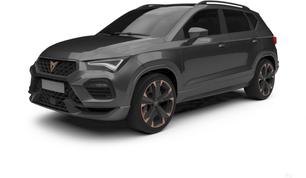
Once you know the Cupra Ateca V is closely related to the Volkswagen Tiguan and Skoda Karoq you can definitely see a resemblance. Still, all three have their own look with the Cupra clearly given the role of being the fierce, sporty one.
While the Ateca V doesn’t have the same menacing styling as the VZx, it’s definitely a seriously sporty looking SUV with its 19-inch alloys, aggressive front bumper, triangular LED running lights and blacked out wing mirrors, roof rails and CUPRA lettering across the tailgate.
The bronze Cupra logo really signals the sporty intent of this brand and I’ve been told on more than one occasion that it looks like a biohazard symbol by people confused by what it is I’m driving. According to Cupra the blade-like design represents “the sense of belonging to a clan”.
Measuring 4381mm long, 1841mm wide and 1625mm tall with 2630mm wheelbase the Ateca V is about 15cm shorter in length than a Tiguan, but as you’ll see in the practicality section the interior dimensions might be larger than you think.
The Ateca V’s cabin is full of dark-coloured materials with black leather upholstered sports seats and steering wheel. In the same way it feels like Batman designed the exterior the interior it has a ‘Made in Gotham City’ feel with a brooding style incorporating high quality textures and surfaces.
I’ve always been a fan of the Polestar 2’s exterior design and unlike many new cars it has aged like fine wine over the years. You need to remember the Polestar 2 dates back to 2016 when it was first revealed as a Volvo concept.
It still has clean lines, iconic lightning signatures, plus a tough stance that evokes just a touch of muscle car.
While it has taken me a while to come around to the new blanked-out grille insert, it suits the character of this car given it’s an EV. It also aligns with the wider Polestar design language.
For 2026 there haven’t been any major changes to the exterior. There’s a new sandy-like ‘Dune’ exterior paint colour replacing the silver ‘Jupiter’, plus a new 20-inch forged alloy wheel design for the Long range Dual motor Performance.
Inside, the Polestar 2 looks fundamentally the same as it did when it first launched, in the best and worst ways.
I appreciate how traditional car-like the layouts of the steering wheel, digital instrument cluster and touchscreen multimedia system are. Sure it doesn’t scream ultra high-tech anymore like some of its rivals, but there’s still an understated premium feel to it.
The same can be said for the rest of the Polestar 2’s interior. Everything feels purposeful in a minimalist way which helps make for a clean design.
Speaking of purposefulness, the optional Bowers and Wilkins sound system features a prominent tweeter on top of the dashboard. It looks stunning and is functional, helping to create an incredibly punchy and full sound stage in the cabin.
One of the few finishes I dislike in the interior is the glossy piano black on the steering wheel buttons. You interact with these frequently and it doesn’t take long for fingerprints to present themselves.
There’s now a new synthetic leather upholstery finish for those who opt for the $4700 Plus package. It’s quilted which helps emulate a premium puffer jacket-like look.
Although it’s expensive, the $4400 ‘Bridge of Weir’ Nappa leather upholstery is beautiful and required if you want ventilated front seats. You can only get black and white finishes, which is fine, but bringing back a tan or caramel option would be delicious.
The Ateca V is only about 4.4m long which is a lot shorter than a Kia Sportage, Nissan X-Trail or Subaru Forester, which are truly mid-size SUVs. So, the Ateca is a small SUV but on the larger side compared to say a Volkswagen T-Roc.
Despite its fairly diminutive exterior proportions the Ateca V has excellent storage and is remarkably spacious. If you have a young, small family and want a five-seater SUV big enough for them but small enough to make urban driving easy the Ateca V ticks both boxes.
Up front there are the gigantic door pockets, two cupholders, a decent-sized covered centre console bin and under-dash storage with wireless phone charging and two USB ports.
The second row is incredibly spacious for a small SUV with so much room for me at 189cm tall to sit behind my driving position. Headroom is excellent, too.
There are also cupholders in the fold-down armrest, two USB ports and big door pockets.
The back door apertures are tall and wide which makes getting little kids in and out of their car seats easier for parents.
A 485L cargo capacity is large for the class and under the boot floor is a space-saver spare wheel.
This has always been the downfall of Polestar 2 and it remains true.
While it’s pretty and has a cockpit-like design, the cabin can feel compromised in terms of space and storage. This is primarily due to the centre console which angles upwards sharply, aggressively segmenting the driver and front passenger space.
The only storage spots on the centre console include a shallow shelf under the centre console, a wireless phone charger and another uncovered storage nook under the touchscreen.
It doesn’t help that the cupholder situation doesn’t allow for a proper centre armrest. You either have no cupholders and an armrest, one cupholder and your arm barely reaches the armrest, or two cupholders and the centre armrest flops into the backseat space. It’s not ideal.
Gripes aside, there are still positives to the Polestar 2’s front row. The seats are comfortable on longer drives and allow for a large degree of electric adjustment.
Ahead of the driver the steering wheel thankfully has physical buttons, allowing for easy use on the move. I also love how satisfying the indicator stalk thwack is. It’s the little things that count.
The digital instrument cluster has a minimalist look and can be customised with a few layouts. I particularly like the Google Maps layout which shows your navigation when using the in-built app.
Moving across, the Google Built-in software for the multimedia system is still up there as one of the most usable out there currently. It’s easy to navigate, plus if you get lost there’s a convenient home button at the bottom of the screen.
Both screens are now driven by a more powerful Qualcomm processor chip which allows for better responsiveness, smoother performance and higher download speeds for in-car apps.
Although we didn’t get a huge opportunity to stress test this new chip, it’s definitely an improvement on the old one. You can technically upgrade your old Polestar 2’s chip through a Polestar service centre, though it conveniently doesn’t list how much this costs.
While physical switchgear is limited, there’s still enough to get by. Over the years I’ve grown accustomed to using the touchscreen to change the climate control, though some physical dials and buttons would be nice.
Apple CarPlay and Android Auto are available in wired form only, which is surprising as wireless smartphone mirroring is now commonplace. It does mean however that your phone will charge up reliably.
Moving to the second row, it’s arguably where the Polestar 2 is at its worst. At a leggy 182cm I do fit behind my driving position but headroom is tight.
It doesn’t help that there’s a huge transmission tunnel which technically isn’t needed given this car is fully electric. That’s a downside of using a combustion-engine platform.
Second-row amenities include air vents, two USB-C ports, as well as a fold-down armrest with cupholders. Heated outboard seats are optional.
At the back the button to pop the boot is down where the number plate is. It’s not overtly obvious unless you know where to look.
As standard the tailgate is manually operated and you need to get the $4700 Plus pack in order to get it electrically operated. It also gets a hands-free function which is handy if you’ve got your hands full with bags.
Boot space is 407L with the rear seats upright, expanding to 1097L with them folded. This includes a 43L underfloor section which is large enough for some cables. The boot size is fairly standard for a vehicle of this size and type.
There’s also a 41L front boot which can be used for further cable storage or other various storage needs.
The Ateca model now has a lower priced grade called the V and it lists for $51,990. That’s more than $10K less than the top-of-the-range VZx which has been out for a couple of years and lists for $63,490.
The Ateca V might be less expensive but the features list is still impressive. Coming standard are 19-inch alloy wheels, sports bumpers, LED headlights, running lights and puddle lights. There’s a proximity key and power tailgate with gesture control, too.
Inside black leather upholstery is standard, so are heated front seats and steering wheel, there’s dual-zone climate control, a power driver’s seat, a 9.2-inch media display with wireless Apple CarPlay and Android Auto and wireless phone charging.
As for options, you can have a panoramic sunroof for $1850 and premium metallic paint for $490.
There’s also the optional 'Tech Package' for $2950 bringing a Beats stereo system and a 360-degree camera. But the best thing about the pack is it also adds dynamic chassis control which adds adaptive suspension, so when you select 'Comfort' mode the suspension becomes softer, and in 'Sport' mode the suspension firms for better handling.
Rivals to the Ateca V include the Lexus UX and Volvo XC40 but also its Volkswagen Group cousins such as the Skoda Karoq and VW Tiguan R-Line.
The 2026 Polestar 2 starts at $62,400, before on-road costs, for the Standard range Single motor and extends all the way to $85,080, before on-road costs, for the Long range Dual motor with the Plus and Performance packages.
This is more expensive than the similarly premium-pushing Tesla Model 3 ($54,990 to $80,900, before on-roads), as well as the more budget-oriented BYD Seal ($46,990 to $61,990, before on-roads).
Despite this, Polestar currently has some major deals and offers on new 2026 Polestar 2 stock to the tune of up to $13,000 off the drive-away price. This can see you drive away in a brand-new model for as little as $55,763, drive-away, in Victoria, which is around $5000 less than a base Model 3 RWD.
There’s a catch though… options. There is a slew of option packages and singular options available and they add up quickly.
Most notable is the new $3500 14-speaker Bowers & Wilkins sound system that must be bought in conjunction with the 'Plus package' which is $4700 on all trims besides the Long range Dual motor as it’s already standard.
Annoyingly, a heat pump is part of the $1500 'Climate package' which also brings heated rear seats, a heated steering wheel and heated wiper nozzles. So many carmakers now include heat pumps as standard fare in EVs as they help reduce energy consumption during colder months.
Beyond this, there’s a standard base of equipment which is fine for the price point. Highlights include LED headlights, a 12.3-inch digital instrument cluster, 11.2-inch touchscreen multimedia system, wired Apple CarPlay and Android Auto, wireless charger, dual-zone climate control and heated front seats with electric adjustment.
The Ateca V has a 2.0-litre turbo-petrol four-cylinder engine making 140kW and 320Nm. That’s a step down in output compared to the VZx’s 221kW and 440Nm, but the V doesn't feel underpowered.
A seven-speed dual clutch automatic transmission shifts gears lighting fast with the drive going to all four wheels. Yes, it’s all-wheel drive.
No changes have been made to the Polestar 2’s electric motor set-up for 2026.
Both the single-motor versions have been rear-wheel drive now for a few years and produce either 200kW or 220kW, depending on the battery pack.
The Long range Dual motor adds a front-mounted electric motor bringing total system outputs to 310kW and 740Nm. It’s capable of doing the 0-100km/h sprint in 4.5 seconds.
The $8980 Performance pack (available only on the Long range Dual motor) bumps the total system power output to 350kW. It also reduces the 0-100km/h sprint to 4.2 seconds.
Cupra says that after a combination of open and urban roads the Ateca V should use 7.1L/100km. That’s not hugely fuel efficient and urban consumption of 8.6L/100km will mean higher fuel bills than a hybrid SUV of this size.
On the launch we saw a fuel consumption average of 7.7L/100km and that’s after city roads, motorways and country roads.
Once we have the Ateca V in our CarsGuide garage we’ll be able to perform a real-world test of its fuel consumption.
The Ateca V has a 55-litre fuel tank and requires 95 RON premium unleaded petrol. Theoretical driving range is around 775km.
Although we didn’t get to drive it at this media launch, the entry-level Polestar 2 Standard range Single motor has arguably received the biggest refresh of the line-up with this MY26 update.
It now has a slightly larger 70kWh lithium-ion battery pack sourced from CATL, replacing the LG Chem-sourced 69kWh lithium-ion battery. As a result there’s 554km of WLTP-claimed range with up to 554km (up from 546km).
Long range versions still have a CATL-sourced 82kWh lithium-ion battery with between 568km and 659km of WLTP-claimed range, depending on the variant. This is good but Tesla has moved the game forward with its Model 3 Long Range RWD which offers up to 750km of range.
We didn’t get a chance to fully test out energy consumption during this media event, but Polestar claims between 14.8kWh/100km and 17.2kWh/100km, depending on the variant. This is much better than when the Polestar 2 first launched.
While the maximum AC charging rate remains at 11kW across the line-up, the Standard range versions can now DC fast-charge at rates up to 180kW (up from 135kW). This means a 10 to 80 per cent charge can now take as little as 26 minutes.
Maximum DC fast-charging for Long range versions is still up to 205kW, allowing a 10 to 80 per cent charge in 28 minutes. Lots of newer rivals offer faster charging now.
The launch of the Ateca V saw us drive the V and the VZx back-to-back, which highlighted how good the V is for the money when it comes to its on-road performance.
The 2.0-litre engine is superbly responsive with loads of torque for such a small petrol SUV, while the dynamics were equally impressive on winding country roads. Even when those roads occasionally and suddenly turned from bitumen to dirt at 100km/h excellent all-wheel drive traction kept everything under control.
The Ateca V we tested has the optional Tech Package fitted which adds dynamic chassis control and adjusts the suspension in the Comfort drive mode setting to a softer level compared to the firmer level in Sport. The ride in any mode, however, is comfortable with great handling.
As standard the Ateca V is given sports suspension and after a quick sample of the Ateca V with this set-up I also found the ride to be comfortable and composed.
There's good visibility even through the rear window, along with nicely weighted accurate steering and a good pedal feel under my feet make the Ateca V effortless and enjoyable to drive.
While outright practicality isn’t the Polestar 2’s strong suit, once you get on the road this melts away almost instantly.
This EV is and has always been a driver’s car that’s engaging and rewarding to steer. It’s a shame that many people’s first experience with it was likely in the second row as a rideshare with a driver that has a bad case of taxi foot.
Surprisingly, during the media launch drive program we had the opportunity to sample the original MY22 Long range Single motor and compare it back-to-back to the MY26 models. It’s rare this kind of thing happen.
This is notable because single-motor versions made the switch from front- to rear-wheel drive back in 2024.
While the MY22 example feels like a bulldog yet still capable of carving up corners, it holds up well if you ignore the odd cabin rattle and creak. You can also feel a marked difference with how the rear guides the latest MY26 Long range Single motor instead of the front when pushed.
This isn’t apparent in calmer, everyday driving situations. If you’re not a car person you likely wouldn’t be able to tell the difference.
The rear-mounted electric motor produces an adequate amount of oomph, allowing you to get up to speed with ease. Like all EVs you get snappy acceleration from a standstill, which is thrilling.
This is dialled up to 11 in the Long range Dual motor Performance. Although the Model 3 Performance is technically faster, it still feels like this Polestar 2 is quick enough.
In the fully loaded all-wheel drive trim you’re able to carve corners enthusiastically. It’s incredibly confidence-inspiring to chuck into corners as there’s grip for days and a bucketload of power to back it up.
Although the regenerative braking system is pretty powerful already, the Performance pack adds chunky Brembo physical brakes for added peace of mind. Perhaps Tesla could take note of this?
The aforementioned Performance pack also adds manually adjustable Öhlins dampers with a ‘Polestar Engineered’ performance chassis. It’s an incredible package with a dialled-in feel, though if you want to adjust the dampers you need to jack up the car.
If you’re not keen on outright performance, the regular Polestar 2’s suspension set-up still holds its own but has an added level of all-around comfort. It’s an improvement from the original which was a little too firm.
Across the line-up the steering is direct and makes this car feel nimble regardless of where or how you’re driving. You’re able to select from different steering feels which increase or decrease the resistance.
Given EVs have no engine noise, they can sometimes have more noticeable road and wind noise out on the open road. Thankfully the Polestar 2’s cabin is quiet enough, that is unless you’re driving on coarse-chip roads.
The Cupa Ateca V hasn’t been tested by ANCAP and the Euro Ncap result of five stars (which is the maximum) has now expired because it was so long ago (2016).
Still, while much of the safety tech isn’t as cutting edge as some new SUVs , there’s AEB, adaptive cruise control, lane keeping assistance, rear traffic alert plus front and rear parking sensors.
The airbag count runs to seven, including a front centre bag to minimise head clash injuries in a side-impact.
For child seats there are three anchor points and two ISOFIX mounts in the back.
The Polestar 2 received a maximum five-star ANCAP safety rating based on testing conducted in 2021.
Standard safety equipment includes eight airbags, autonomous emergency braking (AEB), blind-spot monitoring, rear cross-traffic alert, adaptive cruise control, lane-keep assist, lane centering, front and rear parking sensors as well as a surround-view camera system.
This amount of safety tech is pretty standard fare now, but I particularly like how well they are tuned. It’s more noticeable in a world where new cars from new carmakers continually chime at you even though you’re driving normally.
There are ISOFIX child seat anchorages on the two outboard rear seats, plus top-tether points on all three rear seats.
The Ateca V is covered by Cupra’s five-year, unlimited-kilometre warranty, with servicing needed every 15,000km or annually.
You can buy a five-year service plan for $1990 - which isn’t overly pricey.
The Polestar 2 is covered by a five-year, unlimited-kilometre warranty, whereas the high-voltage battery is covered by an eight-year, 160,000km warranty.
While this battery warranty length is standard, a five-year warranty is getting a little short now in the grand scheme of things as many brands are moving to seven-year warranties.
Owners also get five years' of roadside assistance which can be accessed by pressing the ‘Connect’ button on the overhead console. It’s available 24/7 and includes car recovery and alternative transport, if required.
Logbook servicing is required every 24 months or 30,000km, which is standard for EVs. At the time of writing Polestar Australia was finalising service pricing for the MY26 2 and we'll update this review as soon as we receive the details.
There are a total of 23 Polestar service centres around Australia, a number of them shared with Volvo.