What's the difference?
Not many people even know what a Cupra Ateca V is… and this is the second best thing about this small SUV. The first best thing is that Cupra is owned by Volkswagen.
So, this means you can have your mysterious SUV not many other people drive while knowing it’s underpinned by one of the largest car manufacturers in the world which makes cars millions of people drive and one which also has a reputation for high quality vehicles.
The big news here is the Ateca model range has a new and lower entry fee with the arrival of this V grade. See, until now the only Ateca Australians could buy is the high-performance VZx which while really sporty also came with a pretty big price tag.
So, how much is the Ateca V and what do you get for the money? We found this out at the Australian launch along with how practical and safe it is and what it’s like to drive.
For most Aussies it probably seems the Ford Endura has just magically appeared and some of you might be wondering where Ford’s Territory went. Well, meet the new Territory… kind of.
Where the Territory was Australian-made, the Endura is built in Canada, and this model has been on sale in the United States since 2015.
The Endura received a big revamp at the start of this year and now it’s been introduced here because Ford’s had a gap in its line-up since the end of local car making meant the end of the Territory.
We went to the launch of Ford Australia’s new large SUV to see how it coped with our local roads and to investigate what it offered in terms of practicality, space and value.
The Cupra Ateca V is a much needed more affordable way into this small SUV while still offering a high-end feeling with plenty of standard features. Yes, the V isn't as high-powered as the VZx but it's still great to drive in the city and on the open road. Big on the inside and small on the outside the Cupra Ateca can perform urban and (small) family duties well.
Note: CarsGuide attended this event as a guest of the manufacturer, with accommodation and meals provided.
As much as I loved the Territory I have to say Ford’s Endura is a worthy replacement. This is an easy and enjoyable to drive, spacious, fuel efficient, safe SUV that’s great value with its big features list, long warranty and low servicing costs.
The sweet spot is the entry grade Trend as it get most of the equipment you'll find on the others, without paying more for bigger wheels or a sunroof.
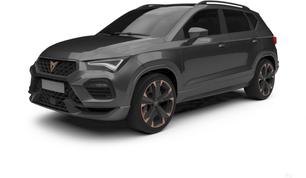
Once you know the Cupra Ateca V is closely related to the Volkswagen Tiguan and Skoda Karoq you can definitely see a resemblance. Still, all three have their own look with the Cupra clearly given the role of being the fierce, sporty one.
While the Ateca V doesn’t have the same menacing styling as the VZx, it’s definitely a seriously sporty looking SUV with its 19-inch alloys, aggressive front bumper, triangular LED running lights and blacked out wing mirrors, roof rails and CUPRA lettering across the tailgate.
The bronze Cupra logo really signals the sporty intent of this brand and I’ve been told on more than one occasion that it looks like a biohazard symbol by people confused by what it is I’m driving. According to Cupra the blade-like design represents “the sense of belonging to a clan”.
Measuring 4381mm long, 1841mm wide and 1625mm tall with 2630mm wheelbase the Ateca V is about 15cm shorter in length than a Tiguan, but as you’ll see in the practicality section the interior dimensions might be larger than you think.
The Ateca V’s cabin is full of dark-coloured materials with black leather upholstered sports seats and steering wheel. In the same way it feels like Batman designed the exterior the interior it has a ‘Made in Gotham City’ feel with a brooding style incorporating high quality textures and surfaces.
Is seems there’s not a single photo out there of the Endura that actually shows this SUV as it truly looks when seeing it with your own eyes.
Profile images make it look like an SUV version of a Ford Mondeo, while front-on shots make it look big and tall like a Ford Escape on steroids. Watching the video that goes with this story will probably give you the most truthful view short of seeing one on the road for yourself.
It’s a good-looking SUV with tough styling at the front with a giant version of the grille worn by the whole Ford car family, to the more delicately designed tailgate.
There are three grades in the Endura range – the entry level Trend, the sporty mid-spec ST-Line and the Titanium at the top.
The ST-Line is the most recognisable thanks to its body kit, blacked out mesh grille and black roof rails. You can spot a Titanium by its sunroof and its bright-finish 20-inch alloy wheels.
So, what are the Endura’s dimensions? Well, at just over 4.8m long, almost 2.2m wide (including the wing mirrors) and a bit more than 1.7m tall the Endura is almost the same size as the beloved Territory, even the wheelbases are within 6.0mm of each other with the new SUV’s being 2.8m long.
Talking of the Territory, if you’re familiar with that Aussie SUV’s insides then you’ll feel at home in the cabin of the Endura because of the way the display is integrated into the dash.
Have a look at the interior images – how much does that look like the screen in the Territory? I’m not a big fan of the air vents either side of the screen, but the dash and the centre console are otherwise beautifully symmetrical in their placement of buttons and dials.
There are high-quality feeling materials in most places. Yes, there are some hard plastics such as on the glove box lid, but there are soft-touch plastics on the dash and also on the rear window sills where many carmakers seem to use what feels like recycled takeaway containers thinking you might not notice.
Oh, and then there’s the gear shifter, or as Ford calls it the ‘E-Shifter’. It’s a rotary dial for the automatic transmission, rather than a lever. It looks a bit alien but it feels like a premium piece of equipment.
The interior of the three grades are almost identical with all of them coming with the chrome effect trim lining the centre console and the glossy black plastic around the cupholders up front. The ST-Line has aluminium-face pedals and a perforated leather-wrapped steering wheel, while the Titanium gets illuminated metal front door scuff plates.
Really, the main difference to the interiors are the seats – the Trend has cloth upholstery, the ST-Line has a suede-like material with leather accents and the Titanium has part leather perforated seats. All upholstery is black.
As for paint colours, there are 10 to choose from including 'Agate Black', 'Blue Metallic', 'Baltic Sea Green', 'Burgundy Velvet', 'Ingot Silver', 'Oxford White', 'Ruby Red' and 'Stone Grey'.
The Ateca V is only about 4.4m long which is a lot shorter than a Kia Sportage, Nissan X-Trail or Subaru Forester, which are truly mid-size SUVs. So, the Ateca is a small SUV but on the larger side compared to say a Volkswagen T-Roc.
Despite its fairly diminutive exterior proportions the Ateca V has excellent storage and is remarkably spacious. If you have a young, small family and want a five-seater SUV big enough for them but small enough to make urban driving easy the Ateca V ticks both boxes.
Up front there are the gigantic door pockets, two cupholders, a decent-sized covered centre console bin and under-dash storage with wireless phone charging and two USB ports.
The second row is incredibly spacious for a small SUV with so much room for me at 189cm tall to sit behind my driving position. Headroom is excellent, too.
There are also cupholders in the fold-down armrest, two USB ports and big door pockets.
The back door apertures are tall and wide which makes getting little kids in and out of their car seats easier for parents.
A 485L cargo capacity is large for the class and under the boot floor is a space-saver spare wheel.
The Endura is longer than a Hyundai Santa Fe and shorter than a Mazda CX-8. The thing is both of those SUVs have seven seats, while the Endura has five. The only seven-seater SUV in Ford’s range is the Everest, which is a big off-roader.
If you don’t need the extra row, then you may see it as a bonus because not having folding seats back there means you’ve got decent boot space – 602 litres up to the cargo cover.
Legroom is also good in the back. I’m 191cm tall and have about 40mm of space between my knees and the seat back, while headroom even in the Titanium with its panoramic sun roof is ample.
As for storage in the cabin, there are four cupholders - two in the front and two in the back. A bottle holder in each door (which are on the small side), there’s a big centre console bin under the armrest, a storage tray under the dash, another one in front of the shifter and a covered dash-top area.
All Enduras come standard with two USB ports, three 12-volt outlets and a 230-volt outlet.
The Ateca model now has a lower priced grade called the V and it lists for $51,990. That’s more than $10K less than the top-of-the-range VZx which has been out for a couple of years and lists for $63,490.
The Ateca V might be less expensive but the features list is still impressive. Coming standard are 19-inch alloy wheels, sports bumpers, LED headlights, running lights and puddle lights. There’s a proximity key and power tailgate with gesture control, too.
Inside black leather upholstery is standard, so are heated front seats and steering wheel, there’s dual-zone climate control, a power driver’s seat, a 9.2-inch media display with wireless Apple CarPlay and Android Auto and wireless phone charging.
As for options, you can have a panoramic sunroof for $1850 and premium metallic paint for $490.
There’s also the optional 'Tech Package' for $2950 bringing a Beats stereo system and a 360-degree camera. But the best thing about the pack is it also adds dynamic chassis control which adds adaptive suspension, so when you select 'Comfort' mode the suspension becomes softer, and in 'Sport' mode the suspension firms for better handling.
Rivals to the Ateca V include the Lexus UX and Volvo XC40 but also its Volkswagen Group cousins such as the Skoda Karoq and VW Tiguan R-Line.
The Endura range starts at a list price of $44,990 for the front-wheel drive (FWD) Trend (add $4000 for the all-wheel drive version), steps up to the ST-Line in FWD for $53,990 (again add $4000 for AWD) and then there’s the $63,990 Titanium in FWD (yep, $4000 more for the all-paw).
The Trend is the base grade but it offers the best value with a giant standard features list. This includes: proximity key, power folding mirrors, 18-inch alloy wheels, rain-sensing wipers, LED headlights, LED DRLs and fog lights, LED tail-lights, dark-tinted rear windows, roof rails, dual exhaust tips, push button start, power adjustable driver’s (10-way) and front passenger seat (six-way), leather-clad steering wheel and paddle shifters, 10-inch screen covering the instrument cluster and dual-zone climate control.
Also coming standard is an 8.0-inch media screen, with sat nav, Apple CarPlay and Android Auto, Bluetooth connectivity, Ford’s 'Sync 3' media system and a nine-speaker stereo.
The ST-Line grade comes with all of those features and adds a 10-way power adjustable front passenger seat, heated and cooled front seats, a power hands-free tailgate and the sporty body kit mentioned under the design heading above.
The Titanium adds a panoramic sunroof (which means it loses the roof rails), heated second row seats and adaptive Bi-LED headlights.
The Ateca V has a 2.0-litre turbo-petrol four-cylinder engine making 140kW and 320Nm. That’s a step down in output compared to the VZx’s 221kW and 440Nm, but the V doesn't feel underpowered.
A seven-speed dual clutch automatic transmission shifts gears lighting fast with the drive going to all four wheels. Yes, it’s all-wheel drive.
The Endura has a 2.0-litre turbo-diesel four-cylinder engine making 140kW of power and 400Nm of torque. That torque peak comes in low at 2000rpm which is where it’s most useful for towing and accelerating off the line.
Braked towing capacity for the Endura is 2000kg.
All Enduras have an eight-speed automatic and you can choose between front-wheel drive or all-wheel drive.
Cupra says that after a combination of open and urban roads the Ateca V should use 7.1L/100km. That’s not hugely fuel efficient and urban consumption of 8.6L/100km will mean higher fuel bills than a hybrid SUV of this size.
On the launch we saw a fuel consumption average of 7.7L/100km and that’s after city roads, motorways and country roads.
Once we have the Ateca V in our CarsGuide garage we’ll be able to perform a real-world test of its fuel consumption.
The Ateca V has a 55-litre fuel tank and requires 95 RON premium unleaded petrol. Theoretical driving range is around 775km.
The diesel engine and the eight-speed auto transmission make an efficient team with claimed fuel economy for the front-wheel drive and all-wheel drive being the same at 6.7L/100km over a combination of open and urban roads.
The launch saw me drive the Endura in Trend FWD, ST-Line AWD and Titanium AWD and the trip computers were reporting a couple of litres more than this, but this would certainly be because of the winding, hilly country roads, and the driver.
The Endura has a 64-litre fuel tank.
The launch of the Ateca V saw us drive the V and the VZx back-to-back, which highlighted how good the V is for the money when it comes to its on-road performance.
The 2.0-litre engine is superbly responsive with loads of torque for such a small petrol SUV, while the dynamics were equally impressive on winding country roads. Even when those roads occasionally and suddenly turned from bitumen to dirt at 100km/h excellent all-wheel drive traction kept everything under control.
The Ateca V we tested has the optional Tech Package fitted which adds dynamic chassis control and adjusts the suspension in the Comfort drive mode setting to a softer level compared to the firmer level in Sport. The ride in any mode, however, is comfortable with great handling.
As standard the Ateca V is given sports suspension and after a quick sample of the Ateca V with this set-up I also found the ride to be comfortable and composed.
There's good visibility even through the rear window, along with nicely weighted accurate steering and a good pedal feel under my feet make the Ateca V effortless and enjoyable to drive.
There’s lots of good news here. The diesel engine is quiet. The cabin is well insulated. Both of those combined saw me on one occasion press the start button not realising the engine was already running. That was in the FWD Trend grade, too. The ST-Line and Titanium have even better levels of insulation.
Steering is excellent – it’s weighted well, accurate, and it’s easy to turn the steering wheel in car parks or in three-point turns.
The ride is comfortable in all grades, but most of all in the Trend and Titanium, while the ST-Line has firmer sports suspension. But that makes it the most fun to drive in the corners where it handles impressively well for a 4.8m long SUV.
Visibility all-round is also outstanding. The side windows are large, the windscreen feels expansive with pillars that don’t get in the way, the dash is low and you sit quite high. While you are high up, the Endura doesn’t feel like a truck to drive. And that goes for the engine too, I’ve already mentioned how quite it is, but it’s smooth as well.
The engine could do with more grunt, though. There were times climbing hills in the overtaking lane that a bit more oomph would have made me feel a little less concerned that we weren’t going to make it past that semi-trailer before his lane ran out.
That was with two people on board and a couple of bags. The Trend FWD is the lightest at 1976kg while the Titanium AWD is 100kg heavier. That’s pretty heavy. The heaviest Mazda CX-9 (a bigger SUV with seven seats) for example weighs 1924kg. I wonder how the Endura would go fully loaded up with family and holiday gear, plus a boat on the back?
AWD or FWD? Well, they both use the same amount of fuel, so it just comes down to, can you afford it?
The FWD Trend I drove struggled for traction under harder acceleration from a standstill. The AWD ST-Line and Titanium I tested had no issues with traction at all. An AWD Trend is where I’d put my money.
Keep in mind the Endura isn’t an off-roader. The AWD system helps in the wet and on gravel, but its lowish ground clearance will prevent it from climbing anything more adventurous than a gutter. Unladen the AWD Endura’s belly hangs 193mm off the ground, while the FWD’s ground clearance is 186mm.
The Cupa Ateca V hasn’t been tested by ANCAP and the Euro Ncap result of five stars (which is the maximum) has now expired because it was so long ago (2016).
Still, while much of the safety tech isn’t as cutting edge as some new SUVs , there’s AEB, adaptive cruise control, lane keeping assistance, rear traffic alert plus front and rear parking sensors.
The airbag count runs to seven, including a front centre bag to minimise head clash injuries in a side-impact.
For child seats there are three anchor points and two ISOFIX mounts in the back.
The Endura has scored the maximum five-star ANCAP rating. The level of advanced safety equipment in the Endura is mighty good. There’s AEB with pedestrian detection, evasive steering assistance, lane keep assistance, which will pull you back into the centre if you drift out, front and rear parking sensors and a reversing camera.
A standout safety function is the traffic sign recognition system which when used in conjunction with adaptive cruise control will spot speed limit signs and adjust your speed to keep you on the right side of the law. Along with all that there are seven airbags, and of course, traction and stability control.
For child seats you’ll find three top tether anchor points and two ISOFIX mounts in the second row.
A space saver spare is under the boot floor.
The Ateca V is covered by Cupra’s five-year, unlimited-kilometre warranty, with servicing needed every 15,000km or annually.
You can buy a five-year service plan for $1990 - which isn’t overly pricey.
The Endura is covered by Ford’s five-year/unlimited kilometre warranty. Servicing is recommended every 12 months or 15,000km and is capped at $299 for the first four services.