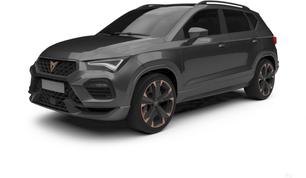
What's the difference?
Not many people even know what a Cupra Ateca V is… and this is the second best thing about this small SUV. The first best thing is that Cupra is owned by Volkswagen.
So, this means you can have your mysterious SUV not many other people drive while knowing it’s underpinned by one of the largest car manufacturers in the world which makes cars millions of people drive and one which also has a reputation for high quality vehicles.
The big news here is the Ateca model range has a new and lower entry fee with the arrival of this V grade. See, until now the only Ateca Australians could buy is the high-performance VZx which while really sporty also came with a pretty big price tag.
So, how much is the Ateca V and what do you get for the money? We found this out at the Australian launch along with how practical and safe it is and what it’s like to drive.
No good deed goes unpunished.
Porsche, a brand synonymous with petrol-guzzling sports cars, tried to do the right thing and make a nearly wholesale switch to electric vehicles by the end of the decade. The problem was, while this made governments happy, it didn’t sit well with customers.
Porsche’s all-electric Macan is enduring a torrid 2026, with sales down over 75 per cent now that all the petrol-engined options are gone.
But that hasn’t stopped the German brand trying again with an all-electric Cayenne. However, there are some key differences that mean this latest electric Porsche won’t suffer the same fate.
Namely, the petrol-powered and hybrid versions aren’t going anywhere and new versions are rumoured to be coming in the not-too-distant future.
For now though, we have this all-new electric Cayenne - so how does it stack up to its predecessors as the sports car brand’s big SUV? And will it be second time lucky for Porsche’s electric transition? Based on two rather unorthodox days of test driving, the verdict might surprise you…
The Cupra Ateca V is a much needed more affordable way into this small SUV while still offering a high-end feeling with plenty of standard features. Yes, the V isn't as high-powered as the VZx but it's still great to drive in the city and on the open road. Big on the inside and small on the outside the Cupra Ateca can perform urban and (small) family duties well.
Note: CarsGuide attended this event as a guest of the manufacturer, with accommodation and meals provided.
There is a lot riding on this new Cayenne Electric, it is the sales leader for the German brand and if it suffers the same sales decline as the Macan, that will be a big concern for Porsche.
The good news is it’s an impressive all-rounder, with an incredible breadth of capability. But so is the electric Macan.
Going electric hasn’t diminished its trademark Porsche elements, and instead has amplified them in many respects. The speed is nothing short of staggering in the Turbo, but across the range the on and off-road driving ability is impressive.
Plus it has the kind of spacious, well-considered and premium appointed cabin you should expect for a luxury SUV.
There are two key differences that could see it succeed where the Macan has faltered. Unlike the Macan, Porsche’s decision to give Cayenne buyers the option to stick with internal combustion if they prefer, is likely to ensure it remains a popular member of its line-up for years to come.
And while the Macan was perhaps too much, too soon, the Cayenne arrives at a time when Australians are embracing electric cars more than ever before. Although the luxury and performance end of the EV market is growing more slowly than the mainstream.
As for the pick of the range, as mind-blowing as the Turbo is, the truth is (like pretty much every Porsche model) the entry-level Cayenne is arguably the pick of the bunch. It has all the performance you’ll reasonably need and offers a good blend of capability and luxury for the lowest price.
Note: CarsGuide attended this event as a guest of the manufacturer with travel, accommodation and meals provided.
Once you know the Cupra Ateca V is closely related to the Volkswagen Tiguan and Skoda Karoq you can definitely see a resemblance. Still, all three have their own look with the Cupra clearly given the role of being the fierce, sporty one.
While the Ateca V doesn’t have the same menacing styling as the VZx, it’s definitely a seriously sporty looking SUV with its 19-inch alloys, aggressive front bumper, triangular LED running lights and blacked out wing mirrors, roof rails and CUPRA lettering across the tailgate.
The bronze Cupra logo really signals the sporty intent of this brand and I’ve been told on more than one occasion that it looks like a biohazard symbol by people confused by what it is I’m driving. According to Cupra the blade-like design represents “the sense of belonging to a clan”.
Measuring 4381mm long, 1841mm wide and 1625mm tall with 2630mm wheelbase the Ateca V is about 15cm shorter in length than a Tiguan, but as you’ll see in the practicality section the interior dimensions might be larger than you think.
The Ateca V’s cabin is full of dark-coloured materials with black leather upholstered sports seats and steering wheel. In the same way it feels like Batman designed the exterior the interior it has a ‘Made in Gotham City’ feel with a brooding style incorporating high quality textures and surfaces.
For all the positives of continuing to offer the previous generation Cayenne alongside the new one, it does come with some downsides too. The most obvious is unmissable design differences between the older generation and this newer one.
This new electric version has the same basic silhouette of the previous Cayenne, but the details give it a distinctive look. Being electric it needs to cut through the air as efficiently as possible, so this new model is longer and lower than the internal combustion versions.
The details of the design also give it a sharper, more modern look too. Not that the previous Cayenne suddenly looks old and outdated, but if you stick with petrol power you will be sacrificing the latest styling.
Another surprising design element with this new model is an optional off-road package, which includes a unique front bumper for greater off-road clearance and approach angle. It’s unlikely that too many Cayenne Electric owners will head deep into the bush, but for those who want to, the unique bumper will help them go further.
However, it does create a rather unusual look, as it has quite a pronounced undercut, or what I referred to as an ‘overbite’ that definitely doesn’t look as well-proportioned as the standard bodykit.
Inside, for all the hype around Porsche performance, one of the brand’s standout features has always been interior design.
This new Cayenne looks really interesting inside, with curved screens for the digital instrument display and the multimedia system, as well as the option to add a third screen in-front of the passenger.
The overall level of fit and finish, the detail and quality of the materials is exactly what you’d expect from a premium brand and an SUV at this price point.
The Ateca V is only about 4.4m long which is a lot shorter than a Kia Sportage, Nissan X-Trail or Subaru Forester, which are truly mid-size SUVs. So, the Ateca is a small SUV but on the larger side compared to say a Volkswagen T-Roc.
Despite its fairly diminutive exterior proportions the Ateca V has excellent storage and is remarkably spacious. If you have a young, small family and want a five-seater SUV big enough for them but small enough to make urban driving easy the Ateca V ticks both boxes.
Up front there are the gigantic door pockets, two cupholders, a decent-sized covered centre console bin and under-dash storage with wireless phone charging and two USB ports.
The second row is incredibly spacious for a small SUV with so much room for me at 189cm tall to sit behind my driving position. Headroom is excellent, too.
There are also cupholders in the fold-down armrest, two USB ports and big door pockets.
The back door apertures are tall and wide which makes getting little kids in and out of their car seats easier for parents.
A 485L cargo capacity is large for the class and under the boot floor is a space-saver spare wheel.
As for the space and practicality, once again Porsche showcases that it’s not a one-trick pony brand. As fast as the Cayenne Electric is - and is very fast - the designers have also ensured it is a genuinely spacious vehicle for a family.
The second row space is good, enough to take two adults in comfort and easily accommodate three kids.
The SUV is obviously the more practical of the pair, with the Coupe losing some rear headroom.
As for the boot, space varies between 781L for the Cayenne SUV and 747L for the S and Turbo SUVs, while the Coupe looks sleeker but comes at the expense of cargo capacity, dropping to 534L for the Coupe and Coupe S and just 500L for the Coupe Turbo.
The technology integration is well-considered too. One highlight is the new curved central multimedia screen, which has a palm rest that extends out from the centre fascia to make it more ergonomic to use the screen.
The intuitive menu, as well as the physical controls for the volume and climate control, plus the ability to integrate the smartphone apps, means the key non-driving functions are incredibly easy-to-use, even on the move.
Integrated into that palm rest is a large centre console space between the front seats, which has both wireless smartphone charging as well as four USB-C ports and two cupholders. It means there is plenty of small item storage space to go with all the room for people.
The Ateca model now has a lower priced grade called the V and it lists for $51,990. That’s more than $10K less than the top-of-the-range VZx which has been out for a couple of years and lists for $63,490.
The Ateca V might be less expensive but the features list is still impressive. Coming standard are 19-inch alloy wheels, sports bumpers, LED headlights, running lights and puddle lights. There’s a proximity key and power tailgate with gesture control, too.
Inside black leather upholstery is standard, so are heated front seats and steering wheel, there’s dual-zone climate control, a power driver’s seat, a 9.2-inch media display with wireless Apple CarPlay and Android Auto and wireless phone charging.
As for options, you can have a panoramic sunroof for $1850 and premium metallic paint for $490.
There’s also the optional 'Tech Package' for $2950 bringing a Beats stereo system and a 360-degree camera. But the best thing about the pack is it also adds dynamic chassis control which adds adaptive suspension, so when you select 'Comfort' mode the suspension becomes softer, and in 'Sport' mode the suspension firms for better handling.
Rivals to the Ateca V include the Lexus UX and Volvo XC40 but also its Volkswagen Group cousins such as the Skoda Karoq and VW Tiguan R-Line.
Starting with the basics, there are two different variants of the new Cayenne - the SUV and Coupe - and three trim grades to choose from - the entry-level model (known only as ‘Cayenne’), the sportier S and the flagship Turbo.
A major factor in the sales decline of the Macan is undoubtedly the rising cost of the car, which leapt up as much as $30,000 on some variants. So Porsche has been more careful with how it has positioned the Cayenne.
The new electric Cayenne is still a more expensive proposition, with the standard Cayenne SUV starting at $167,700 ($173,500 for the Coupe), which is over $20,000 more expensive than the equivalent petrol-powered model. It should be noted that that doesn’t factor in the increased performance and level of standard equipment, which includes air-suspension across the entire electric range.
Moving up the range, at $193,000 (Coupe - $194,500) the Cayenne S Electric is only just over $8000 more than its petrol alternative but the $259,800 (Coupe - $272,000) Turbo is actually more than $40,000 cheaper than the Turbo E-Hybrid. So it is not as simple as saying the electric Cayenne costs more across the board.
However, this isn’t the only one of the key differences between Porsche’s Macan and Cayenne strategy. The Cayenne petrol and hybrid models are here to stay for the foreseeable future. Rather than being completely replaced by the electric version, Porsche has learned its lesson and is giving customers more choice.
Officially Porsche hasn’t confirmed a new-generation of Cayenne petrol/hybrids, but all signs point to a new version coming in the next few years to carry on internal combustion power deep into the 2030s.
Porsche Australia also knows that the competitiveness of our very crowded market means extra equipment is a good idea. So all Australia-bound Cayenne Electrics come relatively well equipped, and more so than most overseas markets. For example, all local examples are fitted with air suspension as standard.
For the Cayenne, standard equipment includes:
For the extra money - aside from extra performance we’ll detail later - the Cayenne S adds:
The Cayenne Turbo adds even more performance as well as:
Adaptive sports seats with 18-way adjustment
The Ateca V has a 2.0-litre turbo-petrol four-cylinder engine making 140kW and 320Nm. That’s a step down in output compared to the VZx’s 221kW and 440Nm, but the V doesn't feel underpowered.
A seven-speed dual clutch automatic transmission shifts gears lighting fast with the drive going to all four wheels. Yes, it’s all-wheel drive.
As mentioned earlier, there are three initial Cayenne Electric variants and each offer a different powertrain option. All are dual-motor, all-wheel drive but the power levels vary greatly depending on what you spend.
The standard Cayenne Electric comes with 300kW (325kW on Overboost), which is enough for this five-seat, family friendly SUV to launch 0-100km/h in just 4.8 seconds, which is genuinely impressive.
However, stepping up to the Cayenne S raises the power level to 400kW (490kW on Overboost) and drops the 0-100km/h time to 3.8 seconds.
Finally there’s the Cayenne Turbo, with up to 850kW of power and a claimed 0-100km/h capability of just 2.5 seconds. Which is borderline crazy for such a big SUV.
It is worth explaining that the 850kW claim for the Cayenne Turbo is only available for short bursts of performance when you activate Overboost, and the ‘standard’ output for the two electric motors is 630kW, which may sound like a lot less but is actually more than enough to make the Cayenne Turbo feel fast anytime you need more performance.
Cupra says that after a combination of open and urban roads the Ateca V should use 7.1L/100km. That’s not hugely fuel efficient and urban consumption of 8.6L/100km will mean higher fuel bills than a hybrid SUV of this size.
On the launch we saw a fuel consumption average of 7.7L/100km and that’s after city roads, motorways and country roads.
Once we have the Ateca V in our CarsGuide garage we’ll be able to perform a real-world test of its fuel consumption.
The Ateca V has a 55-litre fuel tank and requires 95 RON premium unleaded petrol. Theoretical driving range is around 775km.
The Cayenne is Porsche’s third electric model, after the Taycan and Macan, and it shows. The brand has taken battery production in-house for the Cayenne, producing the 106kWh unit at its own factory in Eastern Europe.
Range is rated at 542km for the Cayenne, 571km for the Cayenne S and 537km for the Cayenne Turbo.
Thermal efficiency is the key selling point for Porsche, as it unlocks not only the peak performance but also the repeatability that allows the Cayenne to launch so quickly over and over again. It’s notable, that unlike most other EVs that get slower the more time you extract peak performance out of them, Porsche was happy for us to undertake multiple acceleration runs in the same vehicle.
But that’s not the only trick Porsche has up its sleeve. It will be introducing inductive charging with the Cayenne. This means you’ll be able to buy a charging pad you can place on the floor in your garage, and simply drive it, park on top of it and the Cayenne will charge wirelessly.
This has the potential to be a game-changer for EV buyers as it removes the need to plug in to replenish the batteries, making life even easier for owners. It’s not available in Australia at the time of publication, but the company says it will be available from the fourth quarter and all Australian-delivered models, even those sold now, will be able to be retrofitted to take advantage of the technology.
The launch of the Ateca V saw us drive the V and the VZx back-to-back, which highlighted how good the V is for the money when it comes to its on-road performance.
The 2.0-litre engine is superbly responsive with loads of torque for such a small petrol SUV, while the dynamics were equally impressive on winding country roads. Even when those roads occasionally and suddenly turned from bitumen to dirt at 100km/h excellent all-wheel drive traction kept everything under control.
The Ateca V we tested has the optional Tech Package fitted which adds dynamic chassis control and adjusts the suspension in the Comfort drive mode setting to a softer level compared to the firmer level in Sport. The ride in any mode, however, is comfortable with great handling.
As standard the Ateca V is given sports suspension and after a quick sample of the Ateca V with this set-up I also found the ride to be comfortable and composed.
There's good visibility even through the rear window, along with nicely weighted accurate steering and a good pedal feel under my feet make the Ateca V effortless and enjoyable to drive.
Porsche Australia invited us to drive the new Cayenne Electric in Port Lincoln, South Australia. While a picturesque part of the country, it seemed like an unlikely venue to test drive a new Porsche, as it’s typically Ford Ranger/Toyota HiLux country.
But one of the reasons Porsche launched the Cayenne Electric in regional South Australia was because they had managed to find a small airstrip we could use to fully explore the acceleration potential.
Even some operator error, which meant my launch was using ‘just’ the 630kW, the acceleration was sickeningly fast and had me hitting more than 170km/h in just 200m. With the full 850kW unleashed the Cayenne is actually faster 0-100km/h than Porsche’s hero sports car, the iconic 911 Turbo S.
That alone is a remarkable achievement, but Porsche had a few more reasons for taking us to Port Lincoln. After a drive on some sealed roads, which demonstrated the SUV's on-road composure, we found ourselves heading off-road… more off-road than I thought possible (or at least sensible) in a Porsche.
After surviving some of the gnarliest rocky roads, we found ourselves in some stunning sand dunes. We were driving the Cayenne S with the optional off-road package but the only other modification was to let down the tyres.
Carving through sand dunes like you’re in the Dakar Rally is likely to be a rare job for the Cayenne Electric, but the fact it is capable is immensely impressive and helps to demonstrate the breadth of capability that this electric SUV has.
But Porsche wasn’t finished showing off just how multi-talented the Cayenne is.
They had a Cayenne Turbo attached to a trailer, carrying the previously beaten 911 Turbo S, to prove that it can live up to its claimed 3500kg towing capacity.
Towing a nearly $600k sports car with a $260k SUV is an expensive way to demonstrate the point, but the Cayenne didn’t miss a beat. Certainly the battery was dropping more rapidly than it was unladen, but the electric Cayenne underlined that it can do everything the petrol versions can manage (at least over a short distance).
The Cupa Ateca V hasn’t been tested by ANCAP and the Euro Ncap result of five stars (which is the maximum) has now expired because it was so long ago (2016).
Still, while much of the safety tech isn’t as cutting edge as some new SUVs , there’s AEB, adaptive cruise control, lane keeping assistance, rear traffic alert plus front and rear parking sensors.
The airbag count runs to seven, including a front centre bag to minimise head clash injuries in a side-impact.
For child seats there are three anchor points and two ISOFIX mounts in the back.
As for safety, the Cayenne Electric is as well equipped as you should expect a car at this price to be. There are all the features that have become the norm, including speed limit warning, autonomous emergency braking, lane keeping assist, etc.
But it’s not the fact that it has all the safety features that’s impressive, it’s the level of calibration. Yes, the speed limit warning will go off if you speed, but generally the other safety systems were very well-behaved and understated during our drive.
However, the only caveat with that is our drive was almost entirely in regional areas, so we should reserve final and definitive judgement until we get it into the urban environment.
As for its safety rating, the Cayenne was crash tested by Euro NCAP in December 2025 and awarded a maximum five-star score. It is unlikely ANCAP will crash test such an expensive model here, so expect the same rating to carry over barring something unusual.
The Ateca V is covered by Cupra’s five-year, unlimited-kilometre warranty, with servicing needed every 15,000km or annually.
You can buy a five-year service plan for $1990 - which isn’t overly pricey.
The Cayenne Electric is covered by Porsche’s usual three-year/unlimited kilometre warranty, and the battery gets eight years of coverage.
Both of these are fairly standard by historical terms, but with so many luxury brands - including Audi, BMW, Lexus and Mercedes-Benz - all now offering five years of coverage, it does leave Porsche lagging behind.
Servicing intervals are every 12 months or 15,000km, whichever comes first, which is standard for an internal combustion engine vehicle.
Porsche doesn’t offer capped-price servicing, so prices may vary from dealer to dealer. However, the brand does sell a special EV-focused ‘Porsche Scheduled Maintenance Plan’ that costs $1995 for three years, $3695 for four years and $3995 for five years of servicing.