What's the difference?
Not many people even know what a Cupra Ateca V is… and this is the second best thing about this small SUV. The first best thing is that Cupra is owned by Volkswagen.
So, this means you can have your mysterious SUV not many other people drive while knowing it’s underpinned by one of the largest car manufacturers in the world which makes cars millions of people drive and one which also has a reputation for high quality vehicles.
The big news here is the Ateca model range has a new and lower entry fee with the arrival of this V grade. See, until now the only Ateca Australians could buy is the high-performance VZx which while really sporty also came with a pretty big price tag.
So, how much is the Ateca V and what do you get for the money? We found this out at the Australian launch along with how practical and safe it is and what it’s like to drive.
SUV wagons based on their ute stablemates are by no means a new thing – just look to Toyota Fortuner (based on HiLux), Ford Everest (based on the Ranger) and Isuzu’s MU-X (based on the D-Max) for evidence of that.
But the strategy is not always a successful one and these ute-based wagons have already gone through a stage or two of tweaking and refining in an attempt by car makers to shed some of the lingering ute-related niggles (such as work-focused suspension tunes) and improve the final products so they're better suited to a life of work and play.
The 2018 Trailblazer (formerly known as Colorado7, and based on the Colorado ute) is another clear sign that these wagons are indeed getting better, but are those improvements good enough to attract the cash of an otherwise ute-fixated public?
The Cupra Ateca V is a much needed more affordable way into this small SUV while still offering a high-end feeling with plenty of standard features. Yes, the V isn't as high-powered as the VZx but it's still great to drive in the city and on the open road. Big on the inside and small on the outside the Cupra Ateca can perform urban and (small) family duties well.
Note: CarsGuide attended this event as a guest of the manufacturer, with accommodation and meals provided.
The Trailblazer is a solid all-rounder and deserves the consideration of those in the market for a decent seven-seater 4WD. It does everything well without ever really excelling at any one thing.
Is it fantastic? No. Is it a game-changer? No. Does it represent pretty good value for money in the grand scheme of things? Yep.
The pick of the bunch for me is the LTZ – solid, off-road capable, and suburbs-friendly with just a hint of leather-appointed class. In the LTZ, you get everything worthwhile in the Trailblazer mob and if you’re a family man you won’t feel the need to fork out an extra $1000 for the Z71’s try-hard window dressing.
The Trailblazer is a mostly comfortable SUV wagon, stacked with features and is well worth your consideration if the Isuzu MU-X, Pajero Sport and Toyota Fortuner don’t float your boat.
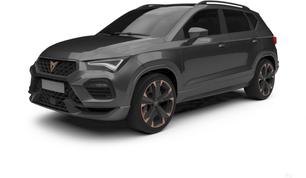
Once you know the Cupra Ateca V is closely related to the Volkswagen Tiguan and Skoda Karoq you can definitely see a resemblance. Still, all three have their own look with the Cupra clearly given the role of being the fierce, sporty one.
While the Ateca V doesn’t have the same menacing styling as the VZx, it’s definitely a seriously sporty looking SUV with its 19-inch alloys, aggressive front bumper, triangular LED running lights and blacked out wing mirrors, roof rails and CUPRA lettering across the tailgate.
The bronze Cupra logo really signals the sporty intent of this brand and I’ve been told on more than one occasion that it looks like a biohazard symbol by people confused by what it is I’m driving. According to Cupra the blade-like design represents “the sense of belonging to a clan”.
Measuring 4381mm long, 1841mm wide and 1625mm tall with 2630mm wheelbase the Ateca V is about 15cm shorter in length than a Tiguan, but as you’ll see in the practicality section the interior dimensions might be larger than you think.
The Ateca V’s cabin is full of dark-coloured materials with black leather upholstered sports seats and steering wheel. In the same way it feels like Batman designed the exterior the interior it has a ‘Made in Gotham City’ feel with a brooding style incorporating high quality textures and surfaces.
The Trailblazer is a solid-looking wagon – all clean, tight lines from front to back – and overall it has a real squat and substantial presence. If we’re going to get all ‘fancy Dan’ with our hyperbole: chrome-accented daytime running headlights swoop back along the chunky body to slick LED tail-lights. If we’re sticking to basics: the Trailblazer looks good.
Inside, the tweaked interior has a tidy if rather basic feel to it – but that’s not a bad thing in a wagon that will have to cop dirt and dropped ice creams amid the general chaos of day-to-day life.
The leather-trim seats add a touch of class to otherwise family friendly dimensions and environment.
The Ateca V is only about 4.4m long which is a lot shorter than a Kia Sportage, Nissan X-Trail or Subaru Forester, which are truly mid-size SUVs. So, the Ateca is a small SUV but on the larger side compared to say a Volkswagen T-Roc.
Despite its fairly diminutive exterior proportions the Ateca V has excellent storage and is remarkably spacious. If you have a young, small family and want a five-seater SUV big enough for them but small enough to make urban driving easy the Ateca V ticks both boxes.
Up front there are the gigantic door pockets, two cupholders, a decent-sized covered centre console bin and under-dash storage with wireless phone charging and two USB ports.
The second row is incredibly spacious for a small SUV with so much room for me at 189cm tall to sit behind my driving position. Headroom is excellent, too.
There are also cupholders in the fold-down armrest, two USB ports and big door pockets.
The back door apertures are tall and wide which makes getting little kids in and out of their car seats easier for parents.
A 485L cargo capacity is large for the class and under the boot floor is a space-saver spare wheel.
Climbing in is easy enough with a sturdy "overhead assist handle" for all comers and goers.
All of the Trailblazer’s seats are mostly comfortable except they are quite flat and hard, which may prove a hindrance over longer trips. The driver’s seat is six-way electrically-adjustable and there is little in the way of lumbar support.
The second row will better suit two passengers than three for long-distance comfort but there is enough room all round – head, shoulders and legs – to avoid most complaints, for a little while anyway.
Third-row passengers will need to be children or those of a shorter stature to cope with the ‘back of the bus’ squeeze – and even then trips should be kept to shorter distances to avoid an in-car riot. It’s not a terrible place to be, in the third row of this thing, but it’s not ideal either – pretty much in keeping with the rear-row offerings of its rivals.
Back up the front again and the dash design is clear, user-friendly and easy to get used to with day-in, day-out use.
There is a fair bit of storage space in the cabin but some of it is awkward to access and actually use. The glove box is big enough to cope with one or two handfuls of bits and pieces. There is a sunglass holder up near the rear-view mirror.
Passengers in the back also get air vents and manual aircon control.
There are two cup holders in front of the small centre console housing the USB port which, when used, eats into that available space.
All doors have a moulded bottle bulge, which wouldn’t cop our CarsGuide water bottle without forceful encouragement.
The second-row passengers get a fold-down centre arm-rest/cup holder when there’s no one sitting in the middle. Passengers in the back also get air vents and manual aircon control.
With all seats up, if you pack to the roof, there is 235 litres of cargo space at the very rear; with the 50/50 split-folding third-row seats folded down, there is 878 litres; with the second-row (60/40 split-fold and tumble) and the third-row seats down, there is 1830 litres of cargo space. There is a retractable cargo blind stowed away under the floor at the rear.
With the second-row seats folded forward, it is easy enough to get into the third-row seats; no contortionist moves required.
There are two 12-volt outlets in the centre dash; one at the back of the centre console (for second-row passengers); and one in the rear cargo area.
Up top, the roof rails are rated to carry 100kg.
The Ateca model now has a lower priced grade called the V and it lists for $51,990. That’s more than $10K less than the top-of-the-range VZx which has been out for a couple of years and lists for $63,490.
The Ateca V might be less expensive but the features list is still impressive. Coming standard are 19-inch alloy wheels, sports bumpers, LED headlights, running lights and puddle lights. There’s a proximity key and power tailgate with gesture control, too.
Inside black leather upholstery is standard, so are heated front seats and steering wheel, there’s dual-zone climate control, a power driver’s seat, a 9.2-inch media display with wireless Apple CarPlay and Android Auto and wireless phone charging.
As for options, you can have a panoramic sunroof for $1850 and premium metallic paint for $490.
There’s also the optional 'Tech Package' for $2950 bringing a Beats stereo system and a 360-degree camera. But the best thing about the pack is it also adds dynamic chassis control which adds adaptive suspension, so when you select 'Comfort' mode the suspension becomes softer, and in 'Sport' mode the suspension firms for better handling.
Rivals to the Ateca V include the Lexus UX and Volvo XC40 but also its Volkswagen Group cousins such as the Skoda Karoq and VW Tiguan R-Line.
The Trailblazer is available in three spec levels, each with a market-competitive price: base-spec LT (from $47,990, excluding on-road costs), LTZ (which we tested; from $52,490) and the limited-edition Z71 (from $53,490).
But those prices soon start to climb when you add in accessories such as all-weather floor mats ($130 for a pair), boot lip protector ($80) and a rigid cargo barrier ($960). Our test vehicle had a Power Blue (prestige paint) colour on the exterior, at a cost of $550.
All models have the 2.8-litre turbo-diesel engine and six-speed automatic transmission. The 4WD system is a dual-range part-time shift-on-the-fly set-up.
The LT’s standard features include cloth seat covers, 17-inch alloy wheels, a seven-inch touchscreen to go with its Holden MyLink infotainment system, Apple Car Play and Android Auto, Bluetooth connectivity, front fog lamps, signature daytime running lights, side steps, limited slip diff, rear parking sensors and a rear-view camera.
The LTZ gets all of that (although its touchscreen is eight inches) and more: integrated satnav, blind spot alert, forward collision alert and heated front seats and leather-appointed seat trim. It has 18-inch alloy wheels.
The Z71 has all of that gear as well as a distinctive sports look, replete with black bonnet, black mirrors, black exterior door handles, Z71 leather-appointed trim and 18-inch black alloy wheels.
The Ateca V has a 2.0-litre turbo-petrol four-cylinder engine making 140kW and 320Nm. That’s a step down in output compared to the VZx’s 221kW and 440Nm, but the V doesn't feel underpowered.
A seven-speed dual clutch automatic transmission shifts gears lighting fast with the drive going to all four wheels. Yes, it’s all-wheel drive.
The 2.8-litre turbo-diesel engine punches out 147kW at 3600rpm and its big-gun 500Nm at 2000rpm and is well-matched to a six-speed automatic transmission. This Trailblazer is, on paper, a very good tow vehicle with so much torque available and from down so low.
Its towing capacity is 3000kg (braked), but I’d prefer to see how it fared in a real-world tow test before I pass judgement.
Cupra says that after a combination of open and urban roads the Ateca V should use 7.1L/100km. That’s not hugely fuel efficient and urban consumption of 8.6L/100km will mean higher fuel bills than a hybrid SUV of this size.
On the launch we saw a fuel consumption average of 7.7L/100km and that’s after city roads, motorways and country roads.
Once we have the Ateca V in our CarsGuide garage we’ll be able to perform a real-world test of its fuel consumption.
The Ateca V has a 55-litre fuel tank and requires 95 RON premium unleaded petrol. Theoretical driving range is around 775km.
Claimed fuel economy is 8.6L/100km (combined). We recorded 9.6L/100km fuel consumption after 200km of mixed driving, including about 30km of gravel tracks, and 10km of hard off-roading. As mentioned earlier, it has a 76-litre fuel tank.
The launch of the Ateca V saw us drive the V and the VZx back-to-back, which highlighted how good the V is for the money when it comes to its on-road performance.
The 2.0-litre engine is superbly responsive with loads of torque for such a small petrol SUV, while the dynamics were equally impressive on winding country roads. Even when those roads occasionally and suddenly turned from bitumen to dirt at 100km/h excellent all-wheel drive traction kept everything under control.
The Ateca V we tested has the optional Tech Package fitted which adds dynamic chassis control and adjusts the suspension in the Comfort drive mode setting to a softer level compared to the firmer level in Sport. The ride in any mode, however, is comfortable with great handling.
As standard the Ateca V is given sports suspension and after a quick sample of the Ateca V with this set-up I also found the ride to be comfortable and composed.
There's good visibility even through the rear window, along with nicely weighted accurate steering and a good pedal feel under my feet make the Ateca V effortless and enjoyable to drive.
The LTZ is 4887mm long (with a 2845mm wheelbase), 1902mm wide (excl mirrors), and 1846mm high. It has a kerb weight of 2203kg.
Its turning circle is 12m but it feels like more of a cumbersome beast when trying to manoeuvre in the bush or in the city, though not enough so for that characteristic to be any sort of deal-breaker.
The tilt-adjustable, electrically assisted steering lacks any reach-adjustment, which is annoying, but it can still be counted on to deliver a precise feel – light at low speeds, heavier at high speeds – when pushing the Trailblazer along at a fair clip on open roads or in and out of corners.
Acceleration seems livelier now; there is more off-the-mark oomph for take-offs and safe, smooth overtaking, even on long gradual climbs, than before. The torquey engine and six-speed auto – with its smooth changes and gear-holding when appropriate – make for a high-achieving combo.
Ride and handling seem better than in Colorado7 guise although the tweaked suspension – Aussie-tuned coil-spring front and coil-spring live-axle rear – and Bridgestone Dueler H/Ts tyres* may account for some of that. However, we did feel some body-roll while driving along back roads, unlike the last time we were in a Trailblazer LTZ. (*The Trailblazer has a full-sized 18-inch spare.)
The locally tuned suspension is, at times, a bit too firm; when we hit heavy bumps and deep potholes on rough gravel tracks several times, we were unsettled because the Trailblazer’s suspension bashed its way over and through.
NVH levels on open-road bitumen can still tend towards the rougher side of things with diesel engine clatter, tyre roar and wind rush clattering a tune on your ear drums.
We completed a series of emergency braking scenarios – on bitumen and dirt – and the Trailblazer’s disc brakes – 300mm at the front and 318mm at the rear – helped rip us into a controlled stop.
Off-road, we had a ball because the beefy Trailblazer seems a much better fit for gravel-track fast blasts and slow-going bush driving than it does for any jaunts in the stop-start city.
Our drive loop included a decent bit of four-wheel driving – coastal sand, bush tracks peppered with rocks of all shapes and sizes, and shallow mud in a dried-out dam. Drive modes can be switched via the centre console dial between 2H, 4H and 4L; high range modes are actually represented by an ‘up’ arrow on the dial; low range is a ‘down’ arrow. Bonus: the Trailblazer’s 500Nm of torque is readily available from way down low.
The Trailblazer has a limited slip diff, 218mm of ground clearance and a wading depth of 600mm, which was never tested as our usual creek crossings were so bone-dry they were more like puddles. Approach, departure and ramp-over angles are 28, 25, 22 respectively.
Its armoury of off-road tech – auto hill-start assist, hill-descent control and more – make it almost unstoppable, straight out of the showroom, for anything demanded of it on a light- to medium-difficulty adventure weekend.
Its 76-litre fuel tank, however, hinders any claim it has to off-road touring potential.
The Trailblazer has 3000kg towing capacity (braked); 750kg unbraked.
Note: Holden has persisted with a system which, when you open a door, the front windows automatically slide down a bit, an action aimed at reducing air pressure when you close the doors. It remains annoying but we still weren’t annoyed enough to actually bother to check the owner’s manual for a possible hack to switch it off.
The Cupa Ateca V hasn’t been tested by ANCAP and the Euro Ncap result of five stars (which is the maximum) has now expired because it was so long ago (2016).
Still, while much of the safety tech isn’t as cutting edge as some new SUVs , there’s AEB, adaptive cruise control, lane keeping assistance, rear traffic alert plus front and rear parking sensors.
The airbag count runs to seven, including a front centre bag to minimise head clash injuries in a side-impact.
For child seats there are three anchor points and two ISOFIX mounts in the back.
The Trailblazer range has a five-star ANCAP rating. The LTZ has seven airbags, and electronic stability control (ABS, EBD etc), rear view camera, front park assist, rear parking sensors, forward collision alert, blind-spot alert, lane-departure warning, rear cross-traffic alert, a tyre-pressure monitoring system and trailer sway control.
The second row has three child restraint anchor points and one ISOFIX child restraint anchor point.
The Ateca V is covered by Cupra’s five-year, unlimited-kilometre warranty, with servicing needed every 15,000km or annually.
You can buy a five-year service plan for $1990 - which isn’t overly pricey.
The Trailblazer comes with a three-year/100,000km warranty. Lifetime capped price servicing includes a free inspection at one month, then $299 (at nine months/15,000km), $399 (18 months/30,000km), $479 (27 months/45,000km), $479 (36 months/60,000km) and so on.
(At time of writing, the LT was being offered for $45,990 driveway with a seven-year/175,000 warranty.)
Potential problems might include cumulative driveline wear and tear from people towing heavy loads (horse floats, boats etc).