What's the difference?
Not many people even know what a Cupra Ateca V is… and this is the second best thing about this small SUV. The first best thing is that Cupra is owned by Volkswagen.
So, this means you can have your mysterious SUV not many other people drive while knowing it’s underpinned by one of the largest car manufacturers in the world which makes cars millions of people drive and one which also has a reputation for high quality vehicles.
The big news here is the Ateca model range has a new and lower entry fee with the arrival of this V grade. See, until now the only Ateca Australians could buy is the high-performance VZx which while really sporty also came with a pretty big price tag.
So, how much is the Ateca V and what do you get for the money? We found this out at the Australian launch along with how practical and safe it is and what it’s like to drive.
Nissan was one of the first to launch a mainstream electric vehicle (EV) in Australia with the cute Leaf hatchback back in 2010.
While two generations of the Leaf have come and gone, Nissan still hasn’t launched another EV offering in Australia. That’s now finally changed.
The Japanese carmaker has just launched the Ariya mid-size electric SUV in Australia roughly five years after it was first revealed. It’s been available in other markets since 2022.
The EV market has gained momentum in Australia and there are a growing number of heavy-hitting rivals out there now for the Ariya to go up against.
Is it too little, too late for Nissan? Read along to find out.
The Cupra Ateca V is a much needed more affordable way into this small SUV while still offering a high-end feeling with plenty of standard features. Yes, the V isn't as high-powered as the VZx but it's still great to drive in the city and on the open road. Big on the inside and small on the outside the Cupra Ateca can perform urban and (small) family duties well.
Note: CarsGuide attended this event as a guest of the manufacturer, with accommodation and meals provided.
I can see how the Nissan Ariya would have changed the game if it launched in Australia back in 2022.
While it is a solid car that’s quiet, comfort-oriented and tech-heavy, there’s now little separating it from the competition apart from the fact it has a Nissan badge and a cracking aftersales package. This is disappointing as we’ve waited a long time for this car to arrive.
Note: CarsGuide attended this event as a guest of the manufacturer, with accomodation meals provided.
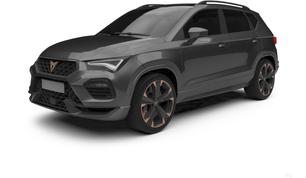
Once you know the Cupra Ateca V is closely related to the Volkswagen Tiguan and Skoda Karoq you can definitely see a resemblance. Still, all three have their own look with the Cupra clearly given the role of being the fierce, sporty one.
While the Ateca V doesn’t have the same menacing styling as the VZx, it’s definitely a seriously sporty looking SUV with its 19-inch alloys, aggressive front bumper, triangular LED running lights and blacked out wing mirrors, roof rails and CUPRA lettering across the tailgate.
The bronze Cupra logo really signals the sporty intent of this brand and I’ve been told on more than one occasion that it looks like a biohazard symbol by people confused by what it is I’m driving. According to Cupra the blade-like design represents “the sense of belonging to a clan”.
Measuring 4381mm long, 1841mm wide and 1625mm tall with 2630mm wheelbase the Ateca V is about 15cm shorter in length than a Tiguan, but as you’ll see in the practicality section the interior dimensions might be larger than you think.
The Ateca V’s cabin is full of dark-coloured materials with black leather upholstered sports seats and steering wheel. In the same way it feels like Batman designed the exterior the interior it has a ‘Made in Gotham City’ feel with a brooding style incorporating high quality textures and surfaces.
Back when the Ariya was revealed, it started a new design language for Nissan, but five years later almost every model in the Japanese carmaker’s line-up has taken some element of this car’s design.
What this means is while the Ariya was unique, it now doesn’t stand out from the crowd as much as it once did. This doesn’t help given there are now so many competitors out there.
However, in person the exterior of this car is stunning. I’m particularly a fan of the two-tone copper paint available on the Advance+ and Evolve e-4orce.
At the front there is a slim and striking LED lighting set-up that stands out, plus the gloss black faux grille is an interesting take on the brand’s ‘V-Motion’ grille. It has illuminated sections that are only noticeable in dark conditions.
Around the side the Ariya appears to be a lot more coupe-like than you’d expect. There’s a body line that runs from the A-pillar all the way to the tailgate. It gives the car a floating roof effect, which is a current design trend.
Other notable design elements on the side include the charge flap on the passenger side front quarter panel, aero covers for the alloy wheels, and an extensive use of gloss black around the wheel arches and door sills. It’ll be interesting to see how the latter hold up in the long run.
At the back there isn’t a whole heap going on beyond the large rear spoiler, which is intricately designed and there to improve aerodynamics.
There’s also a full-width LED light bar for the tail-lights, which is sandwiched by a Nissan wordmark badge. These lighting set-ups are so common now that they’re a little cliche.
Inside, the Ariya is befitting of its flagship status for the Nissan brand. In the top-spec Evolve trim with the blue Nappa leather upholstery and suede dash highlights. I don’t think it pairs well with every exterior paint colour, but it still looks great.
This also isn’t to belittle the lesser trims. While they have darker interiors, this is likely more preferable for many buyers as they’re less out there. The materials, at least in the Advance+, are still at a high quality.
The steering wheel is leather-wrapped and feels buttery soft in the hand. While I loathe the fact there are gloss-black covers over the physical buttons on the steering wheel, it’s still a step in the right direction.
Ahead of the driver are dual 12.3-inch screens across the line-up. It took me a while to notice there’s a wave between the screens as it’s covered by the steering wheel rim. The touchscreen is incrementally closer so you can reach it more easily.
Another major element of the Ariya’s interior design is the centre console. In the Advance+ and Evolve it has electric sliding adjustment, allowing you to customise the position to your desire.
The use of the faux wood trim looks premium, especially because you don’t expect there to be haptic buttons on it. This helps for a clean, button-less look.
The Ateca V is only about 4.4m long which is a lot shorter than a Kia Sportage, Nissan X-Trail or Subaru Forester, which are truly mid-size SUVs. So, the Ateca is a small SUV but on the larger side compared to say a Volkswagen T-Roc.
Despite its fairly diminutive exterior proportions the Ateca V has excellent storage and is remarkably spacious. If you have a young, small family and want a five-seater SUV big enough for them but small enough to make urban driving easy the Ateca V ticks both boxes.
Up front there are the gigantic door pockets, two cupholders, a decent-sized covered centre console bin and under-dash storage with wireless phone charging and two USB ports.
The second row is incredibly spacious for a small SUV with so much room for me at 189cm tall to sit behind my driving position. Headroom is excellent, too.
There are also cupholders in the fold-down armrest, two USB ports and big door pockets.
The back door apertures are tall and wide which makes getting little kids in and out of their car seats easier for parents.
A 485L cargo capacity is large for the class and under the boot floor is a space-saver spare wheel.
This car is built on a dedicated electric architecture which theoretically gives it many benefits as there’s no space needed for a combustion engine, nor its transmission or driveline components.
While the Ariya benefits from this by pushing the wheels to the extremities, it underwhelms in others. More on this in a bit.
As standard the driver’s seat is mounted very high. I’m 182cm tall and in the seat's lowest position I was only a few centimetres off my hair tickling the roofliner. While this is nice from a forward visibility standpoint, I instinctively want to sit lower in the cabin.
Despite this, the front seats are deliciously comfortable. They offer plenty of electric adjustability, allowing you to find your desired seating position. Depending on the trim they’re heated and ventilated, which is a treat in fickle Melbourne weather.
As noted before, the steering wheel features physical buttons, which is a major plus. They’re clearly labelled and are easy to understand.
Ahead of the driver the digital instrument cluster is classic Nissan. There are a range of informative pages to cycle through, as well as two layouts to choose from. All of them look high-res.
Moving across, the touchscreen multimedia system is also a classic Nissan unit. Almost every Nissan model has a variation of this touchscreen now, which kind of makes the Ariya feel less special.
Thankfully however, the user interface is clear and easy to understand. It’s hard to get lost and even if you do, there are shortcut buttons on the side of the screen.
As standard there’s wireless Apple CarPlay, which is great if you have an iPhone and almost expected nowadays, however Android Auto is only offered in wired form only. This is disappointing from a high-tech flagship.
I appreciate there are haptic buttons for the climate control under the touchscreen. It’s much better than having these functions built into the touchscreen. However, the seat heating/ventilation and the steering wheel heating is in the touchscreen, but you can program it to an automatic mode so it’ll turn on and off with the climate control.
The haptic buttons extend onto the centre console which electrically slides in the Advance+ and Evolve. These ones are for the drive mode and ePedal selection.
Speaking of the centre console, it’s a big bulky unit but it barely offers any storage. Under the centre console lid there’s a wireless charger and a miniscule amount of storage. There’s also a tiny phone-sized slot at the front of the centre console, plus a 12V socket and some USB ports.
It’s disappointing Nissan hasn’t taken better advantage of the flat floor accommodated by the dedicated electric architecture. There’s open space between the driver and passenger, which makes it feel like you’re in dedicated recliners.
As a result of the paltry centre console storage, there are two gloveboxes. One on the passenger side and another in the centre. Both look like they’re sizeable, but that’s just the lid as the actual storage space is a fraction of this.
Moving to the second row I have a decent amount of legroom behind my own driving position. Toe room is negligible however and headroom suffers from the panoramic glass sunroof.
Despite this the second-row bench is still comfortable. It’s laid back, though there’s not much lateral support. This means in the bends you’ll be thrown into the door or into the centre of the car.
There continues to be a flat floor in the second row, plus a minimal hump in the rear bench means you could technically go three-up if you wanted. The limitation at this point is shoulder space.
In terms of amenities there are centre console-mounted air vents, USB-C ports, heated outboard seats (depending on the trim) and a fold-down armrest with cupholders. It’s fairly standard.
From the Advance trim and up there’s a standard hands-free power tailgate. This is handy if you’ve got your hands full.
For the boot space itself, it’s fine but not standout. Two-wheel-drive variants are notably better with 466L of boot space with the rear seats upright. The Evolve e-4orce only has 408L due to the rear electric motor.
As expected there’s no spare tyre at all across the line-up. Instead there’s a tyre repair kit under the boot floor.
No Ariya trim has a front boot.
The Ateca model now has a lower priced grade called the V and it lists for $51,990. That’s more than $10K less than the top-of-the-range VZx which has been out for a couple of years and lists for $63,490.
The Ateca V might be less expensive but the features list is still impressive. Coming standard are 19-inch alloy wheels, sports bumpers, LED headlights, running lights and puddle lights. There’s a proximity key and power tailgate with gesture control, too.
Inside black leather upholstery is standard, so are heated front seats and steering wheel, there’s dual-zone climate control, a power driver’s seat, a 9.2-inch media display with wireless Apple CarPlay and Android Auto and wireless phone charging.
As for options, you can have a panoramic sunroof for $1850 and premium metallic paint for $490.
There’s also the optional 'Tech Package' for $2950 bringing a Beats stereo system and a 360-degree camera. But the best thing about the pack is it also adds dynamic chassis control which adds adaptive suspension, so when you select 'Comfort' mode the suspension becomes softer, and in 'Sport' mode the suspension firms for better handling.
Rivals to the Ateca V include the Lexus UX and Volvo XC40 but also its Volkswagen Group cousins such as the Skoda Karoq and VW Tiguan R-Line.
The Nissan Ariya is launching in Australia with four trim levels – Engage, Advance, Advance+ and Evolve e-4orce.
Pricing starts from $55,840 before on-roads and extends to $71,840 before on-roads. This is more than top-selling rivals like the BYD Sealion 7 and Tesla Model Y. It’s more on par with the likes of the Kia EV5 and Zeekr 7X.
With the Ariya Engage at $55,840 before on-roads, you get 19-inch alloy wheels, LED headlights, dual 12.3-inch screens, wireless Apple CarPlay and wired Android Auto, a wireless phone charger, a six-speaker sound system, dual-zone climate control and charcoal fabric upholstery.
Stepping up to the Advance at $59,840 before on-roads brings a hands-free power tailgate, a 10-speaker Bose sound system, heated front seats and steering wheel, as well as black cloth and synthetic leather upholstery.
The Advance+ at $63,840 before on-roads gains a larger 87kWh battery pack as standard, plus a panoramic glass sunroof, a power sliding centre console, ventilated front seats, heated rear outboard seats, as well as black synthetic leather upholstery with suede inserts.
Lastly, the flagship Evolve e-4orce at $71,840 before on-roads gets an all-wheel drive set-up, 20-inch alloy wheels, adaptive high beams, a digital rear-view mirror, electric steering column adjustment and blue Nappa leather upholstery.
This is a generous spread of variants and while the pricing and equipment list doesn’t stand out from the crowd, none of the trims miss out on the basics.
The Ateca V has a 2.0-litre turbo-petrol four-cylinder engine making 140kW and 320Nm. That’s a step down in output compared to the VZx’s 221kW and 440Nm, but the V doesn't feel underpowered.
A seven-speed dual clutch automatic transmission shifts gears lighting fast with the drive going to all four wheels. Yes, it’s all-wheel drive.
There are only two electric powertrain configurations available in Australia.
The Ariya Engage and Advance are powered by a single, front-mounted electric motor that produces 160kW of power and 300Nm of torque. The Advance+ bumps the power figure up to 178kW to compensate for the larger battery pack.
The flagship Evolve e-4orce is the only trim with all-wheel drive. It has a dual-motor set-up with total system outputs of 290kW and 600Nm. This trim is claimed to be able to do the 0-100km/h sprint in 5.6 seconds.
Cupra says that after a combination of open and urban roads the Ateca V should use 7.1L/100km. That’s not hugely fuel efficient and urban consumption of 8.6L/100km will mean higher fuel bills than a hybrid SUV of this size.
On the launch we saw a fuel consumption average of 7.7L/100km and that’s after city roads, motorways and country roads.
Once we have the Ateca V in our CarsGuide garage we’ll be able to perform a real-world test of its fuel consumption.
The Ateca V has a 55-litre fuel tank and requires 95 RON premium unleaded petrol. Theoretical driving range is around 775km.
There are also two battery pack options in Australia.
The Ariya Engage and Advance come with a 63kWh lithium-ion battery with a WLTP claimed range of 385km. This isn’t much for a car that’s around $60,000.
The Advance+ and Evolve e-4orce, on the other hand, get a larger 87kWh lithium-ion battery. WLTP claimed range is 504km and 487km, respectively, which is much more like it for a vehicle of this size.
All variants have a Type 2 CCS combination charge port on the passenger side front quarter panel with a maximum DC charge rate of 130kW. At this rate this will see the battery charge from 10 to 80 per cent in 35 minutes.
AC charging is offered at rates up to 7.4kW on the Engage, Advance and Advance+ trims. 22kW AC charging is optional on the Advance+ and standard on the Evolve e-4orce.
However, thanks to a launch offer for the first 400 vehicles, all Ariyas are getting standard 22kW AC charging, even the ones that typically don’t get it at all. This is a cool offer and an interesting incentive if you are on the fence on actually buying one.
There’s also a free 22kW AC home charger provided as an additional launch offer. You’ll need to install this unit at your own expense.
For energy consumption it depends on the trim level. It ranges between 18.4 and 20.8kWh/100km. During our testing of the Advance+ we saw an average of 14.2kWh and the Evolve e-4orce we saw an average of 18.0kWh/100km. This would give a theoretical range of 613km and 483km, respectively.
It’s worth noting these average energy consumption figures were according to the trip computer and the driving was on higher speed roads on the outskirts of Melbourne.
The launch of the Ateca V saw us drive the V and the VZx back-to-back, which highlighted how good the V is for the money when it comes to its on-road performance.
The 2.0-litre engine is superbly responsive with loads of torque for such a small petrol SUV, while the dynamics were equally impressive on winding country roads. Even when those roads occasionally and suddenly turned from bitumen to dirt at 100km/h excellent all-wheel drive traction kept everything under control.
The Ateca V we tested has the optional Tech Package fitted which adds dynamic chassis control and adjusts the suspension in the Comfort drive mode setting to a softer level compared to the firmer level in Sport. The ride in any mode, however, is comfortable with great handling.
As standard the Ateca V is given sports suspension and after a quick sample of the Ateca V with this set-up I also found the ride to be comfortable and composed.
There's good visibility even through the rear window, along with nicely weighted accurate steering and a good pedal feel under my feet make the Ateca V effortless and enjoyable to drive.
We only got to experience Ariya trim levels with the larger 87kWh battery pack at this launch. It’d be interesting to see how trims with the smaller battery pack fare from a comparative standpoint as they’re lighter but offer less range.
With the Ariya Advance+, it has a single electric motor that offers a decent amount of power and torque. It’s probably all that you’d ever need in everyday traffic.
However, it’s far from being a sporty offering – it’s more comfort-oriented – but when you push it, the limitations of it being front-wheel drive become apparent. Traction control cuts power as soon as the corners get too sharp, but thankfully it never feels like this car is out of line.
For more oomph, this is where the flagship Evolve e-4orce comes in with its dual-motor all-wheel-drive set-up. Although 290kW and 600Nm sounds like a lot, it doesn’t provide neck-snapping acceleration. Instead, acceleration intentionally ramps up incrementally to maintain a serene vibe in the cabin.
This isn’t to call this Ariya trim slow, though. It can do 0-100km/h in 5.6 seconds, which is far from a slouch. The way the power piles on though feels nice during rolling acceleration, making it a lovely tourer. If you do lean into the performance this trim offers however, be prepared to pay for it with a higher energy consumption.
There are multiple regenerative braking modes offered in the Ariya. ‘D’ is normal, ‘B’ exaggerates the effects, then ‘ePedal’ is the closest you get to a one-pedal driving mode. All the modes require you to press the brake pedal to come to a complete stop.
Thankfully, there’s no awkward interaction between the regen brakes and the traditional friction brakes. This helps make it feel like a regular car that just happens to be electric.
The steering changes its weight depending on the drive mode. Regardless of this, however, there is a direct feel through the wheel which is confidence-inspiring, especially out on the open road.
As standard the suspension set-up comprises MacPherson strut front and a multi-link rear across the line-up. With the smaller 18-inch wheels across the majority of the line-up there’s plenty of tyre sidewall to play around with, which makes the ride feel composed and comfortable. It balances the line between being too bouncy and too firm nicely.
The top-spec Evolve e-4orce with its larger 20-inch alloy wheels, however, has less tyre sidewall and as a result the ride is much busier. The effects are made worse when you load more people or weight into the car as it becomes very reactive to every road imperfection, especially large bumps.
Lastly in terms of noise, vibration and harshness levels, it’s extremely quiet in the cabin. This is surprising because the lack of a combustion engine typically makes other noises more apparent.
The Cupa Ateca V hasn’t been tested by ANCAP and the Euro Ncap result of five stars (which is the maximum) has now expired because it was so long ago (2016).
Still, while much of the safety tech isn’t as cutting edge as some new SUVs , there’s AEB, adaptive cruise control, lane keeping assistance, rear traffic alert plus front and rear parking sensors.
The airbag count runs to seven, including a front centre bag to minimise head clash injuries in a side-impact.
For child seats there are three anchor points and two ISOFIX mounts in the back.
The Nissan Ariya has a five-star ANCAP safety rating based on testing conducted by Euro NCAP in 2022.
Standard safety equipment includes seven airbags, autonomous emergency braking (AEB), blind-spot monitoring, rear cross-traffic alert, lane-keeping assist, lane centring, adaptive cruise control, driver attention alert, front and rear parking sensors, as well as a reversing camera.
Stepping up to the Advance brings surround-view cameras. This is pretty standard on the safety front.
The AEB system is active from 5km/h and lane-keep assist is active from 60km/h.
The Ateca V is covered by Cupra’s five-year, unlimited-kilometre warranty, with servicing needed every 15,000km or annually.
You can buy a five-year service plan for $1990 - which isn’t overly pricey.
Like other Nissans, the Ariya is covered by a 10-year/300,000km warranty, providing you service at authorised Nissan service centres when required. If you don't, there's only five years of coverage.
The battery pack on the other hand is covered by an eight-year/160,000km warranty.
There’s also up to 10 years of roadside assistance if you service at authorised Nissan service centres.
Logbook servicing is required every 12 months or 20,000km, whichever comes first, and the first five services are capped at $299 each.
Overall this is a fairly compelling aftersales package, plus it helps that Nissan has a substantial dealer network around Australia.