What's the difference?
The Audi SQ8 has had a mid-life refresh but this upper large SUV still offers luxury with its powerful V8 engine that fans know and love, as well as the features you would expect in a top model.
It competes against the Mercedes-AMG GLE and Porsche Cayenne but we’re family testing the SQ8 to see how it handles domestic life.
Keep reading to see what we’ve discovered.
There’s nothing quite like the Mercedes-Benz GLB. It’s a smallish mid-size SUV with a third seating row (strictly for small children… ), it has a distinctive boxy shape, and for the second generation, you can have a mild-hybrid or fully-electric powertrain. It is the definition of versatile.
The previous GLB was petrol only and Mercedes also offered the similar looking EQB as part of its EQ electric sub-brand. The separate EV model strategy wasn’t working so the German carmaker followed rival BMW’s plan of simply offering electric versions of popular models. Hence the two powertrain options for the new GLB.
This time around Benz has sharpened up pricing, added a bunch of new tech, and developed a new vehicle architecture, while retaining what buyers loved about the original.
Is the new-gen GLB a success?
The Audi SQ8 isn’t your typical performance SUV. It’s more refined and less flashy. The tech can be more complicated than it needs to be and if you’re wanting that V8 soundscape, you won’t find it here.
However, the handling and on road experience are superb plus you can comfortably haul the family around and look good doing it.
The new GLB is a worthy successor to the original. It has retained everything that made it such a unique proposition but improves where it counts - interior space and comfort, in-car and safety tech, standard features, powertrain, ride quality and, importantly, value-for-money.
The EV is the pick of the powertrains and while I didn’t get to drive it, the GLB250+ is the best value.
Servicing is expensive and the standard glass roof is a bugbear but if you can cope with those things, the boxy GLB is a terrific smallish family SUV.
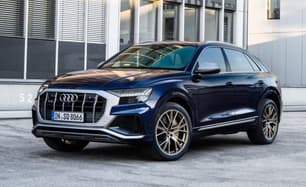
The SQ8 is a gorgeous coupe-style SUV that looks purposeful and poised with its balanced proportions and wide stance. It’s stands apart from its siblings thanks to the S-styled nose treatment and our test model's black accent package makes the honeycomb grille look even sportier.
The update sees new air intake vents at the front, matrix LED headlights and new chrome exhaust tailpipes.
The upgraded 23-inch alloys with red calipers behind them hint at what’s under the bonnet, as does the Sakhir (sack-heer) Gold paintwork which is aptly named after the one-off Grand Prix race circuit.
The interior looks luxuriously appointed with the black Valcona leather upholstery and the dash is headlined by three high-end technology screens. The SQ8 also gets sport seats featuring a quilted design and 'S' badging but there’s not much else separating it from its siblings.
Audi fans will love the the SQ8's more understated interior but newcomers might be surprised it's not as flashy as some of its rivals.
The original first-generation GLB was a standout when it comes to exterior design. It was boxy, upright and unlike anything else in the premium SUV segment. If you wanted a conventional Mercedes SUV you could opt for the smaller, bubble-shaped GLA or the larger, more sophisticated GLC.
But the GLB occupied its own space. Thankfully Benz has largely stuck with the script for the second-gen GLB, but they’ve modernised it.
Built on the new Mercedes Modular Architecture (MMA), the GLB is a full 98mm longer, has a 50mm longer wheelbase, is 27mm wider and 14mm shorter. And it does look noticeably lower to the ground compared to the old model.
While the square silhouette remains, Benz’s latest design direction is seen everywhere. The front end is more rounded now and has a large gaping low-set grille with an LED light bar running the width of the bonnet. It’s an acquired taste but I prefer the previous GLB face.
The rear is a much better angle for the GLB. Looking at it directly from the rear, it has pronounced shoulders that give it a lovely muscular look, and the curved tail-lights are a highlight.
Benz is leaning into its brand in a bid to stand out in an increasingly competitive global market. It’s doing this by using the iconic three-pointed star as a motif in the head and tail-light cluster, as well as the grille which is illuminated for some grades. I’m not sold on that element as it feels a bit over the top, but at least you won’t get confused about what brand of car it is.
Another design element I’m not sold on is the pop-out door handles. With car companies finding better solutions for handles, this seems out of touch.
Inside, everything feels upright. The integrated glass dash panel spans the width of the cabin, while brushed aluminium panels also feature. The signature Benz seat adjuster switches on the doors and the gorgeous air vent design have been upgraded successfully.
The three-spoke leather steering wheel in the GLB350 is a highlight - it’s the perfect width and well executed.
Overall the design is modern, tech focussed and very Benz.
The upper large SUV tag certainly makes sense when it comes to cabin space because there's a lot of it. Both rows enjoy ample head- and legroom and access is great thanks to wide door apertures and high ground clearance.
Comfort is high with well-padded seats and thanks to the Sensory Package all but the middle back seater get some luxury extras.
The centre rear position has compromised legroom courtesy of the transmission tunnel, so it's best for a kid. However, the front seats take the cake with their massage, heat and cooling functions and adjustable supports.
Amenities are great throughout the car and the extendable sun visors, rear electric sunshades, soft-close doors and four-zone climate control clinch the practicality deal.
Individual storage is a bit sparse up front with two cupholders, a drink bottle holder in each door and a shallow middle console that realistically only fits a phone.
The glove box is a great size. I can fit my handbag in it, but there are not a lot of areas to pop your smaller items in.
Individual storage is a bit better in the rear as you get two big map pockets, a drink bottle holder in each door, plus two cupholders in the fold-down armrest - so it feels like you have more places for your bits and pieces.
Technology looks amazing but overwhelming to use until you wrap your head around it all. The haptic feedback also gets tired fast. The built-in satellite navigation is super simple while the head-up display and digital instrument cluster feature pull through directions, which is handy.
Charging options are good with each row getting two USB-C ports and a 12-volt socket but the front also enjoys a wireless charging pad. The pad is slow to charge, though, and left my iPhone feeling super hot whenever it was used.
The boot is a good size at 605L and easy to access, too. The sloping roof means larger items have to sit flush with the seats but you shouldn’t have to worry for road trips.
The back seat has a 40/20/40 split which opens up storage options and this model has a powered tailgate.
The extra length and width means more cabin space which is more apparent in the rear. But there is ample space up front, especially headroom.
The centre console sits up a little too high for my liking but it means you have under console storage with two USB-C ports, and a rubber mat so your phone doesn’t slide around.
It’s got a really deep central bin, while door cavities will only hold smaller bottles. You also get a wireless charger and two cupholders.
There is only a handful of buttons - hazard lights, volume, voice command and drive mode selection - under the central air vents. All other functions are found in the multimedia screen.
Benz has been a standout in the past decade with its MBUX multimedia system and the latest version is responsive, relatively easy to navigate (once you’ve located the key controls), and the graphics look super sharp and cool. The digital instrument cluster is similarly excellent.
Hopping into the second row, the seat base is set higher than the front seats for stadium seating. The seats have some bolstering but quite a lot of lumbar support.
There’s ample space in the second row, thanks to 68mm more space from the back of the seat to the front seat and an extra 34mm of headroom compared to the old car. I have ample knee, head and legroom behind my 183cm (six-foot) tall driving position, although my head is about the same height as the top of the window frame which impedes a little.
Amenities include smallish map pockets, two USB-C ports and knee-level air vents, which is always good to see. There’s a deep but skinny bottle holder on either side and a fold-down centre armrest that sits up a bit too high but it’s wide and has two shallow cupholders and a neat little phone holder.
Each of the 40/20/40 split seats folds via a pull strap at the seat base and the good news is you can adjust the second row backrest a little. The base is also on rails so it can slide fore and aft.
That is how you lower the seats to get into the third row, which is strictly for children. Benz has made it slightly easier for littlies to get back there but it is not a space for taller humans. In fact, Benz recommends up to 171cm tall at most.
One gripe is that there is no sunshade or blind for the massive standard panoramic fixed glass roof. Benz says it is tinted and has a film to reduce UV light and heat, but I’d say a few hours driving in Australian summer will challenge that. Benz isn’t the only brand doing this, but at least you can buy an accessory blind for your Polestar or Tesla. The fact is, not everyone wants a glass roof, especially in Australia, so this feature should be an option.
The boot can swallow 145 litres with all three rows up, increasing to 480L with the third row stowed and 1605L will all seats lowered. This is all decent for a smallish seven seater but if boot space is a priority then maybe have a look at a GLC.
There’s a floor mat and cargo blind but sadly no spare wheel of any kind, just a tyre repair kit, which isn’t great.
There are three fuel-based variants for the Q8 and the model on test is the top-spec SQ8 TFSI quattro. Its mid-life refresh has seen a price hike of $10,015, bringing it's before on-road costs price to $178,815.
Our test vehicle has also been fitted with a few extras, like a 'Sensory Package' ($14,400) which includes a black headliner, upgraded 23-speaker Bang & Olufsen 3D surround sound system, massage function for the front seats, heat function for the rear outboard seats, electric sunshades for the rear row and an air-quality perfume function.
Also fitted are various black and matt carbon accents across/inside the body for a total of $5400, optioned 23-inch alloy wheels ($3000) and specialised 'Sakhir Gold Metallic' paintwork for $1600. Which brings the total MSRP price tag to $203,215.
Even with all of these extras, the SQ8 is still the most affordable performance SUV compared to its nearest rivals as the Porsche Cayenne GTS starts from $212,600 MSRP and the Mercedes-AMG GLE 63 outstrips them both at $272,300 MSRP.
As you'd expect the standard features list is robust for the SQ8 and includes premium features like a panoramic sunroof, electric front seats with heating/cooling and memory functions, full-leather upholstery, soft-close doors and a heated steering wheel.
There is a bunch of high-end technology throughout which includes a colour head-up display, 10.1-inch touchscreen multimedia system, 8.6-inch climate control panel, 12.3-inch digital instrument cluster, satellite navigation, wired/wireless Apple CarPlay and Android Auto, digital radio, four USB-C ports, three 12-volt sockets and a wireless charging pad.
Practical features include keyless entry and start, rain-sensing windscreen wipers, dusk-sensing LED headlights, a powered tailgate, adaptive air-suspension and four-zone climate control.
Overall, not a bad list of features for this part of the market and you won't be left wanting.
The 2026 GLB line-up includes two mild-hybrid and two EV model grades, for now. We can probably expect a spicier AMG version down the track.
Things kick off with the GLB200 front-wheel drive mild-hybrid at $65,400, before on-road costs. This is $2200 cheaper than the previous 200.
Next up is the GLB220 4Matic, which is Benz speak for all-wheel drive. That costs $76,100.
The most affordable EV is the rear-wheel drive GLB250+ at $74,990 which is about $10,000 more than the base hybrid. It’s also about $14,000 more affordable than the previous equivalent EQB grade. Clearly Mercedes has seen the shift in the market and adjusted its prices accordingly.
The range tops out with the GLB350 4Matic at $86,200.
It’s tricky to compare the GLB to other mid-size SUVs as it occupies a fairly rare space given its boxy shape, two powertrain options and seven-seat layout.
A base BMW X3 mild-hybrid is $20,000 pricier than the entry GLB, while Volvo’s EX60 EV will start from $87,000. But they only have five seats each.
Interestingly, a Tesla Model Y L with six seats is $74,900 - just $90 cheaper than the GLB250+. You could argue, however, that Tesla is not a premium brand.
Standard gear in the GLB200 includes:
Step up to the GLB220 4Matic and you’ll also get:
The GLB250+ EV comes with everything you get in the two mild-hybrid grades but also gets a seven-metre home/public charging cable.
The flagship GLB350 4Matic gains the Terrain mode and transparent bonnet of the other 4Matic grade, as well as a second motor and a bump in power and torque.
The tech offering is very impressive and makes up the majority of the standard features list. It’s an extensive list and there’s a lot more when it comes to safety features (see the Safety section). Thankfully Benz no longer offers stripped-out, bare-bones base grades. You could even suggest the GLB offers decent value-for-money. Who would’ve thought?
Being a Benz there are a few options packs including AMG Line for the base grade and a $4000 Premium Plus Package with Digital extras.
Our test vehicle has a 4.0-litre, twin-turbo petrol V8 engine that produces 373kW and 770Nm. That means it sits in the middle of its rivals in terms of outputs with the Mercedes being top-dog with its 450kW/850Nm combo.
Still... the SQ8 is no dainty flower when it comes to power delivery and has an impressive 0-100km/h sprint time of just 4.1 seconds.
The SQ8 is a full-time all-wheel drive with an eight-speed auto transmission and the whole engine combo delivers a powerful but elegant on-road experience.
Both mild-hybrid versions of the GLB are powered by a 1.5-litre four-cylinder turbo-petrol engine with 48-volt mild-hybrid tech that includes a 1.3kWh lithium ion battery.
The front-wheel-drive GLB200 delivers 120 kilowatts of power and 250 Newton metres of torque for an 8.7-second 0-100km/h dash time.
The all-wheel drive GLB220 4Matic gets a power and torque boost to 140kW/300Nm for a 7.5-second 0-100km/h time. Both petrol grades use an eight-speed dual-clutch automatic transmission.
For the EVs, the rear-drive GLB250+ delivers 200kW/335Nm and hits 100km/h from zero in 7.4 seconds.
The GLB350 4Matic ups that to 260kW/515Nm and a 100km/h dash time of 5.5 seconds.
The official combined (urban/extra-urban) fuel cycle figure is 11.9L/100km, which is lower than its rivals.
My real world usage sits at 12.3L/100km after a mix of open-road and urban driving.
This result is decent for a performance SUV but expect it to be thirsty in an urban environment as the on-board gauge hit the mid-20s in the city.
Based on the large 85L fuel tank theoretical driving range is 714km and around 690 using our real-world result. Respectable for a performance SUV but not as good as some family SUVs.
The GLB EVs uses a nickel manganese cobalt (NMC) battery with 85kW of usable energy.
Driving range and energy efficiency for the GLB250+ is a decent 570km and 15.5 kilowatt hours per 100km. The two-motor AWD GLB350 range drops slightly to 554km and uses 17.7kWh/100km
The EVs have four regenerative braking modes. After a long morning drive in the GLB350 I recorded 15.5kWh, which is solid.
The new GLB uses an 800-volt architecture supporting DC fast charging up to 320kW. Under the right conditions at a high-powered DC charging station, you can technically add up to 260km of range in 10 minutes, according to Mercedes.
AC charging capacity is available up to 22kW and there are four regenerative braking modes, as well.
When it comes to fuel economy in the mild hybrids, the GLB200 consumes 6.1 litres per 100km and the GLB220 sips 6.5L. This powertrain has the ability to use electric power to coast when cruising at highway speeds.
The SQ8 delivers on power because it’s effortless to get up to speed and the pick up is super responsive when the start/stop function is turned off (otherwise there can be some lag).
The engine doesn’t sound like a big and grumbly V8, though. There are some growls but it’s mainly when you turn the engine on and not to be obnoxious about it but if you're in a V8, you want to hear it as it’s part of the fun of having a big bruiser engine like this!
What doesn’t help the V8 soundscape is the fact the cabin sounds like a noise-cancelling headphone inside. There is a small hum from road noise but it’s pretty darn quiet. Almost EV quiet at times but that means the driving experience leans more towards refined and elegant rather than sporty and fun.
The SQ8's handling is great - super direct steering, stable in corners and well-rounded passenger comfort when it comes to suspension.
You still get road feedback, which I like as a driver, but it’s not too stiff thanks to the adaptive suspension.
The SQ8 is a large car but you wouldn’t know it when it comes to parking. The 360-degree view camera is clear and the dynamic guidelines help you to position this big unit even the smallest of car parks.
I have driven the previous GLB250, which was a fun, punchy SUV. There’s no sporty second-gen variant yet, but if you’re after performance, check out the EV rather than the mild-hybrid.
I only drove the mild-hybrid briefly at the launch event so I’ll focus most of my impressions on the EV. The GLB220 4Matic is quick enough off the line, but there is some lag. Brakes are strong and the cabin is well insulted.
But for me, the EV is the clear pick.
Of the EVs I only drove the GLB350 4Matic as Benz didn’t have a 250+ available.
It’s very quick from a standing start, but not whiplash quick and that is perfectly appropriate for a family-friendly SUV. It delivers the power in a linear manner but when you put the foot down it is very responsive.
I couldn’t detect a massive difference between Comfort and Sport mode to be honest, but you get enough punch in Comfort.
The GLB is tall and top heavy so there is body roll but that’s fine for this sort of vehicle. You’ll notice the weight of this car if you push it into a tight bend at speed - it’s quite heavy and I felt a bit of lateral movement, but the traction control systems help keep the car in check. The grippy tyres help here, too.
Benz has worked hard to improve ride quality with the new-gen model and it shows. The drive route from Melbourne’s south-eastern suburbs to the Mornington Peninsula was littered with potholes, some that looked like they could cause serious damage. The GLB soaked up even some of the sharper holes like a pro. The ride at urban speeds is calm and measured.
The sound deadening measures have clearly helped as well as it is a much quieter cabin than its predecessor. All of this adds to the feeling that this GLB is a more refined, premium SUV than the old model.
I found the steering a little light and twitchy at the start of the drive but by the end of the day I noticed some heft to the feel, and it’s still direct.
The brakes in the EV are a little slower to respond than the mild-hybrid, which takes some time to get used to.
But overall, the drive experience is largely very positive.
The SQ8 has a maximum five-star ANCAP safety rating from testing done in 2019 and features eight airbags, including side chest airbags for both rows. It's common to only find the latter in the front – so that’s great for a family car.
The SQ8 scored well across its ANCAP individual protection segments, scoring 93 per cent for adult occupant, 88 per cent for child occupant, 71 per cent for vulnerable road user and 75 per cent for its safety assist.
The SQ8 has a long list of safety features including blind-spot monitoring, safe exit warning, driver attention monitor, fatigue reminder, matrix LED lights, SOS call, forward collision warning, rear collision warning, rear cross-traffic alert, lane keeping/departure aids, tyre pressure monitoring, adaptive cruise control (with stop & go and lane keeping), park assist and a 360-degree reversing camera plus front and rear parking sensors.
The rear row features two ISOFIX child seat mounts and three top tether anchors.
The SQ8 has AEB with car, pedestrian, and cyclist detection and is operational from 10 – 250km/h but it is usual to see this system operate from as low as 4.0km/h.
The 2026 GLB is yet to be tested by Euro NCAP or ANCAP, but Benz says it should happen next year.
Benz has packed the GLB with standard safety gear from the base grade, including:
It also comes with Mercedes’ Pre Safe system that uses sensors to help protect occupants by preparing the cabin milliseconds before an unavoidable crash or rollover. It will tighten the seatbelts, shut any open windows or the sunroof, tighten seat bolsters, move seats to a safer position, and even emit a sound to prepare your ears all in a bid to protect occupants.
The 2026 GLB comes with eight airbags, including curtain airbags that stretch all the way back to cover the third seating row and a front centre bag.
The active driver assist systems (ADAS) are incredibly well calibrated and unobtrusive. No incessant beeping here. In fact I didn’t get beeped once on the launch drive. The most noticeable ADAS warning was a vibration in the steering wheel when I drove close to the lane marking, but it’s subtle.
The SQ8 comes with a five-year/unlimited km warranty, which is a normal term for the class.
It also comes with capped servicing for five years or up to 75,000km and averages $920 per service, which is very good for the segment.
Servicing intervals are reasonable at every 12-months or 15,000km, whichever occurs first.
The GLB comes with Mercedes’ five-year, unlimited kilometre warranty, which is now the standard in the premium segment. The EV’s battery warranty lasts eight years or 160,000km, which is also pretty standard.
Services are required every year or 25,000km which is a decent interval.
Benz offers pre-paid service packages running for three, four or five years. The mild-hybrid is $3430 for three years, $4680 for four and $6300 for five years.
The EV is more affordable to service, costing $2525 for three, $3765 for four and $4440 for five years.
This is quite pricey compared to rivals. BMW’s iX3 is offered with a six-year pre-paid plan and it’s $2420. The Polestar 4 is free to service for the first five years.