What's the difference?
The Audi SQ8 has had a mid-life refresh but this upper large SUV still offers luxury with its powerful V8 engine that fans know and love, as well as the features you would expect in a top model.
It competes against the Mercedes-AMG GLE and Porsche Cayenne but we’re family testing the SQ8 to see how it handles domestic life.
Keep reading to see what we’ve discovered.
The Audi Q8 has had a mid-life upgrade and it brings a few minor tweaks to the design, technology and equipment.
Plug-in hybrids tend to rank a little lower on my excitement scale when it comes to available powertrains because I usually find the constant charging inconvenient.
However, the electric driving range of the 60 TSFIe quattro S Line grade has been bolstered by 27km, increasing it to 74km overall.
The Audi SQ8 isn’t your typical performance SUV. It’s more refined and less flashy. The tech can be more complicated than it needs to be and if you’re wanting that V8 soundscape, you won’t find it here.
However, the handling and on road experience are superb plus you can comfortably haul the family around and look good doing it.
The updated Audi Q8 60 TFSIe quattro S line still looks good inside and out. It fits a family comfortably without feeling too big and there’s enough here to satisfy those who like the luxury features.
It's price tag will hurt it but the improved power outputs and driving range is a big plus and makes the plug-in hybrid powertrain make more sense.
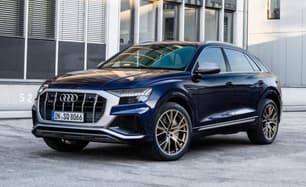
The SQ8 is a gorgeous coupe-style SUV that looks purposeful and poised with its balanced proportions and wide stance. It’s stands apart from its siblings thanks to the S-styled nose treatment and our test model's black accent package makes the honeycomb grille look even sportier.
The update sees new air intake vents at the front, matrix LED headlights and new chrome exhaust tailpipes.
The upgraded 23-inch alloys with red calipers behind them hint at what’s under the bonnet, as does the Sakhir (sack-heer) Gold paintwork which is aptly named after the one-off Grand Prix race circuit.
The interior looks luxuriously appointed with the black Valcona leather upholstery and the dash is headlined by three high-end technology screens. The SQ8 also gets sport seats featuring a quilted design and 'S' badging but there’s not much else separating it from its siblings.
Audi fans will love the the SQ8's more understated interior but newcomers might be surprised it's not as flashy as some of its rivals.
When it comes to style, the Q8 60 TFSIe quattro S line has it in spades. Featuring a design that looks athletic with its long lines and wide stance, you'll always be proud to hop into it.
Red calipers now come standard and they look awesome on the optioned 22-inch alloys. The update sees a redesigned front with new grille and reshaped matrix LED headlights and a 2D badge design.
While SUV coupes aren’t usually my jam, the Q8 manages to tick the 'sexy' box.
The interior is honestly the same and only die-hard fans will notice the new menu screens on the multimedia system. The cabin is a fine example of what a luxury SUV should look like because its polished, well-built and sumptuous but it has the classic Audi edge, so there is still a sporty vibe going on.
The panoramic sunroof adds some airiness to the otherwise dark cabin and the Valcona leather upholstery is liberally splashed about, so most of what you touch feels premium and soft.
The upper large SUV tag certainly makes sense when it comes to cabin space because there's a lot of it. Both rows enjoy ample head- and legroom and access is great thanks to wide door apertures and high ground clearance.
Comfort is high with well-padded seats and thanks to the Sensory Package all but the middle back seater get some luxury extras.
The centre rear position has compromised legroom courtesy of the transmission tunnel, so it's best for a kid. However, the front seats take the cake with their massage, heat and cooling functions and adjustable supports.
Amenities are great throughout the car and the extendable sun visors, rear electric sunshades, soft-close doors and four-zone climate control clinch the practicality deal.
Individual storage is a bit sparse up front with two cupholders, a drink bottle holder in each door and a shallow middle console that realistically only fits a phone.
The glove box is a great size. I can fit my handbag in it, but there are not a lot of areas to pop your smaller items in.
Individual storage is a bit better in the rear as you get two big map pockets, a drink bottle holder in each door, plus two cupholders in the fold-down armrest - so it feels like you have more places for your bits and pieces.
Technology looks amazing but overwhelming to use until you wrap your head around it all. The haptic feedback also gets tired fast. The built-in satellite navigation is super simple while the head-up display and digital instrument cluster feature pull through directions, which is handy.
Charging options are good with each row getting two USB-C ports and a 12-volt socket but the front also enjoys a wireless charging pad. The pad is slow to charge, though, and left my iPhone feeling super hot whenever it was used.
The boot is a good size at 605L and easy to access, too. The sloping roof means larger items have to sit flush with the seats but you shouldn’t have to worry for road trips.
The back seat has a 40/20/40 split which opens up storage options and this model has a powered tailgate.
The cabin offers plenty of space for passengers and you never feel like you're jostling for elbow room unless there's three adults across the rear seat. Comfort is high with ergonomic seating up front with plenty of adjustment and functions. The rear seat has long bases and the seat backs can recline.
Individual storage leaves a little to be desired for the class and the glove box shoulders most of the burden up front as the middle console is really just a shallow shelf large enough for a wireless charging pad and keys or a chapstick.
Each row gets a couple of cupholders and drink holders, and the rear map pockets round out back-seat storage.
Because of the PHEV powertrain, the 60 TFSIe quattro S line has the smallest boot capacity in the line-up at 505L but this is still more than enough for a decent road trip or grocery haul.
The wide boot aperture, level loading area and powered tailgate add some convenience, as does the 40/20/40 split fold on the rear seats.
Access for each row is solid with wide door openings, low seat positions and 205mm ground clearance. Although, the doors have to been slammed shut for them to close properly and this annoyed everyone in the family. You can spring for a soft-close door feature for $1500 and, honestly, it would be worth it.
The 10.1-inch touchscreen multimedia system is logically laid out and the graphics look great. It has haptic feedback which my husband didn’t love as it made it hard to select things on a bumpy road. You also get built-in sat nav, wireless Apple CarPlay and Android Auto. Other than the occasional lag with the CarPlay connecting upon start up, it's all simple enough to use.
Charging options are good with two USB-C ports in each row and the front also gets a wireless charging pad. The big 12.3-inch digital instrument cluster looks great but it can be annoying to find information on it or personalise it.
There are three fuel-based variants for the Q8 and the model on test is the top-spec SQ8 TFSI quattro. Its mid-life refresh has seen a price hike of $10,015, bringing it's before on-road costs price to $178,815.
Our test vehicle has also been fitted with a few extras, like a 'Sensory Package' ($14,400) which includes a black headliner, upgraded 23-speaker Bang & Olufsen 3D surround sound system, massage function for the front seats, heat function for the rear outboard seats, electric sunshades for the rear row and an air-quality perfume function.
Also fitted are various black and matt carbon accents across/inside the body for a total of $5400, optioned 23-inch alloy wheels ($3000) and specialised 'Sakhir Gold Metallic' paintwork for $1600. Which brings the total MSRP price tag to $203,215.
Even with all of these extras, the SQ8 is still the most affordable performance SUV compared to its nearest rivals as the Porsche Cayenne GTS starts from $212,600 MSRP and the Mercedes-AMG GLE 63 outstrips them both at $272,300 MSRP.
As you'd expect the standard features list is robust for the SQ8 and includes premium features like a panoramic sunroof, electric front seats with heating/cooling and memory functions, full-leather upholstery, soft-close doors and a heated steering wheel.
There is a bunch of high-end technology throughout which includes a colour head-up display, 10.1-inch touchscreen multimedia system, 8.6-inch climate control panel, 12.3-inch digital instrument cluster, satellite navigation, wired/wireless Apple CarPlay and Android Auto, digital radio, four USB-C ports, three 12-volt sockets and a wireless charging pad.
Practical features include keyless entry and start, rain-sensing windscreen wipers, dusk-sensing LED headlights, a powered tailgate, adaptive air-suspension and four-zone climate control.
Overall, not a bad list of features for this part of the market and you won't be left wanting.
There are three Q8 grades before you hop into the flagship SQ8 performance model, and the variant on test for this review sits second from the top.
The mid-life refresh sees pricing increased across the entire range and adds over $1700 to the (already steep) $154,284 MSRP price tag.
Compared to its plug-in hybrid rivals, the BMW X5 xDrive50e and Volvo XC90 Recharge Ultra T8, the 60 TFSIe quattro S line slides in as the most expensive.
Our test vehicle has also been fitted with a few extra items like 22-inch alloys, metallic paint and a luxury seat package, which adds ventilation function to the front seats and heated rear outboard seats. It does tack on $9900 to the overall price tag, though.
The 10.1-inch multimedia system remains and while it sits on the smaller end compared to some of its rivals now, it does get an updated layout and apps for 2025.
Other standard equipment includes a panoramic sunroof, matrix LED headlights, heated side mirrors with memory, keyless entry and start, a powered tailgate, heated front seats, electric lumbar support, three-zone climate control, electrically adjustable steering wheel, electric auto cargo cover, and a tyre repair kit.
The technology is the standout with a 17-speaker Bang & Olufsen sound system, wireless Apple CarPlay and Android Auto, digital radio, as well as built-in satellite navigation, a 12.3-inch digital instrument cluster and colour head-up display.
You also get an Audi Connect plus app which allows remote access for security and assistance services including car finder with remote signal, remote lock and unlock, emergency call, and online roadside assistance.
Does the PHEV Q8 offer good value? Value is relative, the features list is fairly robust but it’s hard to ignore that this PHEV sits $10K above its internal combustion siblings.
Our test vehicle has a 4.0-litre, twin-turbo petrol V8 engine that produces 373kW and 770Nm. That means it sits in the middle of its rivals in terms of outputs with the Mercedes being top-dog with its 450kW/850Nm combo.
Still... the SQ8 is no dainty flower when it comes to power delivery and has an impressive 0-100km/h sprint time of just 4.1 seconds.
The SQ8 is a full-time all-wheel drive with an eight-speed auto transmission and the whole engine combo delivers a powerful but elegant on-road experience.
The Q8 60 TFSI e is AWD and has a 3.0-litre V6 turbo-petrol plug-in hybrid powertrain for a combined power output of 360kW and 700Nm of torque.
The power output has increased by 20kW with the mid-life refresh and that shaves 0.4 seconds off the 0-100km/h sprint time bringing it down to just 5.0 seconds. So it’s a quick and powerful SUV.
The powertrain is paired with an eight-speed automatic transmission which is mostly smooth and the switch between petrol and electric is fairly seamless.
As far as plug-in hybrids go, everything seems to work well here.
The official combined (urban/extra-urban) fuel cycle figure is 11.9L/100km, which is lower than its rivals.
My real world usage sits at 12.3L/100km after a mix of open-road and urban driving.
This result is decent for a performance SUV but expect it to be thirsty in an urban environment as the on-board gauge hit the mid-20s in the city.
Based on the large 85L fuel tank theoretical driving range is 714km and around 690 using our real-world result. Respectable for a performance SUV but not as good as some family SUVs.
The mid-life update sees a larger 25.9kWh lithium-ion battery which improves the electric driving range by 27km, bringing it up to 74km overall. This still falls short of its direct rivals but it’s an improvement for efficiency because it’s now more than enough range if you’re just doing the school runs and some errands around town.
The Q8 60 TFSIe has a Type 2 charging port and like most plug-in hybrids, lacks a CCS enhancement, so you have to make do with AC charging options with this one. On a 7.4kW AC charging system you can go from 0-100 per cent in three hours and 45 minutes but if you’re using just a standard house plug port, it will take a few hours more. It's best to leave it overnight.
Audi throws in three charging cables, including a 240-volt domestic charger but you have to pay extra for a wall-mounted box.
The official combined fuel cycle is a low 1.8L/100km and like all plug-ins the best efficiency will be achieved if you charge it often. After charging almost every day and doing a mix of open road and urban driving, my real-world usage has popped out at 7.7L/100km, which isn’t as good as I was hoping but it’s not terrible. I would expect the efficiency to drop on longer trips.
The Q8 likes to drink the good stuff and Audi recommends a minimum 95 RON unleaded petrol to be used for this grade.
The SQ8 delivers on power because it’s effortless to get up to speed and the pick up is super responsive when the start/stop function is turned off (otherwise there can be some lag).
The engine doesn’t sound like a big and grumbly V8, though. There are some growls but it’s mainly when you turn the engine on and not to be obnoxious about it but if you're in a V8, you want to hear it as it’s part of the fun of having a big bruiser engine like this!
What doesn’t help the V8 soundscape is the fact the cabin sounds like a noise-cancelling headphone inside. There is a small hum from road noise but it’s pretty darn quiet. Almost EV quiet at times but that means the driving experience leans more towards refined and elegant rather than sporty and fun.
The SQ8's handling is great - super direct steering, stable in corners and well-rounded passenger comfort when it comes to suspension.
You still get road feedback, which I like as a driver, but it’s not too stiff thanks to the adaptive suspension.
The SQ8 is a large car but you wouldn’t know it when it comes to parking. The 360-degree view camera is clear and the dynamic guidelines help you to position this big unit even the smallest of car parks.
The Q8's athletic looks are matched by its on-road handling. The power has a hefty kick that’s effortlessly delivered once you’re up to speed. It did have a few confused moments when I had to accelerate quickly from a full stop - the lower gears didn’t immediately engage and I got a proper bunny hop but it was short lived and for the most part the powertrain delivers the goods.
The adaptive air suspension makes for a comfortable ride despite the massive wheels and you can comfortably cruise around town or the highway without much jostling.
Cabin noise is minimal around town but you get a low hum of road noise at higher speeds. Overall, it's still a refined cabin space to spend a lot of time in.
I do miss hearing some of the engine thrums though because even when the battery is depleted, you don’t get a lot of engine feedback. It certainly adds to the refinement but it loses some of the fun.
The higher driving position feels comfortable and visibility is quite good. Steering is responsive and feels sporty with lane changes but its 13.3m turning circle lets it down in car parks.
The 360-degree view camera system is clear and this has multiple parking sensors. In theory parking should be easy but again, until you get used to that bigger turning circle it can feel clumsy in smaller spaces.
The SQ8 has a maximum five-star ANCAP safety rating from testing done in 2019 and features eight airbags, including side chest airbags for both rows. It's common to only find the latter in the front – so that’s great for a family car.
The SQ8 scored well across its ANCAP individual protection segments, scoring 93 per cent for adult occupant, 88 per cent for child occupant, 71 per cent for vulnerable road user and 75 per cent for its safety assist.
The SQ8 has a long list of safety features including blind-spot monitoring, safe exit warning, driver attention monitor, fatigue reminder, matrix LED lights, SOS call, forward collision warning, rear collision warning, rear cross-traffic alert, lane keeping/departure aids, tyre pressure monitoring, adaptive cruise control (with stop & go and lane keeping), park assist and a 360-degree reversing camera plus front and rear parking sensors.
The rear row features two ISOFIX child seat mounts and three top tether anchors.
The SQ8 has AEB with car, pedestrian, and cyclist detection and is operational from 10 – 250km/h but it is usual to see this system operate from as low as 4.0km/h.
The PHEV Q8 variant is unrated with ANCAP as it’s not covered by it’s siblings' five-star rating from 2019, but it does have a lot of standard safety features like eight airbags, including side chest airbags for the front and rear passengers. Surprisingly, it misses out on a front centre airbag though.
A standout feature is the safe exit assist which will delay your door from opening if it detects a car or cyclist. Always a handy thing when you have a kid like mine who can carelessly throw open their door.
There is also a ‘pre-sense’ feature where the car detects that you’re approaching traffic at lights or a roundabout and it will automatically start slowing down for you, which I quite liked.
Other standard features include adaptive cruise control with stop and go, lane keeping aid, lane departure warning, blind-spot monitoring, forward collision warning, rear cross-traffic alert, driver attention monitoring (sound and visual alerts), 360-degree view camera system, front and rear parking sensors, tyre pressure loss indicator, intelligent seatbelt reminders, first aid kit, hi-vis vests and a collapsible warning triangle.
The autonomous emergency braking (AEB) has car, cyclist and pedestrian detection and is operational up to 85km/h (up to 250km/h for cars).
There are two ISOFIX child seat mounts and three top tether anchor points. The rear seat is wide enough to accommodate three child seats side by side.
The safety systems feel well-calibrated and are not intrusive for daily driving. In a world when cars seem to chime an alert for everything, this is a welcomed plus.
The SQ8 comes with a five-year/unlimited km warranty, which is a normal term for the class.
It also comes with capped servicing for five years or up to 75,000km and averages $920 per service, which is very good for the segment.
Servicing intervals are reasonable at every 12-months or 15,000km, whichever occurs first.
Audi offers the Q8 60 TFSIe with a five-year/unlimited kilometre warranty and the battery is covered by an eight-year/160,000km warranty which are all pretty standard terms compared to its rivals.
There is a standard five-year servicing package that costs $3570 and servicing intervals are spaced at every 12 months or 15,000km, whichever occurs first. However, if you purchase the Audi Advantage Package you add a further two years of coverage to the warranty, roadside assistance and servicing, which is pretty good for the class.