What's the difference?
Can a hatchback still be a fun and fashionable way to get around when the SUV has become such a status trend?
The facelifted Audi A3 certainly makes a case for it.
The refreshed 2025 A3 is, as Audi puts it, more competitive than before when it comes to not only value but also, you might agree, style.
Last year, before the update even arrived, the A3 sold almost as well as its Volkswagen Golf corporate sibling. In fact, it’s Audi’s third most popular model behind the Q3 and Q5 SUVs.
It’s also third in its segment of ‘Small cars under $40,000’, behind only the MG4 electric car and, you guessed it, the VW Golf.
As such, it also outsells its actual closest rivals the BMW 1 Series and Mercedes-Benz A-Class, both of which are close to the A3 on price.
Now that it’s been given a bit more razzle dazzle, let’s see if the A3 can keep that momentum going.
I remember the first Bond film I ever watched.
I was about eight or nine years old, and it was GoldenEye on VHS. In that film, Pierce Brosnan drove a BMW Z3 convertible, which obviously oozed cool.
I didn’t know at the time that it was just a little bit weird that he wasn’t driving an Aston Martin for the entire duration of the movie, but it didn’t matter, that drop-top Beamer with its radar and missiles imprinted itself on my mind.
As such, I’ve always had a soft spot for BMW’s 'zed' range, so I was quite keen to helm this new one as it came through the CarsGuide office, especially since it shares its underpinnings with the new Toyota Supra.
So, is the new Z4 a case of never meet your heroes? Or did it make me feel a little bit like a secret agent? Read on to find out.
Closing in on $60,000 for a small car isn’t cheap. Ask a car dealer and they might even say the hatchback is a good way to get someone into a showroom to eventually look at an SUV.
But I reckon you’d be doing the A3 a disservice to count it out. It’s always been one of those cars that does everything well, and with this current facelift manages to keep its practicality without becoming boring.
It looks good on the outside, it’s smart on the inside and it’s fun to drive while remaining sensible. Even if you get it in bright yellow.
The Z4 didn’t make me feel like Peirce Brosnan’s 007. It’s way too serious – a proper gritty reboot. Maybe it’s meant for Daniel Craig. Either way, its brave design makes it one of the best-looking BMWs of recent memory, and it’s a tech- and comfort-fest that the Bavarian automaker should be proud of. I just wish it was a smidge more fun behind the wheel.
Eye of the beholder and all that, sure, but the A3 looks cool from the outside. It’s got this angular design but manages it without being too aggressive or busy with other design elements, so it still has a ‘premium Euro’ feel to it.
Shooting pics of the car for this review, the harsh light accentuated its sharp lines. It looks sculptural rather than just some little blob.
At the same time, thanks to the proliferation of sports design packs like the S Line, The A3 looks like it could be an S3, almost. Which makes sense, because the front bumper and rear diffuser as well as the roof spoiler are all partly inspired by RS models.
New for the A3 is the flat, 2D Audi badge, the model name on the B pillar and the new font for its name on the tailgate.
The lights in the cluster are able to look narrower than before thanks to their customisable settings, which allow you to choose the light signature, while the grille has a flatter appearance and the air intakes are bigger. Even the wheels look like they’re from a sports car.
Whether you’d have the A3 in the Python Yellow of our test car is another thing. I don’t mind a loud colour but I reckon a bit of 'District Green', 'Ascari Blue' or 'Progressive Red' would be the vibe.
Also, any colour that isn’t white is a cost-option on the A3, all of them coming in at $1350, except Ascari Blue which is an Audi Sport colour and costs $1850.
Speaking of the vibe, inside the A3 feels properly nice. It’s not just a spruced up Golf in there. There’s proper Audi character to the car, though that means plenty of piano black trim to get smudgy.
Audi’s done a good job making the layout look sleek without resorting to locating all the controls in the screen. There are design elements in the cabin that aren't strictly necessary but are worth doing for the way they look.
Things like the way the vents flank the driver display or the trim inlay on the passenger side of the dash.
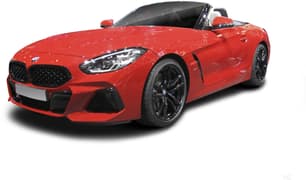
The Z4 is a sight to behold. It’s brave, especially for a BMW, it even betrays the brand’s strongest styling pillars, making its own way with its more horizontal grille design, flat body and curved out rear.
It’s more than that, though. In black, this car looks sinister, brooding. The more you look at it, the more you notice tiny details - the scooped-out sides, or the way the entire rear seems to flick up into the integrated spoiler. I couldn’t get enough of staring at it – it manages to look even better with the roof down.
That’s probably when it hit me. To my eyes, at least, this is the most stunning BMW in years. Sure, the X7 is a sight to behold due to its sheer dimensions and borderline offensive grille, but the Z4 is the opposite. It’s subtle, it hides its details away in its silhouette.
It’s designer, Calvin Luk (an Australian no less), was inspired at least in part by the Z8 – another Brosnan bond car – and you can see the Fisker design reflected in the Z4’s low, flat grille and almost bulbous rear.
Inside, sadly, the Z4’s strong design doesn’t quite play out. There’s no wily Fisker touches here, just a standard set of BMW switchgear. While it all works well, it just dumbs down the Z4’s character.
The big, chunky steering wheel in particular is a let-down. It’s the same wheel that sits in the brand’s X5 SUV, and it feels right there, but not here in a convertible where you’re so close to the ground. A smaller wheel would not only suit this car better, it would make it feel just a smidge more alive. I miss the three-spoke M sport wheel from previous-generation BMW cars.
I do like the dash, which is seemly carved from rhomboid shapes - a theme that rolls into the doors, screens, and vents elegantly. I’m normally not a fan of gloss plastics and chrome touches, but in the Z4 they’re all tastefully applied.
The seats, too, are lovely. I’m not sure about the contrast bright-red leather our car came with, but they’re nice and close to the ground and have excellent trim that you seem to sink into just enough to be comfortable and sporty all at once.
It’s a slick place to be, I just wish it felt less like you were at the helm of an SUV and more like you were driving something that looks this damn good.
Starting from what’s right in front of you as a driver, the steering wheel is the same as in bigger, more expensive Audis. That’s a good thing, because it’s nice to hold, has a good shape for the nine-and-three hand position and it’s not too thick.
As well as the nice, clear buttons on the wheel, you’ve got some physical controls for the climate control and some of the vehicle functions like parking assist and stop-start under the multimedia screen.
For a car this size, the 10.1-inch central touchscreen is plenty big enough, and the fact it doesn't sit up high over the dash is great. It's like a perfect arm's length for your standard-sized adult (like me). I can reach the other side of the screen without needing to lean.
The fact there’s no head-up display is a bit of a let-down, but the now-standard 12.3-inch driver display is very good. It’s configurable yet clear, and means you can get detailed navigation information in front of you rather than having to look to the multimedia screen.
The test A3 has genuine leather upholstery, which is $1100 extra. Not the most you’d pay for leather seats in a Euro, and the seats are comfortable. They're nicely bolstered, the drivers’ side is electrically adjustable and the leather doesn’t feel hard or rough to the touch.
Sitting behind my own seating position in the second row is a little tight, however. At 178cm, my knees almost touch the seat in front. There's also no sunroof, and even though there's just about enough light, that omission doesn’t help the cramped feeling.
There are, like the front, two USB-C ports and the air vents in the back, the latter separately adjustable to avoid arguments, though the cupholders in the armrest are in an awkwardly central position.
Behind that, under the 380-litre boot's floor is a space-saver spare tyre. That's better than some SUVs designed for family adventures that only offer up an inflator/repair kit. Keep that up, Audi. Good job. Well done.
If you fold the rear seats, you get 1200 litres of space. Interestingly, those luggage space figures are the same as the BMW 1 Series.
The Z4 is a convertible, so it’s naturally compromised on space. As far as convertibles go though, you’ll be hard pressed to find one you can fit more stuff into.
The Z4 is wide - the same width, in fact, as a 5 Series - and this carries into the cabin. There are only two seats, but those seats are wide, and occupants will find themselves with luxurious amounts of airspace for their arms, as well as excellent leather-trimmed and padded surfaces for landing elbows on.
Legroom is also great, as the seats have a surprising amount of rail-travel on them, so that even taller folk won’t struggle to fit their limbs in.
A genuinely impressive characteristic of the Z4 is much head room there it is. Despite its low-slung looks from the outside, the roof towers over my 182cm tall head when I’m inside, so this isn’t one of those convertibles that feels like braking too hard might simply decapitate those above six-foot tall.
In terms of storage areas you get some long but shallow trenches in the doors, a bay with connection ports and a Qi wireless charging pad under the air-conditioning controls, a glovebox (hey, not all convertibles have them) and a trick centre console that houses two deep cupholders inside.
There’s also a netted shelf behind the seats that could fit small bags, and given the length of the cabin, you could even fit laptops and the like behind the seats provided you haven’t used the full extent of the seat’s rearward movement.
The boot is deep, wide and long for a drop-top, and offers a total of 281-litres which is more than some popular hatchbacks. It even offers tie-down points and netting either side. To top it off, the fabric roof folds away into its own compartment, so the boot space is unaffected if you choose to drop the lid.
For a convertible – the Z4 is a practicality wizard.
For $54,800, before on-road costs, the A3 can be had as a hatchback - aka Sportback if you’re Audi - or for $57,800 as a sedan.
It’s a little over $4000 more expensive than the pre-facelift version, but Audi reckons there’s about $10,000 more value than before.
And value can be an important when you’ve got the BMW 118 ($57,600) and Mercedes A200 ($61,900) not sitting too far away in terms of price.
Part of the A3’s value equation comes thanks to the addition of the S Line package as standard, which not only makes the A3 look sportier but adds heated sports seats, aluminium interior trim elements and stainless steel on the pedals.
There’s also a larger 12.3-inch screen for the driver display as standard rather than an option. Audi has also reconfigured the air vents for the three-zone climate control, as well as adding a new style gear shifter.
Continued standard kit on the A3 is a wireless phone charger as well as a 10-speaker sound system, an ambient lighting package, a leather steering wheel and synthetic leather trim on the seats which all make for a sporty feel on the inside.
But on the outside there’s also customisable LED headlights and daytime running lights, as well as dynamic indicators and a set of 18-inch alloy wheels.
The car we tested also has a couple of options, its 'Python Yellow' paint is $1350 which I’ll come back to in the design section, but there’s also optional leather seats for $1100 and an electric tailgate for $660, the latter certainly worth it, I reckon.
All up, the car on test comes to $57,910, before on-roads, so even an optioned-up A3 comes in at either the same or less than its closest rivals from BMW and Mercedes-Benz.
The Z4 isn’t cheap, but it plays in a field of expensive Deutsche drop-tops. Our car was the mid-spec 30i which comes in at an MSRP of $104,900 (before on-road costs).
For that you’ll get a more highly tuned version of the base 20i’s four-cylinder turbocharged engine, producing 190kW/400Nm, 19-inch alloy wheels, M Sport brakes, Adaptive M suspension, and adaptive LED headlights.
That’s on top of the already impressively-specified 20i’s kit which includes dual 10.25-inch screens – one for the multimedia functions, the other as a digital dashboard, a head-up display, full Vernasca leather interior trim, auto-dimming rearview mirror, power adjustable and heated front seats with memory function, dual-zone climate control, 10-speaker 205W stereo, a Qi wireless charging pad, and adaptive cruise control as part of a marginally upgraded safety package (more on that in the safety section).
It’s a pretty plush set of equipment, although a challenging value proposition as the almost-as-well-equipped 20i starts from $84,900, a full $20k cheaper.
Rivals for this 30i model? You’ve got the soon-to-be-discontinued Mercedes-Benz SLC300 ($102,500), all-wheel drive Audi TT S quattro ($105,661), and, at a stretch, the entry-level Porsche Boxster ($122,960).
Of course, being a premium European car, there is an extensive options list. Our car was fitted with the excellent and probably-worth-the-money M Sport differential ($2400), as well as the rudely priced M seat belts (literally just the M pattern embroidered in - $560!) and interior ambient lighting package (lovely, perhaps not worth $550).
The Z4 is only offered in five colours, three of which – including our car’s Black Sapphire – come at a cost of $2000. The red interior, surprisingly, is a no-cost option.
If you’re keeping track that brings the car you’re looking at here to $110,410. Not cheap, and it doesn’t have six-cylinders - but given its other attributes explored later in this review, the fact that it still manages to undercut an entry-level Boxster is actually reasonable.
The A3 is powered by a 1.5-litre, turbocharged four-cylinder petrol engine that makes 110kW and 250Nm.
It drives the front wheels via a seven-speed dual-clutch auto transmission and it can hit 100km/h in a claimed 8.1 seconds.
It’s also got a 48-volt mild hybrid system to help with efficiency, though you’d need to be told about it to notice. It also helps with the A3’s (smooth) stop-start system.
Welcome to the age of ridiculously powered four-cylinder turbo engines. Despite a capacity of just 2.0-litres, the engine in the Z4 30i produces a whopping 190kW/400Nm.
That’s probably enough for a car this size. I’m keen to drive the six-cylinder, but surprisingly it seems to offer diminishing returns for extra cylinders offering a 60kW/100Nm power boost for an extra $20,000. Perhaps a six-cylinder is the way to go in a BMW, and given this car’s other seriously sporty attributes, it might be the only way to make it a bit more… fun. More on that in the driving section.
All Z4s are rear-wheel drive, using an eight-speed torque converter automatic. Sorry, no option for a manual this time around.
The A3’s 50-litre fuel tank needs to be filled with RON 95 premium fuel and it’ll drink a claimed 5.3-litres per 100km on the combined (urban/extra-urban) cycle.
Theoretically you’re topping 900km a tank there, but given how fun this car is to drive you’d have to be well behaved to get even close.
For reference, whenever I was on a normal, day-to-day drive on test the A3's trip computer was returning figures in the mid to high sixes.
It’s claimed that the Z4 will drink just 6.5 litres per 100 kilometres on the official combined cycle test, but I found that sticking my foot in occasionally resulted in a slightly more realistic sounding figure of 8.4L/100km.
That’s still a great fuel consumption number for a car like this, and perhaps one of the strongest benefits of having just four cylinders.
A discerning vehicle, the Z4 will drink nothing less than the best-quality 98RON unleaded to fill its 52-litre tank.
First things first, the A3’s exterior and S Line pack are a clue to the way the car drives. It’s probably not the perfect car if you like a cushy, soft ride.
Its suspension errs towards the stiffer side of things, and certain bumps can feel more significant than they need to. But even on particularly bad roads or tram tracks in the city the dampers do a decent job of soaking up the harsh stuff.
It also means there’s more road noise than you’d like on some older highway surfaces, but only in a way that might get annoying if you’re on a road trip with the stereo off for some reason.
The upside of that is its steering feels well weighted and accurate. Plus, the way it handles and corners feels like a bit more grunt would make this a proper driver's car.
It’s not too intense, and there’s enough feedback to make it feel like the A3 shouldn't be a city-dweller only when it comes to driving.
Of course, it’s a hatchback, so you've got the advantages that come with less weight and a lower centre of gravity.
It doesn’t have enough weight to push into understeer more than you’d like on a tight corner. But it also doesn’t feel so light that you’re not sure how it’s going to behave under sharp braking.
The A3’s drivetrain, despite looking underwhelming on paper, feels practical on the road. Sure, 110kW isn't anything wicked, but its 250Nm feel like they’re working in the right places - that being between 1500 and 3500rpm.
It isn't blisteringly quick but even with the seven-speed transmission operating in default auto mode it usually feels like it's in the right place, let alone chipping in with 'manual' shifts via the paddles or shifting drive modes. The A3 has a choice of 'Normal' and 'Sport' shift settings.
You might be a little disappointed if you thought you’d be getting anything approaching a hot hatch, but for an entry-level model the A3 more than holds its own. It’s a solid platform that performs well without compromising too much when it comes to daily driving ability.
A car that looks this good better live up to the promise behind the wheel, right?
For the most part, the 30i does, but it’s a victim of its own performance credentials and luxuriousness.
See, a drop-top should be fun-packed, you should feel close to the road, connected. Sadly, a combination Z4’s excellent suspension and not-so-excellent SUV-like interior separates you too much from the surface below.
An advantage, of course, is the refinement on offer. The Z4 is easily one of the quietest, most refined convertibles I’ve ever driven, but it’s a little too insulated.
I can’t help but feel like it’s all business and no pleasure. It feels a little more like I should be cruising to work on the autobahn and a little less like I should be flinging it around corners on a tight B-road.
It feels almost wrong to drive it in a T-shirt. It’s serious and doesn’t want you to mess around, it wants you to wear a suit and tie.
This grand-tourer style feel is one that will keep a lot of buyers in the premium space happy, but I’m of the opinion that BMW will have that segment well and truly covered by the new 8 Series. If the budget allows.
Regardless, the 30i’s four-cyl engine feels like any six-cylinder would have a few years ago. It’s got a surge to it in the straights that’s quite satisfying, and it responds via the exhaust with an angry tone that makes it feel a little more alive, especially with the roof down.
This feeling was all helped along by our car’s M active differential which simply won’t let the fat tyres at the rear slide unless you’ve got high-speeds and loads of tarmac to play with – for better or worse.
The Z4 also has ‘variable sport steering’ which reacts to the car’s speed and position of the wheels to adjust the input ratio. It’s good when you’re at speed, but the weight and response of the steering can make the Z4 feel bigger than it actually is at lower speeds.
The suspension is firm, and can be a little bouncy over rough surfaces, but seems well suited to the Z4’s chassis.
Other than those notable characteristics you’ll find that the Z4 is wonderfully tuned in terms of its inputs, everything is slick and smooth, suited perfectly for long meandering drives.
Tested in 2020, the A3’s been awarded a maximum five-star rating from ANCAP which applies to the facelifted version.
Six airbags and a suite of active safety tech helped contribute to this, though, whether it would pass with five stars under ANCAP’s current assessment protocols isn’t certain.
That’s likely only down to its relatively non-invasive safety warnings and mild assistance with things like lane-keep and speed warnings.
If you’re someone who’s likely to turn off most of the electronic assistance, the A3’s systems are at a pretty good level as standard.
It’s missing some modern kit like surround-view parking cameras but it does have front and rear proximity sensors and things like rear cross-traffic alert.
Convertibles and safety don’t often fall in the same sentence, unless its one where a concerned relative is trying to convince you not to buy one.
In any case, the Z4 benefits from four airbags (dual front and dual side), as well as the expected electronic stability controls. That optional M Sport differential will have the added bonus of preventing any unexpected slip and slide at the rear.
On the active side the Z4 gets ‘Driving Assistant’ which includes forward collision warning (FCW), lane departure warning (LDW), rear cross traffic alert (RCTA), and rear collision warning. The 30i grade also gets 'active cruise control with stop & go' which allows for full auto emergency braking (AEB) with pedestrian and cyclist detection. Not on the spec sheet, but apparently present in the car I drove was some form of traffic sign recognition (TSR) and lane keep assist (LKAS).
A nice high-res reversing camera displayed on the massive touchscreen is a welcome standard addition.
Considering the meagre safety specification of most convertible cars, the Z4 30i shines with a half-way decent active safety suite. But you can forget ISOFIX child-seat anchor points. There aren't any.
Audi offers a five-year/unlimited kilometre warranty, which is about par for a premium brand, but it also offers five years' free roadside assist and the ability to pay to extend the warranty.
Servicing is $2520 for a five year plan, but the extended two years of 'Audi Advantage' warranty is $3250 and comes with unlimited kilometres, roadside assist and covers two services.
If recent quotes are anything to go by BMW is set to stick by its lacklustre three-year unlimited kilometre warranty, as it says its customers simply aren’t interested in five years (or longer) when it comes to warranty coverage.
It’s a shame, as even Volkswagen has upped its warranty to five years, and Mercedes has considered a 10-year coverage plan in the past.
In terms of servicing, there are two fixed-price plans available – the suspiciously cheap ‘Basic’ plan which comes at a cost of $1373 for five years (or $274.60 per year) and the more realistic-sounding ‘Plus’ which costs $3934 over five years (or $786.80 per year).
Like every other BMW, the Z4’s computer tells you when its service time: how often it needs maintenance will depend on how often – and how hard – you drive it.