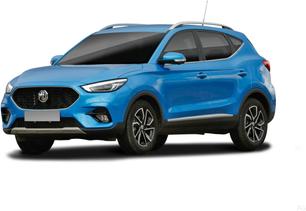
What's the difference?
The ZST is essentially an upgraded version of MG's popular small SUV, the ZS.
The ZST sees some tweaks to the overall design and some added standard safety features. So, if you like the original, there's a good chance you'll like the ZST and I've been driving the top-grade Essence variant with my family of three.
The ZST Essence has some stiff competition from similarly specified rivals like the GWM Haval Jolion Lux and Chery Omoda 5 EX offering affordable packages and similar driving experiences. So, what makes the ZST stand out?
The Mini Countryman is the not-so-mini cousin to the iconic and smaller Mini Cooper.
The new generation offers a larger body-size, fun new interiors and a whole suite of updated technology.
We're in the flagship John Cooper Works grade in Favoured trim to find out if this small SUV is still urban-friendly and fun after all of these changes.
Will the MG ZST Essence fit a small family? Absolutely, and all but the middle seat passenger will be comfortable but there are areas open for improvement. Like it's safety, laggy tech and adding a few extra items in the back seat.
Yet, it still offers a good host of features and an attractive package for a reasonable price tag. Unfortunately, my son missed having the basic amenities but did like the sun roof.
The new Mini Countryman John Cooper Works in Favoured trim offers everything you’d expect it to - the iconic Mini styling, a powerful driving performance and a well-equipped cabin. It’s a wonderfully quick urban dweller that you can park anywhere but is just as happy on the open-road. For me, this is pure fun and offers more personality than a lot of its rivals.
Being the newer and shinier version of the ZS, the ZST presents as a nice little package with its full suite of LED exterior lights, shiny chrome accents and its well-shaped body.
The front is distinctively different from its design muse with a darkened grille, and redesigned fog lights that feature new air intake vents. Other highlights include the 17-inch two-tone alloy wheels with sporty red brake calipers lurking behind them.
The interior is pleasant with a massive sunroof creating a light-filled space and giving the illusion that the cabin is larger than it is.
The synthetic leather upholstery and trims seem robust and perfect for families, but also feel quite plasticky under hand. The red badge embossing on the headrests is lovely, though.
The dashboard is well-proportioned and headlined by an upgraded 10.1-inch touchscreen multimedia system and fully digital instrument cluster.
The gearshift feels a tad too skinny and tall for the general aesthetic but the circular air-vents add some cute personality.
It's a case of the 'not-so-mini' when it comes to the new Countryman because it now stands at 4447mm in length, 1843mm in width and 1645mm in height. That's 170mm longer and 21mm wider than the previous generation!
But the Countryman still has all of the fun styling you’d expect in a Mini and it’s that iconic styling that sets this car apart from its rivals. It knows its fun and isn't afraid to show it.
Our Mini Countryman gets JCW badging across the body of the car, including its wheels but it's the chequered flag motif across the grille that reminds you what’s under the bonnet.
Unfortunately, our test model is finished in the rather boring 'Midnight Black II' but the range of colours and customisations available on the Countryman will help make it feel like your own.
Head inside and there's a hefty mix of materials in the cabin space. You’ve got a thick and rough-textured weave/knit across the dash, doors and tops of the sports seats but that’s then mixed with a black synthetic upholstery and plastics everywhere else.
The red stitching and accents won’t land with everyone but it certainly creates a fun atmosphere.
There are some lovely design highlights with rose gold metal accents in the door handles and air vents. A panoramic sunroof adds some much needed airiness and I adore the way you still get a ‘turn-key’ experience despite having keyless start with the starter knob.
The round media screen isn't as well-integrated as before but it looks gorgeous and the different drive modes give you a range of colours to further customise the cabin.
Practicality is hurt by a lack of individual storage options and a back seat that has only two USB-A ports for its amenities.
The cabin space is spacious, though, and both rows have a decent amount of leg- and headroom despite the massive sunroof.
The steering wheel features height but not reach adjustment and to accommodate I have to sit much closer to the wheel than normal thanks to my poor little T-Rex arms.
Individual storage is the best up front with a small middle console and glove box, two cupholders and two drink bottle holders. The doors also feature large storage bins, which is great to keep the cockpit feeling neat.
The rear row gets two map pockets and a small storage bin in each door. There is also a (very) shallow storage nook at the back of the middle console… think a packet of gum or small wallet size.
My seven-year old isn't as comfortable in the rear because it lacks directional air vents, reading lights and a fold-down armrest. All items which will hinder an adult's comfort, too.
The boot space is a good size at 359L but you can bump it to 1187L with the rear seats folded, the backrest featuring a 60/40 split.
The height of the floor is adjustable and when set in the lowest position creates a deep well to tuck larger items, like luggage, into.
The hard cargo cover can be awkward to shift around or store but is otherwise out of the way when it counts.
Other amenities accentuate the premium-feeling the Essence is going for with the heated front seats and electric drivers seat offering well-padded comfort but on longer journeys, I miss having adjustable lumbar support.
The rear seats aren't as comfortable as the front only because the synthetic leather feels slippery, which is accentuated when you hit corners!
In terms of technology, you get two USB-A ports in each row but the front also gets a 12-volt port. You miss out on fast and wireless charging options.
The multimedia system looks great but can be sluggish to respond and the apps can be slow to load but I like the built-in satellite navigation.
The upgraded sound system has six speakers instead of four but the sound quality is a bit tinny with music and calls.
It was simple to connect to the wired Apple CarPlay. It also has Android Auto, Bluetooth connectivity and AM/FM radio.
The cabin of the Mini Countryman doesn't feel like it belongs in a small SUV. The legroom is still best up front but the second row offers more than enough space for taller adults. It will be most comfortable for four rather than five adults, though.
The electric front seats have large side bolstering and decent padding but they are on the firmer side. You get a little bit of fatigue on a longer trip but around town they’re great and the massage function on the driver's seat is strong.
The rear seat is even firmer than the front and set like a stadium seat, so it won't be as comfy for adults on a longer trip. The fold-down armrest adds some bolstering.
While the storage looks a little odd at first, all of the cubbies are quite functional. There's a lot of them, too, and the dual shelves underneath the starter-knob are particularly handy for your larger 'small' items, like phones and sunnies case. This is where the wireless charging pad is, too.
The glove box can fit a manual and the little centre console is kind of adorable but still fit all of my keys and wallet.
The sliding armrest is a nice touch and there's a couple of USB-C ports underneath it. There are two large cupholders, two drink holders and small storage bins in the doors.
In the rear you get a drink bottle holder in each door, two map pockets, two USB-C ports and two cupholders.
The circular multimedia screen looks great and once you get used to how the menus are accessed and the little shortcuts, it’s a fairly simple system to use while on the go.
The touchscreen is fairly responsive but you'll need to do wide swipes across to switch the menu screens.
I’m not a massive fan of having to access a screen for most of your functions but do like the way climate control remains on the screen at all times and it's just the fan function that needs a couple of extra toggles.
The multimedia system is run by Android Automotive and has wired and wireless phone mirroring. The Apple CarPlay maintained a steady connection this week with my iPhone 15 Pro Max and the built-in sat nav is easy to use.
Rounding out the interior is the large 505L boot and if you want more storage options, the back row has a 40/20/40 split-fold.
The loading space has a small lip, and a handy storage compartment underneath the floor which holds the tyre repair kit and other items you don’t want rolling around. JCWs get a hands-free powered tailgate, which is always handy after a big shopping trip.
There are four variants for the ZST and our test vehicle is the top-spec Essence model, priced at $33,990 drive-away.
Our example's 'Pebble Black' finish is an included colour but other paintwork options can cost an extra $700.
The price point positions it right in the middle of its rivals with the Omoda 5 costing $35,990 drive-away and the Jolion sliding into the most affordable spot at $30,990 drive-away.
To highlight the value-for-money comparison, the Kia Seltos Sport+ FWD model costs $38,790 drive-away and then you start creeping up into the $40K bracket for similarly specified small SUVs.
The ZST Essence is the top-grade and it has a decent number of premium features for its price tag, like a panoramic sunroof, synthetic leather upholstery, heated front seats and an electric driver's seat, keyless entry, keyless start and a full suite of exterior LED lights.
Other standard features include wired Apple CarPlay and Android Auto, 10.1-inch touchscreen multimedia system, digital instrument cluster, one-zone air-conditioning, built-in satellite navigation, 360-degree camera system and an upgraded sound system with six speakers.
There are five versions of the new Mini Countryman, which includes a line-up of petrol and fully-electric powertrains.
For the petrol John Cooper Works (JCW), there are two trim levels available and our test model is the flagship Favoured variant. It's priced from $73,990, before on road costs, making it an affordable high-performance small SUV compared to its Euro rivals.
The third-gen Mini Countryman JCW is built alongside the BMW X1 and because they share the same platform and engine, it directly competes against the X1 M35i xDrive which is priced from $92,300 MSRP.
So, if its the impressive engine outputs you’re after our JCW Favoured is the better pick. The Audi RS Q3 2.5 TFSI quattro is even more expensive at $101,215 but it does have better engine outputs.
Surprisingly, the John Cooper Works Favoured doesn’t add all that much to the ‘base’ Classic trim but the additions include 20-inch alloy wheels with performance brakes (including red calipers) and six extra paintwork options. You also get electric front seats, with memory and massage functions for the driver.
JCW models come with keyless entry and start, heated front seats, a panoramic sunroof, adaptive cornering LED headlights, dual climate control, powered tailgate with kick-function, heated steering wheel and velour floor mats.
The technology includes a round 9.4-inch OLED multimedia screen, dash cam recorder, a premium Harman Kardon sound system, digital radio, a head-up display, 'Spike' Mini Assistant, an interior camera (you can take selfies!), augmented satellite navigation, wireless Apple CarPlay/Android Auto, a wireless charging pad, four USB-C ports and two 12-volt sockets.
While it's impressively more affordable than its peers, the JCW in Favoured trim misses out on a few top-grade features you'd expect at this level. Features like front seat ventilation and heated rear outboard seats or even a massage function on the front passenger seat.
The Essence variant has a 1.3-litre, three-cylinder turbo-petrol engine with a maximum power output of 115kW and 230Nm of torque.
It's a front-wheel drive and features a six-speed auto transmission. Overall, it has enough power to keep up with traffic on the open road but you have to be firm with the accelerator to keep your speed consistent.
The JCW Countryman is an all-wheel-drive with a seven-speed dual-clutch auto transmission. It has a 2.0-litre, four-cylinder, turbo-petrol engine that produces up to 233kW of power and 400Nm of torque. This model has a 0-100km/h sprint time of just 5.4-seconds!
There are eight drive 'experience' modes you can choose from, comprising 'Core', 'Green', 'Go Kart' (very fun), 'Personal', 'Timeless', 'Vivid', 'Balance' and 'Trail'.
The official combined cycle fuel figure is 7.3L/100km and my real-world average came in at 7.7L. That is after a good mix of urban and open-road driving, so the usage is good.
Based on the combined fuel cycle and the relatively small 45L fuel tank, expect a driving range of around 616km.
For a performance SUV, the JCW Favoured has a lowish official combined (urban/extra-urban) fuel cycle figure of just 7.7L/100km and a large 54L fuel tank, giving you a theoretical driving range of up to 701km, which isn’t bad for such a little go-getter.
After doing a few bigger road trips this week, plus a long weekend in the city, my real-world usage has popped out at 7.9L/100km, which is excellent but expect it to be higher if you only do city driving.
The ZST Essence has an okay amount of power relative to the car's small size.
It's an adequate cruiser when I ferry just my husband and son around, but feels a full load of luggage and people.
The steering is responsive and it's an easy car to manoeuvre in tight car parks or city streets, which is great. The visibility is pretty good despite the chunkier pillars and you feel confident when checking your blind-spots.
While the suspension is fairly forgiving and ride comfort is decent, you will still notice the bumps, especially when seated in the back.
The cabin suffers from some wind and road noise and at higher speeds we had to find we raise our voices a bit to be heard. Around town, you don't notice it.
This is just a personal preference but the brake and accelerator pedals are skinnier and more centrally positioned than I prefer. You get used to it, though.
The ZST is pretty easy to park and it's great that you have a 360-degree camera system but the image quality can be grainy. You get rear parking sensors, too, but miss out on ones at the front.
Even if you don’t love the design, the power and performance of the turbo-petrol engine will win you over. It’s just pure unadulterated fun on the open road and in the city. You get a total hot-hatch experience, despite the Countryman being an SUV.
The adaptive suspension feels a little stiff when you’re going over uneven road surfaces at higher speeds and road noise also creeps in, but around town this is a comfortable ride.
Visibility is great, even in heavy rain with a child's car seat installed in the rear (we had a mix of weather on test). Thanks in no small part to the all-wheel drive system it felt sure-footed in the wet and I felt confident this car would do everything I asked of it.
The firm steering makes for a nimble on-road experience no matter the situation and you have gear-shifting paddles on the steering wheel.
There’s also a 'Boost' mode that wrangles the top performance out of the suspension, steering and engine for when you want more control.
You can park the Countryman just about anywhere and the 360-degree camera view system is excellent quality. It’s easy to park, even in small, tight car parks.
The ZST Essence has a good suite of safety features that now come standard like rear cross-traffic alert and blind-spot monitoring.
Other standard features include tyre pressure monitoring, LED daytime running lights, forward collision warning, lane departure alert, adaptive cruise control, seatbelt reminders, a 360-degree camera system and rear parking sensors.
The ZST only features six airbags, while many of its rivals sport seven, including the newer front centre airbag. The ZST variant scored four- from a possible five-star ANCAP safety rating in 2017 testing.
It's important to note that the tested ZS model did not have AEB or lane support systems at the time of testing, these were introduced from the 2020 model year onwards and the ZST has both.
There are ISOFIX child seat mounts on the rear outboard seats and three top tether anchor points but two child seats will fit best. There is enough room for front occupants when a 0-4 rearward facing child seat is installed.
The new Mini Countryman hasn’t been assessed by ANCAP but features a healthy list of crash-avoidance safety features and has nine airbags, including a front centre bag.
Standard safety equipment includes driver monitoring, rear cross-traffic alert, AEB, 'Cornering Brake Control', blind-spot monitoring, emergency e-call, lane keeping aid, lane departure warning, side exit assist, a dash cam recorder, tyre pressure monitoring, 360-degree view camera system plus front and rear parking sensors.
The adaptive cruise control is also well-tuned and one of the better systems I’ve sampled recently.
The rear seat has two ISOFIX child seat mounts and three top tether anchor points but two seats will fit best.
The ZST Essence comes with a seven-year/unlimited km warranty, which is on par with coverage offered by a growing number of its rivals.
There is a seven-year or up to 70,000km servicing program for a total cost of $2339 or an average of $334 per service, which is very competitive for the class.
Servicing intervals are at every 12 months or 10,000km, whichever occurs first, but could be annoying if you travel a lot.
The Countryman is offered with a five-year/unlimited km warranty which is pretty standard fare for a Euro model. You can pre-purchase a five year or up to 80,000km servicing plan for $2250, which is very competitive for the class.
Servicing intervals are condition based, so your Mini will tell you when it needs to visit the workshop.