What's the difference?
The ZST is essentially an upgraded version of MG's popular small SUV, the ZS.
The ZST sees some tweaks to the overall design and some added standard safety features. So, if you like the original, there's a good chance you'll like the ZST and I've been driving the top-grade Essence variant with my family of three.
The ZST Essence has some stiff competition from similarly specified rivals like the GWM Haval Jolion Lux and Chery Omoda 5 EX offering affordable packages and similar driving experiences. So, what makes the ZST stand out?
Not content with being China’s biggest auto brand, Haval is trying to win Australia over and is now throwing everything it’s got at us in the form of its H9 flagship SUV.
Think of the H9 as an alternative to seven-seat off-roaders such as the SsangYong Rexton or Mitsubishi Pajero Sport and you’re on the right track.
We tested the top-grade Ultra in the H9 range when it came to live with my family for a week.
Will the MG ZST Essence fit a small family? Absolutely, and all but the middle seat passenger will be comfortable but there are areas open for improvement. Like it's safety, laggy tech and adding a few extra items in the back seat.
Yet, it still offers a good host of features and an attractive package for a reasonable price tag. Unfortunately, my son missed having the basic amenities but did like the sun roof.
There's a lot to like about the Havel H9 - it's great value, practical and spacious, packed with advanced safety tech, and also darn good looking. More comfortable seats would be an improvement and so would a better feel to the cabin materials and switchgear.
As for the H9's on-road performance - the 2.0-litre engine isn't the most responsive and the ladder frame chassis limits its dynamics.
So, unless you need an off-road SUV the H9 is borderline overkill in the city, where you could step into something without four-wheel drive and with more car-like comfort and handling.
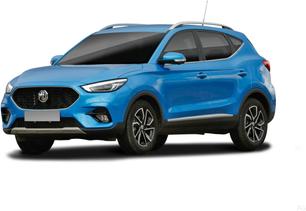
Being the newer and shinier version of the ZS, the ZST presents as a nice little package with its full suite of LED exterior lights, shiny chrome accents and its well-shaped body.
The front is distinctively different from its design muse with a darkened grille, and redesigned fog lights that feature new air intake vents. Other highlights include the 17-inch two-tone alloy wheels with sporty red brake calipers lurking behind them.
The interior is pleasant with a massive sunroof creating a light-filled space and giving the illusion that the cabin is larger than it is.
The synthetic leather upholstery and trims seem robust and perfect for families, but also feel quite plasticky under hand. The red badge embossing on the headrests is lovely, though.
The dashboard is well-proportioned and headlined by an upgraded 10.1-inch touchscreen multimedia system and fully digital instrument cluster.
The gearshift feels a tad too skinny and tall for the general aesthetic but the circular air-vents add some cute personality.
The Haval H9 Ultra's design is not pioneering any new style standards but it’s a good looking beast and far more handsome than those rivals I’ve mentioned above.
I like the gigantic grille and chunky front bumper, the tall, flat roofline and even those tall tail-lights. I also like the fact the red background of the Haval badge hasn't been kept in this update.
There are some nice touches you won’t find on rivals at this price such as the puddle lamps which burn a laser projected ‘Haval’ into the footpath.
Okay, it’s not burnt into the ground, but it’s intense. There are also the illuminated door sills. Small things that make the experience a bit special and match the tough but premium exterior looks – like its insides.
The cabin looks plush and high-end from the floor mats to the panoramic sunroof, but some elements lack a high-quality feel such as the shifter and switchgear for the windows and climate control.
Haval has obviously worked hard to get the look right, now it would be good to see if the touch and feel points can also be bettered.
The H9 is the king of the Haval line-up and it’s also the biggest at 4856mm long, 1926mm wide and 1900mm tall.
Practicality is hurt by a lack of individual storage options and a back seat that has only two USB-A ports for its amenities.
The cabin space is spacious, though, and both rows have a decent amount of leg- and headroom despite the massive sunroof.
The steering wheel features height but not reach adjustment and to accommodate I have to sit much closer to the wheel than normal thanks to my poor little T-Rex arms.
Individual storage is the best up front with a small middle console and glove box, two cupholders and two drink bottle holders. The doors also feature large storage bins, which is great to keep the cockpit feeling neat.
The rear row gets two map pockets and a small storage bin in each door. There is also a (very) shallow storage nook at the back of the middle console… think a packet of gum or small wallet size.
My seven-year old isn't as comfortable in the rear because it lacks directional air vents, reading lights and a fold-down armrest. All items which will hinder an adult's comfort, too.
The boot space is a good size at 359L but you can bump it to 1187L with the rear seats folded, the backrest featuring a 60/40 split.
The height of the floor is adjustable and when set in the lowest position creates a deep well to tuck larger items, like luggage, into.
The hard cargo cover can be awkward to shift around or store but is otherwise out of the way when it counts.
Other amenities accentuate the premium-feeling the Essence is going for with the heated front seats and electric drivers seat offering well-padded comfort but on longer journeys, I miss having adjustable lumbar support.
The rear seats aren't as comfortable as the front only because the synthetic leather feels slippery, which is accentuated when you hit corners!
In terms of technology, you get two USB-A ports in each row but the front also gets a 12-volt port. You miss out on fast and wireless charging options.
The multimedia system looks great but can be sluggish to respond and the apps can be slow to load but I like the built-in satellite navigation.
The upgraded sound system has six speakers instead of four but the sound quality is a bit tinny with music and calls.
It was simple to connect to the wired Apple CarPlay. It also has Android Auto, Bluetooth connectivity and AM/FM radio.
The Haval H9 Ultra is super practical and that's not just because it's big. There are larger SUVs with far less practicality. It's the way the Haval H9 is packaged that's impressive.
For starters, I can sit in all three rows without my knees touching the seatbacks, and I'm 191cm tall. Headroom is getting tighter in the third row, but that's normal in a seven-seat SUV and there's more than enough space for my noggin when in the pilot's seat and middle row.
Cabin storage is great with six cupholders on board (two up front, two in the middle row and two for the back seats). There's a large bin under the centre console armrest up front and more hidey holes around the gear shifter, a flip-out tray for those in the second row and big bottle holders in the doors.
Entry and exit to the second row is made easy thanks to the wide-opening, tall doors and my four-year old son could climb into his seat by himself thanks to the rugged and grippy side steps.
Third-row seats are powered to lower and raise them into position, too.
There are air vents for all three rows, and controls for the climate in the second row.
Cargo storage is also impressive. With all three rows of seats in place there's enough room in the boot for a few small bags, but fold the third row down and you'll be given much more space.
We picked up a 3.0-metre long roll of synthetic turf and it fit in easily with the right side second-row seat folded, still leaving us with plenty of room for our son to sit in his child seat on the left.
Now the drawbacks. Access to the third row is affected by the 60/40 split of the second row with the larger folding section being on the road side.
Also the side-hinged tailgate makes it impossible to fully open if somebody parks too close behind you.
And there's a lack of charging points on board - with only one USB port and no wireless charging pad.
There are four variants for the ZST and our test vehicle is the top-spec Essence model, priced at $33,990 drive-away.
Our example's 'Pebble Black' finish is an included colour but other paintwork options can cost an extra $700.
The price point positions it right in the middle of its rivals with the Omoda 5 costing $35,990 drive-away and the Jolion sliding into the most affordable spot at $30,990 drive-away.
To highlight the value-for-money comparison, the Kia Seltos Sport+ FWD model costs $38,790 drive-away and then you start creeping up into the $40K bracket for similarly specified small SUVs.
The ZST Essence is the top-grade and it has a decent number of premium features for its price tag, like a panoramic sunroof, synthetic leather upholstery, heated front seats and an electric driver's seat, keyless entry, keyless start and a full suite of exterior LED lights.
Other standard features include wired Apple CarPlay and Android Auto, 10.1-inch touchscreen multimedia system, digital instrument cluster, one-zone air-conditioning, built-in satellite navigation, 360-degree camera system and an upgraded sound system with six speakers.
The Ultra is the top grade in the Haval H9 line-up and lists for $44,990, before on-road costs.
At the time of writing you could have the H9 for $45,990 drive-away, and depending on when you’re reading this that offer may still be in place, so check with the dealer.
As a point of reference, the Lux is the base grade H9 and lists for $40,990 before on-road costs.
Coming standard in the H9 is an 8.0-inch screen, ‘eco-leather’ seats, nine-speaker Infinity sound system, rear privacy glass, xenon headlights, laser puddle lights, proximity unlocking, three-zone climate control, heated and ventilated front seats (with massage function), heated second row seats, panoramic sunroof, illuminated scuff plates, aluminium pedals, matt alloy roof rails, side steps and 18-inch alloys.
That’s a stack of standard features for this price, but you’re not getting a whole lot more by going for the Ultra compared to the Lux.
Really, it comes down to brighter headlights, heated second row seats, power front seats and a better stereo. My advice is if the Ultra is too expensive, fear not because the Lux is extremely well kitted out.
Rivals to the Haval H9 Ultra include the SsangYong Rexton ELX, Toyota Fortuner GX, Mitsubishi Pajero Sport GLX or Isuzu MU-X LS-M. All list for around that $45K mark.
The Essence variant has a 1.3-litre, three-cylinder turbo-petrol engine with a maximum power output of 115kW and 230Nm of torque.
It's a front-wheel drive and features a six-speed auto transmission. Overall, it has enough power to keep up with traffic on the open road but you have to be firm with the accelerator to keep your speed consistent.
The Haval H9 Ultra is powered by a 2.0-litre turbo-petrol four-cylinder engine making 180kW/350Nm. That's the only engine in the line-up and if you're wondering why a diesel isn't offered, then you're not the only one.
If you're asking where the diesel is you're probably wondering how much petrol the H9 uses, and I have the answers for you under the next heading.
Shifting gears smoothly is an eight-speed automatic transmission from ZF, the same company chosen by brands such as Jaguar Land Rover and BMW.
The H9's ladder frame chassis and four-wheel drive system (with low range) are the right ingredients for a capable off-roader. During my time with the H9, however, I stayed on the bitumen.
The H9 comes with selectable drive modes including 'Sport', 'Sand', 'Snow' and 'Mud'. There's a hill descent feature, too.
The braked towing capacity of the H9 is 2500kg and Haval says the maximum fording depth is 700mm.
The official combined cycle fuel figure is 7.3L/100km and my real-world average came in at 7.7L. That is after a good mix of urban and open-road driving, so the usage is good.
Based on the combined fuel cycle and the relatively small 45L fuel tank, expect a driving range of around 616km.
I travelled 171.5km in the H9 but in my 55km loop of motorways and urban roads I used 6.22 litres of petrol, which comes to 11.3L/100km (the on-board read-out said 11.1L/100km).
That's not terrible for a seven-seat SUV. Admittedly, I was the only person on board and the vehicle wasn't loaded up. You can expect that fuel figure to rise with more cargo and people piling in.
The official combined cycle fuel consumption claim for the H9 is 10.9L/100km, while the tank has an 80-litre capacity.
A pleasant surprise is that the H9 has a fuel-saving stop-start system, but a not-so pleasant surprise is that it needs to be fed a minimum of 95 RON premium fuel.
The ZST Essence has an okay amount of power relative to the car's small size.
It's an adequate cruiser when I ferry just my husband and son around, but feels a full load of luggage and people.
The steering is responsive and it's an easy car to manoeuvre in tight car parks or city streets, which is great. The visibility is pretty good despite the chunkier pillars and you feel confident when checking your blind-spots.
While the suspension is fairly forgiving and ride comfort is decent, you will still notice the bumps, especially when seated in the back.
The cabin suffers from some wind and road noise and at higher speeds we had to find we raise our voices a bit to be heard. Around town, you don't notice it.
This is just a personal preference but the brake and accelerator pedals are skinnier and more centrally positioned than I prefer. You get used to it, though.
The ZST is pretty easy to park and it's great that you have a 360-degree camera system but the image quality can be grainy. You get rear parking sensors, too, but miss out on ones at the front.
The H9's ladder frame chassis will work to its advantage off the road, providing good rigidity, but as with any body-on-frame vehicle on-road dynamics aren't going to be its forte.
So, the ride is soft and comfortable (the rear multi-link suspension set up would be a major part of that) the overall driving experience can be a little agricultural. These aren't show-stopping issues, and you'll find the same in a Mitsubishi Pajero Sport or Isuzu MU-X.
More disappointing are the things Haval could easily fix. The seats are flat and not the most comfortable, the steering is a little slow, and that engine has to work hard and isn't particularly responsive.
There are also some strange quirks, too. The altimeter read-out said I was at 8180m driving through Marrickville in Sydney (Everest is 8848m) and the auto parking system is more of a guide which tells you how to park rather than doing it for you.
Imagine being 16 again and being coached by your mum or dad and you've got the idea.
That said the H9 handled life with my family without breaking a sweat. It's easy to drive, with good visibility, great insulation from the outside world and excellent headlights (the Ultra gets the brighter 35-watt xenons).
So while it's not the most adept and comfortable car on the road, I feel the H9 could be better suited to off-roading adventures. As I mentioned earlier, I only tested it's on-road performance, but keep an eye out for any future off-road tests we do with the H9.
The ZST Essence has a good suite of safety features that now come standard like rear cross-traffic alert and blind-spot monitoring.
Other standard features include tyre pressure monitoring, LED daytime running lights, forward collision warning, lane departure alert, adaptive cruise control, seatbelt reminders, a 360-degree camera system and rear parking sensors.
The ZST only features six airbags, while many of its rivals sport seven, including the newer front centre airbag. The ZST variant scored four- from a possible five-star ANCAP safety rating in 2017 testing.
It's important to note that the tested ZS model did not have AEB or lane support systems at the time of testing, these were introduced from the 2020 model year onwards and the ZST has both.
There are ISOFIX child seat mounts on the rear outboard seats and three top tether anchor points but two child seats will fit best. There is enough room for front occupants when a 0-4 rearward facing child seat is installed.
When the Haval H9 was tested by ANCAP in 2015 it received a four-star rating from a possible five. In 2018 Haval updated the safety tech on board and all H9s now come standard with lane departure warning, rear cross-traffic alert, lane changing assist, AEB and adaptive cruise control.
It's great to see that this equipment has been added, although the H9 has not yet been re-tested and we're yet to see how it would score with the updated tech.
Also coming standard are front and rear parking sensors.
For child seats you'll find three top tether points and two ISOFIX mounts in the second row.
A full-sized alloy wheel is located under the car - as you can see in the images.
The ZST Essence comes with a seven-year/unlimited km warranty, which is on par with coverage offered by a growing number of its rivals.
There is a seven-year or up to 70,000km servicing program for a total cost of $2339 or an average of $334 per service, which is very competitive for the class.
Servicing intervals are at every 12 months or 10,000km, whichever occurs first, but could be annoying if you travel a lot.
The Haval H9 is covered by a seven-year/unlimited-kilometre warranty. Servicing is recommended at six month/10,000km intervals.