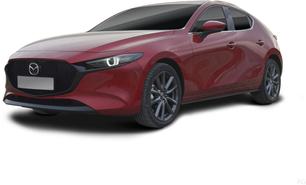
What's the difference?
Half a decade on, the current-generation Mazda 3 has weathered a world of change.
Cheap cars have vanished. Electric vehicles are commonplace and the small car class it belongs to has been decimated by SUVs. Big names like the Ford Focus, Holden Astra and Mitsubishi Lancer are history.
But while it looks identical to the car unveiled at the 2018 LA Auto Show, today’s Mazda 3 has also evolved, albeit gently.
Let’s see how competitive the latest and improved (as well as more expensive) version is.
Renault chairman and CEO Carlos Ghosn may look like a Bond villain, but rather than threatening to end the world he's intent on saving it.
In October last year he launched Groupe Renault's 'Drive the Future 2022' strategic plan, which included a commitment to "eight pure electric and 12 electrified models as part of the [Renault] range" within five years.
But he didn't mention the head start, because Renault already had several pure electric vehicles in its line-up at that point, including the subject of this review.
In fact, the Renault Zoe has been on sale in France since 2012, and stands as Europe's best-selling electric vehicle.
In late 2017, Renault Australia dipped its toe in the electrified waters (risky...) by bringing the Zoe here within a "business-to-business and business-to-government framework."
And in July this year, due to allegedly popular demand, it was made available to private buyers through "selected dealerships"; currently two in Melbourne, and one each in Sydney, Adelaide, Perth and Brisbane.
Just under $50,000 for a city-sized hatch is hardly cheap, but it's entry-level territory for electric vehicles in this market. And what price can you put on helping to save civilisation as we know it?
Let's find out.
Given how effortlessly it traverses the mainstream and premium small car classes, the Mazda 3 might be the best value small car on the planet.
With racy styling, sports car handling, classy interior presentation and impressive, intelligent efficiency, there’s plenty to sink your teeth into here.
Poor rear vision, a dark back-seat area and smallish boot aside, it doesn’t have any glaring faults.
In a world overrun with SUVs, props to Mazda for evolving the small car so brilliantly to mask a half-decade of existence. Continuous improvements have made the 2024 G25 Evolve SP Vision an essential small car shortlist proposition, regardless of price.
The Renault Zoe is a fun to drive, ultra-efficient, practical little hatch. But the dollar-shaped elephant in the room is its price. Without the government ZEV subsidies offered in other markets, it's wickedly expensive, and with fresh competition in the shape of a new 'normalised' Nissan Leaf coming soon it'll have to work hard to wean more than a handful of small-car buyers off their fossil-fuel addiction.
How is it that the current Mazda 3 is already five years old? This hatchback is still stunning, the sort of car you look back at when walking away.
The shape is sleek and almost coupe-like, with a shark-like nose, cab-backward-style long bonnet, upswept shoulder line and a fastback silhouette.
More importantly, it’s the way the light dances across the sculptured sides that draw the eyes in. Bereft of clutter, it makes you wish all mainstream manufacturers had the courage to be so daring.
We’ve said it before – the 'BP'-generation Mazda 3 (Axela in Japan) is the brand’s boldest C-segment hatch since the 1993 'BA' 323 (Astina/Lantis/323F).
But there’s a price to pay for such timeless beauty…
Renault claims no less than 60 patents came out of the Zoe's development, but while BMW's i3 is as hip as Kendrick Lamar on his third encore, and even Toyota's long-serving Prius hybrid still looks ready to roll onto the set of the next Avengers movie, this little hatch isn't shouty at all.
It seamlessly merges into the automotive landscape. A cute, small car with a few flashy blue bits in its head and tail-lights giving the only clue to its distinctly unusual internals.
Underpinned by the same platform as the Clio (with an identical wheelbase) the Zoe is slightly longer (+21mm), fractionally thinner (-2mm) and quite a bit taller (+114mm) than its conventionally powered sibling.
Lead exterior designer Jean Sémériva has literally left his mark on the car, with a full-size thumb print applied in low-relief to the rear door handles. Nice touch.
And monsieur Sémériva has shown admirable restraint in a cool design combining soft curves around the nose, front guards and rear end, with sharp character lines top and tailing the car's flanks.
Vaguely diamond-shaped tail-lights mix a clear lens cover with those nifty blue highlights and brilliant LEDs for an arresting brake and indicator display.
Open the door and a similar blend of tech and tradition creates a clean and simple interior, with strategically placed bright-metal finishes highlighting key elements.
A broad TFT digital instrument screen sits under a minimalist hood, with the 7.0-inch 'R-Link' multimedia screen dominating a central stack lifted by a shiny black face and an illuminated blue keyline around the heating and ventilation controls.
A printed circuit pictogram on the front headrests and left-hand side of the dash is a creative reminder of the Zoe's means of propulsion. And the front seats feature a decorative curved panel, defined by dark piping on each side of the backrest.
Tech highlights include the TomTom Live nav system's ability to describe a circle showing the car's operational radius on current charge, determining whether you can reach a nominated destination. It also taps you into weather updates, traffic danger zones and Renault Assistance.
Plus, the drive-management system can report on energy usage and assess driving behaviour, so lead foots have nowhere to hide.
There is a price to pay for all this quasi-coupe styling flair, and that’s a comparatively snug-feeling interior, though you’d never call it cramped.
Actually, the Mazda 3 is no less spacious than most of its competition in all but one area, with enough room even for 200cm drivers, along with sufficient shoulder width and ceiling height to match.
If you’re really tall, maybe that missing sunroof isn’t such a bad thing, after all.
Sat so low-down on cushy, enveloping front seats that offer plenty of comfort and support, this is the anti-SUV. Maybe Mazda should have called this the MX-3.
Sporty and spot-on, the driving position is a laid-back affair, with an emphasis on better ergonomics, as emphasised by the thoughtful placement of switchgear that’s all within easy reach, ahead of a beautifully flowing and layered dash. Proudly Japanese in flavour, it brings to mind functional minimalism.
Drilling into some of the 3’s finer interior details, the analogue-look digital instrumentation is super-legible, ultra-classy and gorgeously lit at night. As previously mentioned, the dials and surrounding air vents are reminiscent of the later Porsche 944 and 968.
It’s not just all for the sake of aesthetics, either.
Yes, it’s lovely, but the thinned-rim three-spoke steering wheel feels great to grip, with nifty little paddle shifters that are a delight to prod.
Same goes for the physical volume knob and climate-control buttons, sidestepping the need to get distracted and frustrated by virtual sub-menus.
And having a conventional gear lever with old-school Tiptronic-style shifts suits the 3’s athletic vibe.
Plus, forward vision is A-OK, ventilation is faultless, storage is better than you might expect, and the fit and finish is as good if not better than any of this 3’s German premium opponents.
Out back, the split-fold rear backrest is set at a comfortable angle, the cushion is well padded, and you’re provided with USB ports, air vents, and an armrest with two cupholders. More thoughtfulness.
But while knee room is fair, rear headroom isn’t great if you’re tall or wear a beehive, as the falling ceiling line reveals.
Vision out is limited by that rising window line and fat pillars. Getting in and out of the back requires some contortionist moves. And the small windows mean it can be gloomier in the back than a Smiths album.
Finally, at just 295 litres, the 3’s cargo capacity is disappointing. Sure, it eclipses the Corolla hatch’s 217L cubby, but other rivals are far larger back there.
At least the floor is wide and flat and there are 60/40-split backrests for cabin access for longer items.
Note that a space-saver spare wheel lurks underneath. Mazda argues there’s always the closely-related CX-30 if you need (slightly) more space (317L).
Meanwhile, at the other end of the 3…
Like most compact hatches the Zoe offers plenty of space up front and gets a bit squeezy in the back. Although the first surprise is that there's no height adjustment for either front seat.
Happily that wasn't a big issue. At 183cm I was still able to find a good driving position, with storage running to two cupholders (one small, one laughably tiny), plus a pen slot and two oddments trays in the centre console. The second of those trays houses a 12-volt outlet, SD card slot, 'aux-in' jack and USB port.
There are small bottleholders and storage pockets in each front door, a medium-size (7.0-litre) glove box with an open tray above it, and a small tray on the lower part of the dash on the driver's side.
Rear head and legroom is passable for a car of this size, but storage is limited to modest door bins and a single cupholder at the back of the centre console.
However, it's cargo space where the Zoe really raises eyebrows, with 338 litres available (to the parcel shelf) with the single piece rear seatback (as in, it doesn't split-fold) upright.
That's enough to easily swallow our three-piece hard suitcase set (35, 68 and 105 litres), or the CarsGuide pram. In fact, we were able to fit the largest suitcase and the pram at the same time, which is mighty impressive for a city-sized hatch. Push the rear seat flat and space grows to 1225 litres (to the roof), which is heaps.
Carpeting for the boot has been sourced from the cheap 'n' cheerful bin, but there are D-shaped anchor shackles, decent lighting and handy bag hooks back there.
The boot's unlikely volume is partly due to the absence of a spare of any description, a repair/inflator kit being your only option. And in case you were wondering, towing is "prohibited" (Renault's word, not mine).
Mazda has rationalised the MY24 3 range, with fewer grades and no more manuals, sadly.
The pretty little piece of automotive industrial design you see here is the mid-range Evolve SP Vision, which sounds less like a car and more like a posh hairdryer from Vidal Sassoon.
Priced from $36,520 before on-road costs (or about $41K drive-away before you start haggling), this Mazda 3 is a sporty and well-equipped alternative to the likes of the speedy Hyundai i30 N-Line Premium, spacious Kia Cerato GT Turbo, new Subaru Impreza AWD 2.0R and evergreen Toyota Corolla ZR. All cost roughly the same money.
The thing is, do Mazda’s upmarket aspirations mean the 3 possesses the ride quality and chic to embarrass at times substantially more expensive hatchbacks with premium pretensions? We’re talking rivals like the BMW 1 Series, Mercedes-Benz A-Class, Peugeot 308 and VW Golf, here.
Stay with us, because we reckon you might be surprised by how far the 3 has come since its humble 323 predecessors.
Anyway, this version comes with most of the good gear, including a full suite of driver-assist safety tech like front and rear Autonomous Emergency Braking (AEB), blind-spot alert, lane-keep assist and adaptive cruise control, as well as keyless start and walk-away lock, powered driver’s seat with memory, 360-degree camera views, a head-up display, digital radio, sat-nav, auto tilt/folding exterior mirrors, dual-zone climate control, Bluetooth phone/audio connectivity and 18-inch alloys.
Oh, and for 2023, an upgraded version introduces a smartphone charger and wireless for the Apple CarPlay/Android Auto function, along with USB-C port access front and rear.
What’s missing at the Evolve SP Vision’s price point? Some mainstream rivals offer leather and a sunroof, available respectively in the more-expensive GT Vision, from $40,000, and flagship Astina grades, from nearly $42,500.
Still, that’s quite a lot of small car for the money, given the quality of the presentation and design. Speaking of which…
Built at Renault's Flins plant, 40km west of Paris, on the same line as the Clio, the Zoe's offered in two grades; Life ($47,490, before on-road costs), and Intens ($49,490 BOC) as tested here.
That's big bucks for a little car. At just under $50,000 you're looking at internal-combustion competitors like the Audi A3, BMW 1 Series, and Merc A-Class. And while the Zoe's a long way from spartan, it's an equal distance away from luxurious.
That said, the standard features list includes, climate control (with remote 'pre conditioning' activation), 16-inch 'Black Shadow' alloy rims, cruise control, 3D Arkamys audio (with DAB radio, voice recognition, two 'boomer' speakers, two rear bi-cone speakers, and two tweeters), 'Renault Smartkey' keyless entry and start, auto headlights, and rain-sensing wipers.
Plus, you also get rear parking sensors, a reversing camera, the 7.0-inch 'R-Link' multimedia system (with 'Text to Speech' function), one-touch driver's window (the base Life grade misses this), a leather-trimmed steering wheel and gear knob plus black and grey cloth trim (with snazzy contrast stitching).
The DRLs may be LED but the headlights are halogen (a sure sign of this car's age), Apple CarPlay and Android Auto are MIA, and metallic paint, as per 'our' car's 'Zircon Blue' finish is $550 extra. 'Glacier White' is the only no-cost option from six available shades.
When you think about it, shoehorning a big torquey engine in a light and agile small car is a recipe for fun. Ford did just that with the Escort RS2000 in the 1970s… and Mazda’s now an expert at it, too.
The engine in question is the G25, a 2.5-litre four-cylinder naturally aspirated twin-cam petrol engine, delivering 139kW of power at 6000rpm and 252Nm of torque at 4000rpm.
As this Evolve SP Vision hatch tips the scales at 1415kg, it makes for a healthy, and consequently very lively, power-to-weight ratio of over 98kW/tonne.
That’s if you decide to use all the available revs, which the six-speed torque-converter auto makes great use of.
Driving the front wheels, it offers a 'Sport' mode to extend the revs even more, which is keeping in line with this Mazda’s sporty character.
Less so is the company’s decision to ditch the old multi-link independent rear suspension system a few years back for a more prosaic torsion beam arrangement. We’ll get to how that affects ride and handling in a moment.
The Zoe is powered by Renault's R90 synchronous electric motor, producing 68kW from 3000-5000rpm and 225Nm from step-off. Drive goes to the front wheels through a single reduction gear auto transmission.
Claimed acceleration for the city-specific 0-50km/h run is a handy 4.0sec, with the more grown-up 0-100km/h sprint taking a leisurely 13.2sec. Flat biscuit is 135km/h.
Mazda claims the G25 averages 6.6L/100km on the combined cycle… for a carbon-dioxide emissions rating of 154g/km. On a 51L tank, that gives a potential distance of over 940km!
Driven good and hard in our hands, we managed 7.5L/100km, which isn’t bad given the speed and conditions it was subjected to.
Plus, the Mazda’s happy on 91 RON 'standard' unleaded petrol.
None. Next question...
You can have the argument about fuel consumed and source emissions produced in generating the energy required to charge the Zoe's battery, but the fact is this car doesn't consume any fossil fuel and produces zero tailpipe emissions. Helped by the fact it doesn't have a tailpipe.
When launched in 2016, the Zoe's upgraded 41kWh 'Z.E. 40' high-energy lithium-ion battery ranked as the highest energy density automotive unit available.
Developed in collaboration with LG Chem in South Korea, it houses 12 modules (of 16 cells each) for a total of 912 individual cells and weighs in at 305kg.
Renault lists a driving range of 403km for the New European Driving Cycle (NEDC), with a real-world number of 300km a more realistic estimate. And that's almost exactly the range we achieved over a mix of city, suburban and freeway running in seven days with the car. Using overnight electricity rates, a full charge should average less than $8.00.
The Zoe's on-board 'Chameleon' charger allows it to be charged using different power levels (single or three-phase) through the same socket, from 3kW up to 22kW. A Type 2 charging cable (6.5m) for wall box and public charging points (in a natty canvas Z.E. bag) is included with the car.
According to Renault, a wall-box charger (not included with the car) is typically $1600 to $2000 for a residential installation and a mid-range 11kW unit will allow you to charge up in around four hours. High-powered 'Fast' and even juicier 'Rapid' charging points would reduce that time appreciably.
The dash indicator displays charge level and remaining range calculated over the last 200km of driving. A reset function can drop that to an average of the last 30km.
We'll touch on it further in the Driving section but regenerative braking, low-rolling resistance tyres, and 'Eco' mode (reducing air-con load and motor output) are big contributors to maximum range.
And while cabin cooling comes courtesy of a conventional a/c unit, heating is far more exotic. The Zoe's 'Heat Pump' system traps calories in the ambient air outside the car, with a pump compressing and heating them, then directing the heated air into the car, with no impact on range. Super clever.
Ask yourself. What do you want from a new small car?
Since the first Familia of the early 1960s, Mazda’s been at it constantly, through the 1300 and 323 eras and into the modern age of the 3.
The Hiroshima brand knows its stuff. Space, practicality, comfort, ease, reliability and affordability. But a small car has to offer more, specifically in the way it makes the owner feel.
That’s why, while the Focuses, Lancers, Astras and Pulsars are gone, the 3’s still here. And it isn’t just the lush visuals inside and out that are, well, sensory-rich.
As older Alfa Romeo owners know, there’s something special about an engine that sounds alive, and the moment you push the 3’s starter, it purrs into life. That’s the first clue.
Slot the refreshingly old-school lever into Drive, and the G25 leaps into action, and, if you need it to, will keep pulling forward strongly, engine buzzing, like it’s on a mission.
That describes the torquey urge of this big 2.5L four, paired perfectly with the sensibly-geared auto.
We miss Mazda’s magnificent manual immensely, but the 3’s instant response reflects its favourable circa-100kW/tonne power-to-weight ratio.
And, as we’ve harped on in the past, the twin-cam unit’s extra oomph beyond 4000rpm delivers muscular high-speed responses akin to a good turbo – or a great old-school Alfa. You can keep your laggy dual-clutch transmissions, Europe.
Now, sweet, smooth and speedy performance is one thing, but having the chassis tuned with precise and fluid steering for tactile handling, and confident roadholding, backed by nuanced driver-assist and traction controls, are another.
There is a consistent and unifying control to the 3’s linear and forgiving dynamics, reminiscent of past masters like the Focus (and today’s brilliant Peugeot 308) that makes it a joy to drive enthusiastically through fast corners, with the knowledge that it won’t suddenly snap-oversteer and bite an unalert driver back.
For a Mazda, the ride is quiet enough, but there is still some droning transmitted through the cabin, via the Bridgestone Turanza (215/45) tyres, on coarse-chip bitumen surfaces.
And while suspension comfort is pretty impressive for the most part, larger bumps reveal the torsion beam’s limitations, as the car can occasionally thud over them in a way that we remember the multi-link rear end wouldn’t.
Anyway, what we’re saying is that, overall, the 3 Evolve SP Vision is an immersive and interactive driving experience that is right up there with the best of them.
Brawny performance, exquisite agility and a refinement that, collectively, have eluded every small Mazda in living memory until this generation’s 2019 debut. This 3’s right on the money. Still.
Some believe cars have a soul, but the Renault Zoe expresses its feelings with a distinctive accent, the car's 'Z.E. Voice' function giving an audible warning to pedestrians up to 30km/h (when wind and tyre noise take over).
The whirring hum sounds like The Beach Boys warming up the theremin for a rendition of 'Good Vibrations'. Spooky and fun in equal measure.
Like all electric cars the Renault Zoe accelerates quickly from rest, thanks to the motor's ability to deliver maximum torque (225kW) from step off.
At 1480kg (battery 305kg) the Zoe is 177kg lighter than an equivalent Clio, so it's snappy in its natural city habitat, but thrust begins to taper off markedly around the 55-60km/h mark.
The single-speed, reduction gear automatic transmission combines with the motor's sewing-machine smoothness to provide close to perfect drive delivery.
Sitting on the same 'B platform' as the Clio (and 20 other Renault–Nissan–Mitsubishi Alliance models) the Zoe features a strut front, beam rear suspension set-up.
Ride comfort is surprisingly good for such a small hatch, and the battery's location under the floor sets up a centre of gravity 35mm lower than the Clio's, so despite a 59 per cent front/41 per cent rear weight distribution, the car feels well planted in corners.
...the dash graphic – a blue AA-style battery surrounded by rising rings of energy – is reminiscent of 'the machine man' animating in Fritz Lang's Metropolis.
The standard 16-inch alloy wheels are shod with Michelin Energy E-V low-rolling-resistance tyres (195/55), which won't win you pole on a qualifying lap, but are commendably quiet.
There are three driving modes, with the dash graphics aligning to each – Eco (green), Neutral (blue), and Dynamic (violet).
But ECO mode should be reserved for hardcore environmental warriors only. Press the console-mounted button and power from the motor is reduced and air-con output is limited.
It may increase range by a claimed 10 per cent, but what price your sanity? This setting sucks out the car's will to live, and thankfully a second press of the button or pinning the throttle pedal to the floor sees full-strength service resumed. Phew.
The regenerative deceleration and braking system distributes braking force between the clamping of the brake pads and the engine on over-run to maximise battery charge.
While the BMW i3's regen system will have you head-butting the steering wheel (not really) when you get off the throttle, the Zoe's system is more subtle, and watching the dash graphic – a blue AA-style battery surrounded by rising rings of energy – is reminiscent of 'the machine man' animating in Fritz Lang's Metropolis.
Speaking of brakes, the fronts are relatively delicate 258mm vented discs and the 9.0-inch rear drums look like miniature versions of the elaborately fluted units found on 1920s Grand Prix racers. They're beautiful and work well.
Some niggles. The wipers skip and stutter in light rain, the lightweight doors feel clangy when you close them, and the R-Link multimedia system is annoyingly flaky when recognising content (or not) via Bluetooth or USB from a mobile device.
Tested way back when this generation was new in early 2019, the Mazda 3 scored a maximum five-star ANCAP crash-test rating.
On the driver-assist front you’ll find front and rear AEB (with a working range of 40km/h to 200km/h) with pedestrian and cycle detection available between 10-80km/h, while the 'Forward Collision Warning' operates from 40-200km/h.
Blind-spot monitoring, lane departure warning, lane-keep assist, 'Forward Obstruction Warning', rear and front 'Cross-Traffic Alert', 'Secondary Collision', auto high beams, breakaway pedals, adaptive cruise control (with full stop/go functionality and cruising/traffic support), parking sensors front/rear, 360-degree round-view monitor, reverse camera, traffic sign recognition, driver monitor and tyre-pressure monitors are also included.
The lane-keep support systems work between 55-200km/h.
Seven airbags – front, side, curtain and a driver’s knee bag – are fitted, along with anti-lock brakes with 'Electronic Brake-force Distribution', 'Emergency Brake Assist', stability control, traction control, hill-start assist are also fitted, seat-belt pretensioners, and two rear-seat ISOFIX points as well as three top tethers for child seat straps.
The Zoe hasn't been assessed by ANCAP but was awarded a maximum five-star ranking by EuroNCAP in 2013, with annual reviews allowing it to maintain that score through to April this year.
Active crash prevention tech includes ABS, EBD, EBA, ESC, traction control, tyre-pressure-loss sensors, rear parking sensors and a reversing camera.
But forget about more recent systems like AEB, lane-keeping assistance, blind-spot monitoring, cross-traffic alerts or adaptive cruise.
Interestingly, the Zoe continuously monitors the state of each cell in the battery pack and will switch off current immediately if it senses an overheating-style abnormality.
If an impact is unavoidable the airbag count runs to six - driver and passenger front, front side (head and thorax), and full-length side curtain.
There are three top tethers and two ISOFIX positions for child seats/baby capsules across the back row, and all seats feature Renault's 'Fix4Sure' anti-submarining design.
Mazda offers a five-year/unlimited kilometre warranty, with five-years roadside assistance… and that’s nothing special nowadays.
Service intervals are at 12 months or every 15,000km.
A fixed-price service scheme is available, averaging out to $434 annually over the first five years. Mazda shows pricing right up to 16 years and 240,000km on its website.
According to Renault, the R90 motor is "maintenance-free", waterproof and requires no lubrication, with servicing costs "20 per cent lower than an equivalent ICE (internal combustion engine) vehicle."
Despite that, servicing is recommended every 12 months/30,000km for an estimated cost of $231 each time.
Warranty is three years/unlimited km with 24-hour roadside assist included for the first year, and three after that if you have your car serviced at an authorised Renault dealer.
The battery is covered by a separate five year/100,000km warranty.