What's the difference?
The Hyundai Kona is the Korean car giant’s best-selling model in Australia, by a reasonably comfortable margin. And in 2025 it managed to battle its way to the top of the ludicrously competitive ‘Small SUV under $45K’ new-vehicle sales category.
Chery’s breakthrough Tiggo 4 Pro, GWM’s Haval Jolion, the MG ZS and close to 20 other well-credited segment rivals can all dream on because currently the Kona has their measure.
So, what’s all that about? Why are so many Aussie SUV buyers choosing to put a Kona in the driveway?
In an attempt to answer that question we slotted a Kona Hybrid into the CarsGuide garage, in this case a new mid-spec Elite version, to explore its relative strengths and weaknesses.
So, if you’re in the market for a compact SUV, with the Kona on your shortlist (and odds are it already is) stay with us for a detailed examination.
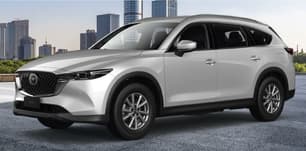
Mazda has a tendency to have a lot of similar looking horses in the stable; blink and you'll miss the (very) subtle differences between the CX-8 and the CX-9 but if you're not super keen on the bulk of the CX-9 and you've outgrown the space of the CX-5... this one's for you.
Especially, if you've been considering its competition - the Hyundai Santa Fe Elite CRDi AWD and Toyota Kluger GXL AWD. Both of which have become known for their features and space.
So, how does it compare? The CX-8 GT SP diesel all-wheel drive seats seven, has a decent boot space (albeit, when the third row isn't in use) and handles like a dream.
Perfect combination? Maybe. I've been driving it for the last week with my family to find out for you.
It’s easy to see why the Hyundai Kona leads the Aussie small SUV category, with this hybrid version enhancing the car’s abilities in key areas. Sharply priced and well-specified, comfortable and practical with a hugely efficient powertrain as well as refined dynamic performance. It’s a compelling package.
So, what did my family think about the Mazda CX-8 GT SP diesel all-wheel drive? I love how it performs on the road - it's super easy to drive and you don't notice how large it is in a car park.
There are some great family-friendly features scattered throughout and I like how practical this is too with the extra seats and top-tether points. The multimedia system isn’t my favourite and I would have preferred to have seen a few extra airbags and a 360-degree view camera, but overall, it’s a good family car and gets an 8.0/10 from me.
My son loved the sun blinds and the cool colour of the seats. He also gives it an 8.0/10.
The Kona’s exterior mixes smooth curves across its softly rounded nose and swollen haunches with sharp lines and geometric shapes in the lower grille, wheel arches and rear bumper.
And when the current, second-generation version arrived in mid-2023 it swapped out its predecessor’s already slimline LED daytime running lights for an even thinner strip running the width of the car, in similar fashion to the Hyundai Sonata sedan and Staria people mover.
The single line light signature is repeated with the tail-lights, a brake, reversing and indicator cluster confined to the outer rear edges.
Throw in a conspicuous diagonal character line across the doors, and bright metallic accents making a visual connection between the top of the tailgate and the lower edge of the side glass and there’s a lot going on.
Always a subjective call, but I don’t mind the Kona’s design, although our test car’s ‘Mirage Green’ paint finish leaves me (and my significant other) cold.
Inside, the colour palette is uniformly grey which contributes to a restrained, relatively low-key feel, although light trim for the headliner and pillar covers brightens the mood somewhat.
The dash treatment is cool and contemporary, comprising a wide wrap-around instrument and media screen panel next to a narrow tray on the passenger side.
Fit and finish is impressive and details like perforated centre panels on the leather-faced seats dial up the premium feel.
To be honest, I can't really tell the CX-8 and CX-9 apart on the road. They're both large SUVs that sport the classic Mazda bonnet - sharp and long. Up close, the CX-9 has a bulkier shape but otherwise they are remarkably similar.
The CX-8's darkened grille generates some interest with its lattice-work and there are enough shiny chrome accents scattered about the car that it looks pretty.
Yet, the sporty sharpness that Mazda is known for is still hinted at with its shaping and the 19-inch black alloy wheels.
Our model is finished in 'Platinum Quartz Metallic' and it is the highlight for the exterior styling for me. I think because it's such an interesting colour to look at - it varies a lot depending on lighting conditions. Sometimes, it almost has a sheen of pink to it and at others, it looks like pearly sand.
The interior looks polished and refined with its burgundy leather trim and soft-touchpoints. Again, there is a lot of chrome inside to make otherwise dull features, like air vents, pop out.
Even though the Kona measures a relatively modest 4350mm end-to-end, it offers up copious amounts of interior space. Dr Who would be proud.
Lots of breathing room up front, with the ‘shift-by-wire’ auto transmission shifter’s location on the steering column freeing up extra space in the centre console.
There’s a lidded bin between the seats (the padded top of which doubles as a centre armrest) with an open tray the size of a shoebox in front of it (which includes a pair of swivel-out bottle or cupholders) as well as a wireless phone charging bay ahead of that.
Generous bins in the doors include a recess for large bottles, plus there’s a decent glove box on the passenger side and a handy open tray above it. Plenty of room to keep the bits and pieces of everyday life under control.
Power and connectivity for the driver and passenger runs to two USB-C sockets and a (180W) 12-volt outlet.
Switching to the back is where the Tardis factor steps up a notch, the Kona offering space more in line with a next-size-up medium SUV.
Sitting behind the driver’s seat set to my 183cm position there’s loads of leg and headroom and even enough shoulder room for three adults to get to know one another on shorter journeys. A close to flat floor also helps with foot room in the centre position. Worth noting the rear seat backrests recline slightly for extra comfort options.
No door bins as such but, again, there are recesses for bottles. Netted map pockets on the front seat backs are helpful as is a fold-down centre armrest, which includes a pair of cupholders.
Individual air vents for back-seaters (in the rear of the front centre console) is always a welcome inclusion, and there’s a small oddments tray underneath them. Another pair of USB-C sockets will keep devices charged.
Boot capacity is healthy at a class-competitive 407 litres (VDA), expanding to 1241L with the 60/40 split-folding second row seat folded.
There are storage wells behind the rear wheel tubs, multiple bag hooks and four tie-down anchors to help keep loads secure.
There’s a temporary space-saver spare under the boot floor, which gets a tick over the increasingly common repair kit option and you’ll be able to tow a 1.3-tonne braked trailer (600kg unbraked).
The CX-8 is a very practical family hauler because there's ample room in all three rows. Yes, even adults will be able to squeeze into that third row without too many complaints!
All rows enjoy well-cushioned seats and up front they are electrically adjustable, but unfortunately, only the driver's side has lumbar support.
The middle row can slide forward manually or by using the electric button found on the side of the seats... but doing it yourself is way faster.
They do slide far enough forward that you won't embarrass yourself too much when you have to clamber into the third row. Where the seats have a 50/50 split-fold and manual adjustments (accessed via the boot).
In the first two rows there are lots of individual storage options but the front enjoys the most. The middle console is deep enough to be useful and I like the dual opening lid. Each row gets a couple of cupholders and drink bottle holders, too.
The charging options are great, with each row getting two USB-C ports and the front getting a wireless charging pad and 12-volt socket.
All of the controls and dials feel within easy reach and the 10.25-inch touchscreen multimedia system graphics are clear.
You can use it as a touchscreen or opt for the rotary dial but switching between the two was awkward for me. Especially, since the touchscreen function is disabled when you are using the wireless Apple CarPlay. This also has wired Android Auto, for those users.
The amenities are practical throughout with a dark headliner, three-zone climate control and heated outboard seats and retractable sun-blinds in the middle row.
Good news for families because there are five top-tether points across the back rows and ISOFIX child seat mounts on the outboard seats in middle row, in case you need them.
You can fit a 0-4 rearward facing child seat and it shouldn’t impact on front passenger comfort.
My six-year old found it super easy to get in and out of this car because of the 205mm ground clearance and wide door apertures. He enjoyed the high seating position, too, but was disappointed he couldn’t see out of the sunroof!
The boot space is a bit cramped with all three rows are in use at 209L but folding the third row opens up a more respectable 775L - perfect for the average family and its stuff!
The loading space is level, with the temporary spare tyre and clever storage compartments housed underneath. There is a retractable cargo blind and net, luggage anchor points and a 12-volt port, too.
And, as always, I love a powered tailgate, which this has!
When you’re sitting on top of the sales pyramid, everyone wants a piece of you and it feels like Hyundai has priced and specified the Kona to match the market with some special touches thrown in here and there.
At $39,950, before on-road costs ($44,738, drive-away), the Hybrid Elite’s standard equipment list is generous.
Aside from the safety and performance tech covered further down, big ticket items include leather-appointed seats and steering wheel, heated and power-adjustable front seats (10-way driver / eight-way passenger), 18-inch alloy wheels, LED headlights, tail-lights and DRLs, keyless entry and start, adaptive cruise control and auto rain-sensing wipers.
There’s also dual-zone climate control, digital radio, wireless Android Auto and Apple CarPlay, six-speaker audio, a 12.3-inch multimedia screen and 4.2-inch instrument cluster, rear privacy glass and more.
A sneaky power tailgate and/or ventilated front seats would be nice at this price-point, but they’re by no means mandatory for the class.
Similarly priced hybrid rivals like the Haval Jolion Ultra Hybrid ($38,990, drive-away), Honda HR-V e:HEV L ($42,900, drive-away), Subaru Crosstrek Hybrid L ($39,590, before on-road costs) and Toyota Corolla Cross GXL Hybrid ($41,190, before on-road costs) are broadly aligned with the above features list but none of them put the Kona Hybrid Elite in the shade.
The GT SP diesel AWD is one of the premium models, sitting third from the top and will cost you $65,560, before on road costs.
However, its price tag positions it as the most expensive compared to its rivals. With the closest rival being the Kluger at $65,310 and the most affordable being the Santa Fe at $60,000.
You do get a stylish-looking package with lots of features for your cash, like heated front seats, heated rear outboard seats, a tilt and slide sunroof, and premium leather interior trim.
There's some great tech scattered throughout, too, like the 10.25-inch touchscreen multimedia system, wireless charging pad, USB-A ports in the third row, Bose Premium sound system with 10 speakers, wireless Apple CarPlay and wired Android Auto.