What's the difference?
Brand Finance self-effacingly describes itself as "the world's leading independent branded business valuation and strategy consultancy". And adds that it regularly picks apart the current and future value of more than 3500 brands across multiple market sectors around the world.
These London-based boffins reckon Delta trumps American Airlines, Real Madrid has knocked off Manchester United, and Haval is a more powerful SUV brand than Land Rover or Jeep. So, no surprise Haval promotes the research on its Australian website.
Just to split hairs, Land Rover leaps to the top of the rankings when it comes to overall value, but in terms of an upward trajectory and potential for future growth, Brand Finance says Haval is the one.
The irony is you probably wouldn't know a Haval if it ran into you, which obviously isn't good in any sense, but a factor of the Chinese Great Wall subsidiary's relatively brief time, and so far, limited sales in the Australian market.
One of three models released in late 2015 to launch the Haval brand locally, the H2 is a small, five-seat SUV competing against a hot bed of more than 20 established players including the segment-leading Mitsubishi ASX, ever-popular Mazda CX-3, and recently arrived Hyundai Kona.
So, is Haval's potential reflected in its current product offering? We spent a week living with the sharply priced H2 City to find out.
BMW’s original X2 crossover from 2018 was not a massive sales success in Australia. The related X1, however, was and continues to be a very popular pick in the ultra competitive premium small SUV class.
BMW has flipped the script for the second-generation X2, giving it a dramatic makeover that ushers in a bold design that’s now in keeping with its SUV strategy. That is to offer a ‘conventional’ SUV - X1, X3 and X5 - and then a coupe-style sibling - the X2, X4 and X6 - to sit alongside it.
Beyond the new look there are significant changes throughout the car, including the introduction of an all electric version - the iX2.
We drove the two flagship grades at the international launch in Lisbon, Portugal - the petrol-powered M35i xDrive, and the iX2 xDrive30. They might look the same, but they maintain their own distinct characters. Let’s dive in…
How you define value will determine whether the Haval H2 City is the right small SUV for you. In terms of metal for money it delivers heaps of space, a reasonable standard features list and adequate safety. But it's let down by mediocre performance, sub-par dynamics and a surprising thirst for (premium) unleaded. Brand Finance may rank Haval high on the power index, but the product needs to climb a few rungs higher before that potential's realised.
There is little doubt the new X2 represents a vast improvement over the original model. The design alone gives it a lot more presence.
More interior and boot space also helps widen the SUV’s appeal and the significant tech updates are welcome.
It is on the pricey side and there are a few too many options that should be standard.
However, the M35i is hard to ignore as a sporty premium crossover, and the iX2 xDrive30 is the sort of electric SUV that should worry Volvo.
They both have their own distinct flavours, so there’s no dud in this line-up. Of course, we will hold final thoughts for the local launch when we can drive all four grades. But until then, it’s a welcome return to form for the X2.
Inoffensive but uninspiring is a blunt yet fair summation of the Haval H2 City's exterior design, especially when you think about rivals like the dramatic Toyota C-HR, edgy Hyundai Kona, or funky Mitsubishi Eclipse Cross.
The nose is dominated by a huge, slatted and chromed grille with bright metal mesh behind it, and vaguely Audi-of-10-years-ago shaped headlights either side.
The lighting treatment is elaborate with projector halogen main beams and reflector halogen high-beam units surrounded by a dotted-line string of LEDs looking uncomfortably like aftermarket inserts available via your online auction site of choice.
Standard fog-lights are recessed into a blacked-out area under the bumper, with another line of LEDs, functioning as DRLs, below that. And just to complicate matters, the upper LEDs only illuminate with the headlights, while the lower units come to life when the headlights are off.
A sharp character line runs along the H2's flanks from the trailing edge of the headlights to the tail, with an equally distinct swage line running from front to back, narrowing the car's mid-section and accentuating the bulge of its wheelarches, filled adequately by standard 18-inch multi-spoke alloy rims.
The rear is similarly reserved, the only hint of flash confined to a roof-top spoiler, cool typeface chosen for the prominent Haval badging across the hatch door, and a diffuser with chrome exhaust tips poking through either side.
Inside, the look and feel is early noughties plain, The dashtop is a nice soft-touch material, but there are lots of buttons and old-school analogue instruments combined with a media and ventilation interface that might have been acceptable on a mainstream model 20 years ago.
Don't even think about Android Auto or Apple CarPlay. The tiny LCD screen (sitting below a CD slot) wins the smallest, most basic graphics award. A miniscule scale reflecting the manual air-con's temperature setting is a particular low-light.
A small 3.5-inch screen between the tacho and speedometer displays fuel economy and distance information, but frustratingly no digital speed read-out. Standard cloth trim has a distinctly synthetic but tough feel, while the polyurethane plastic steering wheel is another throwback.
Sure, we're at the budget end of the market here, but be prepared for low-tech design combined with cheap and cheerful execution.
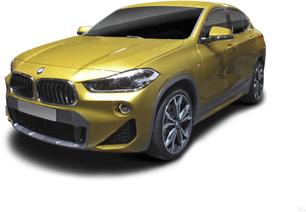
The second-gen X2 looks very different to the original from 2018. That first X2 had a squat stance, looked more like a hatchback than an SUV, and the glasshouse appeared as though it had been squished into the body of the car.
The 2024 X2 adopts a similar design philosophy to the X4 and X6 - swoopy, coupe-like roofline and liftback, and bold styling elements at the front and rear.
It has a much more upright, flush front end, freshly designed large kidney grille and an edgy headlight design. There’s flared wheel arches and broad shoulders at the rear, as well as a cool new horizontal tail-light signature.
The X2 has grown in size in a big way. It’s 194mm longer, 21mm wider, and 64mm taller than the outgoing model. That naturally means more space inside, too.
Inside there are big changes. The X2 adopts elements introduced by the excellent iX SUV a couple of years ago. They include the curved display, and a floating arm rest with a control panel. Some of this is also familiar from the X1.
The materials mostly look and feel like they are high quality, and there is an appealing minimalism to the overall design and layout. The chunky sports steering wheel is visually appealing, but it’s a bit too thick in my hand.
At 4.3m long, 1.8m wide, and just under 1.7m high the Haval H2 is a big small SUV, and there's plenty of room inside.
Up front, storage runs to a bin (with sliding top) between the seats, two large cupholders in the centre console and a lidded oddments tray in front of the gearshift, as well as a sunglass holder, average-sized glove box and door bins with room for bottles. You'll notice the pennies saved with non-illumination of the sunvisor vanity mirrors.
Rear seat passengers pick up generous head, leg, and importantly, shoulder room. Three large adults across the back will be tight but do-able for short trips. Kids and young teenagers, no problem.
A centre fold-down armrest houses neatly integrated dual-cupholders, there are bins with space for bottles in each door and map pockets on the front seat backs. No adjustable air vents for backseaters, though.
Connectivity and power runs to two 12-volt outlets, a USB-A port and an 'aux-in' jack, all in the front.
Although a strong seller in the small SUV segment, the Mazda3's Achilles heel is its modest 264-litre boot, and while the H2 exceeds that number, it's not by much.
The Haval's 300-litre capacity is way less than the Honda HR-V (437 litres), Toyota C-HR (377 litres) and Hyundai Kona (361 litres). But it's enough to swallow the bulky CarsGuide pram or three-piece hard suitcase set (35, 68 and 105 litres), and (as with all contenders in the segment) a 60/40 split-fold rear seat increases flexibility and volume.
If you're into towing, the H2's limited to 750kg for an un-braked trailer and 1200kg braked, and the spare tyre is a full-size (18-inch) steel rim shod with narrower space-saving (155/85) rubber.
Where the previous X2 was a very small crossover with niche appeal, the increase in size for the new model means more people will be interested in it. Possibly even people with a small family.
Those increased dimensions pay dividends inside, with ample headroom up front and more than enough space across the front row, although the raised armrest console is somewhat narrow.
The seats in both the iX2 xDrive30 and the M35i xDrive are very supportive thanks to ample bolstering, but both were also on the firm side. The iX2’s synthetic leather was slightly more comfortable than the M35i’s sports-focused front seats.
The power-adjustable seats and height- and reach-adjustable steering wheel means it’s not hard to find a decent driving position, but forward vision is impeded by a very thick A-pillar, and the letterbox-like rear windscreen in the X2 means rearward vision is limited. Good thing it has excellent parking cameras and sensors.
Storage is decent in the X2, with room for big bottles in the door cavity, and a few nooks and large open spaces in the console. Although secure storage is limited with the armrest housing a very shallow space. I do like BMW’s phone charger setup. Rather than lying on a pad, it slots into a vertical holder that has a latch to keep it in place when cornering. The only drawback is that you can see the screen which could potentially distract some drivers.
The X2 introduces operating system nine to iDrive, which is housed in the central part of the curved display and operated by touchscreen or the controller on the floating central console. After some familiarisation, the functionality isn’t that much different to the previous version of the operating system. The main menu looks cool and is mostly easy to navigate. The sub-menu icons - of which there are heaps - look a little Microsoft Windows.
The X2 has drive modes that also interact with the interior of the car and change lighting, EV noise and more. They include Personal Mode, Sport Mode and Efficient Mode as standard, but if you opt for (and pay extra for) BMW Digital Premium, the modes extend to Expressive Mode, Relax Mode and Digital Art Mode. Some of these are quite cool, especially some of the EV sounds, but would I use them everyday? Probably not.
The clearest indication of increased space is in the second row. There’s much more legroom than the old X2, and behind my six-foot frame I had enough space with a couple of centimetres between my knees and the front seat backs. Toe room was very limited, however.
The roof has been scalloped out to ensure more headroom, which is welcome given the extra sloping roofline.
There are a pair of USB-C ports back there, lower air vents, map pockets, decent door storage, and a centre armrest with cup holders.
The boot is sizeable, in both engine grades but you only get a tyre repair kit. There is underfloor storage for the charging cables in the iX2.
At 560 litres with all seats in place and 1470L with the second row stowed, the petrol grades have a bit more space than the iX2 at 525L (all seats in place) and 1400L (second row lowered).
At the time of publication, the Haval H2 City was carrying a drive-away price tag - $19,990 for the six-speed manual version and $20,990 for the six-speed auto (as tested here).
So, you're getting a lot of metal and interior space for your money, but what about the standard features taken for granted in the H2's main competitors?
Included in that drive-away price are the 18-inch alloys, keyless entry and start, reverse parking sensors, (manual) air-conditioning, cruise control, front and rear fog lights, LED daytime running lights, ambient interior lighting, heated front seats, rear privacy glass, and cloth trim.
But the headlights are halogen, the audio is four-speaker (with Bluetooth and single CD player), the safety tech (covered in the Safety section below) is relatively basic, and 'our' car's 'Pewter' (silver metallic) paint is a $495 option.
Equivalent entry-level competitors from Honda, Hyundai, Mazda, Mitsubishi and Toyota will set you back between five and $10k more than this H2. And if you're happy to live without features like a media touchscreen, digital radio, leather accented wheel and gearshift, rear air vents, reversing camera, etc, etc, etc, you're onto a winner.
In Australia, there will be four X2 grades in total - the xDrive20i and M35i xDrive petrol models, and the iX2 eDrive20 and xDrive30 all-electric models.
The iX2 xDrive 30 and the two X2 petrol grades are expected late in quarter one, or early in quarter two. The iX2 eDrive20 will follow shortly after in the third quarter.
The model grades largely mirror that of the X2’s mechanical twin, the X1, although the X1 is also offered in base front-wheel-drive sDrive18i guise as a range-opener.
At the international launch event, the two grades available to drive were the iX2 xDrive30 and the X2 M35i, so I will focus on those two models when it comes to the driving and practicality sections of this review. But I will detail elements of the whole range in other sections.
That X2 xDrive20i kicks off the range from $75,900 before on-road costs. For that you get features like a leather sports steering wheel, dual-zone automatic climate control, satellite navigation, an automatic tailgate, 19-inch alloy wheels, four USB-C ports and more driver-assistance systems and digital services compared with the previous model.
The $92,900 X2 M35i xDrive adds an extra dollop of performance but also includes 20-inch alloy wheels, a 12-speaker Harman/Kardon sound system, leather upholstery, a panoramic glass roof, a BMW M body kit and more.
The most affordable iX2 is the eDrive20 that kicks off at $82,900, while the iX2 xDrive30 dual-motor all-wheel-drive is $85,700. Both of these currently fall under the luxury car tax threshold at the time of writing.
There are several individual options and options packages across the range that can quickly push these prices up.
The X2 is a bit more expensive than the equivalent grades of the X1. The X2 xDrive20i costs $5500 more than the same X1 grade, while the M35i is only $2000 dearer than the equivalent X1.
For the EV, the X2 price premium is $4000 for the eDrive20 and just $800 for the xDrive30.
When it comes to rivals, pricing is a little higher than similar swoopy small SUVs like the Audi Q3 Sportback when it comes to the petrol models.
For the EV, competitors include the Lexus UX300e ($79,990-$87,665), Mercedes-Benz EQA (from $82,300-$102,579), and the Volvo C40 Recharge ($78,990-$87,990).
The Haval H2 City (as tested) is powered by a 1.5-litre direct-injection, turbo-petrol, four-cylinder engine driving the front wheels through a six-speed automatic transmission.
Peak power (110kW) arrives at 5600rpm, with maximum torque (210Nm) delivered at 2200rpm.
Each of the four grades come with a different powertrain, and the xDrive20i kicks it all off with its 2.0-litre four-cylinder turbocharged petrol unit, making 150kW of power and 300Nm of torque. It drives all four wheels via a seven-speed dual-clutch transmission and can hit 100km/h in 7.4 seconds.
The xDrive M35i ups the fun factor with a gruntier 2.0-litre four-cylinder turbo-petrol unit, driving all four wheels via the same transmission as the 20i, all while delivering power and torque of 233kW/400Nm This ensures a 0-100km/h dash of 5.4 seconds.
The iX2 eDrive20 is powered by a 150kW/247Nm electric motor on its front axle, and the iX2 xDrive 30 uses two motors - one on the front and one on the rear axle for all-wheel-drive traction. The total system output is 230kW and 494Nm and the xDrive30 gets to 100km/h in just 5.6 seconds.
Claimed fuel economy for the combined (ADR 81/02 - urban, extra-urban) cycle is 9.0L/100km, the 1.5-litre turbo four emitting 208g/km of CO2 in the process.
Not exactly outstanding, and over roughly 250km of city, suburban and freeway running we recorded 10.8L/100km (at the bowser).
Another rude surprise is the fact the H2 requires 95 RON premium unleaded fuel, of which you'll need 55 litres to fill the tank.
A fuel-use figure for the xDrive20i is yet to be confirmed, but the front-wheel-drive sDrive20i offered in Europe with a three-cylinder engine sips as little as six litres per 100 kilometres on the combined cycle. Expect the Australian version to be a little higher than that given it’s AWD and has a more potent engine.
The M35i consumes 7.7L/100km.
The high-voltage 64.8kWh lithium-ion battery in the iX2 ensures a driving range on the WLTP cycle of between up to 477 kilometres in the eDrive20 and between 417 and 449km for the xDrive30.
The latter has an energy efficiency range of 16.3 to 17.7kWh/100km, and BMW says you should be able to top up the battery from 10 to 80 per cent in 29 minutes at a fast charging station.
That driving range is not bad compared with the Lexus UX300e and Peugeot e-2008, but not quite as impressive as the Volvo C40 twin-motor.
I missed out on checking the energy efficiency figure of the iX2 xDrive30 following our drive, but after an 88km drive loop, the iX2’s range had dropped by 91km, which is just a 3km difference.
Cold weather and internal-combustion engines are usually firm friends. Lower ambient temperature means denser air entering the cylinder (even under the extra pressure of a turbo), and as long as more fuel arrives at the same time, you'll have a bigger bang and more power.
But the H2 City's 1.5-litre four must have missed the memo, because cool morning start-ups result in a distinct reluctance to proceed at normal pace.
Sure, there's forward motion, but pinning the right-hand pedal to the floor won't shift the speedo needle much above a brisk walking pace. Unsettling.
Even after a few minutes, when things settle into a more predictable pattern, this Haval hovers at the sluggish end of the performance spectrum.
Not that any of the compact SUVs it competes with are rocketships, but you can generally expect a turbo-petrol engine to serve up a decent dose of low-down grunt.
However, with a maximum output of 210Nm delivered at a relatively high 2200rpm the 1.5-tonne H2 won't be threatening the land speed record anytime soon.
Suspension is strut front, multi-link rear, with the H2 City riding on (235/55x18) Kumho Solus KL21 rubber, and on typically pock-marked and bumpy urban roads ride quality could be better.
The steering displays some nervousness on centre, which combines with a lack of road feel and a mildly disconcerting top-heavy sensation in cornering. It's not that the car lurches or suffers from too much body roll; more that something isn't quite right in the front-end geometry.
On the upside, although firm, the front seats are comfortable, the exterior mirrors are nice and big, overall noise levels are moderate, and the brakes (vented disc front / solid disc rear) are reassuringly progressive.
On the downside, the media system (such as it is) is woeful. Plug your mobile device (mine's an iPhone 7) into the car's single USB port and you'll be met by a 'Loading-USB error' message, the heating and ventilation read-outs on the letterbox slot screen are a joke, and to top it all, select reverse and the audio cuts out altogether.
The M135i xDriveis undeniably quick off the mark. The lovely 2.0L turbo engine is well matched to the seven-speed dual-clutch and it’s responsive and willing from a standing start and when overtaking.
The engine sounds lovely too, although we suspect it’s amplified in the cabin, and steering is as sharp as it should be in a warmed-up performance SUV. We darted through some very twisty roads outside Lisbon and had quite a lot of fun in the process, so the M Performance badge is justified.
I drove the previous-generation X2 M35i a few years back and was disappointed with the ride quality. It was quite jiggly on uneven road surfaces and way too firm.
While the new version still has a firm tune to aid dynamic driving, it is much more compliant than the old car and overall ride comfort has improved.
The iX2 is also quick off the mark and in xDrive30 guise is only 0.2sec slower to 100km/h than the M35i.
That lively, smooth EV acceleration is present here, adding a sense of fun to the iX2.
It too has sharp steering, and the cabin is hushed. Not just because it’s an EV either. We were on coastal roads on a windy day and there was only a hint of wind noise in the cabin.
In some instances taking corners that had typical European walls or houses right up against the road, the iX2 would slow before I had a chance to tap the brakes. But it was hard to tell if that was a vehicle safety function, or the regenerative braking.
The ride in the iX2 was a bit of a mixed bag. It coped with some of the pockmarked roads exceptionally well, soaking up the imperfections. But then on other roads it was a little choppy.
It also bounces a little when you go over speed bumps, but that’s not exclusively an iX2 trait. I’ve felt it on many an EV, given the placement of the very heavy battery packs under the floor.
On the driving tech front, the X2 has a well executed head-up display projected directly onto the windscreen. It includes the speedo of course, nav guidance, a crystal clear display and more info.
In terms of active safety the H2 City ticks the 'cost-of-entry' boxes, including ABS, BA, EBD, ESP, rear parking senors, tyre-pressure monitoring and emergency brake hazard lighting.
But forget about more recent systems like AEB, lane keeping assistance, blind spot monitoring, cross traffic alerts or adaptive cruise. And you don't get a reversing camera.
If a crash is unavoidable the airbag count runs to six (dual front, dual front side, and dual curtain). And there are three child restraint/baby capsule top tether points across the back seat, with ISOFIX anchors on the outer two positions.
The Haval H2 scored a maximum five-star ANCAP rating in late 2017, a rank it would not replicate when assessed against 2019's more challenging criteria.
The X2 and iX2 are yet to be crash tested by ANCAP or Euro NCAP for that matter.
As mentioned, it gets a more generous list of standard safety features than its predecessor. Features include the latest version of BMW’s front collision warning system, auto emergency braking, speed limit detection, active pedestrian protection and a front centre airbag.
All X2s come standard with BMW’s Driving Assistant Professional which features ‘Steering and Lane Control System’, adaptive cruise control with stop and go braking function, and a blind-spot monitor, as well as Parking Assistant Plus with a surround-view camera, reversing assistant and ‘Drive Recorder’.
Haval covers all new cars it sells in Australia with a seven year/unlimited km warranty with 24-hour roadside assistance provided for five years/100,000km.
That's a strong statement from the brand, and well ahead of the major players in the mainstream market.
Service is recommended every 12 months/10,000km, and no capped-price servicing program is currently in place.
The X2 range is covered by BMW’s five-year, unlimited kilometre warranty - something the German giant only increased from three years back in 2022. This is now the minimum standard.
The battery warranty for the iX2 is eight years or 160,000 kilometres.
BMW does not have scheduled servicing terms, instead, servicing is condition-based and the car’s computer will alert the driver when to book in for a service.
A five-year servicing package will cost you $3171 for the petrol X2s, while the iX2 is $2186 for six years.