What's the difference?
Meet Ford’s electric pioneer for Australia - the E-Transit.
It may not be as exciting as a Tesla Model S, Porsche Taycan or Audi e-tron, but this electric version of the Blue Oval’s large van will help create a new market for zero-emissions commercial vehicles.
This is seen as a major opportunity by Ford to provide an electric alternative to typically diesel-powered vans, which will no doubt prove popular with fleet operators looking to cut fuel costs and corporate emissions. While unlikely to suit all van buyers, thanks to its limited range and recharging restrictions, for those companies with shorter delivery routes it will certainly have appeal.
Ford’s research (performed by YouGov) suggests up to 58 per cent of business “can see EVs becoming part of their vehicle fleet in the future".
But it’s just Ford’s first step into the larger world of electric vehicles. We’ve already had confirmation the smaller E-Transit Custom is headed our way and there are good odds the Mustang Mach-E will eventually find its way to Australian showrooms, so there’s plenty of exciting models in store for Ford.
In the meantime, though, the E-Transit isn’t due in Australia until sometime in the first half of 2023, but CarsGuide was able to take one for a test drive near Ford’s Detroit headquarters recently to get a taste of what’s to come.
The LDV G10 arrived on the scene in the van segment a few years ago, with the aim of upsetting the equilibrium.
It was a budget-priced, Chinese-made mid-size van with its target set squarely on appealing to customers who might have wanted a HiAce, but couldn’t afford one.
After almost four-and-a-half years on the market in Australia, the LDV G10 is better than ever. It has seen new additions in the cabin, more comfortable seats, and still offers big value for money.
But with the van market moving forward at pace, does the LDV G10 offer appeal beyond the sticker price? We tested the diesel auto model to find out.
Ford has taken an unorthodox approach to entering the electric vehicle market in Australia, avoiding the hype around the Mustang Mach-E and F-150 Lightning and instead laying the foundations with the E-Transit.
But it’s a savvy move, giving the brand a chance to enter what should be a largely untapped market with a vehicle that should appeal to what buyers are looking for. With unchanged space compared to the diesel-powered Transit, the switch to a more powerful electric powertrain makes the E-Transit a win-win scenario for those with a suitable daily driving routine.
Note: CarsGuide attended this event as a guest of the manufacturer, with travel, accommodation and meals provided.
The LDV G10 is a solid option for those buyers who just want a van that gets the job done. It was decent with weight on board, but is probably better suited to parcel carriers rather than pallet shifters.
Safety levels are the biggest concern, as it is falling behind in the class when it comes to active safety tech, and its weak crash test score could be enough to rule it out for some customers.
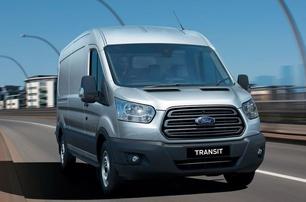
Perhaps the most interesting thing about the design is there’s nothing very different about the E-Transit compared to the regular Transit. Which is a good thing, because the Transit is already a popular delivery van so any change for the sake of difference may have messed with the winning formula.
In fact, the design element that is important is the way Ford has laid the battery packs flat inside the ladder-frame chassis which means none of the cargo space has been compromised. This means the E-Transit has the same load area as its internal combustion equivalent, which is key for any delivery van.
The more you see LDV G10 vans, the more regular they look. Familiarity breeds ignorance, I guess, but I still think the G10 looks smart.
It isn’t quite as boxy as some, with its sleeker front-end styling and almost sedan-like tail-lights helping it stand out from the ‘box-on-wheels’ stigma. It gets 16-inch alloy wheels as standard, and has halogen headlights and misses out on daytime running lights.
But it still is a box on wheels, measuring 5168mm long (on a 3198mm wheelbase), 1980mm wide and 1928mm tall. That makes it a darn sight smaller than the new HiAce, which stepped up significantly in size, and about on par with a Renault Trafic SWB or Ford Transit Custom 300S SWB.
The perceived build quality is mostly okay, though our test car had a few loose plastics on the outside and a seemingly mis-fit windshield rubber.
The cabin is very similar to what you’ll find in the Transit, so there will be familiarity for anyone making the switch from the diesel-powered version. The rotary shifter and 12.0-inch tablet-style multimedia screen make for a smart look but also means minimal space is wasted.
It’s a thoughtfully designed cabin, with plenty of usable storage spaces, including three cup-holders, a pair of bottle-holders and deep storage shelves on the top of the dashboard. The doors are particularly noteworthy, with multiple storage areas carved into the available space.
The seats are comfortable and, naturally with a high-roof van, there’s plenty of head room which creates a spacious feeling.
Behind the seats is the cargo area. In the US-specification E-Transit we drove there was a dividing wall between the cabin and the back of the van, with a small sliding door to access the cargo area, but it’s unlikely this will be offered in Australia. Instead, local models will likely have a hard divider between the cabin and back, with a small window for visibility.
As mentioned earlier, the floorspace in the E-Transit remains the same as the Transit thanks to the battery being laid underneath the floor, so there’s plenty of cargo volume that will please fleet buyers.
In the US the E-Transit’s cargo area measures 11.3-cubic-metres with the medium-height roof and expands to 12.4cu/m with the high-roof body.
Ford says the “targeted payload” will be 1616kg.
Those dimensions translate to a cargo space of 5.2 cubic metres, with a load space spanning 2500mm long, 1590mm wide (1270mm between the arches) and 1270mm tall. That mightn’t be big enough for you, and that’s too bad - there is no high roof version, nor a long-wheelbase model; but you could get an LDV V80 if you really need to step up in size… but we wouldn’t suggest you do that.
The payload for this model is 1010kg, which is decent but not benchmark-setting. It has a gross vehicle mass of 3000kg, meaning a kerb weight of 1990kg. The gross combination mass depends on the model: the GCM for diesel models is 5000kg for a braked trailer, while petrol models have a GCM of 4750kg for a braked trailer (auto) and 4500kg (manual). All models have a GCM of 3750kg for unbraked trailers.
The petrol versions have 1093kg of payload, if you prefer that fuel type. Interestingly, the manual versions have leaf spring rear suspension, while the auto models have coil springs as part of a five-link suspension architecture.
The load area has a six floor-mounted and four wall-mounted tie-down hooks, and the floor is lined with a vinyl covering while up to half-height the inner walls are lined, too. There are four lights mounted on the walls, which is handy for after-hours work.
And every LDV G10 comes with dual sliding side doors (some brands charge thousands more for this convenience), while the back door is a tailgate as standard, with the option of barn doors for diesel models.
For those who need to fork loads in, the barn doors are a no brainer, because the side door apertures (at 820mm wide) aren’t broad enough to load in using a lift. The tailgate also makes it very difficult to load weight in, as we found on test, as our mates at Crown Lifts had to use long tines to fork in our 750kg ballast.
When it comes to creature comforts up front, there is a pair of low-mounted pop-out cupholders, and an open storage area between the seats. There isn’t much covered storage, so if you often carry valuables, you may need to keep that in mind.
The seats are comfortable and offer good adjustment, and they’ve been changed since the diesel auto model launched. They’re no longer a cheap-feeling fabric, but rather a faux-leather accented, mesh-lined set of seats, and both have armrests. Nice.
The presentation is okay, but the ergonomics could be better. The touchscreen is mounted down lower than most, and means you may need to take your eyes away from the road because the controls are down even lower. And the USB? Near the floor.
That screen is still a 7.0-inch display, but now has the same software system as the newer models in the LDV range. That means a nice crisp colourful display with the added advantage of Apple CarPlay… if you can get it to work. We had a few issues when reconnecting a phone without re-starting the car.
Ford Australia originally announced the E-Transit would arrive by “mid-2022” but that date has been pushed back thanks to the ongoing supply challenges faced by most car companies.
While the initial technical details have been confirmed - the first model available will be the 420L long-wheelbase version - the company hasn’t locked in detailed local specifications and pricing yet.
The closest comparison in the current Transit range is the 350L, which is available in both mid- and high-roof variants. Based on the model we test drove in the US, there are similar specifications between the two, including 16-inch steel wheels, partial-leather-trimmed seats and Ford’s SYNC4 multimedia system displayed on a 12.0-inch centrally mounted screen.
While pricing isn't confirmed, it's likely the E-Transit will carry a premium over the Transit so we'd estimate a starting price in the mid-$60,000 range.
If you’re buying an LDV G10, it’s because of the price. The cost of the diesel automatic model we’ve got is usually $32,490 drive-away for ABN holders, but there are promotions running listing it at $29,990 drive-away for ABN holders at the time of writing. If you’re not an ABN holder, just get one, because you’ll save heaps (the G10 diesel auto is $34,147 drive-away for non-ABN holders).
You can get other vans for around this money - the Renault Trafic Trader Life manual, with its gutless 66kW turbo-diesel engine, is $30,990 d/a. But you won’t find a diesel Hyundai iLoad, Peugeot Partner or Toyota HiAce within $10,000 of the LDV.
As for standard spec, you get 16-inch alloy wheels, tyre pressure monitoring, climate control air-conditioning, a 7.0-inch touchscreen with USB connectivity, Apple CarPlay, Bluetooth phone and audio streaming, CD player and AM/FM radio, a digital speedometer, two part fake-leather seats with arm-rests (driver’s side with height adjust), carpet flooring up front, and vinyl floor protective liner in the rear, and a reversing camera.
Standard body fit out is dual sliding side doors and a lift tailgate, though you can get barn doors fitted on diesel models. Unlike some competitors, there is no option for glazing in the rear doors or side panels.
There are also no auto headlights, no auto wipers, push-button start, keyless entry, leather-lined steering wheel, reach adjustment for the steering, and there’s quite a bit missing in the safety section of this review - see below.
One element of the E-Transit we are clear on is what’s under the bonnet. The E-Transit is powered by an 198kW/430Nm electric motor that powers the rear wheels and draws energy from a 68kWh battery.
That means the E-Transit is the most powerful member of the Transit family, with the rest of the range powered by the 125kW/390Nm 2.0-litre four-cylinder turbo diesel engine.
Ford claims the E-Transit has a range of 317km (on the WLTP cycle), which may not sound like a lot for a commercial van but Ford claims in the US the daily average for such vehicles is only 120km.
In order to save charge, the E-Transit is equipped with an Eco Mode which limits top speed, regulates acceleration and limits climate control settings. Ford claims this allows the driver to cut energy usage by between eight to 10 per cent when driven at highway speeds or when unladen.
Under the bonnet of the diesel G10 is a 1.9-litre four-cylinder turbo-diesel with 106kW of power and 350Nm of torque. There’s the choice of a six-speed manual or six-speed automatic, and the G10 is rear-wheel drive. It has a diesel particulate filter, but not stop-start or AdBlue.
Prefer petrol? There’s a 2.4-litre five-speed manual model (105kW/200Nm) or a 2.0-litre turbocharged six-speed auto (165kW/330Nm). Those models are cheaper - $25,990 for the manual for ABN holders, while the turbo-petrol auto is $30,990 d/a.
Charging will be a key element of the E-Transit’s appeal (or not) to buyers, with fleets needing to maximise the van’s time on the road. Ford claims that with a 115kW DC fast-charger the E-Transit battery can go from 15 per cent charge to 80 per cent in just 34 minutes.
With the onboard 11.3kW charger it takes 8.2 hours to get the battery back to 100 per cent capacity.
The E-Transit supports bi-directional use of the battery too. In the US the E-Transit is available with its Pro Power Onboard technology as an option. This allows for the driver to draw up to 2.4kW of power from the vehicle’s battery to power tools and other equipment as necessary.
One feature that is confirmed for the Australian-bound E-Transit is what Ford calls, Scheduled Pre-Conditioning. This is a system that allows the operator to pre-set the climate control for the cabin while the van is still on charge so that you can still have maximum charge available when you start driving.
The combined cycle fuel use claim for the LDV G10 diesel auto is 8.6 litres per 100 kilometres. The manual version uses 8.3L/100km according to the brand.
On test we saw a fuel use return of 9.7L/100km at the pump, across a mix of urban, highway and freeway driving, with and without a load.
Petrol models use a claimed 11.5L (manual) and 11.7L (auto) per hundred.
Electric vehicles have earned a reputation for rapid, exciting acceleration… but that’s not the case with the E-Transit. Performance could best be described as modest, with adequate but unspectacular acceleration.
Which is fine, because the E-Transit is not meant to be a ‘ludicrously’ quick van, instead it’s meant to haul a load as efficiently as possible. On that front it does a good job, with smooth (albeit gentle) acceleration and steady pulling power.
It’s important to note, though, that our test car was unladen - with only some shelving installed in the back. So we’ll have to reserve judgement on how the E-Transit performs with a full load on-board, on Australian roads.
The rest of the driving experience is as you’ll find with the Transit. The steering is nicely weighted and direct, which makes manoeuvring such a huge vehicle straightforward.
The ride is on the firm side, which isn’t unusual for either a van or an electric vehicle as it needs to control so much weight, but it isn’t uncomfortable and offers good control.
You probably wouldn’t choose an LDV G10 as a daily driver if you didn’t intend to use the cargo zone at least 80 per cent of the time.
But if - for whatever reason - you really want to use a van like this on a day-to-day basis, you won’t hate it.
The G10 drives pretty nicely for this type of vehicle. It isn’t as bouncy when unladen as some of the other vans out there, with the suspension proving very quick to settle and mostly very compliant across mixed surfaces.
The steering wheel can jostle a bit over sharp edges, but it steers well, with decent (not too heavy) weighting and predictable response at all speeds.
Without weight on board the engine feels reasonably urgent in its response, which is a bit of a surprise because it’s not a powerhouse based on its outputs. It revs smoothly and pulls with good strength, with little turbo lag to contend with. While it is a bit of a grumbly engine at times, the response is better than adequate.
Plus the transmission is well sorted, with smooth shifts that are predictable.
The braking response is definitely better without weight on board, with a decent progression to the pedal and decent bite when you press hard on the anchors.
The current Transit is not rated by ANCAP, as is the case with most of its full-size van rivals because the safety authority tends to focus on the mid-size vans - such as the Transit Custom, Toyota HiAce and Hyundai Staria-Load.
However, the E-Transit does have a solid safety package, with driver and passenger front, side and curtain airbags all standard. While the E-Transit’s local safety package isn’t locked in, the Transit already boasts autonomous emergency braking with pedestrian detection, lane-keep assist with lane-departure warning, rollover mitigation, side-wind stabilisation, trailer sway control and traffic-sign recognition, so it’s probably a safe bet these will all be included on the E-Transit.
We drove the high-roof E-Transit in the US and with a high-mounted reversing camera it was surprisingly easy to navigate for such a big vehicle.
If safety matters to you, this could be your reason not to buy an LDV G10.
The van scored a mediocre three-star ANCAP crash test safety score - which would be more acceptable if that was under the current, strictest criteria, but it was actually tested in 2015. Which means it would be even lower if tested today.
One of the reasons is the safety equipment - there’s not a lot of it. You get dual front airbags, but no side airbags or curtains. There is no advanced tech like auto emergency braking (AEB), no lane keeping assistance or lane departure warning, no blind spot monitoring or rear cross-traffic alert… But you do get a reversing camera and rear parking sensors.
Ford Australia has already confirmed that the E-Transit will be covered by Ford’s now-standard five-year, unlimited kilometre warranty, plus an extended eight-year/160,000km warranty specifically for the battery and high-voltage electric components.
LDV isn’t close to the leaders in the segment for ownership, with a behind-the-times three-year/100,000km warranty (admittedly with the same cover for roadside assist), and no capped price servicing plan.
Service intervals are every 12 months/10,000km, which is short, and you need to get an initial service done at 5000km, too.
If you’re worried about long-term longevity, you can check out our LDV G10 problems page.