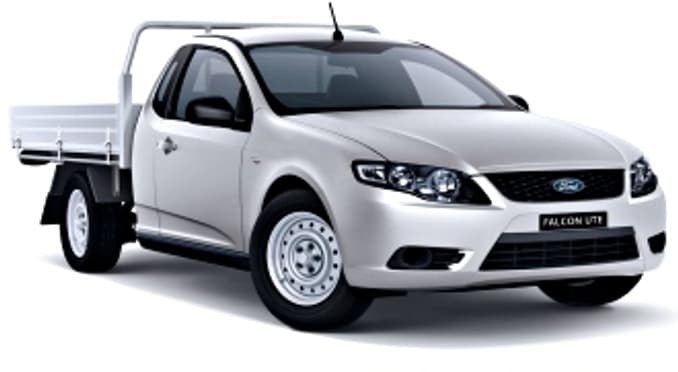
Ford Falcon 2009

Ford Falcon 2009

FROM
$4,070

The 2009 Ford Falcon range of configurations is currently priced from $3,999.

Our most recent review of the 2009 Ford Falcon resulted in a score of 7 out of 10 for that particular example.

Carsguide Contributing Journalist Ewan Kennedy had this to say at the time: Expect to pay from $3000 to $6000 for a 2002 Ford Falcon Futura;$6000 to $10,000 for a 2005 XR8 or a 2010 XT;$8000 to $12,000 for a 2008 XR6T;$9000 to $14,000 for a 2012 XT;$12,000 to $17,000 for a 2011 G6E;$14,000 to $20,000 for a 2011 XR8;$16,000 to $22,000 for a 2014 G6E Ecoboost;$21,000 to $28,000 for a 2014 XR6T;and $30,000 to $41,000 for a 2015 XR8.

You can read the full review here.

This is what Ewan Kennedy liked most about this particular version of the Ford Falcon: Roomy, Huge amount of variety, Spare parts are reasonably priced

The 2009 Ford Falcon carries a braked towing capacity of up to 2300 Kg, but check to ensure this applies to the configuration you're considering.

11.7L/100km (combined)
Single Cab
5 Speed Automatic
Unleaded Petrol
Overview
Likes
Roomy
Huge amount of variety
Spare parts are reasonably priced
Dislikes
Manuals are best avoided
Be wary of ex-taxis
Four-speed automatics can cause problems

Ford Falcon 2009 FAQs

The auto transmission won't engage any gears in my 2009 Ford Falcon FG

This transmission has a finite lifespan and when they die, they sometimes just stop working as yours appears to have done. An automatic specialist will know the telltale signs of this and should be able to diagnose the problem.

But don’t give up hope; you might find the problem is simply a low fluid level in the transmission. Low fluid can certainly provide the symptoms you’re seeing. However, if that’s the case, then you’re chasing a leak, because these transmissions are a sealed system and shouldn’t need periodic topping up.

Show more

Why is the range prediction in my 2009 Ford Falcon FG ticking down so quickly?

These range predictions are a classic case of only being as good as the information being fed into them. What the car does is look at the previous, say, 100km of driving that you’ve done. If that was on a highway, the computer will know that for the last 100km, average fuel consumption was, let’s say, 10 litres per 100km (to keep the maths simple). So, if you still have 20 litres in the tank (which the computer will also know) the computer will figure that you have 200km of range left.

But, if your next driving stint is in stop-start traffic, your fuel consumption might easily rise to 15 litres per 100km, at which point, those 20 remaining litres are only enough for 133km. The farther you drive at your new consumption rate of 15 litres per 100km, the more the computer will realise that the previous range estimation is suddenly wrong and it will move to fix that by constantly reducing the range readout until it matches your actual fuel consumption.

It works the other way, too, and a change from suburban driving to highway work will see the computer hustle to reflect the current consumption and will actually start to increase the range estimation until it all starts to average out again.

This, of course, is the case assuming all the sensors and computers are accurate, and any false or misleading piece of information fed to the computer will also lead to wildly inaccurate range estimates.

Show more

I have a 2009 Ford Falcon, and a red triangle warning light has been coming on the dash.

The triangle symbol is universally used in the car world to suggest a problem. So, more universally, is the colour red. The combination of these is a sign that something, somewhere in your car, all is not well. Actually, on that model Falcon, the warning triangle will be lit as a yellow light for mild problems, and only switches to red for a major issue. Which is what you clearly have. This could be a major safety issue, so don’t ignore it.

You can either have a workshop or Ford dealer check this out for you, but the first step is to press the 'SEL' button which should take you to an information screen with more details about what the car thinks is wrong with itself. After that, it’s an electronic scan to home in on the problem.

Show more

See all Ford Falcon 2009 FAQs
Disclaimer: You acknowledge and agree that all answers are provided as a general guide only and should not be relied upon as bespoke advice. CarsGuide is not liable for the accuracy of any information provided in the answers.

Ford Falcon 2009 Fuel consumption

Fuel consumption for the 2009 Ford Falcon is dependent on the type of engine, transmission, or model chosen. The Ford Falcon currently offers fuel consumption from 11.7L/100km.
show more