What's the difference?
This might be the biggest gamble in Porsche's history. It's the latest version of its best-selling car, the Porsche Macan, only this one has a very big difference.
You see, this time, it’s all-electric. There is not an internal-combustion engine (ICE) in sight. And that makes climbing into an entry-level Macan significantly more expensive than ever before.
So, will this bold shift help or hinder the Macan in Australia? And is this the country’s best all-electric SUV?
There’s only one way find out.
The new-generation Mazda CX-5 is here, promising to be bigger, better and bolder, with fresh styling, sharper handling and more technology. But in a market where hybrid power is becoming increasingly hard to ignore, has Mazda left the CX-5 at a disadvantage? I’ve spent a week with the Evolve grade to find out for you.
There is no doubting the substance of the Porsche Macan Electric. Its ride, steering and poise make it a joy to drive on twisting roads, and it ticks the practicality boxes, too.
The only lingering question is whether enough people are ready to make the all-electric switch. Only then will we know if Porsche's Macan gamble has paid off.
Note: CarsGuide attended this event as a guest of the manufacturer, with travel, accommodation and meals provided.
The Mazda CX-5 Evolve kicks some goals and with its comfortable on-road handling, robust safety equipment and practical interior, it’s still a solid choice for families looking for a mid-sized SUV. The only thing it’s missing is a hybrid powertrain, which would make this already well-rounded package even more compelling.
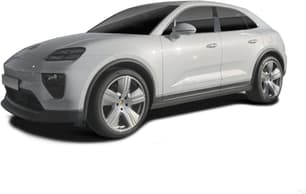
The Macan Electric looks sharp, all aerodynamic and swept-back like a range-maximising electric SUV should.
There’s functional method behind all this swoopy styling, too. The headlights look as though they’ve been chiselled into the body work, and at the grille, you’ll find active venting to help with cooling when needed.
There is also a sizeable front splitter that looks very much like the Macan is sticking its jaw out. All of which is to assist with aero and range.
It’s also a dual charging port layout with access left and right, though the latter is AC charging only, while the one on the left does both.
Step inside the Macan and you’ll find a familiar and very welcoming space. I especially like the twin-screen set-up that looks great in the way it's kind of embedded into the dash. Each is big, clear and easy to use.
I also really like the control panel that gives you quick-button access to the climate control, and the haptic feedback is next level, with the whole screen clicking in or out whenever you hit a button.
That said, in Turbo-guise you’re dropping almost $200,000, and some of the materials feel too hard and plasticky at that price point.
The next-generation Mazda CX-5 is bigger than before, but it retains the sleek body lines and understated styling that have made it such a handsome SUV. The wider front end and repositioned grille give it a more purposeful look than the outgoing model, while the 17-inch alloy wheels keep things suitably restrained.
Inside, the cabin doesn’t feel too basic despite the cloth upholstery. There are plenty of soft-touch materials, a pleasant dashboard and some new technology, including the 12.9-inch multimedia display. You lose most of the physical buttons, though, so there’s a little less of that traditional Mazda tactility.
The fabric seats are cosy and the extra interior space is definitely noticeable. Overall, there is still an understated elegance to the CX-5’s cabin.
There is a little open-sesame magic at play with the Macan, and that starts at the frunk, where, if you lovingly caress the bonnet, it will automatically pop open for you, revealing an 84-litre storage space.
Rubbing the charging port will see it slide open, too, but just in case you’re not the kind of person who likes to fondle their car in public, you can use the key.
The Macan’s boot is a little more traditional, opening to reveal 540 litres (but just 480 litres in the 4S or Turbo) of storage with the rear seats in place, with a wide, flat and very useable area for your goodies.
The back seat of the Macan feels spacious enough, without being outstanding. There’s more than enough space for my 175cm frame, with enough knee and head room, but the way the middle console juts out will definitely eat into leg room for any middle-row passenger.
Elsewhere you get air-con controls with vents, along with bottle storage in each of the doors. There is also a pull-down divider that’s home to two extra cupholders.
The front seats are a particularly comfortable place to spend time, with wide seat bases and plenty of elbow room. Getting in and out is easy thanks to the wide door apertures and 205mm of ground clearance and there’s enough space to settle in for a longer journey.
There’s also plenty of useful storage up front, including a large glove box, dual-opening centre console, cupholders and bottle holders, plus a dedicated phone tray with wireless charging. You get a 12-volt socket and two USB-C ports for keeping everything else topped up.
The 12.9-inch multimedia screen replaces Mazda’s familiar rotary selector with touchscreen operation, which I find easier to use. The updated operating system takes a little while to get your head around and there’s no native sat nav, but otherwise it feels functional and fresh for the new-generation model. Wireless Apple CarPlay and Android Auto are standard, with CarPlay maintaining a solid connection throughout my week.
The extra size of this next-generation model is more noticeable in the back, where improved leg- and headroom is good news for taller adults on longer trips. The rear doors open to almost 90 degrees, making it easier to access the ISOFIX child-seat mounts and three top-tether anchor points.
There’s not a huge amount of extra family-focused kit back in the rear row, but you do get directional air vents, storage bins in each door and a centre armrest with cupholders. My nine-year-old was comfortable, although he did point out the lack of a charging port during a road trip.
And, as a parent, I had one other gripe: keeping the fabric seats clean from my kid’s shoes in rainy weather. Let’s just say some seat covers might be a worthwhile investment.
The boot offers up to 466L with all seats in use. That’s not the largest capacity in the class, but it was more than enough for my little family of three this week. I like the level loading floor, although the boot itself is quite tall, which can make lifting heavier items in and out a little awkward.
I’m also pleased to see a spare tyre, even if it is only a space-saver. And while a powered tailgate would be handy, at this price point I don’t think you’ll really miss it... until you’re standing there with your hands full!
The Macan arrives with four trim levels, the entry-level Macan, the Macan 4, Macan 4S and then the flagship Macan Turbo. The latter is just a name Porsche now applies to its go-fast models — obviously there isn’t an actual turbo in action.
The new electric range opens with the Macan, which lists at $128,400, before on-road costs. A reminder here that the old entry-level Macan with an ICE powertrain would have set you back less than six figures, so this one represents quite the jump.
Now, it should be pointed out that you can still buy the previous-generation ICE Macan, at least until supply runs dry. The brand isn’t getting any more, but suggests there are enough in the country to satisfy demand until around Q2 next year.
Next is the 4, which is $134,400 and adds a second e-motor. Then comes the 4S, yours for $149,300, before the range tops out with the Turbo, which climbs to $184,400. All prices before on-road costs.
Those are big numbers, but at least Australian-delivered cars are some of the best-specified on the planet.
That starts with the Macan, which gets a 12.6-inch digital instrument cluster, and a second 10.9-inch central touchscreen with Apple CarPlay and Android Auto.
It rides on 20-inch alloys, has synthetic-leather seats that are heated up front and Australian cars get things like the clever 'Porsche Active Suspension Management' (PASM) system as standard.
Next up is the Macan 4, which adds a second electric motor, but otherwise largely mirrors the base car’s spec. Next on the list is the 4S, which rides on a different 20-inch alloy, picks up LED matrix headlights, sports a better Bose stereo, a panoramic roof and four-zone climate control.
Finally, the Turbo is the big dog of the electric Macan range, packing serious power, but also arriving with its own 20-inch alloy wheel design (with 21-inch wheels a no-cost option) — an augmented reality head-up display, and things like the 'Porsche Electric Sport Sound', the 'Sport Chrono Package' and a performance-focused 'Sport+' drive mode.
There are five variants available for the third-generation Mazda CX-5, and we’re in the second-from-base Evolve grade for this review. It has a competitive $42,990, before on-road costs price, which puts it neatly among its key rivals. The Hyundai Tucson Hybrid starts at $42,850, while the Kia Sportage SX+ petrol begins at $45,580 and the Toyota RAV4 GX 2WD Hybrid at $45,990, all before on-road costs.
On price alone, the CX-5 looks well placed. But there’s one notable difference - all three rivals offer hybrid powertrains in their respective ranges, while the CX-5 currently does not. And as hybrid power becomes increasingly common in this segment, that omission could prove harder for Mazda to overlook.
The Evolve grade enjoys some solid features though, including:
The entry-level Macan is equipped with a single rear-mounted electric motor, and it will make a total 250kW (265kW with launch control activated) and 563Nm, which is enough to push the cheapest Macan to 100km/h in 5.7 seconds.
The 4 then adds a second electric motor for AWD, upping the grunt to 285kW (300kW with the launch function) and 650Nm, and drops the sprint to a brisk 5.2 seconds.
The 4S is probably the performance sweet spot, with its dual-motor set-up generating 330kW (380kW in launch) and 820Nm, and a blistering sprint of just 4.1 seconds.
But the Macan Turbo is a true monster. We’re talking 430kW (470kW with launch control), 1130Nm and a sprint to 100km/h that’s as fast as a Carrera Cup race car – just 3.3 seconds.
It’s twin-motor, all-wheel drive and offers the kind of brutal acceleration that gives you a little facelift every time you step on the accelerator.
The CX-5 is all-wheel drive and powered by a 2.5-litre four-cylinder petrol engine producing 132kW of power and 242Nm of torque. It has a braked towing capacity of up to 1800kg, giving you the option of some light towing on the weekends, while the six-speed automatic transmission shifts smoothly through its gears.
But there’s no escaping the fact that most of its key rivals now offer hybrid powertrains, and you can feel the absence of one here. The CX-5’s petrol engine is perfectly capable, but it doesn’t have the same efficiency advantage that many buyers in this segment are increasingly looking for.
Every Macan is fitted with a big 100kWh lithium-ion battery, which helps deliver a solid driving range no matter which one you choose.
The entry-level Macan will cover the most distance, at a claimed 654km, while the 4, 4S and Turbo will travel 624km, 619km and 616km, respectively.
The Macan rides on an 800V architecture, and is set up for 270kW DC high-speed charging, which will take 21min to go from 10 to 80 per cent. It will also accept 11kW AC charging, which should take 10 hours to go from empty to full.
Worth noting, though, that most home wall boxes are around 7.0kW, which means a full charge would take more like 13 hours plus.
The CX-5 has a 58-litre fuel tank and claimed combined cycle (urban/extra-urban) fuel consumption of 7.4L/100km, giving it a theoretical driving range of up to 783km. That’s a solid range for a family-sized SUV and means you won’t be constantly thinking about your next fuel stop.
My real-world fuel use settled at 7.8L/100km after a week of longer highway stints and urban trawls, so it’s not too far off Mazda’s official number.
Still, this is where I’d like to see a hybrid powertrain join the CX-5 range. The fuel economy is reasonable, but with so many rivals now offering hybrid options, Mazda is starting to leave some efficiency gains on the table.
Porsche seemed at pains to prove that, though the all-electric Macan has lost its ICE heart, it's still worthy of the badge, and still very much a Porsche.
First stop, then, was the Norwell race circuit in Queensland, to put the Macan through its paces with 0-100km/h sprints, drifting (well drift attempts... ) on a watered-down skid pan and finally some high-speed running on the circuit.
And two things immediately became very clear. The first, and most obvious, was that, like the first men on the moon, we were likely among only a handful of people that might ever take their all-electric Porsche mid-size SUV to a race track. And second, this is one seriously sorted electric car.
Happily, for the many (read: every) owners who won't be pulling out of a pit garage at their next local track day, the Macan is actually more enjoyable on the road than it is on the track.
On the latter, there's a freedom to push too hard – what with the lack of trees, guard rails or oncoming traffic – and cracks do appear, mostly from the screaming tyres struggling with the two-tonne-plus weight.
But on public roads, where a thick fog of consequence prevents you pushing too hard, the Macan is a gem.
Porsche tends to have a knack for these things, I know, but the Macan is a seriously smooth and satisfying drive.
The ride is bang-on (comfortable enough on rougher surfaces, firm and grippy enough on twisting roads) and the steering is direct and confidence-inspiring.
Body-roll has been largely banished, too, with the Macan staying flat, stable and satisfying, even on the tighter stuff.
In much the same way the ICE Macan defined what it meant to be a driver's SUV, I think this one does the same in the EV space. And the fact that it does it with five seats and a decent boot is a sizeable bonus.
But there's no denying it lacks in the emotion department. That sense of excitement, the sound track, the hard-to-define fizz – as competent its this, and as weaponised as the EV powertrain is – it does feel a little clinical, like a tool doing its job and doing it well.
One important caveat. We've driven the 4 and Turbo to date. The entry-level Macan and the mid-tier 4S are still incoming. And I suspect I wouldn't be dropping my deposit on the Turbo.
Yes, the power is ridiculous, but I don't reckon you need it. For me, the 4 is more than enough, but I suspect the real performance sweet spot will be with the 4S.
The CX-5 feels composed around town, with power delivered smoothly for everyday driving. But when you need to punch it off the mark, there’s some noticeable lag, and you have to work the engine harder to find the power when tackling a steeper hill at higher speeds. It’s capable enough, but it can feel like you’re asking a little more of it than you should.
The suspension has a firm edge to it, but I like how responsive the steering feels. The CX-5 is genuinely enjoyable through corners, with a dynamic feel and very little body roll.
The cabin is also impressively quiet, with minimal road or wind noise creeping in at higher speeds. Visibility is good through the front and sides, although the A-pillar can get in the way at times.
The reversing camera provides a clear view, while front and rear parking sensors make manoeuvring easier. Overall, it’s not a difficult SUV to park, despite its larger dimensions.
The Porsche Macan Electric is yet to be assessed by ANCAP, or by Europe’s NCAP, but it doesn’t appear to be missing any key equipment from its safety list.
That includes curtain airbags that extend all the way to the boot, AEB with pedestrian detection, lane keeping assist, a surround view camera and 'Intersection Assist'.
The Mazda CX-5 has a maximum five-star ANCAP safety rating from testing conducted in 2025, with strong results across all four assessment categories.
It scored 90 per cent for adult occupant protection, 91 per cent for child occupant protection, 93 per cent for vulnerable road user protection and 87 per cent for its safety assist systems.
Other equipment include:
The Porsche ownership experience is frankly underwhelming by modern standards, with the brand offering just a three-year/unlimited kilometre warranty, plus an eight-year/160,000km battery warranty.
The positive, though, is that servicing should only be required every two years or 30,000km. You also buy a prepaid service plan for three, four or five years, priced at $1495, $2795, $2995.
The CX-5 is covered by Mazda’s five-year, unlimited-kilometre warranty, which also includes five years of roadside assistance. It’s a solid offering, although longer warranty terms are becoming increasingly common in this segment.
Servicing is reasonably priced at around $440 per service over seven years, and the intervals are well spaced at every 12 months or 15,000km, whichever comes first. That should make ongoing ownership relatively straightforward for families.