What's the difference?
This might be the biggest gamble in Porsche's history. It's the latest version of its best-selling car, the Porsche Macan, only this one has a very big difference.
You see, this time, it’s all-electric. There is not an internal-combustion engine (ICE) in sight. And that makes climbing into an entry-level Macan significantly more expensive than ever before.
So, will this bold shift help or hinder the Macan in Australia? And is this the country’s best all-electric SUV?
There’s only one way find out.
If you’re in the market for a city- and family-friendly compact SUV, you’re in luck.
The small SUV segment is one of the most heavily populated and hotly contested in the Aussie new-car market and the Mazda CX-30 G25 GT SP FWD is pitched against a seething pack of at least 10 similarly sized, generously specified and highly-credentialed competitors.
So, stay with us on a mission to determine whether this high-end version of one of Mazda’s best sellers is worthy of a spot on your new-car short list.
There is no doubting the substance of the Porsche Macan Electric. Its ride, steering and poise make it a joy to drive on twisting roads, and it ticks the practicality boxes, too.
The only lingering question is whether enough people are ready to make the all-electric switch. Only then will we know if Porsche's Macan gamble has paid off.
Note: CarsGuide attended this event as a guest of the manufacturer, with travel, accommodation and meals provided.
About to enter its fifth year in market the Mazda CX-30 is holding up well and this GT SP FWD grade delivers solid value relative to its key competitors, of which there are many. It’s also space-efficient, practical and performs well with top-shelf safety, decent refinement and good dynamic ability.
Alternately, it’s crying out for a hybrid powertrain to improve fuel efficiency, the interior form and function is starting to date and while it meets the market the ownership promise could be sharper. But this little SUV is still worthy of a spot on your new-car short list.
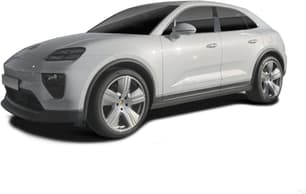
The Macan Electric looks sharp, all aerodynamic and swept-back like a range-maximising electric SUV should.
There’s functional method behind all this swoopy styling, too. The headlights look as though they’ve been chiselled into the body work, and at the grille, you’ll find active venting to help with cooling when needed.
There is also a sizeable front splitter that looks very much like the Macan is sticking its jaw out. All of which is to assist with aero and range.
It’s also a dual charging port layout with access left and right, though the latter is AC charging only, while the one on the left does both.
Step inside the Macan and you’ll find a familiar and very welcoming space. I especially like the twin-screen set-up that looks great in the way it's kind of embedded into the dash. Each is big, clear and easy to use.
I also really like the control panel that gives you quick-button access to the climate control, and the haptic feedback is next level, with the whole screen clicking in or out whenever you hit a button.
That said, in Turbo-guise you’re dropping almost $200,000, and some of the materials feel too hard and plasticky at that price point.
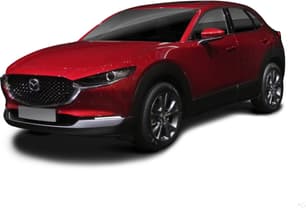
Mazda continues to follow a disciplined design path with everything from the MX-5 sports car to the BT-50 dual-cab ute sharing key attributes like the brand’s signature trapezoidal grille, simple flowing lines and sleek head- and tail-lights, all wrapped up with a subtle hint of chrome here and there.
Car-spotters with the GT SP on their checklist should look out for 18-inch black metallic rims as well as black exterior trim, including the mirror caps.
Inside, the CX-30 maintains Mazda’s restrained approach with smooth surfaces integrated across the multi-layer dash and primo leather-trimmed seats.
That said, this car is starting to show its age with the multimedia screen plonked on the top of the dash (in typical Mazda fashion) and a largely conventional instrument cluster.
Yes, the main dial is configurable courtesy of a central 7.0-inch TFT screen, but next to more recent arrivals boasting sleek, often twinned, flat screen displays the CX-30 looks and feels out of touch.
Functionally, there’s a sensible mix of digital controls and physical buttons (points for audio volume and ventilation dials!), but… the multimedia screen can only be accessed by a rotary controller in the centre console once the car is mobile (it works as a touchscreen when you’re stationary).
Some say touchscreens take your eyes off the road so the controller makes sense, but with a sequential app like Spotify it can take a lot of twirls to get to where you want to go, which upsets concentration and takes your eyes off the road, anyway. I’d prefer the relative ease of a quick press on a screen.
Aside from all that, the materials used are high quality with soft-touch surfaces across key contact points and hard plastics confined to high-wear areas.
There is a little open-sesame magic at play with the Macan, and that starts at the frunk, where, if you lovingly caress the bonnet, it will automatically pop open for you, revealing an 84-litre storage space.
Rubbing the charging port will see it slide open, too, but just in case you’re not the kind of person who likes to fondle their car in public, you can use the key.
The Macan’s boot is a little more traditional, opening to reveal 540 litres (but just 480 litres in the 4S or Turbo) of storage with the rear seats in place, with a wide, flat and very useable area for your goodies.
The back seat of the Macan feels spacious enough, without being outstanding. There’s more than enough space for my 175cm frame, with enough knee and head room, but the way the middle console juts out will definitely eat into leg room for any middle-row passenger.
Elsewhere you get air-con controls with vents, along with bottle storage in each of the doors. There is also a pull-down divider that’s home to two extra cupholders.
At just under 4.4m long, close to 1.8m wide and little over 1.5m tall (with a 2655mm wheelbase) the CX-30 is in the middle of the pack it competes with in terms of key dimensions.
And space up front is more than adequate, with an impressive feeling of roominess for a relatively small SUV.
For storage, there’s a large lidded box (which doubles as an armrest) between the front seats as well as a pair of cupholders in front of the gear-shifter with a bay for wireless device charging ahead of that.
The glove box is big, there are bins in the doors with room for decent size bottles and a drop-down tray for sunglasses sits overhead.
Move to the rear and the amount of space on offer is surprisingly generous. Sitting behind the driver’s seat, set for my 183cm position, I have plenty of head and legroom, although three full-size adults across the back seat will be an uncomfortable proposition for anything other than short trips. A trio of up to mid-teenage kids will be fine.
Adjustable air vents at the back of the front centre console are a welcome inclusion for back-seaters and storage runs to a map pocket (weirdly, on the back of the front seat only), a pair of cupholders in the fold-down centre armrest and bins in the doors with room for smaller bottles.
In-cabin power and connectivity includes two USB-C outlets and a 12-volt socket in the front centre storage box. No USBs specifically for those in the rear, which is a miss for road trips and no 12V in the boot which can be handy when camping or picnicking.
Speaking of the boot, cargo volume with the rear seat upright is okay for the class at 317 litres, which expands to a healthy 1479L with the 60/40 split-folding backrest lowered. For comparison the Kia Seltos coughs up 433L with the rear seat upright.
The space is illuminated, there are tie-down anchors to help secure loose loads and there’s a space-saver spare sitting under the floor.
And if you’re keen on towing a tinnie or similar you’re good to go for a 1200kg braked trailer (600kg unbraked).
The Macan arrives with four trim levels, the entry-level Macan, the Macan 4, Macan 4S and then the flagship Macan Turbo. The latter is just a name Porsche now applies to its go-fast models — obviously there isn’t an actual turbo in action.
The new electric range opens with the Macan, which lists at $128,400, before on-road costs. A reminder here that the old entry-level Macan with an ICE powertrain would have set you back less than six figures, so this one represents quite the jump.
Now, it should be pointed out that you can still buy the previous-generation ICE Macan, at least until supply runs dry. The brand isn’t getting any more, but suggests there are enough in the country to satisfy demand until around Q2 next year.
Next is the 4, which is $134,400 and adds a second e-motor. Then comes the 4S, yours for $149,300, before the range tops out with the Turbo, which climbs to $184,400. All prices before on-road costs.
Those are big numbers, but at least Australian-delivered cars are some of the best-specified on the planet.
That starts with the Macan, which gets a 12.6-inch digital instrument cluster, and a second 10.9-inch central touchscreen with Apple CarPlay and Android Auto.
It rides on 20-inch alloys, has synthetic-leather seats that are heated up front and Australian cars get things like the clever 'Porsche Active Suspension Management' (PASM) system as standard.
Next up is the Macan 4, which adds a second electric motor, but otherwise largely mirrors the base car’s spec. Next on the list is the 4S, which rides on a different 20-inch alloy, picks up LED matrix headlights, sports a better Bose stereo, a panoramic roof and four-zone climate control.
Finally, the Turbo is the big dog of the electric Macan range, packing serious power, but also arriving with its own 20-inch alloy wheel design (with 21-inch wheels a no-cost option) — an augmented reality head-up display, and things like the 'Porsche Electric Sport Sound', the 'Sport Chrono Package' and a performance-focused 'Sport+' drive mode.
The Mazda CX-30 G25 GT SP FWD weighs in at $43,140, before on-road costs and our test example features the optional ‘Vision Pack’, the details of which we’ll get to shortly, raising the price $1300 to $44,440.
Alternate options around that price point include the Hyundai Kona Premium N Line 2WD ($42,500), Kia Seltos GT-Line FWD ($41,850), Mitsubishi Eclipse Cross Exceed 2WD ($40,990), Honda HR-V e:HEV L 2WD ($42,900, drive-away), Nissan Qashqai ST-L FWD ($42,690), Peugeot 2008 GT FWD ($44,490), Renault Arkana Techno FWD ($41,000), Suzuki S-Cross Plus FWD ($41,490), Toyota C-HR 2WD GXL Hybrid ($42,990) and Volkswagen T-Roc Style FWD ($40,590).
That’s quite the automotive smorgasbord, the resulting price and specification cage fight meaning every included feature counts and the Mazda heads into battle with some significant weapons in hand.
Specifically, dual-zone climate control, a head-up display, a 10.25-inch ‘widescreen’ multimedia display, 7.0-inch driver’s multi-information display, 12-speaker Bose audio (with digital radio), wireless Android Auto and Apple CarPlay, ‘Burgundy’ leather seat trim, heated front seats, leather trim on the gearshift and heated steering wheel, wireless phone charging, power-adjustable driver’s seat (with memories), a glass power tilt and slide sunroof and a power tailgate.
There’s also adaptive auto LED headlights, 18-inch black metallic alloy wheels, radar cruise control (with stop/go), a reversing camera, auto-fold (and tilt) heated exterior mirrors and keyless entry and start.
It’s an impressive and competitive equipment list for a small SUV under $45K, even before we get to the performance and safety tech covered later in the review.
The entry-level Macan is equipped with a single rear-mounted electric motor, and it will make a total 250kW (265kW with launch control activated) and 563Nm, which is enough to push the cheapest Macan to 100km/h in 5.7 seconds.
The 4 then adds a second electric motor for AWD, upping the grunt to 285kW (300kW with the launch function) and 650Nm, and drops the sprint to a brisk 5.2 seconds.
The 4S is probably the performance sweet spot, with its dual-motor set-up generating 330kW (380kW in launch) and 820Nm, and a blistering sprint of just 4.1 seconds.
But the Macan Turbo is a true monster. We’re talking 430kW (470kW with launch control), 1130Nm and a sprint to 100km/h that’s as fast as a Carrera Cup race car – just 3.3 seconds.
It’s twin-motor, all-wheel drive and offers the kind of brutal acceleration that gives you a little facelift every time you step on the accelerator.
The CX-30 GT SP is powered by a 2.5-litre, naturally aspirated, four-cylinder petrol engine producing maximum power of 139kW at 6000rpm and peak torque of 252Nm at 4000rpm.
It’s a proven all-alloy unit featuring direct-injection as well as variable intake and exhaust valve timing with drive going to the front wheels via a six-speed auto transmission.
The AWD version of the GT SP adds an electromagnetic multi-plate clutch pack (managed by a multitude of sensors) to selectively engage the rear wheels, as well. But its engine and transmission combination is identical to this FWD model’s.
Every Macan is fitted with a big 100kWh lithium-ion battery, which helps deliver a solid driving range no matter which one you choose.
The entry-level Macan will cover the most distance, at a claimed 654km, while the 4, 4S and Turbo will travel 624km, 619km and 616km, respectively.
The Macan rides on an 800V architecture, and is set up for 270kW DC high-speed charging, which will take 21min to go from 10 to 80 per cent. It will also accept 11kW AC charging, which should take 10 hours to go from empty to full.
Worth noting, though, that most home wall boxes are around 7.0kW, which means a full charge would take more like 13 hours plus.
The CX-30 GT SP FWD’s official fuel consumption figure on the combined (urban/extra-urban) cycle is 6.6L/100km, the 2.5-litre atmo four-cylinder engine emitting 154g/km of C02 in the process.
It features fuel-saving stop-start and cylinder deactivation functions as standard and over a combination of city, suburban and some freeway running we saw an average of 8.4L/100km, which is average for an SUV in this class. A comparable hybrid package would easily better this result.
Based on the car’s 51-litre fuel tank theoretical range between refills is 772km, which drops to just over 600km using our real-world test consumption number. But the good news is this CX-30 runs happily on cheaper 91 RON ‘standard’ fuel.
Porsche seemed at pains to prove that, though the all-electric Macan has lost its ICE heart, it's still worthy of the badge, and still very much a Porsche.
First stop, then, was the Norwell race circuit in Queensland, to put the Macan through its paces with 0-100km/h sprints, drifting (well drift attempts... ) on a watered-down skid pan and finally some high-speed running on the circuit.
And two things immediately became very clear. The first, and most obvious, was that, like the first men on the moon, we were likely among only a handful of people that might ever take their all-electric Porsche mid-size SUV to a race track. And second, this is one seriously sorted electric car.
Happily, for the many (read: every) owners who won't be pulling out of a pit garage at their next local track day, the Macan is actually more enjoyable on the road than it is on the track.
On the latter, there's a freedom to push too hard – what with the lack of trees, guard rails or oncoming traffic – and cracks do appear, mostly from the screaming tyres struggling with the two-tonne-plus weight.
But on public roads, where a thick fog of consequence prevents you pushing too hard, the Macan is a gem.
Porsche tends to have a knack for these things, I know, but the Macan is a seriously smooth and satisfying drive.
The ride is bang-on (comfortable enough on rougher surfaces, firm and grippy enough on twisting roads) and the steering is direct and confidence-inspiring.
Body-roll has been largely banished, too, with the Macan staying flat, stable and satisfying, even on the tighter stuff.
In much the same way the ICE Macan defined what it meant to be a driver's SUV, I think this one does the same in the EV space. And the fact that it does it with five seats and a decent boot is a sizeable bonus.
But there's no denying it lacks in the emotion department. That sense of excitement, the sound track, the hard-to-define fizz – as competent its this, and as weaponised as the EV powertrain is – it does feel a little clinical, like a tool doing its job and doing it well.
One important caveat. We've driven the 4 and Turbo to date. The entry-level Macan and the mid-tier 4S are still incoming. And I suspect I wouldn't be dropping my deposit on the Turbo.
Yes, the power is ridiculous, but I don't reckon you need it. For me, the 4 is more than enough, but I suspect the real performance sweet spot will be with the 4S.
It’s rare in 2024 to find a small SUV that doesn’t have at least one turbocharger attached to its engine, the CX-30’s 2.5-litre ‘atmo’ four being one of those increasingly scarce examples.
But Mazda’s been laser-focused on extracting maximum power and efficiency from its non-turbo petrol engines for yonks and this one stands up well.
It doesn’t have the low-down punch a turbo typically delivers but maximum pulling power arrives at a useable 4000rpm and it’s eager enough for easy city and suburban running as well as confident freeway cruising.
Although Mazda doesn’t quote an official number you can expect a sprint from 0-100km/h in around 8.5 seconds, which is quick for the class.
Worth noting engine noise and a raspy exhaust note make their presence felt under acceleration and the throttle isn’t as refined as it could be. Not a huge deal, but a slight jerkiness is evident on initial, especially moderate, acceleration.
The six-speed auto is smooth and fuss-free, the steering wheel paddle shifters on hand if you need to intervene and select a specific ratio. ‘Sport’ mode peps things up, causing the transmission to shift down earlier and up later. But it’s aggressive in that it often holds onto a gear for too long and you find yourself diving back to the default normal setting.
Tipping the scales at just under 1.5 tonnes, the CX-30 is underpinned by a MacPherson strut front, torsion beam rear suspension and ride comfort on typically pock-marked urban surfaces is average for the category. That is, a bit jittery over bumps and corrugations but there’s no bone-jarring going on here.
Steering feel and response is good and the grippy steering wheel helps with a connection to the front tyres. Speaking of which, the standard rubber is high-performance (215/55) Dunlop SP Sport Maxx 050 which is grippy and commendably quiet.
Push on into a corner and the CX-30 remains balanced and predictable with body roll well under control. Torque vectoring, by engine and physical braking, is also onboard to reel things in if you overstep the mark.
Braking is by discs all around, vented at the front and solid at the rear, and they wash off speed effectively with a satisfyingly progressive pedal action.
Vision is good, which combined with the CX-30’s compact dimensions and 10.6m turning circle, means parking is easy. Especially when you factor in the hi-res reversing camera and front and rear parking sensors.
The Porsche Macan Electric is yet to be assessed by ANCAP, or by Europe’s NCAP, but it doesn’t appear to be missing any key equipment from its safety list.
That includes curtain airbags that extend all the way to the boot, AEB with pedestrian detection, lane keeping assist, a surround view camera and 'Intersection Assist'.
The CX-30 carries a maximum five-star ANCAP assessment from early 2020 when the car was introduced locally.
It scored a stunning 99 per cent in the adult occupant protection category and an impressive 88 per cent for child occupant protection.
Active (crash-avoidance) tech includes AEB (operating from 4.0-160km/h) as well as lane keep assist, lane departure warning, traffic sign recognition, intelligent speed assistance, blind-spot monitoring, front and rear parking sensors, rear cross-traffic alert, a reversing camera and tyre pressure monitoring.
Mazda’s ‘Vision Pack’ is also standard which includes a 360-degree camera view, ‘Cruising & Traffic Support’, driver fatigue monitoring and front cross-traffic alert.
The airbag count runs to seven - dual front and front side, full-length side curtains and driver’s knee.
There are three top tether points for child seats across the second row with ISOFIX anchors on the two outer positions.
The Porsche ownership experience is frankly underwhelming by modern standards, with the brand offering just a three-year/unlimited kilometre warranty, plus an eight-year/160,000km battery warranty.
The positive, though, is that servicing should only be required every two years or 30,000km. You also buy a prepaid service plan for three, four or five years, priced at $1495, $2795, $2995.
Mazda covers the CX-30 with a five-year/unlimited km warranty which is the norm in the mainstream market, and it’s worth noting a growing number of competitors are now at six, seven or even 10 years, although the latter are typically conditional on authorised dealer servicing. Roadside assistance is provided for the duration of the warranty.
Service is recommended every 12 months or 15,000km and Mazda’s ‘Service Select’ program sets maintenance pricing out to seven years, the lowest over that period being $352 and the highest $626, for an annual average of $459, which is reasonable but not exceptional for the category.
For comparison, a similarly specified Toyota C-HR averages $330 per workshop visit over the same period.