What's the difference?
Mazda has a tendency to have a lot of similar looking horses in the stable; blink and you'll miss the (very) subtle differences between the CX-8 and the CX-9 but if you're not super keen on the bulk of the CX-9 and you've outgrown the space of the CX-5... this one's for you.
Especially, if you've been considering its competition - the Hyundai Santa Fe Elite CRDi AWD and Toyota Kluger GXL AWD. Both of which have become known for their features and space.
So, how does it compare? The CX-8 GT SP diesel all-wheel drive seats seven, has a decent boot space (albeit, when the third row isn't in use) and handles like a dream.
Perfect combination? Maybe. I've been driving it for the last week with my family to find out for you.
The Jeep Compass is something of a unicorn among the long list of small SUVs sold in Australia. It is now the only model in either the light or small-SUV category that is available with a diesel engine.
That diesel is found under the bonnet of just one variant – the rugged Trailhawk which is also the flagship of the range.
Aside from Suzuki’s adorable Jimny light SUV, the Compass Trailhawk is the only small SUV with some off-road ability.
After going on sale in Australia in late 2017, the second-generation Compass was overhauled as part of a mid-life update in 2021. Aside from subtle styling tweaks, the biggest change was a new multimedia system.
Has Jeep done enough to lift the Compass from an also-ran to a model that buyers should consider, or was the update too little, too late?
So, what did my family think about the Mazda CX-8 GT SP diesel all-wheel drive? I love how it performs on the road - it's super easy to drive and you don't notice how large it is in a car park.
There are some great family-friendly features scattered throughout and I like how practical this is too with the extra seats and top-tether points. The multimedia system isn’t my favourite and I would have preferred to have seen a few extra airbags and a 360-degree view camera, but overall, it’s a good family car and gets an 8.0/10 from me.
My son loved the sun blinds and the cool colour of the seats. He also gives it an 8.0/10.
The Jeep Compass Trailhawk is a curious beast. On the one hand, it looks pretty cool, and it has a well-executed new interior, featuring one of the best multimedia set-ups in the business. It’s spacious and has a long list of standard comfort and safety gear.
Sadly, that’s where the positives end.
It is way too expensive for what you get, especially when you consider the quality of some of its rivals from mainstream and premium brands.
The driver assist features are badly in need of recalibration and the overall drive experience is a letdown.
If you really want a diesel-powered small SUV, perhaps look at one of the much better diesel models at the smaller end of the medium-SUV segment.
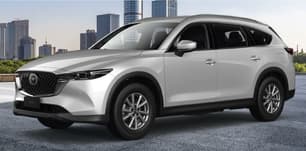
To be honest, I can't really tell the CX-8 and CX-9 apart on the road. They're both large SUVs that sport the classic Mazda bonnet - sharp and long. Up close, the CX-9 has a bulkier shape but otherwise they are remarkably similar.
The CX-8's darkened grille generates some interest with its lattice-work and there are enough shiny chrome accents scattered about the car that it looks pretty.
Yet, the sporty sharpness that Mazda is known for is still hinted at with its shaping and the 19-inch black alloy wheels.
Our model is finished in 'Platinum Quartz Metallic' and it is the highlight for the exterior styling for me. I think because it's such an interesting colour to look at - it varies a lot depending on lighting conditions. Sometimes, it almost has a sheen of pink to it and at others, it looks like pearly sand.
The interior looks polished and refined with its burgundy leather trim and soft-touchpoints. Again, there is a lot of chrome inside to make otherwise dull features, like air vents, pop out.
When the second-gen Compass was revealed, it was seen by many as a mini Grand Cherokee. Which isn’t a bad thing. It looks tough enough, but also has a softer edge than something like the Jimny.
As part of the 2021 update, Jeep refreshed the styling with slimmer LED headlights and a new daytime running light signature, a revamped bumper and seven-slot grille, as well as a broader bonnet.
The Trailhawk features variant-specific red and black decals on the bonnet, and a unique grille treatment, as well as the visible skid plates and red tow hooks.
It certainly gives the impression of having some off-road cred, and while some will love the Trailhawk name emblazoned across the bonnet, it’s a bit much for me. The 'Galaxy Blue' premium paint looks too sparkly in direct sunlight and has an almost purple hue.
An example of wishful thinking is the green ‘Diesel’ badge with a leaf next to it on the rear of the vehicle. Save the eco badges for your electrified vehicles, Jeep.
The CX-8 is a very practical family hauler because there's ample room in all three rows. Yes, even adults will be able to squeeze into that third row without too many complaints!
All rows enjoy well-cushioned seats and up front they are electrically adjustable, but unfortunately, only the driver's side has lumbar support.
The middle row can slide forward manually or by using the electric button found on the side of the seats... but doing it yourself is way faster.
They do slide far enough forward that you won't embarrass yourself too much when you have to clamber into the third row. Where the seats have a 50/50 split-fold and manual adjustments (accessed via the boot).
In the first two rows there are lots of individual storage options but the front enjoys the most. The middle console is deep enough to be useful and I like the dual opening lid. Each row gets a couple of cupholders and drink bottle holders, too.
The charging options are great, with each row getting two USB-C ports and the front getting a wireless charging pad and 12-volt socket.
All of the controls and dials feel within easy reach and the 10.25-inch touchscreen multimedia system graphics are clear.
You can use it as a touchscreen or opt for the rotary dial but switching between the two was awkward for me. Especially, since the touchscreen function is disabled when you are using the wireless Apple CarPlay. This also has wired Android Auto, for those users.
The amenities are practical throughout with a dark headliner, three-zone climate control and heated outboard seats and retractable sun-blinds in the middle row.
Good news for families because there are five top-tether points across the back rows and ISOFIX child seat mounts on the outboard seats in middle row, in case you need them.
You can fit a 0-4 rearward facing child seat and it shouldn’t impact on front passenger comfort.
My six-year old found it super easy to get in and out of this car because of the 205mm ground clearance and wide door apertures. He enjoyed the high seating position, too, but was disappointed he couldn’t see out of the sunroof!
The boot space is a bit cramped with all three rows are in use at 209L but folding the third row opens up a more respectable 775L - perfect for the average family and its stuff!
The loading space is level, with the temporary spare tyre and clever storage compartments housed underneath. There is a retractable cargo blind and net, luggage anchor points and a 12-volt port, too.
And, as always, I love a powered tailgate, which this has!
The Compass sits in the small-SUV category but its larger dimensions mean it’s almost big enough to compete with models in the medium-SUV segment.
It’s longer, taller, wider and has a longer wheelbase than other larger small SUVs like the Kia Seltos and Honda HR-V, but isn’t as big as a mid-size Mazda CX-5.
It feels larger inside than other models it shares a platform with – namely the Jeep Renegade and Fiat 500X, that are no longer sold in Australia.
The biggest change ushered in by the update is the interior. Jeep has completely overhauled the cabin to the point that it’s unrecognisable compared to the pre-facelifted model.
The new dash design is much more appealing and the layout is well executed. There’s a mixture of soft-touch materials and plastic panels with red stitching running across the fascia. It’s so much more up-to-date than the old Compass and there’s a robust yet semi-premium look to the cabin.
A new steering wheel is in keeping with Jeep’s new generation of models that includes the Grand Cherokee due in Australia this year. It’s chunky, feels nice to touch and features clear audio, phone and cruise controls.
Jeep has persisted with its quirk of housing the volume and song/station skip buttons on the rear side of the steering wheel spokes. Once you remember which side volume lives (the right), it’s easy to change the levels. But surely it would be better to house them on the front of the wheel, with labels?
Storage wise, the glove box is narrow, as is the central bin, but it’s deep. The doors will hold 600ml bottles and the console houses two decent-sized cupholders with durable rubber lining which is easy to clean and can take a beating. The cupholders are separated by an upright phone holder.
Speaking of durable, that’s clearly the theme Jeep is going for with the Compass Trailhawk interior. It comes standard with rubber mats throughout, including the boot, which is great for protecting the carpet if you fancy a bit of camping.
What isn’t durable, however, is the cheap and tacky indicator stalk that feels like it will snap off every time you touch it.
After spending some time in European cars prior to the Jeep, it’s nice to experience strong air flow from the air conditioning system, especially at the height of a Melbourne summer. It’s also great to see physical buttons for the air con controls.
You can, however, also control the climate via the latest 'Uconnect 5' multimedia system housed in the 10.1-inch touchscreen.
This system is undoubtedly one of the Compass’ strong points. The modern graphics look very cool and the main icons make sense.
Once you dive into the menu there are extensive options but it’s not overwhelming. It’s intuitive and clever. The sat-nav visuals are clear and appealing too.
It’s an excellent set-up and better than systems from a whole host of Jeep’s mainstream rivals.
Apple CarPlay set-up was easy but there is an odd lag when selecting a command on the touchscreen that isn’t there when you use the Jeep system.
Another highlight is the exceptional Alpine nine-speaker audio system that’s part of the Trailhawk Premium package. It’s a belter!
The new digital instrument cluster has clear dials but changing the screen layout is fiddly. The Compass also lacks a head-up display.
The front seats with red embossed Trailhawk across the front look good, but the cushion feels like it’s elevating you in the seat. It’s not a problem with the power adjustment, it’s just the way the cushioning is designed. Thigh support is limited but upper body bolstering is good.
Visibility is impacted by the narrow rear windscreen and the tiny rear windows behind the C-pillar, that are pointless.
Rear occupants have access to lower air vents, a USB-A and USB-C port, 230-volt AC plug and a 12-volt DC plug. There are two map pockets, rubber floor mats and 600ml bottles will just fit in the door.
Space wise, there’s plenty of leg and toe room in the rear, and just enough headroom for this six-footer to avoid scraping the headliner.
Getting in and out of the front and rear seats is easy thanks to the Compass’ ride height.
The rear seats are flat and firm and the 60/40 split-fold seats have a fold-down central armrest with two cupholders.
When you open the power tailgate, the boot doesn’t look particularly big, but at 438 litres (1251L with rear seats folded), it’s five litres more than the Kia Seltos GT-Line and eight more than the Haval Jolion.
A full-size spare wheel lives under the boot floor and the cargo area features metal tie-down hooks and a small storage tray.
The cargo blind is useful but there’s nowhere to stow it when it’s not in use. And you have to lower the rear seats when you want to put it back in place.
The GT SP diesel AWD is one of the premium models, sitting third from the top and will cost you $65,560, before on road costs.
However, its price tag positions it as the most expensive compared to its rivals. With the closest rival being the Kluger at $65,310 and the most affordable being the Santa Fe at $60,000.
You do get a stylish-looking package with lots of features for your cash, like heated front seats, heated rear outboard seats, a tilt and slide sunroof, and premium leather interior trim.
There's some great tech scattered throughout, too, like the 10.25-inch touchscreen multimedia system, wireless charging pad, USB-A ports in the third row, Bose Premium sound system with 10 speakers, wireless Apple CarPlay and wired Android Auto.
Jeep’s pricing for the updated Compass range is at the higher end of the segment compared with its rivals. It starts at $37,950, before on-road costs, for the Launch Edition and tops out at $51,650 for the range-topping Trailhawk.
Our Compass Trailhawk test vehicle was fitted with options including premium paint ($895) and a 'Trailhawk Premium' package ($4195) that added heated and ventilated front seats, heated steering wheel, a panoramic sunroof and a nine-speaker Alpine audio system. That bumped the price up to $56,740 before ORC, meaning it’s about $60,000 on the road.
Top-spec versions of competitor small SUVs are much cheaper than that. The Kia Seltos GT-Line is $42,200, the Mazda CX-30 X20 Astina is $47,390 and even the European Peugeot 2008 GT Sport is $43,990.
Considering you can buy an Audi Q3 40 TFSI quattro for $61,600 or a Volvo XC40 T5 R-Design for $56,990, Jeep is creeping into premium territory with the Compass Trailhawk.
Luckily, Jeep has packed the Compass Trailhawk with loads of standard goodies.
The Indian-built SUV includes keyless entry and start, wireless charging, leather bucket seats, dual-zone air conditioning, eight-way power adjustable driver’s seat, power folding exterior mirrors, auto-dimming rear-view mirror, a 10.25-inch digital instrument cluster, a 10.1-inch multimedia screen housing a 360-degree surround-view camera, satellite navigation and wireless Apple CarPlay/Android Auto.
As the rugged Compass variant, the Trailhawk comes with off-road bits as standard, like underbody skid plates, a 180-amp alternator, two front (red) tow hooks, reversible carpet and vinyl cargo mat, low-range gearing as part of the four-wheel drive system, hill hold control and a terrain-type mode selector.
Despite all the standard gear and unique off-road features, it still doesn’t represent great value compared with its rivals.