What's the difference?
Mazda has a tendency to have a lot of similar looking horses in the stable; blink and you'll miss the (very) subtle differences between the CX-8 and the CX-9 but if you're not super keen on the bulk of the CX-9 and you've outgrown the space of the CX-5... this one's for you.
Especially, if you've been considering its competition - the Hyundai Santa Fe Elite CRDi AWD and Toyota Kluger GXL AWD. Both of which have become known for their features and space.
So, how does it compare? The CX-8 GT SP diesel all-wheel drive seats seven, has a decent boot space (albeit, when the third row isn't in use) and handles like a dream.
Perfect combination? Maybe. I've been driving it for the last week with my family to find out for you.
The updated Audi Q7 is a bit of a game of ‘spot the difference’ - but even though it’s far from a new generation, the update is more than just some shiny new bits.
While the brand’s first SUV is still in its second generation, a bit of modernised design and some tech tweaks are aimed at keeping it in line with rivals, even as it nears a decade on sale.
As well as the new features, there’s also a new variant bound for Aussie showrooms. So, is it still up to the task?
So, what did my family think about the Mazda CX-8 GT SP diesel all-wheel drive? I love how it performs on the road - it's super easy to drive and you don't notice how large it is in a car park.
There are some great family-friendly features scattered throughout and I like how practical this is too with the extra seats and top-tether points. The multimedia system isn’t my favourite and I would have preferred to have seen a few extra airbags and a 360-degree view camera, but overall, it’s a good family car and gets an 8.0/10 from me.
My son loved the sun blinds and the cool colour of the seats. He also gives it an 8.0/10.
Overall, changes to the Q7 aren’t quite revolutionary, but that’s okay because it was already a fantastic large SUV.
The fact Audi has kept the price around the same mark and introduced a cheaper entry-grade should be welcome news for prospective buyers.
But even the existing variants are capable and impressive family haulers… and now they’re just that little bit better.
Note: CarsGuide attended this event as a guest of the manufacturer, with travel, accommodation and meals provided.
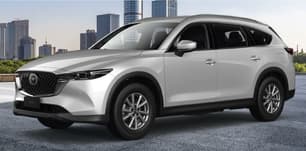
To be honest, I can't really tell the CX-8 and CX-9 apart on the road. They're both large SUVs that sport the classic Mazda bonnet - sharp and long. Up close, the CX-9 has a bulkier shape but otherwise they are remarkably similar.
The CX-8's darkened grille generates some interest with its lattice-work and there are enough shiny chrome accents scattered about the car that it looks pretty.
Yet, the sporty sharpness that Mazda is known for is still hinted at with its shaping and the 19-inch black alloy wheels.
Our model is finished in 'Platinum Quartz Metallic' and it is the highlight for the exterior styling for me. I think because it's such an interesting colour to look at - it varies a lot depending on lighting conditions. Sometimes, it almost has a sheen of pink to it and at others, it looks like pearly sand.
The interior looks polished and refined with its burgundy leather trim and soft-touchpoints. Again, there is a lot of chrome inside to make otherwise dull features, like air vents, pop out.
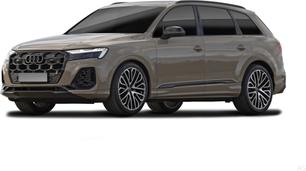
The phrase ‘evolution not revolution’ is applicable here, cliche as it is, with the Q7 having been given a Botox-style lift at the front end.
The standard matrix LED headlights have a higher lighting signature than before, with the lighting elements leading into the lines down the shoulder of the SUV.
The grille now features a hexagonal honeycomb insert, the vertical line styling is now a thing of the past and the functional side vents are a little more aggro.
Overall, it’s a sharper look that brings the Q7 up to date with Audi’s current design language, down to the more angular wheel choices.
At the rear, the new tail-lights are ‘joined’ via a chrome strip spanning the rear, and the lower bumper (with real exhaust exits) has had a refresh.
Audi’s new CI badging (or ‘corporate identity’, pretty sexy stuff) is also present, which includes a new typeface for the ‘Q7’ badge at the rear, which is no longer italicised and is separate from the red ‘S line’ rhombus.
The four rings badge is also flatter and is white with black outlines, rather than a three-dimensional chrome badge.
Inside, the changes are more than skin-deep. In fact, the skin is the same, you’d be hard pressed to notice anything different about the Q7’s interior between pre- and post-facelift without diving into the electronics.
The CX-8 is a very practical family hauler because there's ample room in all three rows. Yes, even adults will be able to squeeze into that third row without too many complaints!
All rows enjoy well-cushioned seats and up front they are electrically adjustable, but unfortunately, only the driver's side has lumbar support.
The middle row can slide forward manually or by using the electric button found on the side of the seats... but doing it yourself is way faster.
They do slide far enough forward that you won't embarrass yourself too much when you have to clamber into the third row. Where the seats have a 50/50 split-fold and manual adjustments (accessed via the boot).
In the first two rows there are lots of individual storage options but the front enjoys the most. The middle console is deep enough to be useful and I like the dual opening lid. Each row gets a couple of cupholders and drink bottle holders, too.
The charging options are great, with each row getting two USB-C ports and the front getting a wireless charging pad and 12-volt socket.
All of the controls and dials feel within easy reach and the 10.25-inch touchscreen multimedia system graphics are clear.
You can use it as a touchscreen or opt for the rotary dial but switching between the two was awkward for me. Especially, since the touchscreen function is disabled when you are using the wireless Apple CarPlay. This also has wired Android Auto, for those users.
The amenities are practical throughout with a dark headliner, three-zone climate control and heated outboard seats and retractable sun-blinds in the middle row.
Good news for families because there are five top-tether points across the back rows and ISOFIX child seat mounts on the outboard seats in middle row, in case you need them.
You can fit a 0-4 rearward facing child seat and it shouldn’t impact on front passenger comfort.
My six-year old found it super easy to get in and out of this car because of the 205mm ground clearance and wide door apertures. He enjoyed the high seating position, too, but was disappointed he couldn’t see out of the sunroof!
The boot space is a bit cramped with all three rows are in use at 209L but folding the third row opens up a more respectable 775L - perfect for the average family and its stuff!
The loading space is level, with the temporary spare tyre and clever storage compartments housed underneath. There is a retractable cargo blind and net, luggage anchor points and a 12-volt port, too.
And, as always, I love a powered tailgate, which this has!
Audi has changed the layout and added new apps in the main 10.1-inch multimedia touchscreen, though fortunately it still has shortcuts to all the Big Dogs in terms of functions: media, navigation, phone, etc.
On top of that, everything is still in big, easy-to-see (and press) blocky buttons on the main screen.
The 8.6-inch screen below also still has climate controls readily available, and there are still physical buttons for a bunch of functions including drive modes.
The wide 12.3-inch driver display also remains familiar, though now has a higher resolution and more functionality in terms of on-road help and safety - which we’ll come to later in this review.
Aside from the tech, ‘spacious’ is an understatement when it comes to the big Audi’s cabin. In the front seats especially, the Q7’s central tunnel and dashboard are easy to reach without feeling like an enclosure as they wrap around the front passengers.
However, if I had to level one criticism at the usefulness of the Q7’s front row, it would be that despite there being physically plenty of room, storage is at a premium.
For something this big, there aren’t many places to put items that aren’t your phone or a drink.
There are door card holders for bigger bottles, some space for small items, and the cupholders of course, but the space under the central armrest including the phone charger is stingy.
Fortunately, the second row is not lacking space and is modular in its adjustability. Occupants can move seats, adjust their angle, and even sort out the middle seat separately.
Depending on how high up the variant chain you go, separate climate controls for the middle row and the panoramic sunroof help create a comfortable and roomy feeling.
The second row can also be tucked up behind the front row for easier access to the third row, which (if the second row is slid forward a tad) is just spacious enough for an average adult to be relatively comfortable for a short trip.
The third row seats are able to be folded or raised with switches that are accessible from the side doors or the (electric) tailgate, where there’s also a switch to lower or raise the rear suspension by 55mm to aid loading.
On that, the Q7 has a claimed luggage capacity of roughly 295L with all seats up, 780L with the third row folded down and 1908L with the second row lowered.
The GT SP diesel AWD is one of the premium models, sitting third from the top and will cost you $65,560, before on road costs.
However, its price tag positions it as the most expensive compared to its rivals. With the closest rival being the Kluger at $65,310 and the most affordable being the Santa Fe at $60,000.
You do get a stylish-looking package with lots of features for your cash, like heated front seats, heated rear outboard seats, a tilt and slide sunroof, and premium leather interior trim.
There's some great tech scattered throughout, too, like the 10.25-inch touchscreen multimedia system, wireless charging pad, USB-A ports in the third row, Bose Premium sound system with 10 speakers, wireless Apple CarPlay and wired Android Auto.
Four variants are available in the Audi Q7 line-up, excluding the performance-bent SQ7. Well, at the time of the launch event, one of those four is yet to arrive, that being the new entry-grade Q7 45 TFSI which starts from $108,815, before on-road costs. TFSI being ‘Turbo Fuel Stratified Injection’ or Audi-speak for ‘turbo-petrol’.
It’s joined by a diesel-powered 45 TDI which starts from $117,284, before on-roads. But ‘entry-grade’ for the Q7 doesn’t mean skint on goodies, both coming in with standard gear like leather-appointed upholstery with heated electrically adjustable front seats, an electric folding third row, wireless phone charging, screens and tech galore, matrix LED headlights, 20-inch wheels, adaptive air suspension, and a slew of safety features including some new stuff, but we’ll get to that later.
The matrix LEDs are one of the main new bits of kit, though a daytime drive route meant not getting to put those to use. They’re pretty, though…
The 45 grades can be upgraded with the $3900 'Premium Package' to add 21-inch alloys, four-zone climate control, black exterior styling and coloured interior ambient lighting.
Stepping up from the 45s are the 50 TDI S line and 55 TFSI S line, which together at $136,815 each form the next rung up from entry.
They’ve got 21-inch wheels and an S line exterior pack along with tinted privacy glass to tell them apart from the entry 45s from the outside, but inside there’s four-zone climate control, ambient lighting, a Bang & Olufsen sound system, a head-up display and proper leather upholstery for the seats.
Australian 50 TDIs and 55 TFSIs come standard with an S line interior pack that includes sports seats, leather steering wheel and shifter, aluminium inlays and door trim, plus black headlining and floor mats with contrast stitching.
There are two option packs at this level: the $4200 'Luxury Seat Package' adds S sports seats that feature an integrated headrest, Valcona leather with diamond stitching, ventilation for the front seats and heating for the second row’s outboard seats.
Then there’s a 'Premium Plus Package' for $5500 which brings 22-inch alloys, sport-tuned adaptive air suspension, dynamic all-wheel steering, a black exterior styling pack and power-assisted closing doors.
Given the update is all up relatively minor, prospective buyers will be pleased to know the same can be said for the pricing changes - even a year ago, the prices for the Q7 variants that were on sale at the time were within a couple of thousand dollars of where they are now.