What's the difference?
Mazda has a tendency to have a lot of similar looking horses in the stable; blink and you'll miss the (very) subtle differences between the CX-8 and the CX-9 but if you're not super keen on the bulk of the CX-9 and you've outgrown the space of the CX-5... this one's for you.
Especially, if you've been considering its competition - the Hyundai Santa Fe Elite CRDi AWD and Toyota Kluger GXL AWD. Both of which have become known for their features and space.
So, how does it compare? The CX-8 GT SP diesel all-wheel drive seats seven, has a decent boot space (albeit, when the third row isn't in use) and handles like a dream.
Perfect combination? Maybe. I've been driving it for the last week with my family to find out for you.
Honda used to be a big deal in Australia back in the 1990s and early 2000s but I wouldn’t be surprised if it’s moved off your radar in recent years.
The Japanese carmaker has seemingly fallen out of favour in the last few years following its move to an agency retail model which negates haggling on price with dealers.
However, Honda is making a resurgence and it’s putting a heavier focus on hybrid power.
The ZR-V small-to-medium SUV has been updated for 2026 and picks up new, more affordable hybrid trims, among other minor tweaks. Read on to see if this car should be on your shortlist.
So, what did my family think about the Mazda CX-8 GT SP diesel all-wheel drive? I love how it performs on the road - it's super easy to drive and you don't notice how large it is in a car park.
There are some great family-friendly features scattered throughout and I like how practical this is too with the extra seats and top-tether points. The multimedia system isn’t my favourite and I would have preferred to have seen a few extra airbags and a 360-degree view camera, but overall, it’s a good family car and gets an 8.0/10 from me.
My son loved the sun blinds and the cool colour of the seats. He also gives it an 8.0/10.
The Honda ZR-V has always been an engaging and fun car that’s the right size for many people. The frugal hybrid powertrain has always been the pick too.
It’s great that Honda has finally introduced more affordable hybrid trims with this update which addresses one of my biggest criticisms of this car previously.
If you’re willing to forgo some luxury features, this entry-level hybrid trim is a fantastic car that still offers enough creature comforts to be driven daily.
Hopefully Honda has some renewed sales success with this car as I believe it’s a clear benchmark for the segment.
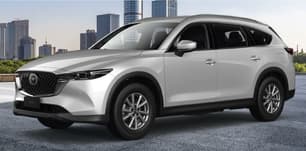
To be honest, I can't really tell the CX-8 and CX-9 apart on the road. They're both large SUVs that sport the classic Mazda bonnet - sharp and long. Up close, the CX-9 has a bulkier shape but otherwise they are remarkably similar.
The CX-8's darkened grille generates some interest with its lattice-work and there are enough shiny chrome accents scattered about the car that it looks pretty.
Yet, the sporty sharpness that Mazda is known for is still hinted at with its shaping and the 19-inch black alloy wheels.
Our model is finished in 'Platinum Quartz Metallic' and it is the highlight for the exterior styling for me. I think because it's such an interesting colour to look at - it varies a lot depending on lighting conditions. Sometimes, it almost has a sheen of pink to it and at others, it looks like pearly sand.
The interior looks polished and refined with its burgundy leather trim and soft-touchpoints. Again, there is a lot of chrome inside to make otherwise dull features, like air vents, pop out.
The exterior of the ZR-V has always left me feeling quite… meh. It’s a mundane and generic look that doesn’t stand out from the crowd, but that's no bad thing because not everyone wants a flashy car.
That said, I’m still not a fan of the front grille, which makes it look like this car has a moustache.
The dark red paint looks nice, though when it’s paired with these generic-looking grey alloy wheels and black wheel arch cladding, it cheapens the look. The top-spec e:HEV LX looks more attractive.
Inside, it’s similarly standard and doesn’t break the mould. Everything is where you’d expect it to be, which is great for functionality.
The wildest part of the interior is the centre tunnel which features a push-button gear selector and a split console section including a small storage area underneath that’s big enough for a phone.
Looking around, it’s a sea of black finishes, which is a bit boring. However, I do like the mesh panel that spans the dashboard and houses the air vents. It’s a premium touch.
The CX-8 is a very practical family hauler because there's ample room in all three rows. Yes, even adults will be able to squeeze into that third row without too many complaints!
All rows enjoy well-cushioned seats and up front they are electrically adjustable, but unfortunately, only the driver's side has lumbar support.
The middle row can slide forward manually or by using the electric button found on the side of the seats... but doing it yourself is way faster.
They do slide far enough forward that you won't embarrass yourself too much when you have to clamber into the third row. Where the seats have a 50/50 split-fold and manual adjustments (accessed via the boot).
In the first two rows there are lots of individual storage options but the front enjoys the most. The middle console is deep enough to be useful and I like the dual opening lid. Each row gets a couple of cupholders and drink bottle holders, too.
The charging options are great, with each row getting two USB-C ports and the front getting a wireless charging pad and 12-volt socket.
All of the controls and dials feel within easy reach and the 10.25-inch touchscreen multimedia system graphics are clear.
You can use it as a touchscreen or opt for the rotary dial but switching between the two was awkward for me. Especially, since the touchscreen function is disabled when you are using the wireless Apple CarPlay. This also has wired Android Auto, for those users.
The amenities are practical throughout with a dark headliner, three-zone climate control and heated outboard seats and retractable sun-blinds in the middle row.
Good news for families because there are five top-tether points across the back rows and ISOFIX child seat mounts on the outboard seats in middle row, in case you need them.
You can fit a 0-4 rearward facing child seat and it shouldn’t impact on front passenger comfort.
My six-year old found it super easy to get in and out of this car because of the 205mm ground clearance and wide door apertures. He enjoyed the high seating position, too, but was disappointed he couldn’t see out of the sunroof!
The boot space is a bit cramped with all three rows are in use at 209L but folding the third row opens up a more respectable 775L - perfect for the average family and its stuff!
The loading space is level, with the temporary spare tyre and clever storage compartments housed underneath. There is a retractable cargo blind and net, luggage anchor points and a 12-volt port, too.
And, as always, I love a powered tailgate, which this has!
In base-model form, it’s expected the ZR-V will have fabric upholstery. However, the seats still feel premium and are deliciously padded. They’re manually adjusted but I was still able to find a good driving position with ease.
One feature I was looking for was heated seats, especially on these brisk Melbourne mornings. It’s rare for a car with fabric seats to get heated seats, though. If you want them that badly, they’re available on higher trims.
Ahead of the driver is a leather-wrapped steering wheel which feels lovely. I particularly like the tactile feel of the buttons and switches.
The digital instrument cluster is clear and crisp. It offers multiple views to customise it, as well as a range of infographic pages to cycle through. I wish you could see the fuel consumption and hybrid system graphics at the same time, but thankfully they’re just a single scroll away from each other.
Moving across, the central touchscreen multimedia system is looking a small in 2026, measuring only 9.0 inches, although it’s still high-resolution and the colours are vibrant.
It appears computing power has been given a boost along with the integration of Google Built-in, as jumping from menu to menu has never been snappier.
Speaking of Google Built-in, it’s great to have the flexibility of using the integrated Google Maps and apps like Spotify and Apple Music, without needing your phone.
However, it’s still nice having Apple CarPlay and Android Auto, though the latter is strangely only offered in wired form. With my iPhone 15 Pro Max, the wireless connection was rock solid, though known interference points did cause CarPlay to stutter.
It’s great to see Honda retaining a physical climate control cluster as it’s intuitive to use. The dials in particular have a satisfying click when twirled.
In terms of storage there are two cupholders, two USB-C ports, a big centre console box, as well as an adequately sized glove box. It’s worth noting this trim level forgoes a wireless charger, meaning you’ll need to plug in to charge your phone.
Moving to the second row, there’s a surprising amount of space, even for adults. At a leggy 182cm, I have plenty of legroom and headroom.
You would easily be able to get two adults in the second row, though you’d be pushing it to fit three as the middle seat is narrow and raised. Kids will be fine, though.
Adding to the annoyance of the middle rear seat, the seat belt is mounted from the roof, which can obstruct rear visibility.
In terms of amenities there are air vents on the back of the front centre console, two USB-C ports, map pockets on the back of each front seat, as well as a fold-down centre armrest with cupholders.
There are also ISOFIX points on the two outboard seats, as well as top-tether child seat anchorages on all three rear seats.
Around the back it’s expected the entry-level hybrid will feature a manually operated tailgate. It’s light to open and close.
With the rear seats upright there’s 380L of boot space available, which is decent for this size of car. This figure includes a small underfloor section.
If you fold the rear seats the boot space expands to 1312L, which is cavernous for this type of car. The rear seats cleverly fold forwards and down at the same time, creating a seamless flat floor.
Boot-related amenities include a number of hooks, a 12V socket plus some lights. As is the case with many hybrids, the ZR-V e:HEV doesn’t come with any spare wheel. You need to make do with a tyre repair kit, which is nowhere near as handy if you have a proper puncture away from a tyre repair shop.
The GT SP diesel AWD is one of the premium models, sitting third from the top and will cost you $65,560, before on road costs.
However, its price tag positions it as the most expensive compared to its rivals. With the closest rival being the Kluger at $65,310 and the most affordable being the Santa Fe at $60,000.
You do get a stylish-looking package with lots of features for your cash, like heated front seats, heated rear outboard seats, a tilt and slide sunroof, and premium leather interior trim.
There's some great tech scattered throughout, too, like the 10.25-inch touchscreen multimedia system, wireless charging pad, USB-A ports in the third row, Bose Premium sound system with 10 speakers, wireless Apple CarPlay and wired Android Auto.
Honda has shuffled the ZR-V line-up for 2026, decreasing the petrol variants to a single, entry-level trim, while increasing the hybrid grades from one to three.
On test here is the ZR-V e:HEV X, which is the cheapest hybrid. It’s priced from $43,400, drive-away, which is $3500 more than the base petrol trim and $8500 less than the top-spec hybrid option.
This is priced keenly against entry-level versions of the Hyundai Kona Hybrid and Toyota Corolla Cross Hybrid, while undercutting the Nissan Qashqai e-Power hybrid.
For the price you get standard 18-inch alloy wheels, adaptive LED headlights, a 10.2-inch digital instrument cluster, a 9.0-inch touchscreen multimedia system with wireless Apple CarPlay and wired Android Auto, dual-zone climate control and cloth upholstery.
Now standard across the ZR-V line-up is Google Built-in which allows for Google Maps integration, the Google Assistant, plus you can download a number of apps, including Spotify, from the Google Play Store.
If you’re after features like a power tailgate, premium sound system, wireless charger, leather upholstery, plus heated seats with electric adjustment, you’ll need to look higher in the line-up. These are largely all nice-to-haves than musts, anyway.