What's the difference?
Mazda has a tendency to have a lot of similar looking horses in the stable; blink and you'll miss the (very) subtle differences between the CX-8 and the CX-9 but if you're not super keen on the bulk of the CX-9 and you've outgrown the space of the CX-5... this one's for you.
Especially, if you've been considering its competition - the Hyundai Santa Fe Elite CRDi AWD and Toyota Kluger GXL AWD. Both of which have become known for their features and space.
So, how does it compare? The CX-8 GT SP diesel all-wheel drive seats seven, has a decent boot space (albeit, when the third row isn't in use) and handles like a dream.
Perfect combination? Maybe. I've been driving it for the last week with my family to find out for you.
The first-generation Volvo XC90 remained on sale for 12 years in Australia before being replaced by the handsome second-gen version that recently clocked up a decade of sales.
There’s a reason for the longevity. People love the Volvo XC90. It is a reliable seven-seat family-friendly SUV with a premium bent. You’ll spot loads of these at fancy private school drop off.
Volvo has extended the life of the second-gen XC90 with a significant late-life update. It adopts some features from its stablemate, the similarly sized and positioned EX90 electric SUV.
It doesn’t get a fully-electric powertrain but you have the choice of a mild-hybrid grade that acts as the range opener and the well-equipped T8 Plug-In Hybrid I’m testing.
Interestingly, a number of this car’s rivals have had their lives extended, too. As many carmakers pour billions into EVs, they’ve taken to delivering major updates to older internal combustion platforms rather than developing all-new underpinnings. The Audi Q7 and BMW X5 are other examples of this.
For the update, Volvo has ushered in a front-end design refresh, a fresh take on the interior, new multimedia and safety tech, a light tweak to suspension and new colours and wheels.
But is this enough to keep premium SUV buyers interested? Let’s find out…
So, what did my family think about the Mazda CX-8 GT SP diesel all-wheel drive? I love how it performs on the road - it's super easy to drive and you don't notice how large it is in a car park.
There are some great family-friendly features scattered throughout and I like how practical this is too with the extra seats and top-tether points. The multimedia system isn’t my favourite and I would have preferred to have seen a few extra airbags and a 360-degree view camera, but overall, it’s a good family car and gets an 8.0/10 from me.
My son loved the sun blinds and the cool colour of the seats. He also gives it an 8.0/10.
It’s a credit to Volvo that the XC90 feels like a new car, even with its older underpinnings. This latest update has successfully addressed areas that needed the most attention, namely the multimedia system, interior and exterior design. The electric driving range now feels somewhat old school compared to the numbers some manufacturers can achieve these days. A lot of PHEVs now exceed 100km EV range and buyers are starting to expect that. And setting up the third row takes way too much effort to want to do it regularly. The new Volvo XC90 is a comfortable, engaging and properly premium family SUV and the updates have only improved what was already a solid offering.
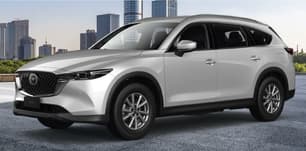
To be honest, I can't really tell the CX-8 and CX-9 apart on the road. They're both large SUVs that sport the classic Mazda bonnet - sharp and long. Up close, the CX-9 has a bulkier shape but otherwise they are remarkably similar.
The CX-8's darkened grille generates some interest with its lattice-work and there are enough shiny chrome accents scattered about the car that it looks pretty.
Yet, the sporty sharpness that Mazda is known for is still hinted at with its shaping and the 19-inch black alloy wheels.
Our model is finished in 'Platinum Quartz Metallic' and it is the highlight for the exterior styling for me. I think because it's such an interesting colour to look at - it varies a lot depending on lighting conditions. Sometimes, it almost has a sheen of pink to it and at others, it looks like pearly sand.
The interior looks polished and refined with its burgundy leather trim and soft-touchpoints. Again, there is a lot of chrome inside to make otherwise dull features, like air vents, pop out.
Back in early 2015, I attended the international launch of the second-generation Volvo XC90. At the time I thought it was a handsome SUV, with Volvo successfully interpreting what is essentially a big people-hauling box on wheels with typical Scandinavian flair.
There’s been a facelift since then, but this latest refresh brings the XC90 bang up to date.
New elements include a modern take on the 'Thor's Hammer' LED headlights, and a new bonnet and grille with an updated diagonal logo spread across the car's face. At the rear the only change is slightly darker tail-lights.
The new grille in particular looks great, and with all of the blacked-out elements of the T8 - grille, lower air intakes, parts of the apron, mirror caps, roof rails and window surrounds - it looks quite cool, especially contrasted with the test car's 'Crystal White' paint. It has elevated the overall look.
Inside, Volvo has made big changes, mostly with the dash and console. It retains the familiarity of other Volvos, but is much more in keeping with its new all-electric EX90 sibling.
It still has a horizontal theme, but with cool new vertical air vents. The new multimedia screen fits well into the dash layout, and isn’t over sized. It’s the ideal size at 11.2 inches. There are a few buttons underneath but not many.
The mix of materials used at the front of the cabin includes ‘Grey Ash’ wood, piano black, chrome, metal-look speakers, grey fabric and soft touch as well as hard plastics. It sounds like it would be too much but it works well.
Volvo has always been a leader when it comes to car seats and the new XC90 is no exception. The beautifully designed ventilated charcoal Nappa leather seats look and feel stunning. The tiny Swedish flag is a nice touch, too.
The engine start/stop button and the crystal selector add a touch of glamour to the cabin. Overall, the XC90 feels properly premium inside, still with a Scandinavian bent. Just lovely.
The CX-8 is a very practical family hauler because there's ample room in all three rows. Yes, even adults will be able to squeeze into that third row without too many complaints!
All rows enjoy well-cushioned seats and up front they are electrically adjustable, but unfortunately, only the driver's side has lumbar support.
The middle row can slide forward manually or by using the electric button found on the side of the seats... but doing it yourself is way faster.
They do slide far enough forward that you won't embarrass yourself too much when you have to clamber into the third row. Where the seats have a 50/50 split-fold and manual adjustments (accessed via the boot).
In the first two rows there are lots of individual storage options but the front enjoys the most. The middle console is deep enough to be useful and I like the dual opening lid. Each row gets a couple of cupholders and drink bottle holders, too.
The charging options are great, with each row getting two USB-C ports and the front getting a wireless charging pad and 12-volt socket.
All of the controls and dials feel within easy reach and the 10.25-inch touchscreen multimedia system graphics are clear.
You can use it as a touchscreen or opt for the rotary dial but switching between the two was awkward for me. Especially, since the touchscreen function is disabled when you are using the wireless Apple CarPlay. This also has wired Android Auto, for those users.
The amenities are practical throughout with a dark headliner, three-zone climate control and heated outboard seats and retractable sun-blinds in the middle row.
Good news for families because there are five top-tether points across the back rows and ISOFIX child seat mounts on the outboard seats in middle row, in case you need them.
You can fit a 0-4 rearward facing child seat and it shouldn’t impact on front passenger comfort.
My six-year old found it super easy to get in and out of this car because of the 205mm ground clearance and wide door apertures. He enjoyed the high seating position, too, but was disappointed he couldn’t see out of the sunroof!
The boot space is a bit cramped with all three rows are in use at 209L but folding the third row opens up a more respectable 775L - perfect for the average family and its stuff!
The loading space is level, with the temporary spare tyre and clever storage compartments housed underneath. There is a retractable cargo blind and net, luggage anchor points and a 12-volt port, too.
And, as always, I love a powered tailgate, which this has!
Any dedicated seven-seat family SUV needs to nail practicality and when it comes to the Volvo XC90, there are clear pros and some surprising cons.
One of the many pros is the seats. As mentioned, they look schmick, but are also supremely comfortable and offer the perfect level of bolstering and support. The T8 has a seat adjustment memory function that can be programmed into the driver profiles that also tailors other functions to suit different drivers.
The quality of the materials and build quality of the cabin is largely impressive. Even the damping of the indicator stalk has a feeling of high-end quality.
Volvo’s digital instrument cluster is clear and easy to navigate, once you work out what the buttons on the steering wheel do. They don’t have words on them so it takes a while. The driver’s manual comes in handy for this.
The big story in the cabin is the new 11.2-inch multimedia display. Volvo uses a Google platform and the car comes with Google Services which includes Google Assistant voice control, Maps and Play.
I’m a fan of Apple CarPlay and once I have assessed a car’s in-house multimedia system I often defer to CarPlay. It’s simple and familiar. But aside from using CarPlay to connect once, I used Volvo’s system for the vast majority of my time with this car.
Logging into your Google account means your favourites come up on the map and there is no downside to functionality. If I had the car for longer I would've added Spotify to the system and logged into that, too, but I was happy listening to digital radio on the phenomenal 19-speaker Bowers & Wilkins sound system.
The screen takes some familiarisation, but once you understand the home keys and how to switch between apps, it’s a pleasure to use. It has a clear layout, nice graphics and is responsive. Yes, the air con controls are mostly housed in the screen, but if you tap the lower part of the screen the entire climate menu appears. It is light years ahead of Volvo’s previous screen set-up.
Most functions are housed in the screen, although there are buttons just under the screen for volume and audio on/off, front and rear demisters, hazard lights and a button to open the glove box.
Storage up front is just okay. The console houses shallow cupholders and a handy upright phone holder, as well as the device charging pad. It’s a shame there’s no under console storage, but the transmission tunnel might be too chunky for that.
The shallow central bin houses two USB-C ports and a 12-volt outlet. Bottle storage is decent in the front door cards.
The panoramic sunroof only has a sheer blind (it’s powered) which is less than ideal in a country like Australia. It’s been fine in winter but I’m curious to know what it’s like in the height of summer.
The second row features manual window blinds to keep your little ones cool.
There’s some back support for the second-row seats but the base is flat. Some of the seat fabric in that row looks like it doesn’t quite fit, but I think that’s the nature of the leather with the intricate designs.
In terms of space, there’s ample leg, toe and headroom, and the rear backrests recline for extra comfort on long trips. The bases roll forward and back and the seats are split 40/20/40.
Kids will likely fight over who has to sit in the middle seat because the combination of an intrusive transmission tunnel and the rear of the front centre console protruding into the space means it is not a great seat.
Occupants have access to chest and knee-level air vents, heated seat and digital climate controls, map pockets, two USB-C ports and a central fold-down armrest with a fiddly cupholder mechanism. The rear doors will only house small, narrow bottles.
Accessing the third row of the Volvo is challenging. For starters, to move the second row seats forward you need to use the lever at the top of the seat and the roller under the base to move them. And they are heavy seats. That leaves just enough of an aperture to get into the third row.
But first you have to raise the third row. Sadly there’s no lever in the boot area to quickly raise or lower the third-row seats. You have to either climb into the boot and reach for the lever at the top of the seats, or reach through the back door and try and raise them that way. And again, they are heavy.
It is a deeply unintuitive system and leaves you exhausted and frustrated. Especially when you consider other seven seaters have a much more functional and lightweight third-row arrangement.
Once in the third row, it’s clear it is for humans with tiny legs only. It is not a space appropriate for six-foot tall men like me, even for short distances. You do get ample headroom, air vents, cupholders and storage boxes on either side that open up to show a kid-friendly spider web design with a friendly looking spider. Cute!
The seats fold flat into the boot floor and the loading lip is level with the floor so loading heavy or long items should be a breeze. You can adjust the air suspension from the boot to lower the height further which is always a handy feature.
It comes with a solid cargo blind but you need to remove it if you want to raise the third row. When putting it back in, it catches on the third-row seat belts, so it’s not the best design.
In terms of boot features, the Volvo comes with a household charging cable that is housed neatly under the boot floor in a stylish bag. Many PHEVs and EVs still don’t have a dedicated spot to house a cable so you have to take up boot space with a chunky cable bag. Good job, Volvo.
It has a powered tailgate, a few nooks and a pair of 5.0kg hooks. However, it doesn’t have a spare wheel of any description. Just a tyre repair kit. This is due to packaging restrictions, but it’s never an ideal solution.
In terms of space, the Volvo can swallow 640 litres of cargo with the second row up and 301L with all three rows in place. That latter figure isn’t bad compared to some seven-seaters.
The GT SP diesel AWD is one of the premium models, sitting third from the top and will cost you $65,560, before on road costs.
However, its price tag positions it as the most expensive compared to its rivals. With the closest rival being the Kluger at $65,310 and the most affordable being the Santa Fe at $60,000.
You do get a stylish-looking package with lots of features for your cash, like heated front seats, heated rear outboard seats, a tilt and slide sunroof, and premium leather interior trim.
There's some great tech scattered throughout, too, like the 10.25-inch touchscreen multimedia system, wireless charging pad, USB-A ports in the third row, Bose Premium sound system with 10 speakers, wireless Apple CarPlay and wired Android Auto.
The pre-update XC90 soldiered on for 10 years and Volvo has, at various points, offered multiple powertrains, including a diesel. Not anymore.
Volvo now offers just two distinct powertrain grades for the XC90, the B5 Bright mild-hybrid from $104,990, before on-road costs, while the T8 plug-in hybrid I am testing tops the range at $130,990.
There’s an increase in cost over the pre-update versions of about $5000 for the B5 Bright and $2600 for the T8 PHEV, but the XC90 remains more affordable than rivals like the Audi Q7, BMW X5 and Mercedes-Benz GLE for equivalent grades.
On top of that, the Volvo is the only dedicated seven-seat premium plug-in hybrid SUV on the market.
The B5 Bright comes standard with a decent amount of gear including Google Services, keyless entry, a power tailgate, 12.0-inch digital driver’s display, wireless charging, powered front seats with heating, cooling and memory functions, wired Apple CarPlay and a new 11.2-inch digital touchscreen with over-the-air updates.
It also gets four-zone climate control, heated rear seats, a 360-degree camera and a crystal gear shifter by Orrefors.
Step up to the T8 PHEV and you gain a 19-speaker Bowers and Wilkins audio system, a panoramic sunroof, heated steering wheel and more.
There is a lot of standard gear packed into both XC90 grades. It can’t match the value of rivals like the Lexus RX and Genesis GV80 but it offers better value than some of those European rivals.