What's the difference?
Mazda has a tendency to have a lot of similar looking horses in the stable; blink and you'll miss the (very) subtle differences between the CX-8 and the CX-9 but if you're not super keen on the bulk of the CX-9 and you've outgrown the space of the CX-5... this one's for you.
Especially, if you've been considering its competition - the Hyundai Santa Fe Elite CRDi AWD and Toyota Kluger GXL AWD. Both of which have become known for their features and space.
So, how does it compare? The CX-8 GT SP diesel all-wheel drive seats seven, has a decent boot space (albeit, when the third row isn't in use) and handles like a dream.
Perfect combination? Maybe. I've been driving it for the last week with my family to find out for you.
The 2022 Mitsubishi Eclipse Cross has a new high-tech powertrain that allows it to run as an electric car, or run using the petrol engine, or even use both at the same time.
But the new hybrid SUV is not like a Toyota hybrid - because this one can be plugged in at home to recharge the batteries, and you should be able to get at least 50 kilometres of EV driving out of just a few dollars worth of electricity.
We’re talking about the new 2022 Mitsubishi Eclipse Cross Plug-in Hybrid EV, or PHEV as we’ve called it in the past. The brand has renamed it to include both ‘Hybrid’ and ‘EV’ in the name because, well, it reckons those terms have a bit more cut-through today than when the company first launched its Outlander PHEV back in 2014.
But with the new Eclipse Cross PHEV variants attracting a huge premium over the regular petrol-turbo models, does the extra money buy you a better car? Let’s find out.
So, what did my family think about the Mazda CX-8 GT SP diesel all-wheel drive? I love how it performs on the road - it's super easy to drive and you don't notice how large it is in a car park.
There are some great family-friendly features scattered throughout and I like how practical this is too with the extra seats and top-tether points. The multimedia system isn’t my favourite and I would have preferred to have seen a few extra airbags and a 360-degree view camera, but overall, it’s a good family car and gets an 8.0/10 from me.
My son loved the sun blinds and the cool colour of the seats. He also gives it an 8.0/10.
The Mitsubishi Eclipse Cross Plug-in Hybrid EV is an interesting inclusion for the brand, especially as it is typically considered a ‘value player’ in the market.
But with negligible real-world fuel consumption benefits if you drive beyond the limited EV range and a high price premium over the non-PHEV models, it’s important you see if the sums add up for your particular needs.
Primarily going to use the car for running around town? Cool. Think the 50-ish-kay EV range will work for you and make you happy? Amazing. Sold on the look of the car? Hat tipped.
But let me say this - if you are considering the Eclipse Cross PHEV, there are some alternatives you should also have on your list, including the MG HS PHEV, the Hyundai Ioniq PHEV, Kia Niro PHEV, and - the one I’d buy - a Toyota RAV4 Hybrid. For me, plug-in hybrid tech is a bit of a halfway house, in most instances offering too high a price premium for the range you’re getting to drive electric. Heck, a Kona Electric isn’t much more than the top-spec Exceed PHEV, and I’d have that if I wanted a real day-to-day EV experience.
To be honest, I can't really tell the CX-8 and CX-9 apart on the road. They're both large SUVs that sport the classic Mazda bonnet - sharp and long. Up close, the CX-9 has a bulkier shape but otherwise they are remarkably similar.
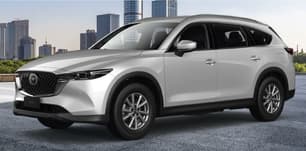
The CX-8's darkened grille generates some interest with its lattice-work and there are enough shiny chrome accents scattered about the car that it looks pretty.
Yet, the sporty sharpness that Mazda is known for is still hinted at with its shaping and the 19-inch black alloy wheels.
Our model is finished in 'Platinum Quartz Metallic' and it is the highlight for the exterior styling for me. I think because it's such an interesting colour to look at - it varies a lot depending on lighting conditions. Sometimes, it almost has a sheen of pink to it and at others, it looks like pearly sand.
The interior looks polished and refined with its burgundy leather trim and soft-touchpoints. Again, there is a lot of chrome inside to make otherwise dull features, like air vents, pop out.
You’re going to be able to tell the PHEV model from its more conventional counterparts by those oversized ‘Plug-in Hybrid EV’ badges on the front doors, and if you want to tell those behind you what you’re driving, there’s also a ‘PHEV’ badge there, too. Wait, wasn’t the plan to do away with the term ‘PHEV’, Mitsubishi?
But aside from that, the outside features just the different 18-inch alloy wheels (which are the same on all PHEV models, no matter the cost - I think that’s a bit lame, because if I’m spending $7500 on the Exceed I’d like a different wheel design!). Oh, and the Aspire and Exceed get that different lower front splitter, too.
Plus the PHEV has two fuel filler doors - one on each side of the car over the rear wheels. The driver’s side one is the EV charging ports (x2 - detailed below), and the passenger’s side one is for the petrol. Note: while the EV port is push-openable, the petrol cap still requires you to lift a lever in the driver’s footwell.
It may be categorised a small SUV but at 4545mm long, riding on a 2670mm wheelbase, 1805mm wide and 1685mm tall, it’s big for its boots. The popular Mazda CX-5 is only 5mm longer, and it plays in the midsize SUV segment!
Inside there are some design differences, with a specific gear joystick-style selector, and a different instrument panel.
It is impressive how the brand has managed to shoehorn a petrol engine, two electric motors, a battery pack and more into the car, but there are some practicality implications. Read about them in the next section.
The CX-8 is a very practical family hauler because there's ample room in all three rows. Yes, even adults will be able to squeeze into that third row without too many complaints!
All rows enjoy well-cushioned seats and up front they are electrically adjustable, but unfortunately, only the driver's side has lumbar support.
The middle row can slide forward manually or by using the electric button found on the side of the seats... but doing it yourself is way faster.
They do slide far enough forward that you won't embarrass yourself too much when you have to clamber into the third row. Where the seats have a 50/50 split-fold and manual adjustments (accessed via the boot).
In the first two rows there are lots of individual storage options but the front enjoys the most. The middle console is deep enough to be useful and I like the dual opening lid. Each row gets a couple of cupholders and drink bottle holders, too.
The charging options are great, with each row getting two USB-C ports and the front getting a wireless charging pad and 12-volt socket.
All of the controls and dials feel within easy reach and the 10.25-inch touchscreen multimedia system graphics are clear.
You can use it as a touchscreen or opt for the rotary dial but switching between the two was awkward for me. Especially, since the touchscreen function is disabled when you are using the wireless Apple CarPlay. This also has wired Android Auto, for those users.
The amenities are practical throughout with a dark headliner, three-zone climate control and heated outboard seats and retractable sun-blinds in the middle row.
Good news for families because there are five top-tether points across the back rows and ISOFIX child seat mounts on the outboard seats in middle row, in case you need them.
You can fit a 0-4 rearward facing child seat and it shouldn’t impact on front passenger comfort.
My six-year old found it super easy to get in and out of this car because of the 205mm ground clearance and wide door apertures. He enjoyed the high seating position, too, but was disappointed he couldn’t see out of the sunroof!
The boot space is a bit cramped with all three rows are in use at 209L but folding the third row opens up a more respectable 775L - perfect for the average family and its stuff!
The loading space is level, with the temporary spare tyre and clever storage compartments housed underneath. There is a retractable cargo blind and net, luggage anchor points and a 12-volt port, too.
And, as always, I love a powered tailgate, which this has!
Up front, the cabin is a pretty smart place, with nice enough materials and finishes, and a few good storage options. There’s a cubby in front of the shifter, but oddly enough it doesn’t have a wireless charger (there are 2x USB 2.0 ports above) and isn’t quite big enough for a smartphone (even the smaller ones don’t fit there all that easily), and there are cup holders between the seats, a decent covered centre console bin, and door pockets large enough for bottles.
The PHEV models get a different instrument cluster dial for EV driving readout info, but all have the old-school 4.2-inch TFT colour display that lacks the size and usability of some rivals with larger info screens - the MG HS PHEV, for instance, has a 12.3-inch digital display, which shows you a lot more info than this tiny little screen does. Heck, there’s not even a digital speedometer in there - and you only get one if you buy the Exceed model, which has a head-up display (HUD).
That’s part of the problem with the way this car’s interface operates. If you want the most detailed information you need to use the touchscreen media system, but that negates the usability of the media functions. On multiple occasions I found myself switching between Apple CarPlay phone calls and searching for that particular driving info screen I found most useful (there are about 15 screens to choose from, and plenty of them are hard to decipher).
It’s a huge disappointment for a customer who might want to see all that detailed information but also listen to a podcast, answer a call, follow their phone’s mapping or just have anything other than the hybrid info come up on the infotainment screen. The screen itself - an 8.0-inch unit, with sat nav integrated into the top spec only - is fine, but small compared to today’s rivals.
In the back seat, there’s a compromise for cabin space. The leg room is good, but the seat has been bumped up to accommodate some of the electrical hardware and the petrol tank, meaning someone my size (182cm/6’0”) will find they’ve got enough room for their legs but not their head, and those even larger will really need to take care getting in and out. While pre-facelift examples of this car had a clever sliding second row seat, that’s gone. It was never a feature in any PHEV version, and undoubtedly the layout of the battery pack has something to do with that.
The double pane sunroof no doubt eats into the space in the rear to a degree as well, and in the Exceed it likely feels a bit more cramped because of the black headliner.
While three adults could potentially fit across the back row for very short trips, there are dual ISOFIX and three top-tether points for child seats. The Exceed is the one you want if you’re aiming to treat your rear-seat passengers right: it has heated rear outboard seats, rear directional air vents and two USB ports for charging - the ES and Aspire miss out on all that stuff.
Boot space is 359L (VDA) for PHEV models, which is a step down from the 405 litres (VDA) for the non-hybrid models. There is extra hardware under the floor, and you don’t get a spare wheel in the PHEV models either - instead there’s a tyre repair kit. For context, we only just managed to fit all three CarsGuide hard suitcases (124L, 95L and 36L) in the boot of the PHEV version, while it was far less of an issue in the non-PHEV.
Oddly, no model comes with a power tailgate.
The GT SP diesel AWD is one of the premium models, sitting third from the top and will cost you $65,560, before on road costs.
However, its price tag positions it as the most expensive compared to its rivals. With the closest rival being the Kluger at $65,310 and the most affordable being the Santa Fe at $60,000.
You do get a stylish-looking package with lots of features for your cash, like heated front seats, heated rear outboard seats, a tilt and slide sunroof, and premium leather interior trim.
There's some great tech scattered throughout, too, like the 10.25-inch touchscreen multimedia system, wireless charging pad, USB-A ports in the third row, Bose Premium sound system with 10 speakers, wireless Apple CarPlay and wired Android Auto.
The 2022 Eclipse Cross PHEV line-up is expensive compared to the petrol-turbo models.
The ES AWD has a list price (all prices MSRP, before on-road costs) of $46,490, while the mid-spec Aspire costs $49,990 and the top-end Exceed lists at $53,990.
I know they’re not like-for-like in every instance - the ES and Aspire petrol-turbo models are 2WD, not AWD, for example, and there are some specification differences, too - but the price jump from each respective non-PHEV version is $15,500 (ES), $14,250 (Aspire) and $12,500 (Exceed).
Yikes.
You’d really, really have to want the EV driving experience to justify that additional expenditure, right?
Here’s a rundown of the specifications across the three PHEV grades.
Standard for the $46,490 ES grade are 18-inch alloy wheels, LED daytime running lights, halogen headlights, keyless entry and push-button start, cloth interior trim, manual front seat adjustment, an 8.0-inch touchscreen media system with Apple CarPlay and Android auto, a reversing camera, a four speaker stereo, digital radio and a rear cargo blind.
Step up to the $49,990 Aspire and you score LED headlights and fog lights, a lower body kit, heated front seats, faux-leather and microsuede trim, auto wipers, adaptive cruise control, an eight-speaker stereo, surround view camera, front and rear parking sensors, and an array of safety equipment that we’ll cover off in the safety section.
Choosing the range-topping $53,990 Exceed model nets you leather seat trim, a heated steering wheel, a head-up display - making it the only grade with a digital speedo! - as well as sat nav, a dual pane sunroof, and a black headliner in the cabin.