What's the difference?
Mazda has a tendency to have a lot of similar looking horses in the stable; blink and you'll miss the (very) subtle differences between the CX-8 and the CX-9 but if you're not super keen on the bulk of the CX-9 and you've outgrown the space of the CX-5... this one's for you.
Especially, if you've been considering its competition - the Hyundai Santa Fe Elite CRDi AWD and Toyota Kluger GXL AWD. Both of which have become known for their features and space.
So, how does it compare? The CX-8 GT SP diesel all-wheel drive seats seven, has a decent boot space (albeit, when the third row isn't in use) and handles like a dream.
Perfect combination? Maybe. I've been driving it for the last week with my family to find out for you.
The plug-in hybrid market is slowly but surely gaining traction in Australia, and Kia has thrown its hat into the ring with the flagship Sorento GT-Line PHEV AWD.
This top-spec seven-seat large SUV pairs family friendly practicality with the promise of lower emissions and petrol savings, at least, in theory.
So, is it the right blend of convenience, space and efficiency for busy families looking to dip a toe into electrification? That’s exactly what my family and I have been finding out.
So, what did my family think about the Mazda CX-8 GT SP diesel all-wheel drive? I love how it performs on the road - it's super easy to drive and you don't notice how large it is in a car park.
There are some great family-friendly features scattered throughout and I like how practical this is too with the extra seats and top-tether points. The multimedia system isn’t my favourite and I would have preferred to have seen a few extra airbags and a 360-degree view camera, but overall, it’s a good family car and gets an 8.0/10 from me.
My son loved the sun blinds and the cool colour of the seats. He also gives it an 8.0/10.
The Kia Sorento GT-Line PHEV is a sumptuously equipped seven-seater that delivers comfort, tech and an easy-going drive. It presents well on the surface, and for the right buyer (one who can make the most of its plug-in capabilities ) it could be a smart, low-emissions option for family life.
But for all its polish, it doesn’t quite do enough to justify itself as the best Sorento in the range. The electric-only driving range isn’t especially generous, and the higher price tag , combined with its lower towing capacity, may leave some families wondering whether the diesel variant is the more practical choice.
It’s not a bad car by any means, but the flagship GT-Line PHEV feels more like a stepping stone than a standout.
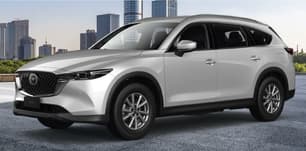
To be honest, I can't really tell the CX-8 and CX-9 apart on the road. They're both large SUVs that sport the classic Mazda bonnet - sharp and long. Up close, the CX-9 has a bulkier shape but otherwise they are remarkably similar.
The CX-8's darkened grille generates some interest with its lattice-work and there are enough shiny chrome accents scattered about the car that it looks pretty.
Yet, the sporty sharpness that Mazda is known for is still hinted at with its shaping and the 19-inch black alloy wheels.
Our model is finished in 'Platinum Quartz Metallic' and it is the highlight for the exterior styling for me. I think because it's such an interesting colour to look at - it varies a lot depending on lighting conditions. Sometimes, it almost has a sheen of pink to it and at others, it looks like pearly sand.
The interior looks polished and refined with its burgundy leather trim and soft-touchpoints. Again, there is a lot of chrome inside to make otherwise dull features, like air vents, pop out.
The Sorento looks exactly how a modern SUV should - confident, capable, and well-proportioned without feeling bulky. It wears its size well, delivering that commanding presence families often want in a seven-seater, without coming across as too aggressive.
I especially like the 19-inch alloy wheels as they suit the vehicle’s stance perfectly. I also like the striking LED lighting signatures front and rear, which really come to life after dark.
Step inside and the cabin strikes a neat balance between tech-forward and user-friendly. You’re greeted by dual 12.3-inch widescreen displays that make a strong first impression, but thankfully Kia hasn’t gone all-digital! You still get physical buttons and dials where they matter, making everything feel intuitive and easy to navigate.
Material quality is a highlight. There’s quilted Nappa leather upholstery, soft-touch surfaces throughout, and even a luxe suede headliner. These premium touches, coupled with the panoramic sunroof, lift the ambience and it's a cabin that feels genuinely upmarket, but not at the cost of family friendly functionality.
The CX-8 is a very practical family hauler because there's ample room in all three rows. Yes, even adults will be able to squeeze into that third row without too many complaints!
All rows enjoy well-cushioned seats and up front they are electrically adjustable, but unfortunately, only the driver's side has lumbar support.
The middle row can slide forward manually or by using the electric button found on the side of the seats... but doing it yourself is way faster.
They do slide far enough forward that you won't embarrass yourself too much when you have to clamber into the third row. Where the seats have a 50/50 split-fold and manual adjustments (accessed via the boot).
In the first two rows there are lots of individual storage options but the front enjoys the most. The middle console is deep enough to be useful and I like the dual opening lid. Each row gets a couple of cupholders and drink bottle holders, too.
The charging options are great, with each row getting two USB-C ports and the front getting a wireless charging pad and 12-volt socket.
All of the controls and dials feel within easy reach and the 10.25-inch touchscreen multimedia system graphics are clear.
You can use it as a touchscreen or opt for the rotary dial but switching between the two was awkward for me. Especially, since the touchscreen function is disabled when you are using the wireless Apple CarPlay. This also has wired Android Auto, for those users.
The amenities are practical throughout with a dark headliner, three-zone climate control and heated outboard seats and retractable sun-blinds in the middle row.
Good news for families because there are five top-tether points across the back rows and ISOFIX child seat mounts on the outboard seats in middle row, in case you need them.
You can fit a 0-4 rearward facing child seat and it shouldn’t impact on front passenger comfort.
My six-year old found it super easy to get in and out of this car because of the 205mm ground clearance and wide door apertures. He enjoyed the high seating position, too, but was disappointed he couldn’t see out of the sunroof!
The boot space is a bit cramped with all three rows are in use at 209L but folding the third row opens up a more respectable 775L - perfect for the average family and its stuff!
The loading space is level, with the temporary spare tyre and clever storage compartments housed underneath. There is a retractable cargo blind and net, luggage anchor points and a 12-volt port, too.
And, as always, I love a powered tailgate, which this has!
Space up front is generous, with excellent seat comfort thanks to wide seat bases, extendable under-thigh support and heating and ventilation. Getting in and out is easy, too, helped by wide door openings and a manageable 176mm ground clearance.
Storage throughout the cabin is thoughtful and abundant. Up front, there’s a large glovebox, a spacious centre console with a removable shelf, two cupholders, door bins with bottle holders, and a handy phone cubby beneath the dash.
The second row adds its own bottle holders and storage bins in each door, map pockets, four cupholders (including one cleverly placed on each door) and a removable floor shelf in front of the centre seat.
Even the third row isn’t forgotten, with a snack cubby and cupholder built into each wheel arch.
Tech-wise, the dual 12.3-inch displays look sharp, and the media system is intuitive and quick to respond. The instrument cluster isn’t particularly customisable, and I’m not a huge fan of the layout, but it displays the essentials clearly. You also get a head-up display, satellite navigation with over-the-air updates, and both wireless and wired Apple CarPlay and Android Auto.
Charging options are solid across all three rows, with multiple USB-C ports, a 12-volt socket in the second row and boot, and a wireless charging pad up front.
The second row offers ample legroom, though headroom is slightly reduced due to the panoramic sunroof. The lack of a transmission tunnel is a win for middle seat comfort, and the bench is wide enough to accommodate three child seats side-by-side. There are three top-tether points and ISOFIX anchors on the outboard seats.
Comfort and convenience features in the second row include heated outboard seats, device pockets, directional air vents, and the same handy storage and charging options mentioned earlier. My son especially loves the retractable sunblinds and the cupholders built into the door handles as they’re easy to reach and super practical. I am, however, disappointed that there’s no separate climate control zone for this row.
As for the third row, it’s best treated as a sometimes seat for adults. Access is more child-sized, and amenities are limited, but you do get directional air vents and a fan control, which are definitely appreciated.
Boot space is tight with all three rows in use, at just 175L, but that was still enough for the odd errand during the week. Fold the third row down and you get a much more usable 604L. Both rows fold completely flat, making it easy to slide in larger items, and the GT-Line includes a powered tailgate and a rare full-size spare wheel for extra convenience.
The GT SP diesel AWD is one of the premium models, sitting third from the top and will cost you $65,560, before on road costs.
However, its price tag positions it as the most expensive compared to its rivals. With the closest rival being the Kluger at $65,310 and the most affordable being the Santa Fe at $60,000.
You do get a stylish-looking package with lots of features for your cash, like heated front seats, heated rear outboard seats, a tilt and slide sunroof, and premium leather interior trim.
There's some great tech scattered throughout, too, like the 10.25-inch touchscreen multimedia system, wireless charging pad, USB-A ports in the third row, Bose Premium sound system with 10 speakers, wireless Apple CarPlay and wired Android Auto.
There are five grades in the Sorento line-up, and this week we're behind the wheel of the flagship GT-Line PHEV AWD. This is the most expensive Sorento you can buy, with a price tag of $84,660 before on-road costs — about $15,000 more than the equivalent petrol or diesel GT-Line variants.
That’s a hefty premium, but when you stack it up against other plug-in hybrid rivals, like the (albeit-premium) Volvo XC90 Ultra Recharge which starts at $124,466 or the BMW X5 xDrive50e with its $125,885 MSRP price tag, the Sorento PHEV starts to look like a more affordable entry point to electrified family motoring.
As the range-topper, the GT-Line doesn’t skimp on equipment. You get all the luxury touches like, heated and ventilated power front seats with memory functionality, heated rear outboard seats, a heated steering wheel, wireless Apple CarPlay and Android Auto, a panoramic sunroof, six USB-C ports and two 12-volt sockets, and a 12-speaker premium Bose sound system.
It also features quilted Nappa leather upholstery, customisable ambient lighting, dual 12.3-inch displays for multimedia and instrumentation, digital radio, Bluetooth connectivity and Kia’s clever Passenger Talk function, which lets the driver’s voice reach the third row through the speakers (a feature many parents will quietly cheer for).
There’s no shortage of thoughtful family focused features either, including rear window shades for the second row, a powered tailgate (operable via the driver’s seat or key fob), remote smart parking assist, one-touch sliding second-row seats, a third row that folds flat, and dedicated fan control in the rear.
The biggest question, though, is whether all of this plus the new plug-in hybrid powertrain is enough to justify the price jump.