What's the difference?
Like many car brands, Honda is storming the hybrid field. The new HR-V brings with it a hybrid powertrain and external facelift but is it enough to keep it competitive in the small SUV segment?
As with any cosmetic surgery you may wonder whether the facelift has been successful.
No tricks – I’ll tell you straight up the new external design might be what you’re looking for if you’re on the hunt for a small SUV that doesn’t look like it moonlights as an Uber for Mr Big Ears (a Noddy reference for any youngsters out there).
We're testing out the top hybrid model, the L, to see what else this urban dweller gets right and what it sometimes gets wrong.
Back in 2022 a friend asked me if they should buy the then-new BYD Atto 3. My advice was to avoid such a new brand, because despite positive first impressions of the electric SUV I couldn’t comment with any certainty on the long-term prospects for BYD.
Well, fast forward to 2026 and things could not be more different. No brand exemplifies the seismic shift in the local car industry more than BYD.
It has emerged not only as the clear leader of the pack from the Chinese car brands, but has done so by taking risks and offering some unusual products. This new Atto 3 Evo is a prime example of that, because while it looks almost-identical to the old model, it has huge changes underneath.
When I say ‘huge’ I mean major upgrades like all-new, 800-volt underpinnings, bigger batteries and even a switch to rear-wheel drive - at least for one model.
BYD is selling one model, with the same name but two very different powertrains and layouts. It highlights the radical changes brought on by the electric revolution in the car industry and demonstrates the flexibility of these platforms compared to internal combustion engine (ICE) vehicles.
And also explains why BYD is no longer just a newcomer with an uncertain future but rather a well-established member of the mainstream market.
But would I recommend buying this new Atto 3 Evo? Read on…
The Honda HR-V e:HEV L offers a respectable driving experience in the city but compared to its rivals, it’s features list and safety don’t always stack up. It sort of straddles the fence between basic and lux at times, which is an odd place for a top-model to be but its sharper styling will win hearts and the cabin is still practical.
So, would I recommend this new Atto 3 Evo to my friend, or indeed anyone in the market for a mid-size electric SUV?
While it may look largely the same as it did back in 2022, the Atto 3 is now a far more compelling proposition than it was then. Certainly BYD has established itself in the market and that means there is more certainty for buyers.
But this new Atto 3 Premium is a big leap forward when it comes to the driving experience. And while that’s not likely to be a huge factor for most mid-size electric SUV buyers, given the price has only crept up marginally (by modern standards) it remains competitively positioned.
For context, the Leapmotor C10 is another mid-size, rear-wheel drive electric SUV from China and it is even more expensive than the Atto 3 and is, to be blunt, nowhere near as good.
If BYD continues to produce cars this good there’s no reason to believe it won’t be a major player for years to come.
Note: CarsGuide attended this event as a guest of the manufacturer with accommodation and meals provided.
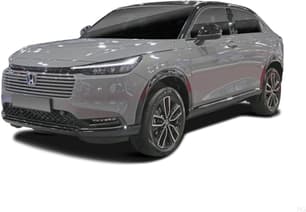
The small SUV segment can often be littered with odd-looking cars that highlight pillowy or severely angular body-shapes (lookin' at you C-HR) but the HR-V offers something stylish and modern instead.
The 2025 HR-V has a sharper design that accentuates the coupe styling, slim LED headlights and crisp-looking grille. A feature highlight is the eye-catching full-length tail-light treatment which makes the design pop at the back.
The interior is gorgeous with a streamlined dashboard that features just the right number of buttons and dials for those who want more tactility in a world where screens rule.
While the technology screens are on the smaller end, they look great against the synthetic leather trims and soft touchpoints that are liberally splashed throughout the cabin.
The cockpit is driver-orientated with everything within reach and easy to use while on the go. The steering wheel looks sporty and feels wonderful.
Everything looks well-built and feels solid; it's a cabin you’ll be pleased to spend time in.
Despite the major changes underneath, BYD hasn’t really changed much from a design point-of-view. Which is a trend for the brand, with the 2024 update also focusing primarily on improving technology rather than the looks.
Externally there is a new lower bumper, which has some subtle changes to its air-intakes, extended daytime running lights, slightly slimmer side skirts and a reshaped rear spoiler.
Inside there are a few minor differences, with the gear selector moving to the steering column to create more storage space in the centre console, and the steering wheel is a new design.
The other notable change is the driver instrument display, which has grown from five- to 8.8-inch.
There’s also a new grey interior colour trim, which looks more premium to this reviewer’s eyes than the blue/white cabin of the older model.
And, for better or worse, the Atto 3’s most memorable feature, the ‘guitar strings’ on the door, remain. While they may not be to everyone’s taste, there is an argument to be made that BYD should be acknowledged for not making the simplest/cheapest cabin possible.
For a small SUV, the cabin is large. Both seating rows feature excellent access with the 195mm ground clearance not eliciting one grunt from my occupants (even the oldies).
Head- and legroom is decent in both rows but taller passengers might brush the ceiling on bumps when seated in the back.
The only area that lacks this feeling of space is the boot, as it only has 304L of capacity available when all seats are in use and that's on the tiny side compared to its rivals. The Kia Niro has 425L which rivals some sedans!
Seat comfort is best in the front where thick padding and a longer cushion offer more comfort on a longer journey, despite lacking lumbar support.
The rear seats are harder and shorter and you should expect some big stretches from adults after a road trip. However, the directional air vents and other amenities keep it from feeling too basic on comfort.
There are lots of storage options with a glove box that's large enough to fit a manual with room to spare, a small middle console, two large 'stacked' shelves in front of the gearshift, four cupholders, four drink-bottle holders and two map pockets that also feature a device holder large enough to fit my iPhone 15 Pro Max.
The HR-V has 'Magic' seats in the rear which means the base can fold up or the backs can be folded flat. It’s a cool feature that opens up extra storage options.
The technology is simple to use and responsive. The touchscreen multimedia system has built-in satellite navigation, the Honda Connect app, wireless Apple CarPlay and wired Android Auto. The CarPlay is easy to set up and maintains a steady connection.
Charging options are good with a single USB-A and three USB-C ports, as well as, a 12-volt socket but you miss out on a wireless charging pad despite the L being the top grade.
The new driver instrument display is a big improvement. Frankly, the old screen was quite small and provided limited information compared to this newer, larger display.
The 15.8-inch multimedia touchscreen came with the last update and remains a relatively straightforward system to use. However, the need to take your eyes off the road to adjust controls for the air-conditioning is unnecessary and could be fixed by the simple addition of physical controls.
The decision to move the gear selector to the steering column liberates a good amount of space between the front seats.
There is now room for two smartphones to sit side-by-side (although only one wireless charging pad), as well as two cupholders and a lidded console box.
Space inside the cabin obviously remains the same, with good room for what is a small (or at least a smaller mid-size) SUV.
Cargo space, on the other hand, is changed. The Dynamic measures 434-litres, which is almost identical to the previous model. Things are different for the Premium with the shift to the rear-mounted motor, with the rear boot measuring 490L plus there is now a 101L under bonnet storage space.
There are three HR-V variants available, starting with the petrol base-model Vi X, moving to the mid-spec e:HEV X and on to the top-grade e:HEV L; which is the model on test here.
The L is priced from $42,900, drive-away (2000, NSW postcode), which positions it as the most affordable compared to its similarly graded rivals. The Kia Niro HEV GT-Line is $55,487, drive-away, and the Toyota C-HR Koba is $55,180, drive-away.
Despite having a much higher price tag, the rivals sport a few extra features including electric front seats, ventilated front seats, larger media screens, wireless Android Auto, a wireless charging pad and upgraded sound systems... just to name a few.
Oh, and the HR-V is only a four-seater, so the rivals also boast a fifth seating position.
That being said, the L isn't a total lump in the features department and the standard equipment is still pretty good (just not full-bodied like it's rivals).
The L comes with synthetic leather and cloth mixed upholstery and trims, heated front seats, a heated steering wheel and 18-inch alloy wheels.
Technology includes a 9.0-inch touchscreen multimedia system with satellite navigation, wireless Apple CarPlay, wired Android Auto, six-speaker sound, the 'Honda Connect' app, a 7.0-inch digital instrument cluster, one USB-A port, three USB-C ports, a 12-volt socket and Bluetooth connectivity as well as AM/FM and digital radio.
Practicality feels well-rounded with keyless entry and start, rain-sensing windscreen wipers, dusk-sensing headlights, dual-zone climate control and a powered tailgate.
BYD has taken this opportunity with the major update to make some tweaks to its price and positioning. The line-up has been changed with the Dynamic name replacing Essential on the entry-level model, while the flagship remains the Premium.
The Dynamic starts at $41,990 and the Premium at $46,990, both prices exclude on-road costs. Notably, both of those are a jump up from the out-going model, which started at just $39,990 for the Essential and $44,990 for the Premium.
However, there are some good reasons for the jump, which we’ll detail in a moment. But the overall level of standard equipment is good, so the value proposition remains appealing.
2026 BYD Atto 3 Evo Dynamic standard equipment
2026 BYD Atto 3 Evo Premium standard equipment
The L is a hybrid which combines a 1.5L four-cylinder petrol engine with an electric motor and together they produce up to 96kW of power and 253Nm of torque.
Which is plenty to make the L feel like a zippy city car but on the open road, the engine has a tendency to over-rev and can get whiny going up a hill, which may be a by-product of the continuously variable auto transmission.
The Dynamic retains the same front-mounted, front-wheel drive electric motor as the Essential, which provides 150kW/310Nm of performance.
The Premium, on the other hand, gets an entirely new underpinning, with BYD’s new ‘e-Platform 3.0’ chassis, which introduces 800V electrical architecture (compared to 400V for the Dynamic). This includes a larger battery but also a switch to a rear-mounted, rear-wheel drive motor that makes 230kW/380Nm, which is a sizeable bump from the Dynamic.
The HR-V L has a low combined (urban/extra-urban) fuel cycle figure of just 4.3L/100km which is not far off the 4.0L/100km claims of its rivals. Combined with the 40L fuel tank, you have a theoretical driving range of up to 930km, which is pretty darn good!
After doing a lot of urban driving, with a couple of longer trips thrown in, my real-world usage came out at 5.1L, which is isn't too far off the claimed figure, is still a good result overall and computes to a range in excess of 780km.
Naturally, the changes to the motors and platform also mean some major changes to the batteries and driving range.
The Premium now features a 74.8kWh lithium iron phosphate (LFP) battery, which allows for a claimed range of 510km, up from the 420km previously offered by the pre-updated model.
The Dynamic, however, has the 420km range, as it now uses the same 60.4kWh LFP battery as the old Essential Extended Range.
The previously available 49.9kWh battery, that had 325km of range, is now dropped. So, while the Dynamic technically costs more than the previous Essential, it comes with a bigger battery so you’re getting a higher specification vehicle.
BYD claims the charging speed has been increased thanks to the new 800V architecture. The Premium is now capable of taking up to 220kW of DC charging, which means it can get to 80 per cent capacity in as little as 25 minutes.
The Atto 3 Evo also features vehicle-to-load (V2L) functionality, which means you can draw power from the car’s battery to power small electronic devices if needed.
The HR-V L is an SUV perfectly suited to city life. Its power delivery is responsive around town, allowing for quick bursts when needed and the well of power feels deep until you get onto the open road. And as mentioned, that’s when it’s let down a bit.
The HR-V has a tendency towards mild understeer in quicker sweeping bends but is otherwise surefooted on the road. The suspension is firm, and you’ll notice the bumps here and there, but ride comfort still manages to be okay most of the time. Also road noise isn’t too high around town.
The visibility is great until you’re trying to look out of the back window and have a passenger to your left or a car seat installed. A digital rearview mirror would have been quite welcome in these scenarios.
Like most small SUVs the HR-V is easy to park and it’s small enough to be your best friend in a tiny car park. However, the reversing camera doesn’t reflect the grade level as the quality of the feed isn’t the best.
BYD didn’t have any examples of the Dynamic for us to drive, which makes sense given the significance of the changes to the Premium.
Previous experience with the front-wheel drive version of the Atto 3 didn’t leave much of an impression. It’s a perfectly acceptable mid-size SUV in terms of how it drives and rides, but it didn’t do anything special that made it stand out in a very competitive field.
This new Premium model, however, is a different story. The switch to the rear-wheel drive layout unsurprisingly has a dramatic impact on the way it drives.
Around town, at urban speed, it feels good but where it shines is on the open road. It’s not wildly fast when you put your foot down, like some other EVs, but it has excellent composure and feels responsive.
It’s not what you’d call a sporty or ‘hot SUV’ but it certainly leaves a good impression, one that will last longer than the front-wheel drive version.
Certainly the steering could be tuned better, it doesn’t offer much feeling, particularly just off-centre. And the ride can be noticeably firm at times, hitting bumps with a sharpness that you can feel in the cabin. It’s another example of where the Chinese brands could benefit from local suspension and chassis tuning to help it better suit Australia’s unique conditions.
The HR-V has a four- out of a possible five-star ANCAP safety rating from testing done in 2022. It only features six airbags and its individual assessment scores aren’t as high as its rivals.
In fact, both the rivals I’ve mentioned performed much better and have additional safety features to boot, including safe exit assist, 360-degree view camera systems and rear occupant alert. Which the HR-V misses out on.
The top model HR-V benefits the most in safety compared to the lower grades and includes blind-spot monitoring, front fog lights, forward collision warning, rear cross-traffic alert, lane keeping aid and departure warning, traffic sign recognition, intelligent seatbelt warning, adaptive cruise control and a reversing camera as well as front and rear parking sensors.
Some notes, though. The lane departure and keeping aids seem to 'activate' whenever they feel like it. I had them come on more on unmarked roads than marked.
The adaptive cruise control can be too sensitive at times and having the car slam on brakes when you're passing a parked car on the highway going 100km/h is a scary experience to say the least.
The HR-V has AEB with car, pedestrian, and cyclist detection which is operational from 5.0 to 100km/h (170km/h for car).
Being a four-seater, you only get two ISOFIX child seat mounts and two top-tether anchor points and while it is easy to fit a child seat in, the top of it wipes out your rearview vision.
The safety is pretty disappointing as it lets down an otherwise solid SUV.
In addition to the other changes underneath, BYD has also taken this opportunity to include some additional safety. The Advanced Driver Assistance System (ADAS) gets a new Child Presence Detection function with an in‑cabin sensor that can alert you if someone is left in the vehicle after it is locked. There’s also a new Driver Monitoring System for both models.
The Atto 3 still has a maximum five-star ANCAP rating from a 2022 crash test.
Other standard safety equipment includes:
In addition the Premium adds:
Honda offers the HR-V with a five-year/unlimited km warranty and an eight-year battery warranty which is on the lower end considering it's rivals can get up to seven-years unlimited km warranty now.
The five years capped-priced servicing program offers excellent value, however, as services are a flat $199, which is great for the class.
Servicing intervals are at every 12 months or 10,000km, whichever occurs first and that should be fine for the average city dweller. But it could get annoying if you put higher than average kays on your car every year.
One of my ‘dislikes’ when I drove the Atto 3 in 2024 was “long-term BYD prospects still unclear” - driven by the fact it was still a relatively small brand with a limited line-up (the Shark 6 wouldn’t launch until two months later). Well, as I write this in September of 2026 it’s safe to say BYD’s long-term prospects look as good as any brand.
It is sitting in second spot on the year-to-date sales charts, behind only Toyota but surpassing the likes of Kia, Ford and Mazda. There can be no question BYD has cemented its place in the Australian market.
It already has more than 100 dealer and service locations, with plans to grow that to 150 by the end of 2026.
As for the Atto 3’s specific ownership credentials, it’s covered by the brand’s standard six-year/150,000km warranty. The battery has a separate eight-year/160,000km warranty and the Drive Unit (the motor) is covered for eight years and 150,000km.
Service intervals are every 12 months or 20,000km, and with capped price servicing the Dynamic should cost you $1410 and the Premium $1670 for the first five years.