What's the difference?
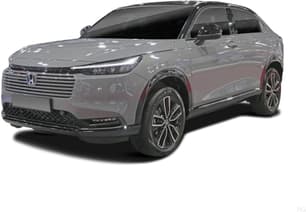
Like many car brands, Honda is storming the hybrid field. The new HR-V brings with it a hybrid powertrain and external facelift but is it enough to keep it competitive in the small SUV segment?
As with any cosmetic surgery you may wonder whether the facelift has been successful.
No tricks – I’ll tell you straight up the new external design might be what you’re looking for if you’re on the hunt for a small SUV that doesn’t look like it moonlights as an Uber for Mr Big Ears (a Noddy reference for any youngsters out there).
We're testing out the top hybrid model, the L, to see what else this urban dweller gets right and what it sometimes gets wrong.
Kia has released the newly updated Niro, which is the smaller and less sporty sibling to Kia’s popular, EV6. As far as EVs go, it has a decent driving range and specs that should entice first-time electric vehicle owners to dip their toes into the EV pool.
However, the updated model does come with a price hike… which might not excite a budget-conscious buyer, especially with such affordable competitors like the MG ZS EV and Hyundai Kona Electric also available.
I’ve been hanging in it for a week with my family of three to see how it handles!
The Honda HR-V e:HEV L offers a respectable driving experience in the city but compared to its rivals, it’s features list and safety don’t always stack up. It sort of straddles the fence between basic and lux at times, which is an odd place for a top-model to be but its sharper styling will win hearts and the cabin is still practical.
The Kia Niro S Electric is a solid little SUV that has decent space inside and some nice specs, but it's more expensive than its nearest rivals. The EV powertrain can take a little getting used to and I would have liked a smoother ride, but the 460km driving range is good.
For first-time EV owners, this wouldn’t be a bad option if you wanted to dip your toes in the water but it will suit urban dwellers and smaller families, like mine, best. This gets a 7.5/10 from me.
My son wasn’t in love with this one. Not enough buttons for him to press and he did comment on how bumpy the ride was in the back. He gives it a 6.0/10.
The small SUV segment can often be littered with odd-looking cars that highlight pillowy or severely angular body-shapes (lookin' at you C-HR) but the HR-V offers something stylish and modern instead.
The 2025 HR-V has a sharper design that accentuates the coupe styling, slim LED headlights and crisp-looking grille. A feature highlight is the eye-catching full-length tail-light treatment which makes the design pop at the back.
The interior is gorgeous with a streamlined dashboard that features just the right number of buttons and dials for those who want more tactility in a world where screens rule.
While the technology screens are on the smaller end, they look great against the synthetic leather trims and soft touchpoints that are liberally splashed throughout the cabin.
The cockpit is driver-orientated with everything within reach and easy to use while on the go. The steering wheel looks sporty and feels wonderful.
Everything looks well-built and feels solid; it's a cabin you’ll be pleased to spend time in.
It’s a compact SUV with a footprint that's 4420mm long, 1825mm wide and 1570mm tall. But while small, I wouldn’t call it cute. It’s boxier than its sibling and without any of the swoopy design elements that make the EV6 look cool.
I do like the way the two-tone body panelling, which is seen most prominently on the C-pillar, breaks up the ‘blocky-ness’ and creates areas of interest. As do the high-mounted rear LED lights.
Speaking of lights, the base model makes do with halogen headlights, which unfortunately stand out against the LED daytime-running lights. You’ll notice the dimmer light at night, too.
The 17-inch alloy wheels are thick for better aerodynamics but the clever two-tone colouring stops them from looking unfashionable.
The interior has a lot style cred with the curvature of the door panelling blending in almost seamlessly with the dashboard.
The gently sloping panelling that houses the multimedia systems and switchable touchscreen interface for the controls creates a very pleasing cabin space.
There are some harder plastics mixed in here but enough soft touchpoints that you won’t be bothered by them.
For a small SUV, the cabin is large. Both seating rows feature excellent access with the 195mm ground clearance not eliciting one grunt from my occupants (even the oldies).
Head- and legroom is decent in both rows but taller passengers might brush the ceiling on bumps when seated in the back.
The only area that lacks this feeling of space is the boot, as it only has 304L of capacity available when all seats are in use and that's on the tiny side compared to its rivals. The Kia Niro has 425L which rivals some sedans!
Seat comfort is best in the front where thick padding and a longer cushion offer more comfort on a longer journey, despite lacking lumbar support.
The rear seats are harder and shorter and you should expect some big stretches from adults after a road trip. However, the directional air vents and other amenities keep it from feeling too basic on comfort.
There are lots of storage options with a glove box that's large enough to fit a manual with room to spare, a small middle console, two large 'stacked' shelves in front of the gearshift, four cupholders, four drink-bottle holders and two map pockets that also feature a device holder large enough to fit my iPhone 15 Pro Max.
The HR-V has 'Magic' seats in the rear which means the base can fold up or the backs can be folded flat. It’s a cool feature that opens up extra storage options.
The technology is simple to use and responsive. The touchscreen multimedia system has built-in satellite navigation, the Honda Connect app, wireless Apple CarPlay and wired Android Auto. The CarPlay is easy to set up and maintains a steady connection.
Charging options are good with a single USB-A and three USB-C ports, as well as, a 12-volt socket but you miss out on a wireless charging pad despite the L being the top grade.
It’s surprisingly roomy inside and all passengers will enjoy decent leg and headroom, but taller passengers will find the backseat cosier than the front.
As such, two child seats will fit best but you do have ISOFIX child seat mounts on the outboard positions and three top-tether points, if you need them.
The synthetic leather/cloth seat trim cleans well and is nice to touch. The seats themselves, front and rear, are well-padded and super comfortable.
The backs of the front seats can double as coat hangers and have hardened kickplates, which are always practical for little feet.
The front row gets the most amenities and tech. The 8.0-inch touchscreen multimedia system has clear graphics but is different to other Kia’s I’ve sampled recently. It seems to have been simplified but you’ll get used to it quickly.
There are plenty of charging options available, too, with a USB-A and C port, plus a 12-volt socket. Not needing a cable for the wireless Apple CarPlay is a bonus, too!
The front row also has the most storage space with two retractable cupholders, dedicated phone tray, glove box, middle console and skinny drink bottle holders in each door.
Back seat passengers enjoy two USB-C ports, reading lights, drink bottle holders in each door plus an armrest with two cupholders. As well as, a standard three-pin socket in case you need to run electrical gear or charge anything up on the go.
The windows are wide and offer good visibility but I really like the 150mm ground clearance. It was super easy for my six-year old to climb in and out, plus he got a good view this week!
The boot is good for this size SUV with 475L of capacity available. It does look more like a hatchback, because while you can readjust the floor to sit lower, the back still slopes up.
However, it was fine for my weekly grocery and school run. The 'frunk' storage is small at 20L, which is just big enough for a charging cable.
You don’t get a spare wheel but you do get a puncture repair kit. And being the base model, it’s not a powered tailgate but it’s not heavy to close.
There are three HR-V variants available, starting with the petrol base-model Vi X, moving to the mid-spec e:HEV X and on to the top-grade e:HEV L; which is the model on test here.
The L is priced from $42,900, drive-away (2000, NSW postcode), which positions it as the most affordable compared to its similarly graded rivals. The Kia Niro HEV GT-Line is $55,487, drive-away, and the Toyota C-HR Koba is $55,180, drive-away.
Despite having a much higher price tag, the rivals sport a few extra features including electric front seats, ventilated front seats, larger media screens, wireless Android Auto, a wireless charging pad and upgraded sound systems... just to name a few.
Oh, and the HR-V is only a four-seater, so the rivals also boast a fifth seating position.
That being said, the L isn't a total lump in the features department and the standard equipment is still pretty good (just not full-bodied like it's rivals).
The L comes with synthetic leather and cloth mixed upholstery and trims, heated front seats, a heated steering wheel and 18-inch alloy wheels.
Technology includes a 9.0-inch touchscreen multimedia system with satellite navigation, wireless Apple CarPlay, wired Android Auto, six-speaker sound, the 'Honda Connect' app, a 7.0-inch digital instrument cluster, one USB-A port, three USB-C ports, a 12-volt socket and Bluetooth connectivity as well as AM/FM and digital radio.
Practicality feels well-rounded with keyless entry and start, rain-sensing windscreen wipers, dusk-sensing headlights, dual-zone climate control and a powered tailgate.
There are two variants for the Niro, our base model, the S, and the range-topper GT-Line.
Despite being the base model, the Niro S will still set you back $65,300, before on-road costs. Which makes it about $5K dearer than the equivalent Kona Electric, and $20K more expensive than the ZS EV.
There is a hybrid Niro (also available in two grades), if you’re not quite ready to commit to a full EV life. The price isn’t as eye-watering, either, being just $44,380, before on-road costs.
The Niro is well-specified, though, and the driver will enjoy an electric seat with adjustable lumbar support while the passenger side remains manual.
The regenerative braking is customisable (levels 0-3), there’s an 'iPedal' function, a dual-zone climate system, reversing camera and the backs of the front seats even double as coat hangers.
The tech is also good, with an 8.0-inch touchscreen multimedia system, 10.25-inch digital instrument panel plus wireless Apple CarPlay and wired Android Auto all coming as standard equipment. More on the tech below.
The L is a hybrid which combines a 1.5L four-cylinder petrol engine with an electric motor and together they produce up to 96kW of power and 253Nm of torque.
Which is plenty to make the L feel like a zippy city car but on the open road, the engine has a tendency to over-rev and can get whiny going up a hill, which may be a by-product of the continuously variable auto transmission.
The Niro is a full EV and has a front-wheel drive drivetrain with a maximum output of 150kW/255Nm. It’s not as powerful as its stablemate and only has the single-motor which is powered by a 64.8kWh lithium-ion battery but going from 0-100km/h can still be achieved in 7.8 seconds. With specs like those, this is most suited for an urban setting.
The HR-V L has a low combined (urban/extra-urban) fuel cycle figure of just 4.3L/100km which is not far off the 4.0L/100km claims of its rivals. Combined with the 40L fuel tank, you have a theoretical driving range of up to 930km, which is pretty darn good!
After doing a lot of urban driving, with a couple of longer trips thrown in, my real-world usage came out at 5.1L, which is isn't too far off the claimed figure, is still a good result overall and computes to a range in excess of 780km.
Such is the EV life but you can’t escape the charging.
The onboard DC charger has up to 85kW of capacity and that means on a 50kW fast charger station, you can get from 10 to 80 per cent in 65 minutes.
However, if plugged into a 350kW ultra-fast charger, you’ll only save 22 minutes because it can’t accept that faster speed.
On a 7.5kW system, you’ll go from 10 to 80 per cent in approximately nine hours, 25 minutes. On an 11kW, you’ll see that figure drop to six hours, 20 minutes.
The charging port is a Type 2 (CCS Combo2) and the car comes with an emergency charging cable that can plug into a standard three-pin domestic socket, if needed.
However, it’s slow going and you’re looking at a wait time of up to 27 hours, 30 minutes to get to a full charge. All other cables cost extra.
The official kWh/100km consumption is 16.2kWh and my average on-test figure was 14.3kWh after a mix of urban and open-road driving.
However, I did see figures getting closer to 20kWh on longer trips. Still, I would consider my average to be efficient.
The Niro S has a driving range of up to 460km (WLTP).
The HR-V L is an SUV perfectly suited to city life. Its power delivery is responsive around town, allowing for quick bursts when needed and the well of power feels deep until you get onto the open road. And as mentioned, that’s when it’s let down a bit.
The HR-V has a tendency towards mild understeer in quicker sweeping bends but is otherwise surefooted on the road. The suspension is firm, and you’ll notice the bumps here and there, but ride comfort still manages to be okay most of the time. Also road noise isn’t too high around town.
The visibility is great until you’re trying to look out of the back window and have a passenger to your left or a car seat installed. A digital rearview mirror would have been quite welcome in these scenarios.
Like most small SUVs the HR-V is easy to park and it’s small enough to be your best friend in a tiny car park. However, the reversing camera doesn’t reflect the grade level as the quality of the feed isn’t the best.
This is a pretty simple car to drive but it doesn’t feel as fun as some other EVs I’ve driven. It can even feel sluggish when you accelerate from a full stop and that makes it feel laggy in stop/start traffic.
Once you’re on your way, the acceleration is fairly responsive. You feel confident overtaking on the open road, too.
The car feels connected to the road with minimal shuddering through the steering wheel. The car responds in a timely manner when you have to make sudden moves, which I like.
Sometimes, the lane keeping aids make it feel jerky and I turned it off in some situations.
The regen braking delivers a big physical presence like the EV6 but isn’t as refined and can feel almost ‘bunny hoppy’ at times.
You can customise it up to four levels, zero being low regen and four being the iPedal. I’m not overly fond of the iPedal, so didn’t use it that much this week and kept it at level 3.
You do have to change up how you drive an EV, so this wasn’t that surprising and something I’m sure you’d get used to.
The ride comfort is pretty mixed. Around town, it’s good but there’s quite a bit of passenger movement in this. You kinda feel like you’re bobbing along sometimes, which is jolting.
You also feel the road but the seats are so comfortable, they stop it from feeling too rough.
Surprisingly, the cabin gets very loud with wind and road noise. You can still chat but you won’t forget that it’s there, which is a shame.
I didn’t notice much difference between the drive modes, so it was kept on 'Normal', too.
This is very easy to park! It’s a good size for even a tight car park with a 10.6m turning circle and the reversing camera is super clear, which is great.
However, I would have liked to have seen front parking sensors, as well as the rear sensors. You can get them on the GT-line though.
The HR-V has a four- out of a possible five-star ANCAP safety rating from testing done in 2022. It only features six airbags and its individual assessment scores aren’t as high as its rivals.
In fact, both the rivals I’ve mentioned performed much better and have additional safety features to boot, including safe exit assist, 360-degree view camera systems and rear occupant alert. Which the HR-V misses out on.
The top model HR-V benefits the most in safety compared to the lower grades and includes blind-spot monitoring, front fog lights, forward collision warning, rear cross-traffic alert, lane keeping aid and departure warning, traffic sign recognition, intelligent seatbelt warning, adaptive cruise control and a reversing camera as well as front and rear parking sensors.
Some notes, though. The lane departure and keeping aids seem to 'activate' whenever they feel like it. I had them come on more on unmarked roads than marked.
The adaptive cruise control can be too sensitive at times and having the car slam on brakes when you're passing a parked car on the highway going 100km/h is a scary experience to say the least.
The HR-V has AEB with car, pedestrian, and cyclist detection which is operational from 5.0 to 100km/h (170km/h for car).
Being a four-seater, you only get two ISOFIX child seat mounts and two top-tether anchor points and while it is easy to fit a child seat in, the top of it wipes out your rearview vision.
The safety is pretty disappointing as it lets down an otherwise solid SUV.
The Niro EV S has a good list of safety features, with the following being standard: LED daytime running lights, lane departure alert, lane keeping aid, blind-spot monitoring, rear cross-traffic alert, a reversing camera (with dynamic guidelines), rear parking sensors, driver fatigue alert, check rear occupant alert and adaptive cruise control (with stop/go function).
It has auto emergency braking with car, pedestrian and cyclist detection as well as junction turning assist, which is operational from 5.0-85km/h.
The Niro was recently awarded a maximum five-star ANCAP safety rating in 2022. It has eight airbags and that does include the newer front centre airbag.
There are ISOFIX child seat mounts on the rear outboard seats and three top tethers, but two seats will fit best. And while there will be room for a 0-4 rearward facing child seat, it will encroach on front passenger comfort.
Honda offers the HR-V with a five-year/unlimited km warranty and an eight-year battery warranty which is on the lower end considering it's rivals can get up to seven-years unlimited km warranty now.
The five years capped-priced servicing program offers excellent value, however, as services are a flat $199, which is great for the class.
Servicing intervals are at every 12 months or 10,000km, whichever occurs first and that should be fine for the average city dweller. But it could get annoying if you put higher than average kays on your car every year.
The ongoing costs are great on the Niro. It comes with Kia’s ‘better-than-average-for-the-market’ seven-year/150,000km warranty, which also covers the battery.
You get a seven-year capped-price servicing plan and services average $250 per year, which is good.
Servicing intervals are more in line with a petrol car at every 12 months or 15,000km. It’s usual to see those intervals doubled on an EV but it’s still reasonable.