What's the difference?
Yes, this is the car that Ferrari said it would never build. In fact, Ferrari Chief Design Officer, Flavio Manzoni told this very publication (albeit way back in 2015) that "Enzo Ferrari would turn in his grave" should the company ever make something other than a two-door sports car.
But I'd advise you not to get too hung up on all of that. Times change, and the automotive world is a very different place compared to five or 10 years ago.
So, yes, this is the first Ferrari SUV (even if the brand steadfastly refuses to call it one). And it’s the first prancing horse with four doors and four seats.
But it’s also the only SUV on the planet (at least, that I’ve ever heard of) that’s powered by a properly screaming naturally aspirated V12 petrol engine.
So, is this Purosangue the world’s most super SUV, and thus worthy of its iconic badge? Or does it only detract from the brand’s impressive performance legacy?
Let’s go find out, shall we?
Things that have had a name change AFTER they’ve become famous…
Okay… there’s Kanye West’s switch to Ye, Twitter’s rebranding to X and now this – the Audi Q8 e-tron.
As the brand’s first production EV, it used to be known simply as Audi e-tron. But that was confusing, because – Porsche Taycan-based GT and RS sports sedans aside – every electrified vehicle that the company has made before and since wears e-tron as a suffix.
Beyond new badging, the Q8 e-tron also brings a facelift and improvements underneath, to better challenge the BMW iX, Jaguar I-Pace and Mercedes EQC and EQE large electric SUVs, among others.
How does the Ingolstadt EV fare? Let’s find out.
Write the Purosangue off as nothing more than another SUV-sized cash grab at your peril. It's not just the easiest-to-live-with Ferrari ever made, but also, and indisputably, an actual Ferrari, regardless of its body shape.
Note: CarsGuide attended this event as a guest of the manufacturer, with travel, accommodation and meals provided.
The Audi Q8 e-tron ushers in welcome improvements to an already likeable and capable large luxury SUV.
But it is also feeling dated compared to newer and fresher rivals like the BMW iX, isn’t as good to drive as the best, offers disappointing range for the size of the new battery, and prices are creeping up for what is essentially a half-decade-old EV.
The name change isn’t enough. What the Q8 e-tron really needs is a massive leap in its Vorsprung durch Technik in a rapidly evolving electrified landscape.
Very good… but far from great.
The word ‘SUV’ is a bit like Voldemort around Maranello — as in, he who shall not be named. And if I’m totally honest, I thought the brand’s refusal to acknowledge what they’ve so obviously made here was just marketing guff to protect its performance heritage.
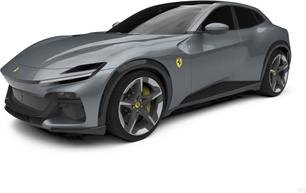
But seeing the Purosangue in the metal has shifted that view a little. Sure, it will compete with models like the Lamborghini Urus, but it doesn’t exactly look like an SUV, does it?
In fact, and this would likely be another dirty word in Ferrari land, it almost looks more like a hot hatch, what with its short rear overhang, swollen body styling and the positioning of each wheel in the furthest possible corners.
But more than that, the Purosangue looks elegant. Aggressive, sure, but still somehow a little understated. And for mine, that’s a huge tick in the positive column.
Unlike some of its competitors, the Purosangue looks like it was designed by adults, for adults, and not by cordial-addled children.
There’s no active aero at work here, with the airflow instead built into the design. Like the openings at either side of the front end, which channel air past the front tyres, or the positioning of the rear spoiler, which pushes air down over the rear windscreen so effectively there's apparently no need for a rear windscreen wiper.
Traditionally, interiors have not been Ferrari’s strongest suit, but the Purosangue is a comfortable and premium space to spend time, and the seats and the steering wheel especially, look fantastic.
The tech, though, isn’t perfect. Some of it (like the haptic Engine Start button) is an awesome addition, but while the twin screens for driver and passenger look good, the technology is a little clunky, and simply not as smooth as using a single, centrally mounted screen.
The Q8 e-tron looks smaller than it actually is, with the SUV wagon’s length/width/height/wheelbase numbers measuring in at 4915/1937/1633mm/2928mm, respectively.
The Sportback version is slightly lower at 1619mm.
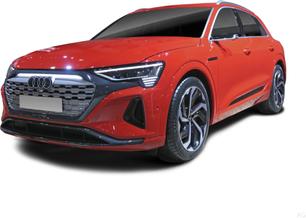
You’ll need a keen eye to spot the difference between the old e-tron and new Q8 e-tron, with almost all of the visual changes reserved for the front end.
For starters, there’s a new, two-dimensional four-ring logo that looks larger and flatter than before, sitting within a sleeker and slimmer grille treatment that now takes in the restyled headlights. Along with the redesigned bumper, the effect serves to broaden the SUV’s stance.
The effect also suggests improved aerodynamics, aided by small air foils near the wheel arches and a fully-clad underbody section.
Otherwise, aside from the odd inclusion of the make-model name on the B-pillar and minor trim updates out back, the Q8 e-tron keeps the same, contemporary appearance of its predecessor. Which is no bad thing.
And there are even fewer changes inside.
Not the kind of thing you’d normally care about in a Ferrari review, I know, but then this isn’t a normal Ferrari.
So, let’s focus on the back seat for a moment. The Purosangue is a strict four seater. Asked why not just install a bench backseat for more family-friendly practicality, the brand had a quality answer locked and loaded.
The reason, it says, is because a car in this price bracket needs to instil a sense of dignity in every seat, and by installing three across the back row, you don’t just ruin the middle seat, but the two window seats as well, because then everyone is uncomfortable.
It make sense, right? Even if I still harbour suspicions that, by installing just the four seats in the Purosangue, it moves it just a little further from that dreaded SUV tag.
Either way, there is more space in the rear of the Purosangue than you might expect by looking at it. Each rear seat rider can stretch out, with more than enough head and legroom.
And while there, they can access their seat functions and climate control settings through a nifty pop-up rotary dial (front seat riders get one, too).
The rear doors open automatically with a long pull on a lever at the base of the window. Ferrari says the rear-hinged doors serve two purposes, the first being that they allow easier access to the rear seats, and the second being that they look much cooler than regular, boring doors.
The engineers, though, concede making them a reality was a nightmare, with the brand replacing three fastening points with a single massive hinge that emerges from the rear of the body.
There’s more practicality on offer here, too, courtesy of a 473-litre boot space (and more if you flatten the back seats), with a flat load space, and hidden storage beneath it.
The Purosangue measures in at 4973mm in length, 1589mm in height, and 2028mm in width, and it rides on a new spaceframe chassis bespoke to this model.
More than merely good enough.
Entry and egress are easy thanks to a lofty ride height and wide-opening doors. Once sat, you’ll discover Audi has not changed anything much inside compared to the old e-tron. Frankly, very little needed to.
You’ll still find a strikingly stylish and upmarket cabin offering sufficient space for five people, a commanding driving position, superbly supportive front seats that are a boon when long-distance driving, plenty of storage options, ample ventilation and suitably moody lighting.
While not the most modern dash on the market when contrasted to the vast ‘hyper’ screens of some rivals, the Q8 e-tron’s remains very architectural in appearance and presentation.
Trim and material quality are certainly up to brand expectations. Practicality remains a priority, with lots of storage areas within the dash, console and door cards.
There are no fewer than three screens – a 12.3-inch digital instrument cluster Audi calls 'Virtual Cockpit', a 10.1-inch central multimedia display with haptic feedback and an 8.6-inch unit for climate control.
While they may seem daunting at first, a little familiarisation means most users will find them easy to operate.
Kudos, too, to the super-clear markings in the instrumentation, as well as the very satisfying tactile sensations of using the quality switchgear and controls. Typical Audi thoroughness here.
The same applies to the Q8 e-tron’s roomy and pleasantly-presented back seat area, with intelligently designed seating offering a nicely angled backrest as well as supportive cushion.
Three people can fit across without too much pain, though two is better, as the folding centre armrest and other amenities like air vents and climate control systems can be better-accessed and enjoyed.
You can see, smell and feel where your money’s gone inside. This is a quiet, isolated and cocooning experience, whether cruising on the motorway or stuck in heavy urban traffic. As you’d expect from a luxury SUV.
About the only real jarring aspect are the $3500 virtual exterior mirrors, created to improve aero performance. Their door-mounted screens are set low, outside the natural visual eyeline of the driver, creating confusion and adding precious extra seconds of eyes not on the road ahead. They’re irritating to the point of frustration.
Otherwise, the Q8 e-tron gets the job done inside, with cargo capacity at a reasonable 569 litres in the SUV wagon and 528L in the Sportback. And there’s even a 62L tub in the frunk up front to store the cables that also come standard with the EV.
Audi interior and packaging expertise strikes again.
How much the Purosangue actually costs is something a moot point. Officially, it starts at $728,000, before all your on-road costs.
But Ferrari says every Purosangue will go through its personalisation, 'Atelier' or 'Tailor Made' programs, meaning no two vehicles will be exactly alike, adding significant cost to the sticker price.
But perhaps the biggest issue is that you can’t actually buy one. Ferrari paused orders globally in November last year as it realised its factory capacity had been exhausted by demand.
Right now, all it can say is that, should you want one, you should speak to your dealer, while warning that average global wait times are in excess of 18 months.
Further complicating matters is the fact the brand has issued a production cap on the Purosangue, with the SUV not to exceed 20 percent of Ferrari’s total production volume.
The idea is two-fold. One, Ferrari’s production capacity is limited, and so freeing up space on a factory line isn’t easy. And two, unlike its Italian competition, Ferrari wants to remain Ferrari, not the Purosangue company.
So, this newcomer will produce incremental growth without dominating the entire line-up.
The brand is holding triple-figure orders and expressions of interest in Australia, and though it’s not sure how many cars we’ll actually get, they will begin arriving before the end of the year.
Ferrari in Australia is also yet to confirm exactly what local customers will get, but standard fare internationally includes 22-inch (front) and 23-inch (rear) alloys, leather-and-Alcantara seating (now made from 68 percent recycled materials) in both rows, twin screens (one in the instrument cluster for the driver, and another mounted in the dash directly in front of the passenger), standard Apple CarPlay and Android Auto, a 21-speaker Burmester stereo, automatic-opening rear doors and an automatic boot, seat and steering wheel heating, and an in-seat massage function.
You also get an engine that could power a small city, but let’s circle back to that, shall we?
First thing’s first. The Q8 e-tron has very little in common with the existing Q8 petrol, diesel and SQ8 high-performance models.
These, along with the larger Q7, have internal combustion engines.
However, keep in mind all leverage variations of the same 'MLB Evo' architecture that first saw the light of day all the way back in 2015. So, no spring chickens here.
But as it currently also serves Bentley, Lamborghini and Porsche SUVs, we’re talking about a classy set of components, anyway. Plus, the pre-facelift model was only rolled out on the world market in 2019.
For now, only a single variant is here, known as the Q8 e-tron 55, meaning the previous, smaller-battery 50 and flagship SQ8 aren’t here yet. That will happen sometime during 2024.
As before, there’s the choice of a traditional SUV wagon or more-popular BMW X6-style Sportback SUV coupe.
Prices start at $153,900 (all prices are before on-road costs) for the former and $165,900 for the latter, and that’s a jump of nearly $8K and $9K respectively over their old e-tron-as-a-noun-rather-than-an-adjective predecessors.
At least the Q8 e-tron is well equipped.
On the safety front, you’ll find about 40 driver assistance systems, backed up by a plethora of cameras, radar sensors and ultrasonic sensors to help keep the SUV as secure as possible.
These include a 360-degree camera system, adaptive cruise control, lane-support systems, rear cross-traffic assist and Autonomous Emergency Braking (AEB).
More on safety further down below.
All models also include adaptive air suspension with a variable ride height range of 76mm, a drive-mode selector that switches between normal and sport settings, LED headlights with auto high beams, keyless entry/start, front and rear climate control, heated and powered front seats and adjustable regenerative braking paddles on the steering wheel.
There's also a head-up display, three digital screens including electronic instrumentation and a central touchscreen with haptic feedback, satellite navigation, Android Auto, wireless Apple CarPlay, digital radio, wireless smartphone charging, four USB-C ports, an electric tailgate with gesture control, roof rails and 20-inch alloy wheels – with a space-saver spare wheel to boot.
Plus, an undisclosed number of Launch Edition SUVs from $165,900 are also available, adding Audi’s S line exterior styling touches, 21-inch wheels, sports front seats, a racier steering wheel, electric steering column adjustment and more.
Note that the base Q8 e-tron 55 does not include leather upholstery (it’s synthetic material instead) or a sunroof as standard.
Pricing and spec, then, are generally in-line with the luxury Euro EV SUV competition, which is to say, a bit on the exxy side.
Let’s check out the changes.
Nothing but Ferrari’s best here, with a mid-front mounted V12 engine providing the power, and plenty of rapid forward momentum.
This naturally aspirated 6.5-litre monster produces a total 533kW at 7750rpm and 716Nm at 6250rpm – and climbs to a screaming 8250rpm.
It channels that power to all four wheels via an eight-speed dual-clutch automatic, and a compact and front-mounted power transfer unit that calls the front tyres into action.
It’s a clever solution that allows the Purosangue the grip of all-wheel drive when you’re in fourth gear or below, reverting to rear-wheel-drive at higher speeds.
The reasoning is that you get the lower-speed grip without requiring a heaver permanent AWD solution.
There are more clever things at play here, too. Like a new 'Active Suspension' system that replaces the need for anti-roll bars with motorised adaptive dampers.
Each corner has an electric actuator that can then individually stiffen or soften the suspension as required to keep the Purosangue flat when cornering, or supple on bad road surfaces.
You can also lift or lower the ride height slightly, including for launch control which flatness the Purosangue for maximum aero slipperiness.
Tech-overload alert. As per its predecessor, the Q8 e-tron 55 continues with two electric motors – one on each axle – for ‘quattro’ all-wheel drive.
Upgraded internals are said to improve efficiency substantially. Both are induction/asynchronous motors, mated to a single-gear two-stage ratio planetary transmission.
In the 55 model, the dual-motor set-up delivers a combined 300kW of power and 664Nm of torque, for a healthy 0-100km/h sprint-time of 5.6 seconds, on the way to a 200km/h top speed.
That’s impressive, given the lightest Q8 e-tron 55 tips the scales from 2595kg. That said, the Audi’s power-to-weight ratio is an equally strong 116kg/tonne.
Other updates include more direct steering, stiffer front suspension and retuned chassis controls.
Suspension is a five-link arrangement all-around, with adaptive air suspension featuring an electronically controlled with continuously variable adaptive damping system.
If there’s a fly in this Ferrari’s ointment, we’ve found it. Big V12 engines mean big fuel use, and the Purosangue will require a claimed 17.3L/100km on the combined cycle.
Be warned, though, the Ferrari’s accelerator calls to your right foot like a siren song luring sailors to the rocks, and should you get aggressive with it, I’d suspect your fuel figures to be even higher.
The C02 emissions are pegged at 393g/km.
You might expect a lower score than seven for this section, and I take your point. But for mine, you're buying a vehicle with a huge V12 engine, so you probably know what you're in for, right?
The good news is that the lithium-ion battery pack size rises from 95kWh to 114kWh, and is accompanied by faster DC charging capability, due to a jump from 150kW to 170kW.
While far from the class best, this cuts down charging times by a considerable margin.
The claimed driving range is 454km, while average consumption is a disappointing 25.6kWh/100km. The Q8 e-tron’s trip computer during our run in it recorded a mid-to-high 20s readout, by the way.
There’s a reason most supercars aren’t daily drivers, and it’s not always just a financial one.
It’s because they’re the most specialist tools in the automotive toolbox, usually engineered to attack race tracks and alpine roads, but not the school run or bumper-to-bumper traffic.
But you put up with it — the too-firm ride, the questionable ergonomics — because when you do land upon the kind of road your car was built for, any other inconvenience vanishes like traces of smoke from a chimney.
Which is exactly what makes the Purosangue such an interesting proposition, because here is a Ferrari that will likely be driven more, and for longer spells, than any Ferrari to have come before it, but it still needs to excite the senses on the right road.
So has Ferrari pulled it off? In a word, yes.
Honestly, when you’re just tootling around it’s easy to forget you’re driving a supercar.
That V12 engine falls silent, the exhaust is almost non-existent (owing largely to the sound deadening of the cabin – to really hear this beast at full roar you want to crack a window, or find a tunnel), and the suspension (each driving mode has two suspension settings, medium and soft, allowing for some serious fine-tuning of the ride comfort) floats across most road surfaces.
It feels much like any other premium SUV, and not one with a nuclear power plant lurking just ahead of the dashboard.
Because there is a Hyde to this Jekyll, and it arrives when you dial up the sportiness, or get a little too heavy with the accelerator. Then that big V12 roars into life, along with the exhaust, and suddenly you’re very much behind the wheel of Ferrari once again.
Engage launch control and you can feel the Purosangue hunker down, dropping lower onto the wheels and readying for action. Flatten your right foot, and 100km/h arrives in a claimed 3.3 seconds, with 200km/h flashing by in 10.6 seconds.
But there is a quirk here, and that is that the Purosangue doesn’t always feel blisteringly fast. It's powerful, sure, and plenty quick, too, it's just that somehow it doesn't always feel quite as fast as the spec sheet suggests.
Maybe it’s the theatre, or all in my mind, but I reckon the best way to experience the all-out performance is by taking over the gearing yourself, and listening to the machine-gun-popping of the rev limiter before squeezing the paddle shifter, to truly feel like you're unlocking every ounce of performance on offer.
Is it the sharpest Ferrari ever built? Obviously not, and even a carbon-fibre roof can’t compensate for the over 2.0-tonne weight here.
But I promise, should you find yourself on a twisting road, the Purosangue can paint a supercar-sized smile on your face just the same.
The steering isn't quite as sharp as it might be in a true supercar (I suspect its been softened to make the Purosangue more comfortable on freeways and over longer distances), but it still inspires plenty of confidence, while the the rear-wheel-steering helps tuck you nearly into corners before that big engine drags you out the other side, that operatic exhaust bellowing along with you.
A real Ferrari? You bet.
For decades, Audi used the advertising tagline ‘Vorsprung durch Technik’ – which means Progress through Technology in its native German – to highlight how advanced its vehicles are.
So, how has the Q8 e-tron advanced over its predecessor?
Right from the get-go, there’s so much to dig about the electric Audi SUV, especially if you’re new to luxury EVs.
To start with, it’s as quiet as you’d expect, even by luxury brand standards. As the Audi accelerates, the sense of momentum is somewhat masked by how refined and civilised your progress is.
Watch that, though. You could get a speeding fine more easily than you expect!
Anyway, with 664Nm of torque coming on instantly, there’s certainly no shortage of it, backed up by enough muscle for effortless and instantaneous overtaking. This sort of motoring can become highly addictive.
Similarly, a low centre of gravity, combined with a beautifully modulated electric power steering and the quattro AWD set-up, provides pleasing agility combined with reassuring roadholding. Even when you’re pressing on, the Q8 e-tron corners and grip with confidence and control.
So far, so good. Especially considering the air suspension is further cushioning your sense of speed, with excellent bump absorption for an isolated ride.
That’s on the standard 20-inch alloys spec. Riding on the larger wheels, there is a bit more firmness, as well as some road-noise intrusion.
Plus, it doesn’t take long to realise the Q8 e-tron is a very heavy vehicle. Though undeniably quick and athletic, changing directions in a hurry means that the SUV can feel a bit unwieldy.
Throttle response at higher velocities can seem a little muted and, over certain crests and humps when travelling fast, there is a sense that the driver really needs to have their wits about them.
Best to take it a bit easier, then, and enjoy the serenity the Audi EV SUV delivers in more typical and restrained travelling scenarios.
There is so much that the Q8 e-tron brings, and driving it normally really does reveal a sophisticated, comfortable, dependable and high-quality grand-touring experience.
Push a bit harder, though, and some cracks show up.
The Ferrari Purosangue has not, and surely will not, be independently crash tested, but does arrive with a pretty stacked suit of safety kit, including AEB, adaptive cruise control, lane keeping assist, blind-spot monitoring, rear cross-traffic alert, traffic sign recognition and hill descent control.
Tested way back in 2019 but updated in September, 2023, the e-tron/Q8 e-tron range scored a maximum five-star ANCAP crash-test rating.
There is no shortage of safety equipment – with passive and active, driver-assist-heavy technologies designed to avoid an accident, with full surround-view cameras also providing an extra level of security.
Standard kit includes Audi’s 'Pre-Sense front' and 'Pre-Sense rear', offering AEB, cross-traffic alert and active lane-keep assistance tech, as well as adaptive cruise control with full stop/go, eight airbags (dual front as well as side and curtain airbags for all outboard occupants), hill-descent control, anti-lock brakes, electronic brake-force distribution, brake-assist, electronic stability control, traction control and tyre pressure monitors.
The AEB system can detect pedestrians and cyclists between 10km/h and 85km/h, and even at night, while for other motor vehicles that increases to 250km/h (an upper velocity more relevant for the coming SQ8 e-tron). The active lane warning operations is from 65-250km/h.
Both outboard rear seats feature ISOFIX child-seat latches, along with three top tethers for straps.
Every Ferrari arrives with a three-year, unlimited kilometre warranty, with the option of extending coverage for up to seven years at the point of purchase.
Also available is Ferrari's 'Power20' coverage, which covers the engine, gearbox, transmission and all other major mechanical and electronic components for 20 years from the point of purchase.
The recommended service interval is 12 months/20,000km, and there's also a seven-year capped-price servicing program, called '7-Year Genuine Maintenance', which allows you to prepay for all your servicing needs.
Audi provides a five-year/unlimited kilometre warranty as well as six-years’ worth of free roadside assistance, which is nothing unusual these days, while the battery warranty is eight years or 160,000km.
The first six years of scheduled servicing is free, too. Intervals are every two years/30,000km (whichever comes first).
Plus, owners also receive six years of complimentary access to Chargefox’s network.