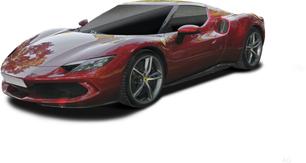
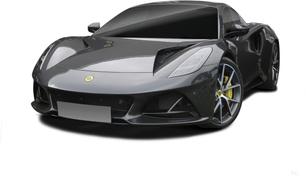
What's the difference?
I know, picture Ferrari and you'll likely be conjuring images of potent V12 or V8 engines, a scenery-shaking exhaust bark on start-up and a fuel bill that would make a Sheikh wince.
But this one, the 296 GTS, doesn't have, or do, any of those things. In fact, it doesn’t so much explode into life as it does kind of whirr gently, as though you’ve just switched on a photocopier.
And yet, people I trust on these matters reckon this just might be the best Ferrari to have ever worn the badge. So, I guess we better get to figuring out what the hell is going on with this plug-in Prancing Horse.
Lotus - it’s one of the most iconic names in the history of automobiles and was once Great Britain’s answer to Ferrari - on the road and the Formula One circuit.
But that was a long time ago, in the 1960s and ‘70s. Since then Lotus has been on a rollercoaster ride through various owners who put in various levels of investment, resulting in various degrees of success.
But through it all, Lotus has stayed true to the ethos of company founder, Colin Chapman - ‘simplify, then add lightness.’ It’s obviously a playful saying, but it spoke to the core elements of Lotus cars, agility and driving purity.
Lotus rarely worried about big, powerful engines and instead focused on creating the best-handling cars.
That was the past, though, because Lotus Cars is now owned by Geely, the Chinese automotive giant that also counts Volvo, Polestar, Zeekr and more under its control.
Geely’s vision for Lotus is very different to what has come before, with a future focused on building electric SUVs and sedans; such as the already released Eletre and Emeya.
All of which is a very long way to get us to the car we’re actually testing - the MY24 Lotus Emira.
This is the last petrol-powered sports car from Lotus, and while it has been available already with a V6 engine, it has recently arrived with a Mercedes-AMG four-cylinder turbo.
Given its place in the grand scheme of things, the Emira not only needs to live up to the legacy of the iconic models that came before it, but also needs to lay the foundations for the brand’s electric future. Which is a lot of pressure for one car to carry…
Anyone who says electrification somehow muddies the Ferrari formula is wrong. This plug-in Prancing Horse is among the most potent and direct vehicles I’ve ever driven, and the electric motor only adds to the experience.
If this really is the final petrol-powered Lotus sports car then it’s a sad day for fans of the brand and its history. But it’s also worthy of celebration because they have made a car that is genuinely impressive.
It may not be perfect, and it will have to fight hard to lure buyers away from Porsche, BMW and co. but for anyone who enjoys a dynamic, engaging and incredibly fun sports car the Emira should be on your short-list.
Alternatively, if you’ve always dreamed of buying a traditional Lotus sports car and haven’t got around to it until now, this is your last chance so don’t wait too long.
It is hard not to swoon when you gaze upon the 296 GTS, and I say that with no bias - I don’t think all Ferraris have looked this good.
But this is Ferrari at its dreamy, sweeping best, from the tarmac-kissing front — which generates so much downforce and cooling it negates the need for active aero — to its swollen haunches and the glass-topped engine window.
So what’s the difference between this and the GTB? Largely it is the ability to drop the folding roof, meaning you can feel the wind in your hair and that exhaust in your soul. To be honest, though, I reckon it looks better top up...
It’s a cockpit-style driver’s set-up inside, and there’s lots I love and some things I don’t. But let’s start with the steering wheel, which might be one of the best in existence.
It feels magic under the touch, as do the giant flappy paddles which remain fixed in place as you turn the wheel.
It’s also surprisingly comfortable in the figure-hugging sports seats, though climbing in and out of them is not necessarily something you want to do in front of a crowd.
Downsides? There is plenty of tech in the 296 cabin, but it’s all controlled from the steering wheel, making it fiddly and annoying to use.
Also, there are F1-levels of complexity on the control-everything steering wheel, and if I’m being honest, there are some buttons or switches, the function of which I still don’t fully understand.
As mentioned earlier, the Emira is meant to be a bridge between Lotus’ past and its future - combining elements of its previous sports cars while also laying the visual tone for future models.
The design does a good job of that, because there’s clearly a link to the Exige and Evora of the recent past, but it also takes heavy influence from the limited-run Evija hypercar.
In turn, this new design language will spread out across the all-new electric models, including the Eletre SUV and Emeya sports sedan.
The styling does a good job of making the Emira look and feel like a premium sports car, without the need for any flashy wings or similar. It’s a simple, compact but stylish sports car.
This trend carries over to the cabin, with the more premium finish with the carpets, leather and good quality switchgear, as well as the digital instrument display and 10.2-inch multimedia touchscreen. Gone are the days of a Lotus having a minimalist, exposed aluminium interior with only the bare necessities. This is a proper premium sports car.
What do you want to know around practicality? We’re talking two seats, about 200 litres of cargo space total and a couple of smallish storage spaces in the cabin. And… that’s about it.
Next question, please.
While it’s a more luxurious Lotus, it remains a compact and impractical sports car - and that’s very much on brand. In terms of storage inside the cabin, there are two cupholders and a small lidded console box, but the size of the cabin means everything is quite narrow and feels a little tight for space.
There is a decent sized, although not very deep, shelf behind the seats, so you can put smaller, softer items there and hope they don’t slide around too much.
In terms of actual luggage space, there isn’t much. There’s a small boot behind the engine, and while deep, it’s pretty narrow so you’ll only get soft bags in there if you plan on taking your Emira on a road trip.
Okay, hold your breath for a moment. The 296 GTS lists at $668,146, which is a sizeable jump over the hard-top GTB, which is more like $551,800. But what price a little open-air freedom?
What you get for that investment is a two-part (solid) folding roof, of course, but also what might be Ferrari’s most high-tech offering to date, with a plug-in hybrid system delivering potent performance rather than a usable EV driving range, a mega-clever braking system and an almost telepathic six-way 'Chassis Dynamic Sensor' designed to link the car’s key functions to make the experience, and the driver, somehow better.
Elsewhere, there are sports seats, Matrix LED headlights, 20-inch alloys, keyless entry and a very cool engine start touch-button on the even cooler steering wheel.
Oh, and there's wireless charging and Apple CarPlay, both thankfully standard in Australia, the latter controlled through the steering wheel and digital driver display.
It's all beautifully finished and a joy to behold and sit in.
In terms of size and price, the Emira lines up almost directly against the Porsche 718 Cayman, which is a formidable adversary, but also the likes of the BMW M4. Notably, it’s significantly cheaper than anything offered by the likes of Ferrari, Maserati and McLaren.
The MY24 Emira range begins at $155,900, before on-road costs, for the entry-level model but stretches up to just over $206,000 for the i4 First Edition we’re driving here.
The Emira has been designed as a more premium and luxurious sports car compared to the stripped down and basic models of the recent past, such as the Elise and Exige, so it gets a range of items not previously seen on many Lotus models - such as carpeted floors and the choice of either Nappa leather or Alcantara trim.
Also included are LED headlights, climate control, keyless ignition, cruise control, rear parking sensors, a premium sound system and a 12.3-inch digital dashboard.
It's worth noting the MY25 Emira line-up was detailed earlier this month. You can read all about it, including pricing and specification, here.
Now we're talking. The powertrain here is both tremendous and terrifying, pairing a 3.0-litre twin-turbo-petrol V6 with a rear mounted electric motor, and a 7.5kWh battery, to deliver a total 610kW and 740Nm. That power is fed through an eight-speed dual-clutch auto transmission.
Those are, frankly, scary numbers, and enough, Ferrari says, to dispatch 100km/h in just 2.9 seconds, and to push on to a top speed of 330km/h.
The MY24 Emria first arrived in Australia with the same Toyota-built 3.5-litre V6 engine Lotus had used in recent years in the likes of the Exige and Evora. However, this new AMG-built four-cylinder provides a fresh choice.
Importantly, while built by Mercedes-AMG, the tuning and calibration is unique to Lotus (but we’ll discuss that in detail later).
That means the 2.0-litre unit is tuned to make 268kW/430Nm, which is less potent than AMG offers in its 310kW/500Nm A45 hot hatch, although a more potent version of the four-pot Emira has been confirmed for MY25.
The engine is paired with an eight-speed dual-clutch auto transmission, which you can either leave in automatic mode or change gear manually using the F1-style paddles on the steering wheel.
As well as the ability to start up and slink away silently, the Ferrari 296 GTS’s little battery will deliver a 25km EV-only driving range, and contribute to the overall claimed fuel use of just 6.5L/100km.
Charging is AC only, and the the brand reckons it takes around 90mins to top up using an 11kW charger. The self-charging is on-point, though, with the Ferrari able to quickly recoup energy from braking and the like to top up the battery without needing to plug in.
Given the Emira is a sports car, the four-cylinder turbo is tuned for performance over economy and that’s reflected in an 10.1L/100km return on the combined (urban/extra-urban) cycle. That’s not too bad for a sports car, but is relatively thirsty given the engine capacity and the overall size of the car.
The Emira is equipped with a 60-litre fuel tank, so it has a driving range of approximately 594km.
The engine is undoubtedly a highlight, and we’ll get to that in a moment, but I first want to talk about the steering in this car.
It might sound like a weird point to get hung up on, but it is sensational, and maybe the best I’ve ever experienced. Generally speaking, super-responsive steering can risk feeling overly sharp and uncomfortable when cruising, but somehow the 296 manages to feel super natural, super responsive, and super engaging, without every feeling sharp or darty. It’s just predictable, responsive, and spectacular.
Honestly, it is a highlight of a drive experience filled with highlights, with another being the dual-nature of this drop-top supercar. Long before I got anywhere near a twisting road I needed to navigate the usual nightmare that is Sydney, tackling traffic, suburbia, freeways, tunnels and expansion joints galore, and the 296 never felt uncomfortable.
Instead, the 296 slipped into a comfortable kind of lope, never jarring or rough, and eminently easy to get along with. And yet, when you arrive on the right road that veil of sensibility drops, and the Ferrari quickly reminds you of its potential.
For a start, the acceleration is properly, startlingly aggressive. Engage the 'Qualification' drive mode (which unlocks the full might of the Ferrari's electrified powertrain) and flatten your right foot, and you'll find the world suddenly hurtling past your windows, and your knuckles will no doubt whiten as you feel the rear tyres fighting for traction against the onslaught should you try it on anything but the straightest of roads.
It's addictive, but it's just one element of a near-perfect combination on offer here, with the 296 GTS the stiffest Ferrari drop-top to date, which becomes immediately clear as you start to attack corners with ever-growing confidence.
Grip, stability and stiffness in spades, the GTS delivers. And all accompanied by an exhaust howl so angry and evil it’s hard to believe it’s being generated by a V6.
It’s a thing of very near perfection.
Just to be clear right up front, the score for this section is heavily biased towards the car's dynamic attributes, because frankly the Emira can be hard to live with at times.
At urban speeds the powertrain feels like a dog straining at its leash, which can result in some awkward moments.
For example, there were multiple instances where the gearbox refused to change out of second gear when exiting a roundabout, letting the engine rev quite hard and likely annoying my neighbours.
Some of the gear changes can be clunky too, not slotting as sweetly as they should on a sports car costing in excess of $200K.
However, you forget all that when you get the Emira onto a stretch of twisty, winding open road (preferably smooth tarmac) and move it from the 'Tour' to 'Sports' mode. The car comes alive, revving hard, shifting with precision and feeling like a puppy running through a field in pure ecstasy.
Like the great cars to come before it from Lotus, the Emira is in its element carving through corners. The steering is incredibly accurate, direct and responsive - as good as any sports car I’ve driven in recent memory. The chassis responds to those inputs with immediacy, too, feeling nimble, agile and engaging.
This is Lotus at its best.
Not much chance of the 296 GTS being crash-tested in Australia — you’d be able to hear the Italians weeping across the ocean.
You do get front and side airbags parking sensors, a reversing camera, auto high beam and tyre pressure monitoring.
Sports cars are not typically beacons of safety, not that they’re dangerous but the priority is speed, not complex and often weighty safety technology. It’s part of the reason these types of cars are rarely crash tested by the authorities, as is the case of the Emira.
But this more modern and luxury focused Lotus comes with a raft of safety items including adaptive cruise control, an anti-collision system (Lotus-speak for AEB), fatigue alert, road sign information, a vehicle speed limiter, lane departure warning, rear cross-traffic alert and lane change assist.
Standard is a three year warranty, but you can extend that for up to five years. Then, if your car has less than 90,000km on the clock, you can opt into the 'New Power15', which gives you up to 15 years total warranty coverage and is fully transferable.
The first seven years scheduled maintenance is free-of-charge.
Lotus Australia offers a three year warranty, which is in line with Porsche's cover, so that’s competitive in the sports car market.
However, the brand does not offer capped price servicing, so you’ll need to discuss with your local dealer how much regular maintenance will cost you. The service intervals are every 12 months/15,000km.