What's the difference?
I know, picture Ferrari and you'll likely be conjuring images of potent V12 or V8 engines, a scenery-shaking exhaust bark on start-up and a fuel bill that would make a Sheikh wince.
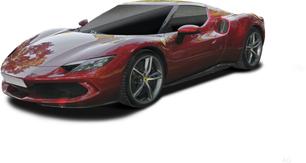
But this one, the 296 GTS, doesn't have, or do, any of those things. In fact, it doesn’t so much explode into life as it does kind of whirr gently, as though you’ve just switched on a photocopier.
And yet, people I trust on these matters reckon this just might be the best Ferrari to have ever worn the badge. So, I guess we better get to figuring out what the hell is going on with this plug-in Prancing Horse.
Believe it or not, the McLaren 540C is an entry-level model. But you won't find anything remotely resembling rubber floor mats, steel wheels, or cloth seats here. This is a 'base' car like few others.
Revealed in 2015, it's actually the cornerstone of McLaren's three-tier supercar pyramid, being the most affordable member of the Sport Series, with the properly exotic Super Series (650S, 675LT and now 720S), and pretty much insane Ultimate Series (where the P1 hypercar briefly lived) rising above it.
So, how has this British upstart managed to build a world-beating supercar brand so quickly?
Only a few years ago, McLaren meant nothing to anyone outside the octane-infused world of motorsport. But in 2017, it's right up there with aspirational sports car big guns like Ferrari and Porsche, both of which have been producing road cars for close to 70 years.
So, how has this British upstart managed to build a world-beating supercar brand so quickly?
Everything you need to know to answer that question resides inside the stunning McLaren 540C.
Anyone who says electrification somehow muddies the Ferrari formula is wrong. This plug-in Prancing Horse is among the most potent and direct vehicles I’ve ever driven, and the electric motor only adds to the experience.
The 540C is desirable on so many levels. Its dynamic ability, blistering performance, and stunning design make the cost of entry a value-for-money ticket. And the refreshing thing is, choosing a McLaren, with its focus on function and pure engineering, sidesteps the wankery that so often goes with ownership of an 'established' exotic brand. We absolutely love it.
It is hard not to swoon when you gaze upon the 296 GTS, and I say that with no bias - I don’t think all Ferraris have looked this good.
But this is Ferrari at its dreamy, sweeping best, from the tarmac-kissing front — which generates so much downforce and cooling it negates the need for active aero — to its swollen haunches and the glass-topped engine window.
So what’s the difference between this and the GTB? Largely it is the ability to drop the folding roof, meaning you can feel the wind in your hair and that exhaust in your soul. To be honest, though, I reckon it looks better top up...
It’s a cockpit-style driver’s set-up inside, and there’s lots I love and some things I don’t. But let’s start with the steering wheel, which might be one of the best in existence.
It feels magic under the touch, as do the giant flappy paddles which remain fixed in place as you turn the wheel.
It’s also surprisingly comfortable in the figure-hugging sports seats, though climbing in and out of them is not necessarily something you want to do in front of a crowd.
Downsides? There is plenty of tech in the 296 cabin, but it’s all controlled from the steering wheel, making it fiddly and annoying to use.
Also, there are F1-levels of complexity on the control-everything steering wheel, and if I’m being honest, there are some buttons or switches, the function of which I still don’t fully understand.
In 2010 the recent rise (and rise) of McLaren Automotive really began, when its design director, the hugely respected Frank Stephenson, started to send things in a compelling direction.
He says McLarens are 'designed by air' and that intricately sculpted, wind-tunnel-driven approach to supercar beauty is clear in the 540C's shape.
It's aimed at so-called everyday supercars like the Audi R8, and Porsche 911 Turbo, yet it incorporates all the subtle aero tricks that define the brand's dynamic personality.
A serious front spoiler and a mix of large intakes low in the nose create a delicate balance between downforce and corridors for cooling air.
The dihedral design doors swinging up to their fully open position is a camera phone attracting, jaw dropping, traffic-stopper.
Broad strakes down the side, standing proud of the main bodywork, are reminiscent of a formula one car's turbulence reducing barge boards, and giant intake ducts channel air through to the radiators in the cleanest, most efficient way possible.
And the look is suitably spectacular. You could hang the dramatically carved doors in a contemporary art museum.
Barely noticeable flying buttresses extending from the rear of the main roofline make a big contribution to downforce, cooling and stability with a minimal drag penalty.
There's a delicate lip spoiler on the trailing edge of the main deck, and a giant multi-channel diffuser proves air flow under the car is just as carefully managed as that going over it.
But the 540C doesn't lack traditional supercar drama. The dihedral design doors swinging up to their fully open position is a camera phone attracting, jaw dropping, traffic-stopper.
The interior is simple, striking and single-mindedly driver-focused. The chunky wheel is completely unadorned, the digital instruments are crystal clear, and the seats are the perfect combination of support and comfort.
The vertical 7.0-inch 'IRIS' touchscreen is cool to the point of minimalism, managing everything from audio and nav, to media streaming and air-con, with low-key efficiency.
What do you want to know around practicality? We’re talking two seats, about 200 litres of cargo space total and a couple of smallish storage spaces in the cabin. And… that’s about it.
Next question, please.
There are some cursory concessions to practicality… like a glovebox, a single cupholder under the dash at the leading edge of the centre console, a small bin between the seats, housing multiple USB outlets, and other storage options here and there.
The latter includes a shelf at the top of the bulkhead behind the seats, marked with a specific label saying (words to the effect of) 'don't put stuff here', but that's more about objects flying forward in a high-G deceleration, which in this car is more likely to be the result of hitting the brakes, rather than a crash.
But the 'big' surprise is the 144-litre boot in the nose, complete with light and 12 volt power outlet. It easily swallowed the CarsGuide medium sized, 68-litre hard shell suitcase.
In terms of getting in and out, make sure you've done you warm-ups because frankly it's an athletic challenge to maintain composure and get the job done either way. Despite best efforts, I hit my head a couple of times, and aside from the pain it's worth pointing out that being a follicularly-challenged person I'm forced to display abrasions in full public view.
Okay, hold your breath for a moment. The 296 GTS lists at $668,146, which is a sizeable jump over the hard-top GTB, which is more like $551,800. But what price a little open-air freedom?
What you get for that investment is a two-part (solid) folding roof, of course, but also what might be Ferrari’s most high-tech offering to date, with a plug-in hybrid system delivering potent performance rather than a usable EV driving range, a mega-clever braking system and an almost telepathic six-way 'Chassis Dynamic Sensor' designed to link the car’s key functions to make the experience, and the driver, somehow better.
Elsewhere, there are sports seats, Matrix LED headlights, 20-inch alloys, keyless entry and a very cool engine start touch-button on the even cooler steering wheel.
Oh, and there's wireless charging and Apple CarPlay, both thankfully standard in Australia, the latter controlled through the steering wheel and digital driver display.
It's all beautifully finished and a joy to behold and sit in.
At $331,500, we reckon the McLaren 540C is a supercar bargain. For just on $140k less than a Ferrari 488 GTB it delivers equivalent visual drama, and isn't far behind on speed and dynamic ability.
Standard kit runs to climate control air con, an alarm system, cruise control, remote central locking, LED headlights, tail-lights and DRLs, keyless entry and drive, a limited-slip differential, leather steering wheel, power folding mirrors, four-speaker audio, and a multi-function trip computer.
'Our' car featured close to $30,000 worth of options; headline items being the 'Elite - McLaren Orange' paint finish ($3620), a 'Sport Exhaust' system ($8500), and the 'Security Pack' ($10,520) which includes front and rear parking sensors, a reversing camera, alarm upgrade and a vehicle lifter that raises the front of the car an extra 40mm at the push of a column stalk. Very handy.
And the signature orange shade follows through with orange brake calipers peeking out through the standard 'Club Cast' alloy rims, and similarly coloured seatbelts inside.
Now we're talking. The powertrain here is both tremendous and terrifying, pairing a 3.0-litre twin-turbo-petrol V6 with a rear mounted electric motor, and a 7.5kWh battery, to deliver a total 610kW and 740Nm. That power is fed through an eight-speed dual-clutch auto transmission.
Those are, frankly, scary numbers, and enough, Ferrari says, to dispatch 100km/h in just 2.9 seconds, and to push on to a top speed of 330km/h.
Aside from you and a passenger, the most important thing sitting between the 540C's axles is the 3.8-litre (M838TE) twin-turbo V8.
Developed in collaboration with British high-tech engineering specialist, Ricardo, McLaren's used it in various states of tune across different models, including the P1, and even in this 'entry-level' spec it produces enough power to light up a small town.
In 540C trim, the all-alloy unit delivers 397kW (540 metric horsepower, hence the model designation) at 7500rpm, and 540Nm from 3500-6500rpm. It uses race-derived dry sump lubrication, and a compact flat plane crank design, favoured by Ferrari and others in high-performance engines.
While vibration damping can be an issue with this configuration, it allows a much higher rev ceiling relative to the more common cross plane arrangement, and this engine screams up to 8500rpm, a stratospheric number for a road-going turbo.
The seven-speed 'Seamless-Shift' dual-clutch transmission sends drive exclusively to the rear wheels and comes from Italian gearbox gurus Oerlikon Graziano. It's been progressively refined and upgraded since its first appearance in the MP4-12C in 2011.
As well as the ability to start up and slink away silently, the Ferrari 296 GTS’s little battery will deliver a 25km EV-only driving range, and contribute to the overall claimed fuel use of just 6.5L/100km.
Charging is AC only, and the the brand reckons it takes around 90mins to top up using an 11kW charger. The self-charging is on-point, though, with the Ferrari able to quickly recoup energy from braking and the like to top up the battery without needing to plug in.
McLaren claims 10.7L/100km for the combined (urban/extra urban) fuel economy cycle, emitting 249g/km of CO2 at the same time.
For the record, that's six per cent better than the Ferrari 488 GTB (11.4L/100km – 260g/km), and if you take it easy on a constant freeway cruise, you can lower it even further.
But most of the time, we, ahem, didn't do better than that, averaging 14.5L/100km via the trip computer in just over 300km of city, suburban and freeway running.
The engine is undoubtedly a highlight, and we’ll get to that in a moment, but I first want to talk about the steering in this car.
It might sound like a weird point to get hung up on, but it is sensational, and maybe the best I’ve ever experienced. Generally speaking, super-responsive steering can risk feeling overly sharp and uncomfortable when cruising, but somehow the 296 manages to feel super natural, super responsive, and super engaging, without every feeling sharp or darty. It’s just predictable, responsive, and spectacular.
Honestly, it is a highlight of a drive experience filled with highlights, with another being the dual-nature of this drop-top supercar. Long before I got anywhere near a twisting road I needed to navigate the usual nightmare that is Sydney, tackling traffic, suburbia, freeways, tunnels and expansion joints galore, and the 296 never felt uncomfortable.
Instead, the 296 slipped into a comfortable kind of lope, never jarring or rough, and eminently easy to get along with. And yet, when you arrive on the right road that veil of sensibility drops, and the Ferrari quickly reminds you of its potential.
For a start, the acceleration is properly, startlingly aggressive. Engage the 'Qualification' drive mode (which unlocks the full might of the Ferrari's electrified powertrain) and flatten your right foot, and you'll find the world suddenly hurtling past your windows, and your knuckles will no doubt whiten as you feel the rear tyres fighting for traction against the onslaught should you try it on anything but the straightest of roads.
It's addictive, but it's just one element of a near-perfect combination on offer here, with the 296 GTS the stiffest Ferrari drop-top to date, which becomes immediately clear as you start to attack corners with ever-growing confidence.
Grip, stability and stiffness in spades, the GTS delivers. And all accompanied by an exhaust howl so angry and evil it’s hard to believe it’s being generated by a V6.
It’s a thing of very near perfection.
The best word to describe driving this McLaren is orchestration. The 540C's dynamic elements flow seamlessly together to transform its operator into a conductor guiding a well-honed mechanical orchestra through an energetic concerto.
And slipping (carefully) over the carpeted bulkhead into the driver's seat is like dropping into an ergonomic masterclass. It feels like you're putting the car on, rather than getting into it.
Like all other current McLarens, the 540C is constructed around a one-piece, carbon-fibre tub, which it calls MonoCell II. It's super stiff, and just as importantly, light.
McLaren quotes a dry weight (no fuel, lubricants, or coolant) for the 540C of 1311kg, with the kerb weight a stated 1525kg (including a 75kg passenger). Not featherweight, but with this kind of power sitting a few centimetres behind your head, it's not a lot.
The engine sounds brilliantly guttural, with lots of exhaust roar managing to find a way past the turbos.
A sophisticated launch control system means zero to licence loss is achieved in a flash (0-100km/h – 3.5sec), with jail time lurking if you ever decide to explore the 540C's 320km/h maximum velocity. And in case you're wondering, it'll blast from 0-200km/h, in just 10.5sec.
The engine sounds brilliantly guttural, with lots of exhaust roar managing to find a way past the turbos. Maximum torque is available across a flat plateau from 3500-6500rpm, and mid-range punch is strong. However, the 540C is anything but a one-trick pony, or is that 540 ponies?
The double wishbone suspension, complete with the adaptive 'Active Dynamics Control' system lets you channel all that forward thrust into huge cornering speed.
The switch from Normal, through Sport to Track progressively buttons everything down harder, and an ideal weight distribution (42f/58r) delivers fantastic agility.
Feel from the electro-hydraulic steering is amazing, the fat Pirelli P Zero rubber (225/35 x 19 front / 285/35 x 20 rear), developed specifically for this car, grips like a Mr T handshake, and the standard 'Brake Steer' torque vectoring system, which applies braking force to optimise drive and minimise understeer, is undetectable in the best possible way.
A console switchable 'Powertrain Control System' also offers three settings, and in the upper modes, shifts from the seven speed dual clutch 'box are eye-blink rapid.
The steering wheel paddles come in the form of a genuine rocker, so you're able to change up and down ratios on either side of the wheel, or one-handed.
You'll love catching a glimpse of the heat haze shimmering up off the engine in the rear-view mirror at the lights.
Hammer towards a quick corner and the reassuringly progressive steel rotor brakes bleed off speed with complete authority. Flick down a couple of gears, then turn in and the front end sweeps towards the apex without a hint of drama. Squeeze in the power and the fat rear rubber keeps the car planted, and perfectly neutral mid-corner. Then pin the throttle and the 540C rockets towards the next bend… which can't come quickly enough. Repeat, and enjoy.
But slotting everything into 'Normal' mode transforms this dramatic wedge into a compliant daily driver. Smooth throttle response, surprisingly good vision and excellent ride comfort make the McLaren a pleasure to steer around town.
You'll love catching a glimpse of the heat haze shimmering up off the engine in the rear-view mirror at the lights, and the (optional) nose-lift system makes traversing awkward driveways and speed bumps manageable.
Not much chance of the 296 GTS being crash-tested in Australia — you’d be able to hear the Italians weeping across the ocean.
You do get front and side airbags parking sensors, a reversing camera, auto high beam and tyre pressure monitoring.
In terms of active safety, the car's dynamic ability is one giant safeguard against a collision, and that's backed up by tech features including ABS and brake assist (no AEB, though), as well as stability and traction controls.
But if a crunching-type incident is unavoidable, the carbon-composite chassis offers exceptional crash protection with dual front airbags in support (no side or curtain airbags).
Not a huge surprise that ANCAP (or Euro NCAP, for that matter) hasn't assessed this particular vehicle.
Standard is a three year warranty, but you can extend that for up to five years. Then, if your car has less than 90,000km on the clock, you can opt into the 'New Power15', which gives you up to 15 years total warranty coverage and is fully transferable.
The first seven years scheduled maintenance is free-of-charge.
McLaren offers a three year/unlimited km warranty on the 540C, and servicing is recommended every 15,000 km or two years, whichever comes first. No capped price servicing program is offered.
That's a lot of kays for a premium exotic like this, and some may not see 15,000km on the odometer… ever.