What's the difference?
Back in the day, the 3 Series sedan was often the entry to the brand for first time BMW owners, and for good reason. They offered practical interior space without compromising on engine performance.
And they simply looked good, no boring nanny design elements. Then the 1 Series came along and price points bumped up, so how does the ‘entry’ BMW 320i M Sport live up to its long-standing reputation?
With an updated dashboard that brings the interior and tech up to market and a sharper exterior design, it more than holds its own at the table of luxury sedans, despite hard competition from the likes of the Audi A4, Mercedes-Benz C200 and Jaguar XE.
However, if the Merc is a placid and well-behaved mare… the BMW is the barely-broken-in bronco and it takes a certain kind of ‘rider’ to enjoy what the 320i has to offer.
I’ve been discovering just that this week with my family of three. What did we find out? Read below!
The entry-point into one of Australia's most popular brands has been around for almost 10 years in its current generation, but the Mazda2 has had a refresh.
Possibly for the last time in its current lifespan, the small hatchback gets a facelift to remain appealing, Mazda hopes, to first-car-buyers.
Mazda's up against not only direct rivals, like the Suzuki Swift and Toyota Yaris, but also the shifting market.
Mazda has sold just over 3500 Mazda2s so far this year, but almost 11,000 CX-3 small SUVs, the latter based on our friend here's platform.
It's a name with a little over two decades behind it, but can it be a first-car-favourite in an increasingly difficult small car market?
I thoroughly enjoyed my time in the BMW 320i M Sport. It’s fun to drive and I felt connected to what the car was doing on the road. The harder ride may not appeal to some but I didn’t mind it. The cosy back seat and boot mean it will probably suit a smaller family best and one which doesn’t have to worry about carrying a lot of gear around regularly, but it suited my needs just fine.
I reckon this is a car for those drivers who don’t want to compromise on performance but still have a kid or two. If you’re after the cushioned comfort of a Merc, this won’t appeal but I didn't want to give this one back and happily give it a firm 8/10.
My son liked the sports car looks and enjoyed the amenities in his row. He gives it a 10/10.
While Mazda's insistence that the Mazda2 is a 'first-car' could be very limited by the incomes of most teenagers or early-20s city-dwellers, the starting price being close enough to $20,000 for a dynamically enjoyable and convenient small car isn't to be scoffed at.
The new styling of the Mazda2 is well executed, and as an alternative to small SUVs (which continue to become more popular) it's a sensible option, especially considering its efficiency and ease of use.
The lower specifications in the range are probably the best in terms of value, as even the features on the higher grades aren't groundbreaking, and the Pure SP definitely exudes the most style cred.
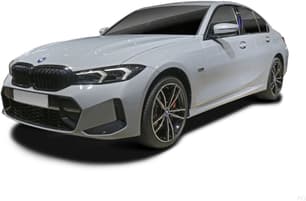
Sharper than its predecessor, the new 320i has LED everything with the rear lights being longer and curving around to the sides of the car.
The classic 'kidney' grille is darkened and more pronounced, with the black panelling extending to the rear to create an unapologetically sporty presence. A presence that’s accentuated by the twin exhausts.
The batcave interior with its black headliner, black seats… black everything, looks smart and stylish.
You do have a fair bit of harder touchpoints throughout but the customisable ambient lighting helps to soften the overall effect.
With its 2068mm width, 4709mm length and 1435mm height, the sedan makes its presence known without feeling cumbersome to manoeuvre. Urban dwellers need not fear their local car park!
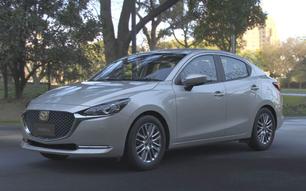
Aside from the Pure SP, the Mazda2's styling changes are subtle. Mazda's design team aimed to move the model's looks slightly away from the previous ‘premium' chrome-adorned look to a sportier and more ‘aggressive' style.
A redesigned front bumper and mesh grille, with the rear's nip and tuck being more subtle, don't need to do much to keep the hatchback looking fresh. Despite being almost a decade old, the Mazda2 looks, to some extent, like it could be a new generation.
The Pure SP in particular is a highlight, with the blocked grille evoking some ‘electrification' vibes, while the coloured-accent treatment at the front and rear of most variants is a welcome addition for something different.
The range of differing wheels is also a plus point for the Mazda2 range, with each model having its own distinct characteristics.
Inside, the Pure SP also gets a stand-out panel across the dash in a lighter colour like mint, while others get different seat trims and colour accents in places like the vent surrounds.
New colours for the range are 'Aero Grey Metallic' and 'Air Stream Blue Metallic'.
For such a sleek looking sedan, it’s generous up front with plenty of head and legroom.
You can adjust the seat to sit quite low and both front seats have extendable under-thigh supports, which should excite taller drivers.
My 189cm (6’2”) brother has the 328i and is very comfortable but taller front passengers will encroach on back seat passenger comfort.
The front seats are quite firm on the backside, they also lack adjustable lumbar support, so expect to stretch the kinks out on a longer trip.
The amenities and tech feel well thought out and easy enough to use. The 12.3-inch touchscreen multimedia system looks great and has the best-looking graphics I’ve sampled.
The BMW system is intuitive to use once you get used to it. If you’re not interested in using the touchscreen, you can also utilise the rotary-wheel for menu selections.
There’s also Bluetooth connectivity, wireless Apple CarPlay and Android Auto plus built-in satellite navigation.
The 12.3-inch digital instrument panel is customisable and the information displayed simply but you won’t really look at it because of the head-up display.
Front occupants enjoy a wireless charging pad for their smart phone, a USB-A and USB-C port plus a 12-volt socket. Rear passengers get a couple of USB-C ports, too.
The storage is good for this size sedan but overall passenger room takes priority, but the glove box and middle console will suffice for everyday use.
While it may not excite others, I love the big bottle holders in the doors. They’re large enough for my big 1.5L bottle and angled for easy access. These are found in the rear doors as well.
Back seat passengers enjoy climate control, directional air vents, two cupholders, netted map pockets and reading lights.
My six-year old was happy with the amenities and lower ground clearance because he felt comfortable and had his independence.
The boot offers a good capacity of 480L and the aperture isn’t too narrow, so you can comfortably access items if they roll to the back.
I had plenty of room for my little family’s needs but if you’re a larger family, you may need to get strategic with gear storage.
Being a base model, you do miss out on a powered tailgate, which is a shame but not too much of an issue given this is a sedan and the lid isn’t heavy.
There’s also no spare tyre or even a puncture repair kit but you have run-flats, so you should be able to limp to a service centre if need be.
The Mazda2's interior is mostly unchanged through the facelift, with the car's overall dimensions unchanged and not affecting space for its occupants.
Up front, the two seats are comfortable for adults and arm, shoulder, and head room is ample.
Storage space for drinks, phones, or small bags and wallets is sufficient, though not quite road-trip-worthy.
In the rear seats, adults will find enough space to be comfortable for short trips but might get a little restless after a while.
Headroom when sitting upright is tight for anyone around 182cm (six-feet) tall, and a lack of armrest and little storage save for the doors means loose items will be joining occupants on the seat or sitting on the floor.
The Mazda2 has a claimed 250 litres of luggage space in the boot, which is fine for a small hatchback, but short of rivals like the Toyota Yaris' 270L.
There are seven variants for the BMW 3 Series sedan and our model is the base model for the petrol variants.
There is a plug-in hybrid version, the 330e, if you’re after a more fuel-efficient option but it will up the price by about $20K.
As it stands the 320i M Sport is $78,900, before on-road costs. Our model has been finished in 'M Brooklyn Grey', which adds $1539 to the price.
That puts it at a similar price point as its rivals. You get a well-specified package with the M Sport but it doesn’t have the same sense of cushioned comfort as the Merc does, but more on that later.
Still, the sporty and streamlined interior is headlined by BMW’s dual 12.3-inch screens that sit propped on the dash like a futuristic cockpit.
The mix of synthetic leather and cloth seats are electric and have adjustable side bolsters for when you want to go hard in a turn.
The interior also boasts a sunroof and wireless Apple CarPlay and wired Android Auto. There are some other highlights like the 18-inch alloy wheels, leather steering wheel and the crystal-clear head-up display, to name a few.
Mazda has managed to keep pricing for its entry model relatively low for the segment. In fact, the base Pure in manual form starts from $22,410, before on-roads, and the auto is only $2000 more.
That means at a time when the Toyota Yaris is starting to look more expensive than its historic ‘cheap and cheerful' image allows, Mazda is pushing the Mazda2 to be slightly more premium while keeping its price competitive.
Standard features for the range, which start in the Pure variant, include a 7.0-inch touchscreen with Apple CarPlay and Android Auto capability, plus auto headlights and windscreen wipers.
The Pure SP, which starts at $25,210, gains a different styling kit that adds a body-coloured front panel to the grille, plus a carbon-look roof in vinyl. It also gains the ‘shark-fin' roof aerial.
The Evolve, which starts from $25,910, gains LED DRLs, with the mesh grille replacing the SP's block colour panel.
Its upholstery gets red stitching, plus it's also got a couple more tech additions with Mazda's active head-up driver display, traffic sign recognition and satellite navigation.
Finally, there's the top-spec GT, from $27,610, which gains unique aero-inspired 16-inch alloy wheels, and a set of black leather-upholstered seats with synthetic suede and red trim.
A sedan is available in Pure or GT specification at the same prices and with the same features as the hatch, though you can't get a Pure sedan in manual - that's available in the hatch only.
The 320i M Sport has the ‘baby’ engine in the 3 Series line-up but the 2.0-litre, four-cylinder turbo-petrol powertrain still delivers on power with a maximum output of 135kW/300Nm.
This is a rear-wheel drive and has an eight-speed auto-transmission which delivers very smooth gear changes.
Despite having the smaller engine, it can still go from 0-100km/h in just 7.4 seconds.
Mazda's ‘SkyActiv-G' 1.5 litre four-cylinder petrol engine is the unit used for six-speed manual and automatic models, but outputs vary slightly.
Manual cars produce 82kW and 144Nm, while autos deliver a slightly lower 81kW and 142Nm, both driving the front wheels only.
It's pretty much the same engine you used to find in an entry-grade MX-5, just with less power.
In a world with rising fuel prices, the efficiency of this decently powered sedan should excite you.
The official combined fuel cycle is 6.5L/100km. Real world testing saw my figure at 7.4L/100km after a mix of open-road and urban driving this week.
I thought that was great for how hard I drove it and for the power, you won’t be wincing when you put your foot down. I would expect it to be higher in an urban setting.
The 320i has a 59L fuel tank and based on the official combined cycle figure, you should get just over 900km of driving range, which is great, especially if you do 'roadies' like me!
Improved fuel efficiency and lower CO2 emissions come thanks to the automatic's slight drop in power and torque.
Mazda claims a 5.0L/100 km rating for the automatic Mazda2, which is down by 0.3L/100km over the previous version, but the manual's unchanged engine tune burns through the petrol at 5.4L/100km.
Filling the 44-litre tank with at least 91RON or even E10 is fine, and with its auto variant's efficiency rating means the Mazda2 technically has a theoretical range of 880km.
Comparatively the Mazda2 scores well here, the more expensive Toyota Yaris comes with a 4.8L/100km consumption claim with its CVT auto. A Suzuki Swift, with a smaller 1.2-litre engine, also has a 4.8L/100km rating.
There's a lot that I like about how this performs but a highlight is how eagerly the car responds when you accelerate.
However, it’s not unbridled power. There’s no bucking at the front or shuddering through the steering wheel. It’s controlled but still very fun.
The lower centre of gravity and coupe-like height of this does mean it handles corners well and the bolstered seats hold you firmly into place, meaning you can be free to drive this a little harder than you might normally. Which I did and can confirm it handles itself well.
This has the M Sport suspension, which means it’s stiff, but you feel very connected to the road.
You do get a lot of talk-back from bumps in the road but unless you hit a big pothole, you never feel rattled by them.
But it is a harder ride than other luxury models, which doesn’t bother me as I like the handling, but if you want limo-like comfort, look elsewhere.
The cabin is very nice to spend a lot of time in and relatively quiet, even at higher speeds.
The 11.4m turning circle and sleek dimensions makes it very handy to park, even in tight car parks. The nose is long but the front and rear parking sensors take out any ‘will I make it’ moments and the super clear reversing camera is great.
Our drive loop for the Mazda2's launch included a mix of urban, highway, and rural driving, with varying road quality and conditions.
Fortunately for the little hatchback, it handled everything well or at least at a passing mark, with only a couple of small shortcomings that are common in the segment.
The Mazda2 is a joy to drive in most circumstances, with a lively but confidence-inspiring chassis and controls that give a connected feel to the road.
At low speeds, the Mazda2's relatively low power isn't noticeable, with the gearbox getting things moving at a reasonable pace and the engine is responsive enough with the traditional gearbox helping it along.
It's worth noting that for ultimate control over the drivetrain, Mazda still offers a six-speed manual transmission in the entry-grade Pure, and it's a gem.
Smooth, sporty shifts and well thought out gear ratios mean the manual is easy to handle even in traffic, and the clutch has a forgiving bite point. The 'i-Stop' stop/start system works with the three-pedal car, too, as does cruise control.
In terms of handling and comfort, the Mazda2 is a little shaken by large bumps, though some of the rough surfaces on our test loop were particularly brutal.
Similarly, when pushed hard to conquer steep hills the 1.5-litre engine becomes a little harsh.
On twisty sections the Mazda2 (especially in manual form) provides ample fun while remaining predictable in its steering and chassis feedback, rather than feeling loose.
The safety list includes a suite of features and the following come as standard: adaptive cruise control, auto emergency braking (operational from 5.0-210km/h), blind-spot monitoring, speed sign recognition, forward collision warning, SOS emergency call button, daytime running lights and rear cross-traffic alert.
I like the intelligent seatbelt reminder and that the bonnet is considered 'active', meaning it will lift up and away from the engine if the sensors detect that a pedestrian has been hit.
However, I have to call out the lane departure and keeping aids. It’s a hit or miss system and I tested it extensively this week once I noticed it.
You can customise the sensitivity levels and even on the highest sensitivity, it works too sporadically for my liking. BMW should improve this system for future instalments.
The 3 Series has been awarded a maximum five-star ANCAP safety rating but it was done a while ago in 2019. It only has seven airbags and is missing the newer front centre airbag.
There are ISOFIX child seat mounts on the outboard seats and three top tether anchor points but the back seat is a bit too narrow to comfortably fit three child seats side by side.
You'll be able to fit a 0-4 rearward facing child seat but may struggle if you're a tall family.
The updated Mazda2 is equipped with the brand's suite of 'i-Activsense' safety tech, which includes 'Smart City Brake Support' for operating forward and reverse, blind-spot monitoring and rear cross-traffic alert.
The Evolve and GT model grades are fitted with traffic sign recognition.
The GT model grade comes fitted with front parking sensors and a set of surround-view parking cameras.
The Mazda2 also features six SRS airbags to cover the driver and front passenger, side airbags, and curtain airbags front and rear. It also has ISOFIX anchor points and top tethers for child seats in the rear.
Mazda isn't going to put the Mazda2 up for a new crash test rating by ANCAP, with the brand telling us the new safety additions bring the car's safety up to date, though its original rating from 2015 was a maximum five stars.
The 320i comes with a five-year/unlimited km warranty, which is standard for this class.
You can choose between a three- or five-year capped-priced servicing plan. The five-year plan costs just $2150, or $430 a year, which is competitive for this class.
Like other BMWs, servicing intervals are condition-based, with the car letting you know when it needs to be serviced.
Mazda offers a five-year/unlimited-kilometre warranty across the range, under which the Mazda2 will be covered. That's on par for the market, although some rivals, like the MG3, come with a seven-year term.
Scheduled servicing costs for the first seven workshop visits range from $334 to $587, and are undertaken every 12 months or 15,000km (whichever comes first).