What's the difference?
Audi is known as a design-led brand, and arguably no model in the line-up embodies that ethos more than the Audi A7 Sportback.
This all-new version of Audi's largest swoopy five-door hatchback takes the concept of the original first-generation version and, rather than reinventing the idea, reimagines it with a more modern and even more style-focused look, inside and out.
And it's a very convincing execution, indeed.
Half a decade on, the current-generation Mazda 3 has weathered a world of change.
Cheap cars have vanished. Electric vehicles are commonplace and the small car class it belongs to has been decimated by SUVs. Big names like the Ford Focus, Holden Astra and Mitsubishi Lancer are history.
But while it looks identical to the car unveiled at the 2018 LA Auto Show, today’s Mazda 3 has also evolved, albeit gently.
Let’s see how competitive the latest and improved (as well as more expensive) version is.
The Audi A7 is a really likeable car, one that is heavily focused on style but also emanates substance. The 55 TFSI model will appeal to many, but my initial impression is that the best buy in the range could well be the entry-level 45 TFSI. I can't wait to sample it sometime in 2019.
Given how effortlessly it traverses the mainstream and premium small car classes, the Mazda 3 might be the best value small car on the planet.
With racy styling, sports car handling, classy interior presentation and impressive, intelligent efficiency, there’s plenty to sink your teeth into here.
Poor rear vision, a dark back-seat area and smallish boot aside, it doesn’t have any glaring faults.
In a world overrun with SUVs, props to Mazda for evolving the small car so brilliantly to mask a half-decade of existence. Continuous improvements have made the 2024 G25 Evolve SP Vision an essential small car shortlist proposition, regardless of price.
If you can't find something interesting about the design of the Audi A7, there's a good chance you're visually impaired.
The original A7 Sportback was perhaps ahead of its time in the way it blended the lines of a coupe with the practicality of a big sedan, and the new second-generation version pushes the envelope even further into the future. The vision, according to chief designer Andreas Koglin, was "a clear form with sharp lines and tight shapes", including the distinguishable 'boat tail' at the rear.
This is a technologically advanced looking car - big, long, sleek and stylish. From the LED headlights (or matrix LED and laser lights - yes, frikkin' lasers that have the same 5500 Kelvin as the sun, according to Audi) and daytime running lights, to the long, lean LED tail-light assembly, there's an illuminated, enlightened air to the A7.
Plus, with the matrix lights, both ends of the car do a sort of disco sequence as part of the start up and shut down procedure for the car.
There are a few carefully balanced lines across the body of the A7 that help catch the light, which is something you can't really say about its closest direct rival, the Mercedes-Benz CLS. It still retains the 'big-metal-small-glasshouse' look of the existing model, but there are definitely more angles and interesting elements to this new-generation car.
There are two exterior types offered for Australia - the S line that you see here is the version that'll be fitted to the two higher grade models, while the entry-grade model gets a less aggressive look to its front and rear bumpers. To my eyes, the base car actually looks more luxurious, where the S line models - when not fitted with the optional black exterior styling pack that deletes the chrome trims outside - have a slightly uneasy look in the grille area. With a black edge to the single frame grille, it looks a touch more convincing.
The A7 is still large, at 4969mm long (-5mm) and riding on a longer 2926mm wheelbase (+12mm), spans 1908mm wide (2118mm including mirrors), but it's also a little bit taller, at 1422mm (+2mm). According to Audi, the interior space has been increased by 21mm in this generation, making for a more luxurious cabin than before.
Things are a little edgier in terms of design in the cockpit, too. Gone is the appealing wraparound dashboard design, with a more driver-focused treatment evident. It looks sharper, more shapely, and has improvements to the usability inside, too.
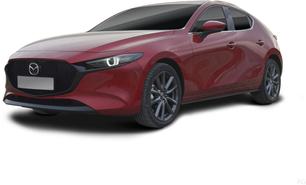
How is it that the current Mazda 3 is already five years old? This hatchback is still stunning, the sort of car you look back at when walking away.
The shape is sleek and almost coupe-like, with a shark-like nose, cab-backward-style long bonnet, upswept shoulder line and a fastback silhouette.
More importantly, it’s the way the light dances across the sculptured sides that draw the eyes in. Bereft of clutter, it makes you wish all mainstream manufacturers had the courage to be so daring.
We’ve said it before – the 'BP'-generation Mazda 3 (Axela in Japan) is the brand’s boldest C-segment hatch since the 1993 'BA' 323 (Astina/Lantis/323F).
But there’s a price to pay for such timeless beauty…
According to Audi, the A7's interior is said to offer a "futuristic lounge type ambience". And if your vision of a lounge in the future includes beautiful textile finishes, quality trims, and your choice of three crisp screens to look at and interact with, it certainly lives up to that.
Unlike the existing model, which seemed to draw a bit more inspiration from the world of watercraft, the new model isn't as luxe looking, with a more tech-focused approach inside. The wraparound finish on the dash is gone, and everything is more driver-centric in its orientation - the screens are tilted just enough towards the pilot and the design of the dashboard helps anchor the person in the driver's seat as the most important in the car.
As a driver, I still struggle to come to terms with climate controls that require you to use a screen, and I think it's distracting, too. At least with the Audi screen there's the possibility to slide up or down on the temperature display to make quick changes, rather than having to tap the screen repeatedly.
The haptic feedback on the screens is something that does take a bit of getting used to, because the response time isn't as instant as some regular touchscreen systems, but the menus are all pretty logically laid out.
And of course, all the storage considerations are dealt with, including good cupholders between the seats, decent door pockets, some loose item caddies and so on. In the back there's a flip-down armrest with cupholders, bottle holders in the doors and map pockets on the seat backs. One really neat addition is illuminated seat belt buckles - clever!
Space back there is mostly good, but it's better if you're short. There's enough legroom and shoulder-room for three adults, but anyone taller than me (I'm 182cm) will likely lack some headroom due to the curvaceous roofline.
The boot is good at 535 litres - enough to deal with two golf bags, the brand claims. The shape of the boot means tall items mightn't fit, but the length and width is good, and you get tie-downs with a mesh net to keep things in order. And there's a space-saver spare wheel under the boot floor.
There is a price to pay for all this quasi-coupe styling flair, and that’s a comparatively snug-feeling interior, though you’d never call it cramped.
Actually, the Mazda 3 is no less spacious than most of its competition in all but one area, with enough room even for 200cm drivers, along with sufficient shoulder width and ceiling height to match.
If you’re really tall, maybe that missing sunroof isn’t such a bad thing, after all.
Sat so low-down on cushy, enveloping front seats that offer plenty of comfort and support, this is the anti-SUV. Maybe Mazda should have called this the MX-3.
Sporty and spot-on, the driving position is a laid-back affair, with an emphasis on better ergonomics, as emphasised by the thoughtful placement of switchgear that’s all within easy reach, ahead of a beautifully flowing and layered dash. Proudly Japanese in flavour, it brings to mind functional minimalism.
Drilling into some of the 3’s finer interior details, the analogue-look digital instrumentation is super-legible, ultra-classy and gorgeously lit at night. As previously mentioned, the dials and surrounding air vents are reminiscent of the later Porsche 944 and 968.
It’s not just all for the sake of aesthetics, either.
Yes, it’s lovely, but the thinned-rim three-spoke steering wheel feels great to grip, with nifty little paddle shifters that are a delight to prod.
Same goes for the physical volume knob and climate-control buttons, sidestepping the need to get distracted and frustrated by virtual sub-menus.
And having a conventional gear lever with old-school Tiptronic-style shifts suits the 3’s athletic vibe.
Plus, forward vision is A-OK, ventilation is faultless, storage is better than you might expect, and the fit and finish is as good if not better than any of this 3’s German premium opponents.
Out back, the split-fold rear backrest is set at a comfortable angle, the cushion is well padded, and you’re provided with USB ports, air vents, and an armrest with two cupholders. More thoughtfulness.
But while knee room is fair, rear headroom isn’t great if you’re tall or wear a beehive, as the falling ceiling line reveals.
Vision out is limited by that rising window line and fat pillars. Getting in and out of the back requires some contortionist moves. And the small windows mean it can be gloomier in the back than a Smiths album.
Finally, at just 295 litres, the 3’s cargo capacity is disappointing. Sure, it eclipses the Corolla hatch’s 217L cubby, but other rivals are far larger back there.
At least the floor is wide and flat and there are 60/40-split backrests for cabin access for longer items.
Note that a space-saver spare wheel lurks underneath. Mazda argues there’s always the closely-related CX-30 if you need (slightly) more space (317L).
Meanwhile, at the other end of the 3…
There are three models in the range, and considering the most natural competitors to the Audi A7 - the Mercedes-Benz CLS (from $136,900) and the BMW 6 series GT (from $123,500) - there's an argument that this car is something of a bargain. Ahem. 'Bargain' is relative, clearly.
The entry-level model is the 45 TFSI, which lists at $113,900 plus on-road costs. That's pretty close to the existing starting point for the A7, but now there's a bit more gear included as standard. It doesn't arrive until around the middle of 2019, though.
This model is comprehensively kitted out, with standard inclusions consisting of 20-inch alloy wheels, adaptive suspension, Audi's 'progressive steering' system, LED headlights with high-beam assist, an electronic tailgate with smart opening, keyless entry and push-button start, 'Valcona' leather trim and sports front seats, electric front seat adjustment and front seat heating and three-zone climate control air conditioning.
Other goodies include an LED interior ambient lighting package, head-up display, Audi's 12.3-inch 'Virtual Cockpit' digital driver information display, a 10.1-inch media screen and 8.6-inch control touchscreen, Bluetooth phone and audio streaming, USB connectivity, Apple CarPlay and Android Auto phone mirroring, and wireless smartphone charging.
Next up the model range is the 55 TFSI, which has a list price of $131,900 before on-road costs - which is the exact same price, and carries the exact same level of standard specification, as the diesel-powered 50 TDI model (also due mid-2019). This splits the difference between the existing models, but still undercuts the rivals by a good margin.
Over the entry-grade model, the 50 TDI and 55 TFSI models bring matrix LED headlights (with light animation), a different 20-inch wheel design, the S line exterior styling pack - essentially a body kit with new front and rear bumpers incorporating mesh-look diffusers and new side sills, plus S line badging.
These two models also get different interior styling, too, with S line embossed leather seats, illuminated door sill trims, a flat-bottom leather wheel with paddle shifters, dark brushed aluminium inlays, stainless steel faced pedals, black headlining, piped floor mats, electric steering column adjustment and a Bang & Olufsen 3D 705-watt sound system with 16 speakers and subwoofer.
There's a lot of safety kit included at each price point, too - see the section below for a breakdown.
Audi has tried to simplify things in terms of optional gear - apparently its customers said there was too much complexity when it came to electing bits and bobs, so the company's local arm has just one optional package... and a few other items it says are very much "buyer specific".
The 'Premium Plus' package costs $6500 for the 45 TFSI and $8000 for the other two models (and you get air suspension included in those grades). Across all grades the pack adds 21-inch alloy wheels, tinted rear glass, a panoramic glass roof, an extended upholstery package, four-zone climate control with rear touch control panel, plus a colour interior lighting package with up to 30 colours.
Other options include metallic paint (up to $2200), a four-wheel steering system ($4200) and laser headlights ($2500).
Mazda has rationalised the MY24 3 range, with fewer grades and no more manuals, sadly.
The pretty little piece of automotive industrial design you see here is the mid-range Evolve SP Vision, which sounds less like a car and more like a posh hairdryer from Vidal Sassoon.
Priced from $36,520 before on-road costs (or about $41K drive-away before you start haggling), this Mazda 3 is a sporty and well-equipped alternative to the likes of the speedy Hyundai i30 N-Line Premium, spacious Kia Cerato GT Turbo, new Subaru Impreza AWD 2.0R and evergreen Toyota Corolla ZR. All cost roughly the same money.
The thing is, do Mazda’s upmarket aspirations mean the 3 possesses the ride quality and chic to embarrass at times substantially more expensive hatchbacks with premium pretensions? We’re talking rivals like the BMW 1 Series, Mercedes-Benz A-Class, Peugeot 308 and VW Golf, here.
Stay with us, because we reckon you might be surprised by how far the 3 has come since its humble 323 predecessors.
Anyway, this version comes with most of the good gear, including a full suite of driver-assist safety tech like front and rear Autonomous Emergency Braking (AEB), blind-spot alert, lane-keep assist and adaptive cruise control, as well as keyless start and walk-away lock, powered driver’s seat with memory, 360-degree camera views, a head-up display, digital radio, sat-nav, auto tilt/folding exterior mirrors, dual-zone climate control, Bluetooth phone/audio connectivity and 18-inch alloys.
Oh, and for 2023, an upgraded version introduces a smartphone charger and wireless for the Apple CarPlay/Android Auto function, along with USB-C port access front and rear.
What’s missing at the Evolve SP Vision’s price point? Some mainstream rivals offer leather and a sunroof, available respectively in the more-expensive GT Vision, from $40,000, and flagship Astina grades, from nearly $42,500.
Still, that’s quite a lot of small car for the money, given the quality of the presentation and design. Speaking of which…
All three drivetrains offered in the A7 have some form of mild hybridisation. The entry-level 45 TFSI engine is a 2.0-litre four-cylinder turbo producing 180kW of power (at 5000-6000rpm) and 370Nm of torque (1600-4500rpm). It has a 0-100km/h claim of 6.8 seconds, and employs a seven-speed dual-clutch auto with quattro all-wheel drive. It employs a 12-volt mild-hybrid system to assist with stop-start traffic and uses brake regeneration, too.
The high-spec petrol is the 55 TFSI, a 3.0-litre V6 producing 250kW (at 5000-6400rpm) and 500Nm (1370-4500rpm). The 0-100 claim is 5.3sec, and it also uses a seven-speed dual-clutch auto. It has a 48-volt mild-hybrid system that uses a larger capacity battery and a belt-driven starter generator that recuperates energy in stop start traffic and, according to Audi, can also allow the car to coast for up to 40 seconds at speeds of 55-160km/h.
The same 48-volt tech is used for the only diesel model in the range, the 50 TDI. This powertrain uses a 3.0-litre turbo-diesel engine producing 210kW (3500-4000rpm) and 620Nm (2250-3000rpm), and unlike the petrols, it has an eight-speed automatic (not a dual-clutch). The claim for acceleration is 5.7sec from 0-100km/h.
When you think about it, shoehorning a big torquey engine in a light and agile small car is a recipe for fun. Ford did just that with the Escort RS2000 in the 1970s… and Mazda’s now an expert at it, too.
The engine in question is the G25, a 2.5-litre four-cylinder naturally aspirated twin-cam petrol engine, delivering 139kW of power at 6000rpm and 252Nm of torque at 4000rpm.
As this Evolve SP Vision hatch tips the scales at 1415kg, it makes for a healthy, and consequently very lively, power-to-weight ratio of over 98kW/tonne.
That’s if you decide to use all the available revs, which the six-speed torque-converter auto makes great use of.
Driving the front wheels, it offers a 'Sport' mode to extend the revs even more, which is keeping in line with this Mazda’s sporty character.
Less so is the company’s decision to ditch the old multi-link independent rear suspension system a few years back for a more prosaic torsion beam arrangement. We’ll get to how that affects ride and handling in a moment.
The mild hybrid tech in each of the A7 models help it offer miserly fuel consumption.
The 45 TFSI model claims 7.1 litres per 100 kilometres; the 55 TFSI model just a touch more, at 7.3L/100km. And as you might expect, the 50 TDI diesel model is the most efficient, using a claimed 6.0L/100km.
We only drove the 55 TFSI on test, and the dashboard indicated display of 9.1L/100km seemed pretty respectable.
Mazda claims the G25 averages 6.6L/100km on the combined cycle… for a carbon-dioxide emissions rating of 154g/km. On a 51L tank, that gives a potential distance of over 940km!
Driven good and hard in our hands, we managed 7.5L/100km, which isn’t bad given the speed and conditions it was subjected to.
Plus, the Mazda’s happy on 91 RON 'standard' unleaded petrol.
A lot of the time when we go on new car launches the test drive route is planned to highlight handling dynamism, with less focus on the day-to-day drudgery most of us will actually encounter.
The launch of the Audi A7 was primarily of that design, too, but (thankfully?) there was some disgusting traffic to deal with on our in and out of Brisbane, where it was clear the A7 is superbly comfortable.
Well, that is, if you get the air suspension system. The ride was impressively cushioned, untroubled by sharp edges and road joins, and the suspension eliminated pothole effects, too. All the cars I drove on the launch were the 55 TFSI model, and all had the air suspension - the cynic in me thinks there's probably a reason for that, and I'd love to sample one without it.
This stint of stop-start driving saw the engine cut out at speeds up to 22km/h when you're decelerating, allowing us to coast to a stop without the engine burning fuel.
Once we exited the city limits and found ourselves on the roads of Mt Nebo and Mt Glorious, the chance presented itself to push the A7 in some bendy bits. With the dynamic drive mode selected, the transmission in sport mode, and about a hundred corners to contend with, the big German luxury hatch showed its skills.
The air suspension kept the circa-1815kg model relatively flat in the bends, but the front seats lacked adequate side bolster support despite being called 'sports' seats. Obviously physics were at play here.
The steering was more eager in the four-wheel steer version we sampled, and that's definitely an option for the enthusiastic owner to consider. Otherwise, the steering was accurate, if devoid of meaningful feel.
And while the engine was strong in its response and the transmission clever in its shift speed and intelligence, it became clear that this was a car that seemed more adept at open road cruising than bruising a series of hairpins. It didn't disappoint in terms of dynamics - it just felt its size.
Eventually when we reached an open road, the effortlessness of the A7 came to the fore. Comfort mode engaged, it paced along beautifully, the adaptive cruise taking its surroundings in nicely. There is a touch of wind noise and the suspension can be loud when you encounter pockmarked sections, but it doesn't feel flustered at speed.
One of the nice elements of the A7's smarts is that it will pulse the accelerator pedal to warn you that you could be saving fuel - say you're approaching an 80km/h zone, and you're driving at 100km/h, the throttle will throb to let you know you could ease off. Neat.
At the end of our day of driving, I was left with the impression that the Audi A7 is more than capable as a luxury saloon, one that was relaxing to drive - even when we encountered a five km traffic jam on the way back into Brisbane. It feels well engineered, without excessive gimmickry and with enough genuine quality to leave you feeling pampered.
Ask yourself. What do you want from a new small car?
Since the first Familia of the early 1960s, Mazda’s been at it constantly, through the 1300 and 323 eras and into the modern age of the 3.
The Hiroshima brand knows its stuff. Space, practicality, comfort, ease, reliability and affordability. But a small car has to offer more, specifically in the way it makes the owner feel.
That’s why, while the Focuses, Lancers, Astras and Pulsars are gone, the 3’s still here. And it isn’t just the lush visuals inside and out that are, well, sensory-rich.
As older Alfa Romeo owners know, there’s something special about an engine that sounds alive, and the moment you push the 3’s starter, it purrs into life. That’s the first clue.
Slot the refreshingly old-school lever into Drive, and the G25 leaps into action, and, if you need it to, will keep pulling forward strongly, engine buzzing, like it’s on a mission.
That describes the torquey urge of this big 2.5L four, paired perfectly with the sensibly-geared auto.
We miss Mazda’s magnificent manual immensely, but the 3’s instant response reflects its favourable circa-100kW/tonne power-to-weight ratio.
And, as we’ve harped on in the past, the twin-cam unit’s extra oomph beyond 4000rpm delivers muscular high-speed responses akin to a good turbo – or a great old-school Alfa. You can keep your laggy dual-clutch transmissions, Europe.
Now, sweet, smooth and speedy performance is one thing, but having the chassis tuned with precise and fluid steering for tactile handling, and confident roadholding, backed by nuanced driver-assist and traction controls, are another.
There is a consistent and unifying control to the 3’s linear and forgiving dynamics, reminiscent of past masters like the Focus (and today’s brilliant Peugeot 308) that makes it a joy to drive enthusiastically through fast corners, with the knowledge that it won’t suddenly snap-oversteer and bite an unalert driver back.
For a Mazda, the ride is quiet enough, but there is still some droning transmitted through the cabin, via the Bridgestone Turanza (215/45) tyres, on coarse-chip bitumen surfaces.
And while suspension comfort is pretty impressive for the most part, larger bumps reveal the torsion beam’s limitations, as the car can occasionally thud over them in a way that we remember the multi-link rear end wouldn’t.
Anyway, what we’re saying is that, overall, the 3 Evolve SP Vision is an immersive and interactive driving experience that is right up there with the best of them.
Brawny performance, exquisite agility and a refinement that, collectively, have eluded every small Mazda in living memory until this generation’s 2019 debut. This 3’s right on the money. Still.
The Audi A7 doesn't have a five-star safety rating from either ANCAP or Euro NCAP. It's hard to see it not getting that rating, if it were to be tested, because every trim grade has an array of high-tech safety equipment.
The A7 is fitted with a surround-view camera system (360 degree camera) and there are front, side and rear parking sensors, as well as Audi's version of auto emergency braking (AEB) which it calls 'pre sense' - and it operates up to 250km/h.
There's also a reverse AEB system, lane keeping assistance, blind spot monitoring, cross traffic alert (front and rear), and there's adaptive cruise control with traffic jam assist (allowing semi-autonomous driving up to 60km/h), a system that'll stop the car if it doesn't think you can make a gap in the traffic (Intersection Assist) and a system that prevents you from opening your door into the path of cyclists, pedestrians or oncoming traffic.
There are dual ISOFIX child seat restraints in the back, as well as three top-tether attachments. The A7 has dual front airbags, side airbags front and rear, and curtain airbags (Audi claims a total of 10, but by most other makers' counts, that'd be eight).
Tested way back when this generation was new in early 2019, the Mazda 3 scored a maximum five-star ANCAP crash-test rating.
On the driver-assist front you’ll find front and rear AEB (with a working range of 40km/h to 200km/h) with pedestrian and cycle detection available between 10-80km/h, while the 'Forward Collision Warning' operates from 40-200km/h.
Blind-spot monitoring, lane departure warning, lane-keep assist, 'Forward Obstruction Warning', rear and front 'Cross-Traffic Alert', 'Secondary Collision', auto high beams, breakaway pedals, adaptive cruise control (with full stop/go functionality and cruising/traffic support), parking sensors front/rear, 360-degree round-view monitor, reverse camera, traffic sign recognition, driver monitor and tyre-pressure monitors are also included.
The lane-keep support systems work between 55-200km/h.
Seven airbags – front, side, curtain and a driver’s knee bag – are fitted, along with anti-lock brakes with 'Electronic Brake-force Distribution', 'Emergency Brake Assist', stability control, traction control, hill-start assist are also fitted, seat-belt pretensioners, and two rear-seat ISOFIX points as well as three top tethers for child seat straps.
As with all Audi models, there's a three-year/unlimited kilometre warranty offered. Mainstream brands seem to be pushing to five years' warranty, while the premium makers lag behind.
The company also offers a three-year pre-purchase capped price service plan called the 'Audi Genuine Care Service Plan', which you can bundle into your finance package. Exact pricing isn't known yet, but you can expect it to average out at about $650 for every 12 month/15,000km service (based on the previous generation model).
Mazda offers a five-year/unlimited kilometre warranty, with five-years roadside assistance… and that’s nothing special nowadays.
Service intervals are at 12 months or every 15,000km.
A fixed-price service scheme is available, averaging out to $434 annually over the first five years. Mazda shows pricing right up to 16 years and 240,000km on its website.