What's the difference?
Audi is known as a design-led brand, and arguably no model in the line-up embodies that ethos more than the Audi A7 Sportback.
This all-new version of Audi's largest swoopy five-door hatchback takes the concept of the original first-generation version and, rather than reinventing the idea, reimagines it with a more modern and even more style-focused look, inside and out.
And it's a very convincing execution, indeed.
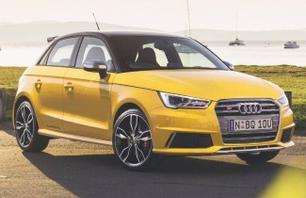
Spoilt. That's what we are. If you're in the market for a hot hatch, you can have your pick of German-built and French ones from as little as $27,000. There isn't a dud among them now that the VW Polo GTI has had a bit of an update and you can pick and choose your style. Audi's S1 is aiming to be king of the kids with its stiffly-priced S1.
Set the finances aside and consider for a moment what's on offer. As it turns out, a lot.
The Audi A7 is a really likeable car, one that is heavily focused on style but also emanates substance. The 55 TFSI model will appeal to many, but my initial impression is that the best buy in the range could well be the entry-level 45 TFSI. I can't wait to sample it sometime in 2019.
Cars this small shouldn't be this fast and useable at the same time, but the Audi S1 is. It isn't without its problems - the ride is harder even than the Fiesta ST which might weary some prospective buyers.
It's also a bit difficult to justify the price - in its basic form it's missing a few creature comforts that you'd expect in a $50,000 car - reversing camera, high-res screen, that sort of thing.
However, in the hot hatch world, those things don't matter. It has the bragging rights, the tech and the outright blinding speed to take on the bonkers Focus ST and equally zany Megane RS. And even the Audi S3.
If you can't find something interesting about the design of the Audi A7, there's a good chance you're visually impaired.
The original A7 Sportback was perhaps ahead of its time in the way it blended the lines of a coupe with the practicality of a big sedan, and the new second-generation version pushes the envelope even further into the future. The vision, according to chief designer Andreas Koglin, was "a clear form with sharp lines and tight shapes", including the distinguishable 'boat tail' at the rear.
This is a technologically advanced looking car - big, long, sleek and stylish. From the LED headlights (or matrix LED and laser lights - yes, frikkin' lasers that have the same 5500 Kelvin as the sun, according to Audi) and daytime running lights, to the long, lean LED tail-light assembly, there's an illuminated, enlightened air to the A7.
Plus, with the matrix lights, both ends of the car do a sort of disco sequence as part of the start up and shut down procedure for the car.
There are a few carefully balanced lines across the body of the A7 that help catch the light, which is something you can't really say about its closest direct rival, the Mercedes-Benz CLS. It still retains the 'big-metal-small-glasshouse' look of the existing model, but there are definitely more angles and interesting elements to this new-generation car.
There are two exterior types offered for Australia - the S line that you see here is the version that'll be fitted to the two higher grade models, while the entry-grade model gets a less aggressive look to its front and rear bumpers. To my eyes, the base car actually looks more luxurious, where the S line models - when not fitted with the optional black exterior styling pack that deletes the chrome trims outside - have a slightly uneasy look in the grille area. With a black edge to the single frame grille, it looks a touch more convincing.
The A7 is still large, at 4969mm long (-5mm) and riding on a longer 2926mm wheelbase (+12mm), spans 1908mm wide (2118mm including mirrors), but it's also a little bit taller, at 1422mm (+2mm). According to Audi, the interior space has been increased by 21mm in this generation, making for a more luxurious cabin than before.
Things are a little edgier in terms of design in the cockpit, too. Gone is the appealing wraparound dashboard design, with a more driver-focused treatment evident. It looks sharper, more shapely, and has improvements to the usability inside, too.
The A1 is so small it starts to strain Audi's design language. When you cram on the S-style bumpers and raccoon-eyed trim on the hatchback, it's starts to look a bit busy.
It isn't quite a shrink-wrapped A3 - Ingolstadt's designers know better than that - but it's full of Audi design cues, such as the strong, light-catching character lines, distinctive LED daytime running lights and fondness for big wheels.
Inside is along the themes of the A3, with what are becoming Audi's trademark; round eyeball air-con vents, the manual fold-down screen familiar to Q3 owners (but smaller) and a good clear dash. The handbrake jars slightly as it feels cheap to hold and wobbles a bit.
The S Sport seats are big and comfortable, and the top half of the backs are capped in plastic, which was colour-coded on our car. The rear passengers will certainly get an eyeful of whatever terrifying hue you've chosen, so choose wisely.
Despite the five doors, the back seats are occasionals, like the Mini the A1 is gunning for, and the boot is very small, but okay for shopping for couples or singles.
There are three models in the range, and considering the most natural competitors to the Audi A7 - the Mercedes-Benz CLS (from $136,900) and the BMW 6 series GT (from $123,500) - there's an argument that this car is something of a bargain. Ahem. 'Bargain' is relative, clearly.
The entry-level model is the 45 TFSI, which lists at $113,900 plus on-road costs. That's pretty close to the existing starting point for the A7, but now there's a bit more gear included as standard. It doesn't arrive until around the middle of 2019, though.
This model is comprehensively kitted out, with standard inclusions consisting of 20-inch alloy wheels, adaptive suspension, Audi's 'progressive steering' system, LED headlights with high-beam assist, an electronic tailgate with smart opening, keyless entry and push-button start, 'Valcona' leather trim and sports front seats, electric front seat adjustment and front seat heating and three-zone climate control air conditioning.
Other goodies include an LED interior ambient lighting package, head-up display, Audi's 12.3-inch 'Virtual Cockpit' digital driver information display, a 10.1-inch media screen and 8.6-inch control touchscreen, Bluetooth phone and audio streaming, USB connectivity, Apple CarPlay and Android Auto phone mirroring, and wireless smartphone charging.
Next up the model range is the 55 TFSI, which has a list price of $131,900 before on-road costs - which is the exact same price, and carries the exact same level of standard specification, as the diesel-powered 50 TDI model (also due mid-2019). This splits the difference between the existing models, but still undercuts the rivals by a good margin.
Over the entry-grade model, the 50 TDI and 55 TFSI models bring matrix LED headlights (with light animation), a different 20-inch wheel design, the S line exterior styling pack - essentially a body kit with new front and rear bumpers incorporating mesh-look diffusers and new side sills, plus S line badging.
These two models also get different interior styling, too, with S line embossed leather seats, illuminated door sill trims, a flat-bottom leather wheel with paddle shifters, dark brushed aluminium inlays, stainless steel faced pedals, black headlining, piped floor mats, electric steering column adjustment and a Bang & Olufsen 3D 705-watt sound system with 16 speakers and subwoofer.
There's a lot of safety kit included at each price point, too - see the section below for a breakdown.
Audi has tried to simplify things in terms of optional gear - apparently its customers said there was too much complexity when it came to electing bits and bobs, so the company's local arm has just one optional package... and a few other items it says are very much "buyer specific".
The 'Premium Plus' package costs $6500 for the 45 TFSI and $8000 for the other two models (and you get air suspension included in those grades). Across all grades the pack adds 21-inch alloy wheels, tinted rear glass, a panoramic glass roof, an extended upholstery package, four-zone climate control with rear touch control panel, plus a colour interior lighting package with up to 30 colours.
Other options include metallic paint (up to $2200), a four-wheel steering system ($4200) and laser headlights ($2500).
Starting at $49,900, Audi S1 is by far the priciest of the small-hatch based hotties, at least until Mini's madcap JCW arrives. This price is just almost double that of VW stablemate's forthcoming 2015 Polo GTI.
Standard on the manual-and-five-door-only S1 is a ten speaker stereo, climate control, ambient lighting, remote central locking, cruise control, satnav, headlight washers, auto headlights with xenon low beams, partial leather seats, leather-bound steering wheel, auto wipers and rear parking sensors.
Our Misano Red ($990 option) came with two extra packs. The Quattro Exterior Package ($3990) adds bi-xenon headlights with red trim, red brake calipers, spoiler, quattro logos on rear doors (ahem!) and five-spoke 18-inch alloys that are part matt black, part polished.
The Quattro Interior Package ($2490) adds S Sport front seats with Nappa leather and red backrest capping with quattro logo (ugh), more nappa around the cabin with contrast stitching, flat bottom steering wheel and red rings on the air vents.
There's an S Performance Package that brings the best of these two packs together for $4990, saving about $1500 and the embarrassment of the quattro logos.
Our test car also had aluminium air vents ($220), black contrasting boot lid ($300) and black roof ($720).
The A1 is so small it starts to strain Audi's design language
The grand total is a sobering $58,610. There's a couple more options that'll easily pop you over $60,000.
Audi's MMI is dash-mounted in the A1 as there's no room on the narrow centre console. As ever, it works well and doesn't take much getting used to. The satnav is a bit grainy on the smaller screen but is otherwise a competent unit.
Sound is from a ten-speaker stereo and you can stream across Bluetooth or plug in a memory card. The sound was good but the system did take a while to find the phone whenever we came back to the car.
All three drivetrains offered in the A7 have some form of mild hybridisation. The entry-level 45 TFSI engine is a 2.0-litre four-cylinder turbo producing 180kW of power (at 5000-6000rpm) and 370Nm of torque (1600-4500rpm). It has a 0-100km/h claim of 6.8 seconds, and employs a seven-speed dual-clutch auto with quattro all-wheel drive. It employs a 12-volt mild-hybrid system to assist with stop-start traffic and uses brake regeneration, too.
The high-spec petrol is the 55 TFSI, a 3.0-litre V6 producing 250kW (at 5000-6400rpm) and 500Nm (1370-4500rpm). The 0-100 claim is 5.3sec, and it also uses a seven-speed dual-clutch auto. It has a 48-volt mild-hybrid system that uses a larger capacity battery and a belt-driven starter generator that recuperates energy in stop start traffic and, according to Audi, can also allow the car to coast for up to 40 seconds at speeds of 55-160km/h.
The same 48-volt tech is used for the only diesel model in the range, the 50 TDI. This powertrain uses a 3.0-litre turbo-diesel engine producing 210kW (3500-4000rpm) and 620Nm (2250-3000rpm), and unlike the petrols, it has an eight-speed automatic (not a dual-clutch). The claim for acceleration is 5.7sec from 0-100km/h.
This is where the action is. The S1's tiny body packs a 2.0-litre turbocharged four-cylinder producing 170kW and 370Nm of torque. The S1 will streak to 100km/h in 5.9 seconds thank to the traction aid of quattro all-wheel drive.
All Audi S1s come with a six-speed manual
Despite a pretty solid hammering during its week with us, including more time than we'd have liked in Sydney traffic, the stop-start function helped deliver a pretty reasonable 10.2L/100km, however that's a long way over claimed 7.1L/100km.
All Audi S1s come with a six-speed manual, so dual-clutch haters can save the whining. The only downside from not having a self-shifter is the ECU can't deliver the boy racer farts, parps and crackles of the other S cars.
A lot of the time when we go on new car launches the test drive route is planned to highlight handling dynamism, with less focus on the day-to-day drudgery most of us will actually encounter.
The launch of the Audi A7 was primarily of that design, too, but (thankfully?) there was some disgusting traffic to deal with on our in and out of Brisbane, where it was clear the A7 is superbly comfortable.
Well, that is, if you get the air suspension system. The ride was impressively cushioned, untroubled by sharp edges and road joins, and the suspension eliminated pothole effects, too. All the cars I drove on the launch were the 55 TFSI model, and all had the air suspension - the cynic in me thinks there's probably a reason for that, and I'd love to sample one without it.
This stint of stop-start driving saw the engine cut out at speeds up to 22km/h when you're decelerating, allowing us to coast to a stop without the engine burning fuel.
Once we exited the city limits and found ourselves on the roads of Mt Nebo and Mt Glorious, the chance presented itself to push the A7 in some bendy bits. With the dynamic drive mode selected, the transmission in sport mode, and about a hundred corners to contend with, the big German luxury hatch showed its skills.
The air suspension kept the circa-1815kg model relatively flat in the bends, but the front seats lacked adequate side bolster support despite being called 'sports' seats. Obviously physics were at play here.
The steering was more eager in the four-wheel steer version we sampled, and that's definitely an option for the enthusiastic owner to consider. Otherwise, the steering was accurate, if devoid of meaningful feel.
And while the engine was strong in its response and the transmission clever in its shift speed and intelligence, it became clear that this was a car that seemed more adept at open road cruising than bruising a series of hairpins. It didn't disappoint in terms of dynamics - it just felt its size.
Eventually when we reached an open road, the effortlessness of the A7 came to the fore. Comfort mode engaged, it paced along beautifully, the adaptive cruise taking its surroundings in nicely. There is a touch of wind noise and the suspension can be loud when you encounter pockmarked sections, but it doesn't feel flustered at speed.
One of the nice elements of the A7's smarts is that it will pulse the accelerator pedal to warn you that you could be saving fuel - say you're approaching an 80km/h zone, and you're driving at 100km/h, the throttle will throb to let you know you could ease off. Neat.
At the end of our day of driving, I was left with the impression that the Audi A7 is more than capable as a luxury saloon, one that was relaxing to drive - even when we encountered a five km traffic jam on the way back into Brisbane. It feels well engineered, without excessive gimmickry and with enough genuine quality to leave you feeling pampered.
If you're buying the S1 as a comfortable urban runabout with a cool badge, you're half right. While the seating for front passengers is certainly supportive, the hard suspension tune will ensure you're well aware of road surface imperfections.
The S1 is a rocket
Thankfully, what it missed out on in the ride department it makes up for in every other way - the S1 is a rocket. The 2.0-litre turbo jammed under the bonnet has almost no lag and is paired with a slick six-speed manual that is terrific fun to manhandle through the gears.
The way the S1 picks up speed when it's on boost is addictive and licence-endangering. A flattened accelerator in second or third will obliterate just about anything this side of $100,000 and you'll be having more fun in this than big brother S3 because the chassis is more adjustable and there's a bit more life.
You can hear the turbo sing to accompany the bassy exhaust growl. Hit the massive brakes hard and the car remains stable even over rutted roads. Turning the wheel brings almost-instant turn-in, mashing the throttle again a fun little wriggle. It's superb.
It's tremendous fun point-to-point on a twisty road
You'll have to be a bit patient with the throttle to get the wriggle, though - give it too much too early and it will want to push wide, the quattro system shuffling power around to try and quell understeer while the electronic diff fiddles with the braking system to do the same thing. It gets there in the end, but you're better off meting out the power with your right foot for maximum rewards.
It's tremendous fun point-to-point on a twisty road - despite being a bit heavy for its size (1415kg), it's as chuckable as the next best thing, the Fiesta ST.
The Audi A7 doesn't have a five-star safety rating from either ANCAP or Euro NCAP. It's hard to see it not getting that rating, if it were to be tested, because every trim grade has an array of high-tech safety equipment.
The A7 is fitted with a surround-view camera system (360 degree camera) and there are front, side and rear parking sensors, as well as Audi's version of auto emergency braking (AEB) which it calls 'pre sense' - and it operates up to 250km/h.
There's also a reverse AEB system, lane keeping assistance, blind spot monitoring, cross traffic alert (front and rear), and there's adaptive cruise control with traffic jam assist (allowing semi-autonomous driving up to 60km/h), a system that'll stop the car if it doesn't think you can make a gap in the traffic (Intersection Assist) and a system that prevents you from opening your door into the path of cyclists, pedestrians or oncoming traffic.
There are dual ISOFIX child seat restraints in the back, as well as three top-tether attachments. The A7 has dual front airbags, side airbags front and rear, and curtain airbags (Audi claims a total of 10, but by most other makers' counts, that'd be eight).
Six airbags, stability and traction control, ABS, brake assist and distribution all add up to a five star ANCAP rating.