What's the difference?
The bZ4X was the first of a new era for Toyota.
The Japanese carmaker has had a lot of success with its hybrid technology which it pioneered back in the late 1990s. However, it took all the way until 2024 for its first fully electric car, the bZ4X, to launch in Australia (following a number of delays).
By this point Toyota was already late to the game, plus competition in the EV segment has been getting stiffer and stiffer.
It’s now mid-life facelift time and Toyota has thrown everything at the bZ4X. Read on to find out whether or not this has improved the formula.
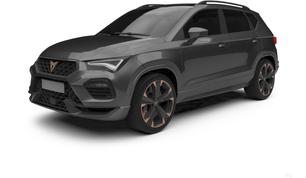
Not many people even know what a Cupra Ateca V is… and this is the second best thing about this small SUV. The first best thing is that Cupra is owned by Volkswagen.
So, this means you can have your mysterious SUV not many other people drive while knowing it’s underpinned by one of the largest car manufacturers in the world which makes cars millions of people drive and one which also has a reputation for high quality vehicles.
The big news here is the Ateca model range has a new and lower entry fee with the arrival of this V grade. See, until now the only Ateca Australians could buy is the high-performance VZx which while really sporty also came with a pretty big price tag.
So, how much is the Ateca V and what do you get for the money? We found this out at the Australian launch along with how practical and safe it is and what it’s like to drive.
When the bZ4X first launched it was already late to the game and blended into the background too much. However, this update has dramatically improved its appeal.
Despite this, the electric mid-size SUV segment is incredibly fierce and it’s hard to not get caught up in glitzier rivals like the BYD Sealion 7, Tesla Model Y and Zeekr 7X.
It’ll be interesting to see whether the Australian public reacts to this update and if it draws in more punters.
The Cupra Ateca V is a much needed more affordable way into this small SUV while still offering a high-end feeling with plenty of standard features. Yes, the V isn't as high-powered as the VZx but it's still great to drive in the city and on the open road. Big on the inside and small on the outside the Cupra Ateca can perform urban and (small) family duties well.
Note: CarsGuide attended this event as a guest of the manufacturer, with accommodation and meals provided.
The exterior design of the bZ4X never really blew me away. It’s just sensible and not too out there. In saying that though, being sensible is no bad thing and can be seen as a positive for some buyers.
This facelift has brought Toyota’s new corporate look, including the hammerhead shark-like LED lighting signature. It already features on models like the C-HR, Camry and RAV4. In fact this update has made the bZ4X look more like an electric RAV4 than ever before.
I like the C-shaped daytime running lights but I’m not a fan of how the main headlight section is now separate. I prefer how they looked before.
The black wheel arch cladding is now also glossy and not matte. Sure, this looks great right now, but it likely won’t be long until it unfortunately gets scratched.
Inside, if you covered up the Toyota badge you could likely fool me into thinking this is a Lexus. The new 14.0-inch touchscreen is virtually identical to the one in models like the Lexus NX, RX and GX.
There are also plenty of premium-feeling soft-touch materials around the cabin. I’m not a huge fan of the grey and white two-tone interior, at least from a family-friendly standpoint, but thankfully you can get an all-black interior instead.
Another major design change with the interior is the new centre console. It now features two wireless chargers and a revised button layout. I particularly like it because it’s no longer covered in glossy piano black.
Once you know the Cupra Ateca V is closely related to the Volkswagen Tiguan and Skoda Karoq you can definitely see a resemblance. Still, all three have their own look with the Cupra clearly given the role of being the fierce, sporty one.
While the Ateca V doesn’t have the same menacing styling as the VZx, it’s definitely a seriously sporty looking SUV with its 19-inch alloys, aggressive front bumper, triangular LED running lights and blacked out wing mirrors, roof rails and CUPRA lettering across the tailgate.
The bronze Cupra logo really signals the sporty intent of this brand and I’ve been told on more than one occasion that it looks like a biohazard symbol by people confused by what it is I’m driving. According to Cupra the blade-like design represents “the sense of belonging to a clan”.
Measuring 4381mm long, 1841mm wide and 1625mm tall with 2630mm wheelbase the Ateca V is about 15cm shorter in length than a Tiguan, but as you’ll see in the practicality section the interior dimensions might be larger than you think.
The Ateca V’s cabin is full of dark-coloured materials with black leather upholstered sports seats and steering wheel. In the same way it feels like Batman designed the exterior the interior it has a ‘Made in Gotham City’ feel with a brooding style incorporating high quality textures and surfaces.
The front seats in the bZ4X are deliciously comfortable and supportive. They make long trips a breeze, plus the ventilation that’s standard on the AWD trim works well in the heat.
Despite this, I’m still not a huge fan of the driving position. You need to look over the steering wheel in order to view the almost windscreen-mounted digital instrument cluster. It’s a similar set-up to what Peugeot employs and is intended to reduce the amount you need to stray your eyes from the road.
I appreciate this but it just doesn’t work for everyone. Personally I need to jack the seat up more than I’d like in order to see the screen fully. When I do this my knees get in the way of the steering wheel no matter how I position it, which isn’t ideal.
The set-up in the related Solterra is a little better as it has a squared-off steering wheel instead of a traditional round steering wheel.
Going back to the digital instrument cluster, the content display on this is still rather limited. Thankfully, critical information like your current speed is displayed clearly, but having added customisation through more informative displays to toggle through or more themes would be a nice extra touch.
Moving across the larger touchscreen multimedia system is a welcome addition, but I didn’t think there was anything wrong with the old one. The user interface is still basic in a good way, meaning it’s hard to get lost.
A difference is the climate control features are now fully integrated into the touchscreen, save two physical dials that change the dual-zone climate control temperature.
While this means you need to press on the touchscreen to change certain climate control-related features now, a lot of these in the pre-update were touch-sensitive buttons on a panel under the touchscreen. Really, it makes no difference.
Wireless Apple CarPlay and Android Auto are still standard and work flawlessly with my iPhone 15 Pro Max. There are now also two wireless chargers, which is great if you want to charge your phone and your passenger’s phone.
However, they don’t work properly as they don’t offer any ventilation. They regularly make my phone overheat and stop charging, even on shorter trips. If you want to reliably top your phone’s battery up, it’s best to just plug into a USB port with a cable.
Looking elsewhere around the cabin, there is an adequate amount of storage, though some more would be nice. There are two decently sized cupholders, a small shelf under the centre console and a side-hinging centre console box. Like the pre-update version, there is still no proper glove box.
In the second row there’s plenty of legroom available for adults behind adults, though due to the placement of the high-voltage battery this leaves you with a knees-up feeling. This is common in a number of EVs, even some that are based on dedicated electric architectures, like the bZ4X.
Headroom also isn’t fantastic as the roof starts to taper back where your head is located. You wouldn’t want to be much taller than 180-odd centimetres back there. It’s also made worse when you recline the seat backrest.
Second-row amenities include air vents, heated outboard rear seats, USB-C ports, seatback map pockets, as well as a fold-down armrest with some cupholders and a tablet holder.
At the back there is a hands-free power tailgate which is rather slow to open and close and makes plenty of beeping while doing so. It's a classic Toyota on this front.
The bZ4X AWD offers 410L of boot space with the rear seats upright which is slightly less than the 2WD due to the added rear electric motor.
It’s a decent space but doesn’t stand out from the crowd. There’s some extra underfloor storage which is large enough to fit some cables and that’s about it. Unfortunately there’s no front boot.
Boot-related amenities include a cargo blind, a variety of hooks, as well as vehicle-to-load (V2L) capability using 220V/1500W AC inverter and a single household power socket. The latter allows you to power household appliances using the vehicle’s high-voltage battery.
Disappointingly there is no spare wheel, but this isn’t uncommon for EVs. You have to make do with a tyre repair kit, which is fine if you have a small air leak but pointless if you have a proper puncture.
The Ateca V is only about 4.4m long which is a lot shorter than a Kia Sportage, Nissan X-Trail or Subaru Forester, which are truly mid-size SUVs. So, the Ateca is a small SUV but on the larger side compared to say a Volkswagen T-Roc.
Despite its fairly diminutive exterior proportions the Ateca V has excellent storage and is remarkably spacious. If you have a young, small family and want a five-seater SUV big enough for them but small enough to make urban driving easy the Ateca V ticks both boxes.
Up front there are the gigantic door pockets, two cupholders, a decent-sized covered centre console bin and under-dash storage with wireless phone charging and two USB ports.
The second row is incredibly spacious for a small SUV with so much room for me at 189cm tall to sit behind my driving position. Headroom is excellent, too.
There are also cupholders in the fold-down armrest, two USB ports and big door pockets.
The back door apertures are tall and wide which makes getting little kids in and out of their car seats easier for parents.
A 485L cargo capacity is large for the class and under the boot floor is a space-saver spare wheel.
There are still only two trim levels in the bZ4X line-up – 2WD and AWD, the latter on test here.
Compared to the pre-update version, pricing has been slashed by up to $10,000, depending on the variant.
The line-up now starts at $55,990, before on-road costs, for the 2WD and extends to $67,990, before on-road costs, for the AWD.
This top-spec bZ4X AWD now undercuts the corresponding Subaru Solterra AWD Touring by $2000. These two cars are twins under the skin and are built in the same Japanese facility.
It also undercuts the top-selling Tesla Model Y Long Range AWD by $1000, which is a major feat. However, certain rivals like the BYD Sealion 7 Performance and Zeekr 7X Long Range are still cheaper but not all of them offer all-wheel drive.
With this update there’s now a larger 14.0-inch multimedia touchscreen, two wireless phone chargers, vehicle-to-load (V2L) capability, plus a hands-free power tailgate and heated steering wheel standard across the line-up.
This is above and beyond the standard LED headlights, roof rails, dual-zone climate control and heated front seats with electric adjustment in the 2WD.
The AWD brings larger 20-inch alloy wheels, a panoramic glass sunroof, a nine-speaker JBL sound system, digital rear-view mirror and ventilated front seats.
This is a lot of standard equipment and you can’t really complain because you’re getting all of this for less than before.
The Ateca model now has a lower priced grade called the V and it lists for $51,990. That’s more than $10K less than the top-of-the-range VZx which has been out for a couple of years and lists for $63,490.
The Ateca V might be less expensive but the features list is still impressive. Coming standard are 19-inch alloy wheels, sports bumpers, LED headlights, running lights and puddle lights. There’s a proximity key and power tailgate with gesture control, too.
Inside black leather upholstery is standard, so are heated front seats and steering wheel, there’s dual-zone climate control, a power driver’s seat, a 9.2-inch media display with wireless Apple CarPlay and Android Auto and wireless phone charging.
As for options, you can have a panoramic sunroof for $1850 and premium metallic paint for $490.
There’s also the optional 'Tech Package' for $2950 bringing a Beats stereo system and a 360-degree camera. But the best thing about the pack is it also adds dynamic chassis control which adds adaptive suspension, so when you select 'Comfort' mode the suspension becomes softer, and in 'Sport' mode the suspension firms for better handling.
Rivals to the Ateca V include the Lexus UX and Volvo XC40 but also its Volkswagen Group cousins such as the Skoda Karoq and VW Tiguan R-Line.
While there have been a number of spec changes or additions with this update, even more tweaks have happened under the skin.
All versions of the bZ4X now make more power and torque. The AWD’s dual electric motor set-up now has a total system output of 252kW (+92kW) and 438Nm (+101Nm).
Like the pre-update version, the bZ4X AWD offers 'X-Mode' off-road drive modes, crawl control, as well as downhill assist control. However with 20-inch alloy wheels as standard, I doubt these will be taken off the beaten track very often, if at all.
The Ateca V has a 2.0-litre turbo-petrol four-cylinder engine making 140kW and 320Nm. That’s a step down in output compared to the VZx’s 221kW and 440Nm, but the V doesn't feel underpowered.
A seven-speed dual clutch automatic transmission shifts gears lighting fast with the drive going to all four wheels. Yes, it’s all-wheel drive.
Another big under-the-skin change with this update is Toyota has fitted the bZ4X line-up with a larger 74.7kWh lithium-ion battery pack.
As a result this EV has more range. The AWD now offers up to 517km of WLTP claimed range (up from 411km) with an official energy consumption figure of 16.0kWh/100km.
During my largely urban testing over the Christmas break I saw an average energy consumption of 14.4kWh/100km. In fact, on one particular trip into the city with minimal traffic I saw an average energy consumption of 10.5kWh/100km. This is incredibly low for an all-wheel drive EV and almost Tesla-like.
Using my as-tested energy consumption figure, the bZ4X AWD has a theoretical total range of 518km.
The Type 2/CCS combination charge port remains on the left-hand front wheel arch which is fine because it’s kerbside, but at some public charging stations it can be hard to connect the cable without having it run up against the front bumper.
Speaking of charging, the maximum AC charging rate has now been upped all the way from 11kW to 22kW, which is a fantastic update. This now allows for a 10 to 100 per cent charge in 3.5 hours.
While peak DC fast-charging unfortunately is still capped at 150kW, Toyota claims it can remain at a higher charge rate for longer now thanks to reworked battery thermal technology.
A fast charge from 10 to 80 per cent is now meant to take 45 minutes. It would be good to see quicker charging because many of this car’s rivals are faster and this can make a world of a difference during long road trips.
Cupra says that after a combination of open and urban roads the Ateca V should use 7.1L/100km. That’s not hugely fuel efficient and urban consumption of 8.6L/100km will mean higher fuel bills than a hybrid SUV of this size.
On the launch we saw a fuel consumption average of 7.7L/100km and that’s after city roads, motorways and country roads.
Once we have the Ateca V in our CarsGuide garage we’ll be able to perform a real-world test of its fuel consumption.
The Ateca V has a 55-litre fuel tank and requires 95 RON premium unleaded petrol. Theoretical driving range is around 775km.
The bZ4X AWD was never a slow car to begin with but the added oomph is welcome.
While it's not overtly noticeable in everyday driving, when you mash the throttle at the lights you're pinned back in the seat a lot more than before.
Despite this, it still doesn’t feel like this car wants to be driven quickly. If you drive with a docile right foot, the bZ4X is a supremely comfortable vehicle that’s relaxing and easy to drive.
There are a number of regenerative braking modes to select from by using the steering wheel-mounted paddle shifters, but none of them offer a one-pedal driving mode. This means you need to use the brake pedal to come to a complete stop.
As a result, this car’s driving experience is more like a combustion or hybrid vehicle, like the RAV4. This can make the transition to an EV easier if you’ve never driven one before.
The steering feel in the bZ4X has a noticeable weight and heft to it which feels nice when you’re zipping around on urban streets. It also feels like the steering wheel is actually connected to the wheels rather than the overly assisted and light steering systems in some of its rivals.
Where the added steering heft can feel a touch annoying is when you’re doing a tight parking manoeuvre. This car is longer than you think, meaning you may need to do three-point turns more often.
Speaking of parking, the bZ4X’s surround-view camera system is detailed and high-resolution, which is a great peace of mind. The semi-autonomous park assist is also fantastic as it can detect and park the vehicle within painted lines, rather than just slot it between two parked vehicles.
Adding to the comfort factor is this car’s ride, which is a major highlight. Despite the large 20-inch alloy wheels, the suspension does a great job at softening bigger bumps and small road imperfections.
There is little that upsets the interior ambience in this car, making it a serene place to be regardless of where you’re travelling. For an EV you’d expect more tyre and wind noise given there’s no engine to drown the noise out, but Toyota has seemingly done a great job of insulating the cabin and choosing suitable tyres.
The launch of the Ateca V saw us drive the V and the VZx back-to-back, which highlighted how good the V is for the money when it comes to its on-road performance.
The 2.0-litre engine is superbly responsive with loads of torque for such a small petrol SUV, while the dynamics were equally impressive on winding country roads. Even when those roads occasionally and suddenly turned from bitumen to dirt at 100km/h excellent all-wheel drive traction kept everything under control.
The Ateca V we tested has the optional Tech Package fitted which adds dynamic chassis control and adjusts the suspension in the Comfort drive mode setting to a softer level compared to the firmer level in Sport. The ride in any mode, however, is comfortable with great handling.
As standard the Ateca V is given sports suspension and after a quick sample of the Ateca V with this set-up I also found the ride to be comfortable and composed.
There's good visibility even through the rear window, along with nicely weighted accurate steering and a good pedal feel under my feet make the Ateca V effortless and enjoyable to drive.
The updated bZ4X still has a maximum five-star ANCAP safety rating based on testing conducted on the pre-update car by Euro NCAP.
Toyota has notably now made the full safety suite standard across the entire line-up.
Previously the 2WD missed out on features like blind-spot monitoring and a surround-view camera, among others.
As standard there are eight airbags, autonomous emergency braking (AEB), rear cross-traffic alert, lane-keep assist, adaptive cruise control, driver attention monitoring and traffic sign recognition.
There’s also connected services with SOS emergency calling, plus automatic collision notification, vehicle insights and charge station search available with a smartphone companion app.
All of the safety systems operate in a seamless manner and don’t interrupt the driving experience unless they actually need to. This is becoming increasingly uncommon.
The Cupa Ateca V hasn’t been tested by ANCAP and the Euro Ncap result of five stars (which is the maximum) has now expired because it was so long ago (2016).
Still, while much of the safety tech isn’t as cutting edge as some new SUVs , there’s AEB, adaptive cruise control, lane keeping assistance, rear traffic alert plus front and rear parking sensors.
The airbag count runs to seven, including a front centre bag to minimise head clash injuries in a side-impact.
For child seats there are three anchor points and two ISOFIX mounts in the back.
As standard there is a five-year, unlimited-kilometre warranty which is fine but does not stand out for the segment anymore.
However, if you service at one of Toyota’s 260+ dealers around Australia when required, warranty coverage for the high-voltage battery can be extended all the way out to 10 years.
Logbook servicing is required every 12 months or 15,000km, whichever comes first, and the first five services are capped at $180 each. While the pricing in classic Toyota fashion is competitive, the 12 month intervals aren’t (in the EV space). The standard is now closer to 24 months.
As part of the ownership package owners get Mode 2 and Mode 3 charging cables. The 'Toyota Go' loyalty programs also allows for the choice of a complimentary 7.0kW home charger or 12-month Chargefox subscription.
The Ateca V is covered by Cupra’s five-year, unlimited-kilometre warranty, with servicing needed every 15,000km or annually.
You can buy a five-year service plan for $1990 - which isn’t overly pricey.