What's the difference?
The Renault Megane RS is still here, in case you were wondering.
You may have let it slip your mind in recent times, because there’s been a lot of action in the hot hatch scene with the release of the new-generation Ford Focus ST, a fond farewell to the VW Golf R, and consistent talk of the upcoming Toyota Corolla GR hot hatch.
The Megane RS is more than just ‘here’, though. The RenaultSport Megane hatch range has expanded in recent times, and we’ve just spent some time with the Trophy model which first arrived in Australia late in 2019.
It is certainly keeping its presence known in 2020 Renault Megane RS Trophy spec, which represents the most powerful and fastest version of the standard model range before you get to the rip-snorting (and eye-wateringly expensive) Trophy R.
So what’s it like? Read on and you’ll find out all about it.
If Holden had a dollar for every time someone had criticised the new and international flavour of Australia’s formerly home-grown hero, it would surely have more than enough spare cash to blow the dust of that vast South Australian factory and restart local Commodore production immediately.
Hell, there’d probably be enough left over to relaunch the Camira while they were at it. And maybe even knock out a new Gemini or two.
So we’re not going to do that again here. The all-new Commodore, in this case the Calais Tourer, is now here - granted having travelled further than the one it replaces - and so we’ll be playing this review with the straightest of bats.
Because the truth is, if you peel the badging - and thus the swirling emotion - off its elongated rump, then you’ll find this German-built Tourer is, really and truly, a very good thing.
If the Renault Megane RS Trophy is your dream car let me say this: there’s no overarching reason that I’d say you shouldn’t go ahead and buy it.
But with so much amazing competition in this part of the market, it’s hard to put it ahead of its rivals. And it’s going to be even harder for it to stay high on the contenders list as more new metal arrives in the coming years.
A best-of-both-worlds option that should have us questioning our SUV obsession, the Calais Tourer delivers plenty of practicality perks and a higher ride height in a dynamic and car-like package. The equipment levels are spot on, including the comprehensive safety package, and it you act smartly, you'll get a hugely long warranty to boot.
It sure is thirsty, though, and we can't help but think plenty of owners would be happier with a smaller, more-efficient engine.
The Megane RS Trophy’s dimensions don’t really communicate just how chunky it really is. At 4364mm long on a 2670mm wheelbase, 1875mm wide and 1435mm tall, it is pretty conventional in terms of size for the segment.
But it packs a lot of style into that size. I for one love those broad hipped wheel-arches, the signature LED headlights and chequered flag lighting signature at the bottom of the bumper, and the bright, eye-catching colours available really just ram the message home that this isn’t your average Megane.
I could happily leave behind the red flecks on the wheels, which look a bit too blingy and not quite ‘lightweight racing-spec’ to me. But they obviously appeal to a certain buyer - maybe someone who wants a bit more drive-by flair, as opposed to track-day talking points.
The Trophy model builds upon the Cup variant, using the same chassis and hardware under the skin, and therefore running the brand’s 4Control four-wheel steering and a mechanical Torsen limited slip diff. More on that in the driving section below.
Exterior design and styling are one thing - but you probably spend more time sitting inside your car than just admiring it from a distance. How does the interior of the RS Trophy stack up? Check out the interior images to make up your own mind.
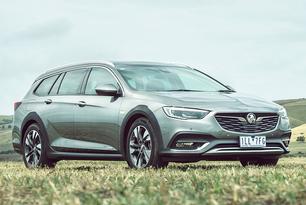
Less an SUV (happily), and more a high-riding wagon, the Calais Tourer borrows a little from the Subaru XV in its exterior design, sporting the same plastic cladding over each wheel arch. Clearly there is a whole heap of shared DNA between the Sportwagon and Tourer, and so it offers similar perks; like its SUV-shaming boot space.
Elsewhere, the Tourer shares the same soft and rounded edges as the rest of the Commodore range, and while it is genuinely quite handsome from most angles, it is at its best viewed front on, where a simple front-end is bookmarked at each corner by a narrow headlight on top, and an encased fog light below. It’s all a touch understated, sure, but it looks sharp in the metal.
Inside, it’s a clean and functional cabin design, with most of the touchscreen functions controlled by a simple row of four horizontal buttons, and with a gloss-black surround encasing the centre console. The thin leather wheel feels lovely under the touch, and the contrasting door trims and soft-touch materials find their way into the backseat, too.
The Megane RS Trophy’s cabin carries over some of the design cues from the exterior. It looks and feels like a hot hatch should.
There’s a lovely part-Nappa leather, part-Alcantara steering wheel with paddle shifters and a ‘centre line’ marker - but some may lament the lack of a flat-bottom to the wheel, which is a current trend in the “trust me I’m actually very sporty” breed of cars.
The manually adjustable seats are very supportive though they are a bit firm, so those wishing for ultimate comfort over long distance trips might be left wanting. But there is good adjustment to the seats, and they’re heated, too.
There are some nice elements to the cabin including soft plastics on the dashboard, but the lower plastics - below the eye-line - are quite hard and not very pleasant. However, the inclusion of ambient lighting does distract from that, and add a bit of flair to the cabin.
The portrait-style media screen is fine most of the time, though it does take some learning. The menus aren’t as intuitive as you might hope, with a mix of on-screen buttons and off-screen touchpad-style controls that can be difficult to hit when you’re driving. We also had a couple of instances of glitching while using Apple CarPlay and Android Auto smartphone mirroring.
Storage is okay. There are shallow cupholders between the seats, a covered centre console bin, as well as a storage section in front of the gear selector that’s big enough for a wallet and phone, and bottle holders in the doors.
In the rear seat there’s enough space for someone my size (182cm) to sit behind their own driving position, albeit with limited knee room and toe room. Headroom is good, and there are dual ISOFIX child-seat anchor points and three top-tethers for baby seats.
You’ll find a pair of small door pockets, two map pockets, and rear-seat directional air vents, which is nice. There’s a flip-down arm-rest with cupholders, too, and unlike some other high-price hatches with ambient lighting up front, the Megane gets LED light strips on its rear doors, too.
The boot space is good in the Megane RS Trophy, with luggage capacity claimed at a healthy 434 litres. On test, the car fit all three CarsGuide suitcases (124L, 95L and 36L) with room to spare. Speaking of spare (ahem), there isn’t one: it comes with a repair kit and tyre pressure monitoring, but no spare wheel of any kind.
The Tourer serves up identical storage space to its Sportwagon near-enough twin, with 793 litres of storage (to the roof line) with the rear seats in place, and 1665 litres with the rear seat folded down. That’s about 200 litres more than the regular Commodore hatchback.
Where the Tourer does differ from the Sportwagon is in its exterior dimensions, measuring 5004mm in length (versus 4986mm in the Sportwagon) and 1525mm in height (versus 1483mm). Width and wheelbase are identical, though (1871mm and 2829mm), and so the interior space dimensions - like headroom and legroom - are identical no matter which of the estate-style Commodores you opt for.
The key dimension here, though, is ride height, with the Tourer offering 20mm more ground clearance (42mm greater height overall) than the Sportwagon. That, combined with the on-demand all-wheel-drive system, allows for some light off-roading - though you won’t be conquering Everest.
Up front, expect two cupholders hidden under a gloss-black cover, as well as power and USB connections located in a central cubby. The back seat is home to two extra cupholders hidden in a pulldown divider, and there is room in each of the doors for bottles. The back seat is also home to air vents (but no temperature controls) and two USB charge points located just below the vents.
The Renault Megane RS Trophy has a list price of $52,990 for the six-speed manual, or $55,900 for the six-speed dual-clutch auto model, as tested here. Those costs are RRP/MSRP, and don't include on-roads.
Standard equipment for this range-topping ‘regular’ RS model includes 19-inch ‘Jerez’ alloy wheels with Bridgestone Potenza S001 tyres, an active valve exhaust system, Brembo brakes, LED headlights with LED daytime running lights, rear fog lights, front/rear/side parking sensors, semi-autonomous parking system, reversing camera, auto locking, smart key card and push-button start, and steering column-mounted paddle shifters.
There’s also auto headlights, auto wipers, dual zone climate control, an auto dimming rearview mirror, heated front seats with manual adjustment, a nine-speaker Bose sound system with subwoofer and amplifier, an 8.7-inch touchscreen media system with aux port, 2x USB ports, Bluetooth phone and audio, Apple CarPlay and Android Auto, sat nav, the brand’s RS Monitor track timing software, and a 7.0-inch TFT colour screen for the driver with configurable modes and digital speedo.
You can find a run down of the safety tech and equipment fitted in the safety section below.
Options available include an electric sunroof ($1990), and there is also the choice of a few metallic paint colours: Diamond Black and Pearl White metallic are both $800, while the Signature Metallic Paint colours - Liquid Yellow and Orange Tonic as you see here - are $1000. Only Glacier White will cost you no extra.
Wondering where it sits among its closest rivals? If you’re thinking about a Ford Focus ST (from $44,690 - manual or auto), Hyundai i30 N (from $41,400 - manual only), the outgoing VW Golf GTI (from $46,690 - auto only), or the mighty Honda Civic Type R (from $51,990 - manual only) the Megane RS Trophy is expensive. Only the VW Golf R Final Edition ($57,990 - auto only) is dearer… unless you’re thinking of comparing to the likes of a Mercedes-AMG A35 ($69,300).
The Calais has long formed the most luxurious rung of the Commodore ladder, and the wagon-ish Tourer is without doubt the most practical version. It will set you back $45,990 ($47,990 drive-away) in the guise we’ve tested here, and $53,990 In Calais V specification.
Not to be sneezed at, then. But it does arrive with plenty of stuff to help justify your investment.
Outside, you’ll find 18-inch alloys, a handsfree auto-opening boot, heated mirrors, keyless entry with push-button start, a remote start function, rain-sensing wipers and automatic headlights with LED DRLs. Inside, expect leather seats that are heated in the front, a leather-wrapped wheel, dual-zone climate control, standard satellite navigation and a wireless charging pad for compatible phones.
On the technology front, an 8.0-inch touchscreen pairs with an eight-speaker stereo, and it’s both Apple CarPlay and Android Auto equipped. There’s also a genuinely impressive standard safety package, too, but we’ll drill down on that under the Safety sub-heading.
Engine specs matter if you’re talking about performance hatchbacks, and the Megane RS Trophy is no exception.
It has a 1.8-litre four-cylinder turbo-petrol engine that punches hard for its size, with 221kW of power (at 6000rpm) and 420Nm of torque (at 3200rpm). That’s for the six-speed dual-clutch automatic transmission, as was fitted to our test car. If you buy the six-speed manual, you miss out on a bit of grunt - it has 400Nm (at 3200rpm) and the same peak power.
In auto spec the RS Trophy “300” offers higher figure vs the Sport and Cup “280” models (205kW/390Nm), and more engine performance per litre of capacity than the Focus ST (2.3-litre: 206kW/420Nm), Golf GTI (2.0-litre: 180kW/370Nm; TCR 2.0-litre: 213kW/400Nm), and even the Golf R (2.0-litre: 213kW/380Nm).
All Megane RS models are front-wheel drive (FWD/2WD) and no Megane RS is all-wheel drive (AWD). The Trophy and Cup models both get 4Control four-wheel steering, which is an interesting aspect of the drive experience. More on that below.
There are multiple drive modes to choose from, including Comfort, Neutral, Sport, Race and the configurable Perso mode. These can alter engine, transmission, throttle, traction control, exhaust noise, fake engine sound and steering sharpness - but not suspension, because the dampers aren’t adaptive units.
A really rather good 3.6-litre V6 engine Is parked under the bonnet, feeding 235kW at 6800rpm and 381Nm at 5200rpm to all four wheels as required, thanks to an on-demand all-wheel-drive system. The suspension is tuned specifically for its high-riding antics, too.
The grunt is fed through a nine-speed automatic, and while Holden doesn’t quote a specific zero-to-100km/h time, it’s no slouch from the lights.
The 3.6-litre engine means a braked towing capacity of 2100kg, and an unbraked max of 750kg.
The claimed official combined fuel consumption for the Megane RS Trophy is 8.0 litres per 100 kilometres. That’s for the EDC auto model as tested. The manual is said to use 8.3L/100km.
You might achieve that if you drive gently, though over my testing - which incorporated hundreds of kilometres of highway and country road driving, as well as a few spirited stints and some urban snarls - I saw a return of 10.8L/100km at the pump.
The Megane RS requires 98RON premium unleaded, and the fuel tank capacity is 50 litres.
Not so good, I’m afraid. The offical number is on the high-side at 9.1 litres per 100 kilometres on the claimed/combined cycle (though that's less than the equivalent Subaru Outback), but we were averaging a smidge under 14.0L/100km after what was admittedly quite a lot of city driving. Still, that’s high.
Emissions are pegged at 212g/km or C02, and the Tourer’s 61-litre tank will accept cheaper 91RON fuel, or an E10 blend.
The Megane RS Trophy has the ingredients to be an all-time legendary hot hatch, but they don’t work together well enough for it to be a truly great car to drive.
That is, they don’t work together on public roads. I didn’t get a chance to sample the RS Trophy at the track, and I’m sure that may well alter some of my opinions. But this was a review focused around everyday driving first and foremost, because - unless you’ve got quite a fleet of cars - you’ll be spending a lot of time in mundane motoring in your Megane RS, too.
Other hot hatches in the segment manage to combine big power and torque with immense traction and steering prowess. The Megane RS used to, as well.
But this new version seemingly has some issues harnessing the grunt, and the 4Control four-wheel steering system simply isn’t as rewarding as it should be.
I had several instances where the traction on slippery surfaces was lacking, while even in the dry I noticed distinct torque steer and the Bridgestone tyres struggled to cope under hard acceleration. That’s despite the fact the Trophy gets a mechanical LSD.
Further, that four-wheel steering actually makes it pretty hard to judge the behaviour of the car at times, with an artificial feel to it that just doesn’t do it justice. There will be some who say that the four-wheel steering - which can angle in the rear tyres to help you pivot in corners more adeptly - is excellent. But I’m not one of them. I really found it hard to predict this car’s behaviour. I never really gelled with it.
At the very least there’s a non-interventional lane keeping assist system, which emits a pulsing sound through the speakers rather than actively vibrating or adjusting the steering.
The ride is unapologetic in its firmness – although, if you’re across the history of RS Megane models, that is to be expected for a Trophy chassis. It can be tiring on longer road trips especially if the surface isn’t great.
While it is extremely fast in a straight line - 0-100km/h is claimed at just 5.7 seconds - it wasn’t as quick through corners as I was expecting it might be, and that comes down to its four-wheel steering mostly, along with a lack of usable traction at times. It simply isn’t as connected to the road as the previous RSs have been.
It was also a bit laggy then lurchy at lower speeds when taking off from a standstill, such is the nature of the dual-clutch in stop-start situations.
To put it bluntly, I didn’t enjoy this car anywhere near as much as I thought I might. It just isn’t as pure a driving machine as I’ve come to expect from the RS brand. Perhaps I should aim to try it on a track!
Really very good. That 3.6-litre engine (why they haven’t offered the Tourer with the smaller and smarter turbo engine is something of a mystery) might be a touch old-school and a touch thirsty, but it’s a rich and powerful thing, and it gives the Calais-stamped Tourer a perky personality that defies its dimensions.
The Calais Tourer was built in Germany, and fitted with an engine and transmission from the USA, before undergoing local tuning here in Australia (think bespoke steering and suspension tunes calibrated both at the company’s testing facility and after a 200,000km test on Aussie roads), and it’s the last of those Dr Frankenstein ingredients that have had the biggest impact here.
The Tourer’s ride is fantastic, perfectly poised between firm composure and everyday comfort, and - like most good wagons - it will honestly leave you wondering why so many people are clamouring aboard the SUV train when you can all the space with better dynamics in a humble estate.
The nine-speed ‘box is smooth and sharp in its operation, too. But the fuel use is a concern. Sure, we spent the bulk of our time in the city, where stop-start traffic naturally uses more fuel. But then, surely so would most owners?
The Renault Megane has not been awarded an ANCAP crash test rating, but the regular (non-RS) model scored five stars against EuroNCAP criteria back in 2015.
The RS Trophy (manual or automatic) comes fitted with adaptive cruise control with speed limiter, auto emergency braking (AEB) at speeds between 30km/h and 140km/h, blind spot monitoring, lane departure warning with audio alert, reversing camera, surround parking sensors and semi-autonomous parking.
Missing is rear cross-traffic alert, front cross-traffic alert, rear AEB, pedestrian detection and cyclist detection.
You’ve got to hand it to the Lion for the standard safety package here, which includes the Holden Eye camera system as standard, adding auto emergency braking (AEB), lane keep assist, lane departure warning and forward collision warning. You’ll also find semi-autonomous parking, a reversing camera and rear parking sensors.
The Calais Tourer adds blind-sport monitoring and rear cross-traffic alert to that pretty comprehensive package. All of which helps the Commodore range qualify for the maximum five-star ANCAP safety rating.
Finally, you can add six airbags and two ISOFIX attachment points to the mix.
The Renault Megane RS range is covered by a five-year/unlimited kilometre warranty, which adds some peace of mind for owners.
Further, the service intervals are generous, at 12 months/20,000km - though the brand states the Megane RS is actually “subject to adaptive servicing requirements” as the oil condition sensor may trigger a service check requirement prior to the standard intervals.
Unlike other Renault models with a five-year capped price servicing plan, the Megane RS is only covered for three years/60,000km. The service costs for the EDC dual-clutch auto models are higher than the manual versions, due to replacement transmission oil being needed (adding $400 to the first service).
The costs for the first three services are: $799 (12 months/20,000km); $299 (24 months/40,000km); $399 (36 months/60,000km). Consumables beyond those service intervals include: every 24 months or 20,000km - air filter replacement ($49) and pollen filter replacement ($63); every 48 months or 60,000km - accessory belt replacement ($306). Spark plugs are included at no cost, due every 36 months/60,000km.
The car is backed for up to four years of roadside assistance when serviced within the Renault dealership/service network.
Holden has recently relinquished the initial warranty offering, now including the Commodore in its seven-year, unlimited-kilometre warranty program, meaning it mixes with the very best in the aftercare business. For now, at least; normally, the Commodore carries the brand's standard three year/100,000km warranty. But be on the lookout for the return of this deal if you miss out this time.
Service intervals are pegged at 12 months or 12,000kms, and the Commodore falls under Holden’s extensive capped-price servicing program, and it will cost between $259 and $359 for each of the first seven annual services.