What's the difference?
The new-generation Mazda CX-5 is here, promising to be bigger, better and bolder, with fresh styling, sharper handling and more technology. But in a market where hybrid power is becoming increasingly hard to ignore, has Mazda left the CX-5 at a disadvantage? I’ve spent a week with the Evolve grade to find out for you.
Don’t let people talk you into buying a tiny car just because you live in the city. That’s what I’ve learnt from being a car reviewer and living about eight kilometres from the CBD.
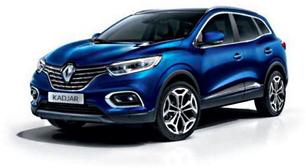
Yes, car spaces are small, or almost non existent, but the people that live there are as full-sized as people elsewhere and they often carry around just as much gear. What you need is a big, little car and the Renault Kadjar is that – a small SUV which is actually bigger than most.
The Kadjar is also French, and that’s appealing to us city folk because even though there are millions of us living in one square metre we like to think of ourselves as different, as individuals, cosmopolitan, metropolitan.
So the Kadjar looks perfect then, right?
Well, it’s good yes… in some ways, but after reading this you might prefer its Japanese cousin, the Nissan Qashqai. Let me explain...
The Mazda CX-5 Evolve kicks some goals and with its comfortable on-road handling, robust safety equipment and practical interior, it’s still a solid choice for families looking for a mid-sized SUV. The only thing it’s missing is a hybrid powertrain, which would make this already well-rounded package even more compelling.
The Renault Kadjar Intens ticks a lot of the urban boxes. It’s small, which is good for navigating narrow city streets and parking in tight spaces, but it’s also spacious and practical. The Kadjar is fuel efficient for a four-cylinder petrol engine and it has that sophisticated French styling.
The Intens is expensive, though, and unless you absolutely have to have leather seats, a glass roof, and the Bose stereo I’d go for the mid-range Zen grade and save yourself $5K but still have all the same safety tech. That said the Intens has auto parking as standard which is a nice convenience for the city.
Safety could be better. The AEB system doesn’t have pedestrian and cyclist detection, rear cross traffic alert, or reverse emergency braking.
Finally, the dual-clutch automatic and 1.3-litre turbo-petrol engine while a fuel efficient combination, isn’t all that easy to live with and can make driving a less-than-smooth experience. The Nissan Qashqai’s combination of CVT auto and four-cylinder naturally aspirated engine is better suited to the urban jungle - something to think about there.
Now the scores, the Kadjar Intens gets the same mark for daily driving and its urban talents – it could be smoother to drive, but there’s still lots to like.
The next-generation Mazda CX-5 is bigger than before, but it retains the sleek body lines and understated styling that have made it such a handsome SUV. The wider front end and repositioned grille give it a more purposeful look than the outgoing model, while the 17-inch alloy wheels keep things suitably restrained.
Inside, the cabin doesn’t feel too basic despite the cloth upholstery. There are plenty of soft-touch materials, a pleasant dashboard and some new technology, including the 12.9-inch multimedia display. You lose most of the physical buttons, though, so there’s a little less of that traditional Mazda tactility.
The fabric seats are cosy and the extra interior space is definitely noticeable. Overall, there is still an understated elegance to the CX-5’s cabin.
People talk about French design being good. Well if you want to see just how good take a look at the Nissan Qashqai, because the Kadjar is fundamentally the same SUV with Renault’s design spin applied.
Yep, as I mentioned about 15 seconds ago, Renault and Nissan are part of an alliance that allows them to share the same cars, but each brand has room to ‘make it their own’ with styling that delivers a very different look, inside and out.
Now, the Qashqai is not an ugly car, but I think the Kadjar is more stylish and premium looking in the same way the larger Renault Koleos SUV is gorgeous compared to the relatively straight-laced Nissan X-Trail it’s based on.
There’s no doubt the Kadjar is a Renault thanks to the giant diamond logo on the plunging grille. I like the way the front bumper rises up into the bonnet like it’s all one piece, but I’m not completely sold on the rear of the car which looks a bit like its shirt is tucked into the back of its pants, which makes no sense unless you look at the images.
Still, the tail-lights have a prestige feel and the Kadjar model name spelled out across the tailgate is a confident statement, also adopted recently by other brands such as Volkswagen (T-Cross) and Ford (Puma).
Telling the Intens apart from the other two grades is fairly easy, it has 19-inch wheels (the others have 17-inch rims), there’s the enormous glass roof, and it also has a chrome effect on the front and rear bumpers, side skirts, and around the fog lights. It’s a more premium look.
That higher-end feel goes into the cabin as well with the Intens’ black leather upholstery and colourful ambient lighting. The touchscreen is tiny, though, and there isn’t a great deal inside that you don’t get in the entry-grade Kadjar’s cabin, which is also almost as stylish.
The Kadjar is classified as a small SUV, which means nothing really when it comes to wondering if it’s going to fit in your garage or in the tiny parking spaces we’re faced with in the city.
So, I’ve mapped it out for you. The Kadjar’s dimensions are, 4449mm long, 2058 mm across (including the wing mirrors), and 1612mm tall.
Another interesting thing – each B-pillar is adorned with a little French flag. I’m not sure if they're a sign of Gallic national pride or to remind everybody that meets the Kadjar that Renaults are French.
Either way, you don’t see this type of thing on other cars and for many buyers the appeal of a Renault is having a car that’s not like everybody else’s.
The front seats are a particularly comfortable place to spend time, with wide seat bases and plenty of elbow room. Getting in and out is easy thanks to the wide door apertures and 205mm of ground clearance and there’s enough space to settle in for a longer journey.
There’s also plenty of useful storage up front, including a large glove box, dual-opening centre console, cupholders and bottle holders, plus a dedicated phone tray with wireless charging. You get a 12-volt socket and two USB-C ports for keeping everything else topped up.
The 12.9-inch multimedia screen replaces Mazda’s familiar rotary selector with touchscreen operation, which I find easier to use. The updated operating system takes a little while to get your head around and there’s no native sat nav, but otherwise it feels functional and fresh for the new-generation model. Wireless Apple CarPlay and Android Auto are standard, with CarPlay maintaining a solid connection throughout my week.
The extra size of this next-generation model is more noticeable in the back, where improved leg- and headroom is good news for taller adults on longer trips. The rear doors open to almost 90 degrees, making it easier to access the ISOFIX child-seat mounts and three top-tether anchor points.
There’s not a huge amount of extra family-focused kit back in the rear row, but you do get directional air vents, storage bins in each door and a centre armrest with cupholders. My nine-year-old was comfortable, although he did point out the lack of a charging port during a road trip.
And, as a parent, I had one other gripe: keeping the fabric seats clean from my kid’s shoes in rainy weather. Let’s just say some seat covers might be a worthwhile investment.
The boot offers up to 466L with all seats in use. That’s not the largest capacity in the class, but it was more than enough for my little family of three this week. I like the level loading floor, although the boot itself is quite tall, which can make lifting heavier items in and out a little awkward.
I’m also pleased to see a spare tyre, even if it is only a space-saver. And while a powered tailgate would be handy, at this price point I don’t think you’ll really miss it... until you’re standing there with your hands full!
The Kadjar is a big-small SUV, in that it’s longer than many in the same segment at 4.4m with a wheelbase of more than 2.6m, which means more space inside for people and their stuff.
That said, don’t expect limousine legroom, but at 191cm (6'3") tall, I can sit behind my driving position with my knees only just touching the front seat back, which is pretty darn good for a small SUV.
Making life a bit more comfortable back there, too, are directional air vents, two USB charging ports and a 12V power outlet. There are another two USB ports and a 12V up front, too.
Cabin storage is okay. The door pockets in the back are big enough for a 500ml bottle, while there are larger ones in the front, along with two cupholders and another circular hole, which looks like it’s for coins, if anybody still uses those?
The centre console bin is pretty decent in size and so too is the boot which has a cargo capacity of 408 litres with all seats up and 1478 litres with the second row folded flat.
There are five variants available for the third-generation Mazda CX-5, and we’re in the second-from-base Evolve grade for this review. It has a competitive $42,990, before on-road costs price, which puts it neatly among its key rivals. The Hyundai Tucson Hybrid starts at $42,850, while the Kia Sportage SX+ petrol begins at $45,580 and the Toyota RAV4 GX 2WD Hybrid at $45,990, all before on-road costs.
On price alone, the CX-5 looks well placed. But there’s one notable difference - all three rivals offer hybrid powertrains in their respective ranges, while the CX-5 currently does not. And as hybrid power becomes increasingly common in this segment, that omission could prove harder for Mazda to overlook.
The Evolve grade enjoys some solid features though, including:
The Intens is the highest grade of Kadjar you can buy and has a list price of $37,990. As a point of reference, the entry-grade Kadjar with an automatic transmission is $29,990. So, what are you getting for an extra $8K?
Well, the entry-level Kadjar comes with a 7.0-inch touchscreen with Apple CarPlay and Android Auto, cloth seats, dual-zone climate control, privacy glass and 17-inch alloy wheels. The Intens gets 19-inch alloys, leather seats (heated up front), a seven-speaker Bose sound system, leather steering wheel, panoramic sunroof, as well as LED headlights and fog lights.
The Intens also comes standard with auto parking, and even the most determined DIY parkers will appreciate that in the city.
The Intens also has more advanced safety equipment than the entry-grade, although the same tech also comes on the mid-spec Zen for $32,990.
You may already know this, but the Kadjar and the Nissan Qashqai are essentially the same car. Renault and Nissan have an alliance which lets them share technology and as well as entire models.
So, you might want to compare the Kadjar Intens to a Qashqai Ti which lists for $38,790. Other models to check are the Mitsubishi ASX and Toyota C-HR.
The CX-5 is all-wheel drive and powered by a 2.5-litre four-cylinder petrol engine producing 132kW of power and 242Nm of torque. It has a braked towing capacity of up to 1800kg, giving you the option of some light towing on the weekends, while the six-speed automatic transmission shifts smoothly through its gears.
But there’s no escaping the fact that most of its key rivals now offer hybrid powertrains, and you can feel the absence of one here. The CX-5’s petrol engine is perfectly capable, but it doesn’t have the same efficiency advantage that many buyers in this segment are increasingly looking for.
While the Renault Kadjar and Nissan Qashqai are essentially the same car, they don’t share the same powertrain. The Kadjar has a smaller but more powerful engine – a 1.3-litre turbo-petrol four-cylinder making 117kW/260Nm.
Shifting gears is a seven-speed dual-clutch auto. There’s no manual available, and all Kadjars are front-wheel drive.
Frankly, the Qashqai four cylinder with less grunt and CVT are a smoother combination. The dual-clutch auto and turbo lag means power delivery and acceleration are delayed, while low-speed gear shifts can be jerky.
The CX-5 has a 58-litre fuel tank and claimed combined cycle (urban/extra-urban) fuel consumption of 7.4L/100km, giving it a theoretical driving range of up to 783km. That’s a solid range for a family-sized SUV and means you won’t be constantly thinking about your next fuel stop.
My real-world fuel use settled at 7.8L/100km after a week of longer highway stints and urban trawls, so it’s not too far off Mazda’s official number.
Still, this is where I’d like to see a hybrid powertrain join the CX-5 range. The fuel economy is reasonable, but with so many rivals now offering hybrid options, Mazda is starting to leave some efficiency gains on the table.
Renault says after a combination of open and urban roads the Kadjar will have used 6.3L/100km. In my own testing I measured 6.5L/100km at the fuel pump. That’s outstanding.
The CX-5 feels composed around town, with power delivered smoothly for everyday driving. But when you need to punch it off the mark, there’s some noticeable lag, and you have to work the engine harder to find the power when tackling a steeper hill at higher speeds. It’s capable enough, but it can feel like you’re asking a little more of it than you should.
The suspension has a firm edge to it, but I like how responsive the steering feels. The CX-5 is genuinely enjoyable through corners, with a dynamic feel and very little body roll.
The cabin is also impressively quiet, with minimal road or wind noise creeping in at higher speeds. Visibility is good through the front and sides, although the A-pillar can get in the way at times.
The reversing camera provides a clear view, while front and rear parking sensors make manoeuvring easier. Overall, it’s not a difficult SUV to park, despite its larger dimensions.
Renault’s Kadjar may be a better-looking version of Nissan’s Qashqai, but it doesn’t drive as well. This comes down to the engine and transmission Renault has gone with.
There’s turbo lag with that small four-cylinder and this delay is made more pronounced by a dual-clutch transmission that causes the vehicle to lurch during shifts.
This type of shemozzle is not uncommon, the Ford Puma and Nissan Juke behave in the same way with their similar powertrains.
There’s nothing wrong with them, it’s just that for a car that’s probably going to spend its life mainly in the city, the Kadjar won’t provide the smoothest driving experience.
The Qashqai has a CVT automatic and while these transmission aren’t as sporty feeling as a dual-clutch, they’re smooth and good for easy city driving.
The Kadjar does have a comfortable ride and good handling, so if you’re able to get used to the antics of the engine and transmission there’s more to like than not about the way this Renault drives.
The Mazda CX-5 has a maximum five-star ANCAP safety rating from testing conducted in 2025, with strong results across all four assessment categories.
It scored 90 per cent for adult occupant protection, 91 per cent for child occupant protection, 93 per cent for vulnerable road user protection and 87 per cent for its safety assist systems.
Other equipment include:
The Kadjar hasn’t been given an ANCAP safety rating, but it did score the maximum five stars when tested by its European equivalent Euro NCAP in 2015.
But beware, the Kadjar isn’t equipped with much in the way of advanced safety equipment. Yes, there is AEB on all grades, while the mid-spec Zen and top-of-the-range Intens come with blind spot monitoring and lane departure warning. But that’s about it. No lane keeping assist, or rear cross traffic alert, or adaptive cruise.
There are front and rear parking sensors, which are almost vital in the city, and a reversing camera.
It’s for this reason the score here is so low – charging $38K and not having anywhere near the level of safety tech on a new car that costs much less is disappointing.
For child seats there are three top tether anchor points across the second row and two ISOFIX points.
Under the boot floor is a space saver spare wheel.
The CX-5 is covered by Mazda’s five-year, unlimited-kilometre warranty, which also includes five years of roadside assistance. It’s a solid offering, although longer warranty terms are becoming increasingly common in this segment.
Servicing is reasonably priced at around $440 per service over seven years, and the intervals are well spaced at every 12 months or 15,000km, whichever comes first. That should make ongoing ownership relatively straightforward for families.
The Kadjar is covered by Renault’s five-year/unlimited kilometre warranty.
Service intervals are every 12 months or 30,000km and capped at $399 for the first three services, followed by $789 for the fourth then back to $399.
There’s also up to five years roadside assistance, if you service your Kadjar with Renault.