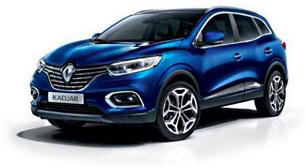
What's the difference?
Don’t let people talk you into buying a tiny car just because you live in the city. That’s what I’ve learnt from being a car reviewer and living about eight kilometres from the CBD.
Yes, car spaces are small, or almost non existent, but the people that live there are as full-sized as people elsewhere and they often carry around just as much gear. What you need is a big, little car and the Renault Kadjar is that – a small SUV which is actually bigger than most.
The Kadjar is also French, and that’s appealing to us city folk because even though there are millions of us living in one square metre we like to think of ourselves as different, as individuals, cosmopolitan, metropolitan.
So the Kadjar looks perfect then, right?
Well, it’s good yes… in some ways, but after reading this you might prefer its Japanese cousin, the Nissan Qashqai. Let me explain...
What does the Mazda CX-5 have in common with the VW Golf, Lotus Elise and Porsche Cayenne?
They all saved their respective carmakers from going under.
Keeping rivals like the Toyota RAV4, Hyundai Tucson and Volkswagen Tiguan on their toes since launching in 2012, the Japanese medium-sized SUV has wooed buyers with its styling, quality, driveability, ease and brand reputation ever since.
Now, after 14 years, five million-plus examples of essentially the same vehicle, a third-generation CX-5 has launched, and we have questions.
Like, what’s actually changed? Are the changes enough? How does it drive? And where’s the hybrid?
Keep reading for answers and more.
The Renault Kadjar Intens ticks a lot of the urban boxes. It’s small, which is good for navigating narrow city streets and parking in tight spaces, but it’s also spacious and practical. The Kadjar is fuel efficient for a four-cylinder petrol engine and it has that sophisticated French styling.
The Intens is expensive, though, and unless you absolutely have to have leather seats, a glass roof, and the Bose stereo I’d go for the mid-range Zen grade and save yourself $5K but still have all the same safety tech. That said the Intens has auto parking as standard which is a nice convenience for the city.
Safety could be better. The AEB system doesn’t have pedestrian and cyclist detection, rear cross traffic alert, or reverse emergency braking.
Finally, the dual-clutch automatic and 1.3-litre turbo-petrol engine while a fuel efficient combination, isn’t all that easy to live with and can make driving a less-than-smooth experience. The Nissan Qashqai’s combination of CVT auto and four-cylinder naturally aspirated engine is better suited to the urban jungle - something to think about there.
Now the scores, the Kadjar Intens gets the same mark for daily driving and its urban talents – it could be smoother to drive, but there’s still lots to like.
In many important and mostly pleasing ways, the third-generation CX-5 takes a confident step forward.
Bigger in the places that matter, smoother yet just as fun to drive and arguably better looking, it remains a high-quality, affordable and safe mid-sized SUV. The second-from-bottom Evolve AWD seems to be the value sweet spot.
However, the switch to a largely buttonless touchscreen interface is disappointing, as are higher entry prices, fewer model grades and no drops in fuel consumption.
Ultimately, though, the latest CX-5 reveals only half the picture, with the next and increasingly more relevant piece, the long-awaited hybrid, still up to 18 months away.
Maybe that’s the innovation that Mazda’s golden goose deserves most.
Note: CarsGuide attended this event as a guest of the manufacturer, with travel, accommodation and meals provided.