What's the difference?
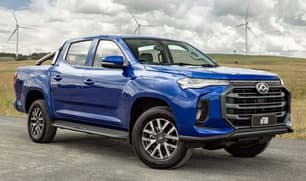
This is it: Australia’s first fully electric ute.
It is telling of the times that the eT60, a dual-cab, no less, doesn’t come from a traditional titan of Australia’s car market like Ford, Nissan or Toyota.
Instead, it comes from Chinese upstart, LDV. The brand has already made a name for itself importing affordable alternatives to these mainstream rivals.
The combustion version of the T60 is chipping away at the market share of established names, commanding nearly six per cent of the light commercial market, placed fifth behind Mitsubishi.
Can the brand be more than a cut-price option, though? Does it have what it takes to be a first-mover with its all-electric dual-cab? We drove a pre-production example at its Australian launch to find out.
Remember when MG’s first convertible sports car came out? I don’t, I’m 30. But I remember when the most recent one came out.
It’s got a weird name and it’s very hard to avoid drawing attention to yourself when you get out of it at the shops… but should you buy one?
I’ve been getting about in the new MG Cyberster to answer exactly that question.
The eT60 presents as an electric vehicle clearly converted from a combustion vehicle to take advantage of being first in our market.
It comes with some significant downsides, from the lack of key specifications and safety equipment to the downright average drive experience, but in other areas it’s specified right, with decent charging specs, and surprisingly good software on that centre multimedia screen.
In some ways, these impressions are a reflection of how far the ute market has come in Australia in the last few years, with many commercial offerings now feeling just as complete as passenger cars in terms of specification and driving prowess.
LDV has left open the door for future tweaks and improvements to the eT60’s spec, ride, and features, and we’re keen to get it in for a longer test in the near future. Either way, though, the brand says it has no shortage of buyers lining up to be a part of the zero emissions future of commercial vehicles.
The Cyberster is certainly an impressive thing in a lot of ways, but if you were expecting a perfect sports car from MG, you'll be a bit disappointed.
It's quite expensive if you're looking for a nice EV, but on the flip side it's quite cheap if being fast is your main concern.
If anything, the Cyberster is an exciting look at what the brand is capable of, even if it's a bit rough around the edges.
The eT60 is hard to tell apart from its combustion equivalents from the outside. If you were expecting a blanked-out grille, aerodynamic wheels, or some other special EV-specific design flair, you’ll be surprised to find there are none.
To that end, the eT60 shares the exterior appeal of the combustion range, with a big, tough-looking grille, modern LED DRLs, sturdy looking alloy wheel designs, and enough chunky personality from the wide stance and additional bits like the sidesteps and sports bar.
Peeking underneath reveals the housing for the batteries, notably no spare wheel, and the tray is utilitarian with the spray-in tubliner. At least the ute scores colour-matching bodywork all around.
The same goes for the inside, which certainly feels like a commercial offering. Again, all the items in there mirror its base combustion equivalent, with the only giveaway of its electric nature being the dial-shifter which replaces the lever on the centre console.
The cabin surroundings are largely hard-wearing plastics, including the steering wheel, making the swish touchscreen with surprisingly fast software look somewhat out-of-place.
The analogue dash cluster, for example, looks a bit old-school for an EV, and in terms of look and feel, the T60 generally feels a bit behind the pace compared to its traditionally more expensive rivals.
While it lacks in some areas, though, it is worth something that this dual-cab flies under-the-radar. Fleet operators won’t need to worry about a strange-looking ute with unnecessary frills, and common body panels with combustion versions will make repairs easy, too.
MG reckons the Cyberster draws on the proportions of classic roadsters like its MG A and B from the ‘50s and ‘60s.
And I reckon that’s about where the comparison ends, really.
But don’t get me wrong, I think it’s got some pretty angles and nice elements.
It’s got the long bonnet, but its cabin isn't set so far back and its aerodynamic lines and curves probably weren't a priority back then either.
This is the standard colour, English White, which is more like off-white or cream or beige.
You can have a red roof on the lighter colours, white, silver, and grey, but red and yellow Cybersters have black ones.
The tail-lights at the back were inspired by the union jack, but they’re probably one of the elements on this car I'd put in the ‘tacky’ column.
Your burning question here will be how much the eT60 can tow and haul. With the same suspension set-up as the Pro version, this ute is capable of carrying a 1000kg payload, or tow 1000kg braked.
This is limited, but when you consider its 2300kg kerb weight due to the addition of those batteries, reasonable.
Operators should keep in mind that the 330km driving range is unladen, so you can expect half of that or less when loaded to capacity.
Tray dimensions come in at 1510mm wide (1129 between the arches), 1485mm long, and 530 high. Axle load capacity at the rear is 2100kg, and the eT60 has a GVM of 3300kg.
The approach and departure angles, as well as the clearance are mostly the same as the combustion version, coming in at 27 degrees, 24 degrees, and 187mm respectively.
Technical stuff aside, the cabin is as hard-wearing and practical as you would hope for a working ute, with a total of six cupholders and four bottle holders, a glove compartment, and sunglass holder, two USB 2.0 ports, two 12V outlets, and the welcome addition of a full-size 220V household power outlet.
The synthetic seat trim is so-so for comfort, and the seat bases are quite high, leaving someone at my 182cm height quite close to the roof.
The lack of telescopic adjust for the steering wheel is a shame, but not unusual for products from LDV’s SAIC parent company (this problem is shared with the MG ZS, for example).
The rear seat continues to offer comparatively good space for this segment, even behind my own driving position, although it would be predictably quite tight with three abreast.
As this was a brief test, we can’t tell you what it looks or feels like when loaded up, but the spray-in tubliner is better than offering the eT60 with simply a painted tray, as it’s good-to-go from day one.
A three-screen dash sounds a little daunting at first, but it’s not that far from the giant screens in some new cars now.
The central 10.25-inch screen is info only, while the flanking 7.0-inch screens are touchscreens, as is the climate control screen in the console.
As much as I’m a fan of physical buttons where possible, this car shows that multiple screens means you don’t need many sub-menus.
Basically, this feels like a lot, but you get used to it relatively quickly.
And while it also seems like MG’s software has become more intuitive and less laggy, the placements of the screens is a little annoying - the side screens on the dash are blocked by the steering wheel, and the central touchscreen is a bit fiddly.
Like I mentioned, no wireless phone mirroring is a let-down and there’s not really an obvious place to put a phone, but the ability to level out the cup holders is kind of interesting and the central storage where the USB-A and C ports are is big enough.
There’s a narrow bit of storage behind the seats, but the boot is actually 249 litres and seems much more usable than you might expect.
It's also worth noting the Cyberster comes with an AC slow charging cable as standard, but not a DC fast-charging cable for plugging in at some charging stations.
The eT60 is expensive. Shockingly expensive. The single variant which will initially arrive in Australia wears a before on-road costs price tag of $92,990.
To put that in perspective, its specification is equivalent to that of the base-model ‘Pro’ combustion version, which now wears a price-tag of $43,148.
Do the math. You could literally have two T60 Max Pros for the same cost as one of these electric versions, given the latter's price premium of $49,842.
To make matters worse, the eT60 is rear-drive only, and with its nearly 90kWh battery pack offers just 330km of driving range, and that’s without being loaded-up.
This price is puzzling for more than one reason, however. For a start, 90kWh of batteries certainly doesn’t cost nearly $50,000 (if you take the average price of a lithium cell per kWh in 2022, the battery should cost closer to $20,000).
In fact, even the electric Mercedes-Benz Vito van with a similarly-sized battery comes in at $85,353 before on-road costs.
To this you could argue many things, but perhaps the most salient point is the fact that big corporate commercial fleets with zero emissions targets are seemingly obliged to pay up given the eT60 has become the only zero-emissions option in the ute space.
Standard gear is mostly shared with the Pro grade of the combustion T60, but there are some real oddities.
Good things include 17-inch alloy wheels and a slick 10.25-inch multimedia touchscreen with Apple CarPlay connectivity, synthetic leather interior trim with six-way electric adjust for the front passengers, LED DRLs, and a sports bar over the tray, which itself has a spray-on tub liner pre-applied, and side-steps to make it easier to hop in and out.
A big bonus is the household-sized 220V power outlet on the back of the centre console, which can be used to power tools and charge devices.
Then things get a bit strange. For example, this is the only fully electric car I’ve ever driven which has a turn-key ignition (as opposed to a push-start system).
It also has an analogue dial cluster, a plastic steering wheel with no telescopic adjust, halogen headlights (in 2022, really?), a manual handbrake, and the example we drove didn’t even have a dedicated park gear. To exit the vehicle, you leave it in drive or neutral, rip the handbrake on, and turn it off. Very odd.
There’s some welcome items here, and it’s also nice that despite LDV’s clear focus on commercial buyers, the eT60 is a dual-cab, so you can actually use it for more than just hauling stuff, but there are just some things (the lack of a park gear in particular) which make it feel a bit pieced together on a tight budget. Rough for a vehicle which costs nearly $100K.
The MG Cyberster finds itself here as the only electric convertible sports car on offer, which means it’s hard to compare its $115,000 price tag to any direct rivals.
The Kia EV6 GT and Hyundai Ioniq 5 N are the wrong shape, the Porsche Cayman has the wrong running gear and most other things with doors like this are a lot more expensive.
So what does $115,000, before on-road costs, get you?
It’s only available in one variant, with pretty much the only cost-option being paint colours.
Aside from the scissor doors, there’s the electric folding roof, triple-screen cockpit with another centre panel, an eight-speaker Bose sound system, heated electric seats and steering wheel, and ambient lighting.
The exterior lights are all automatic intelligent LEDs, and you can open the doors with the key fob.
It is, however, missing a couple of things.
No phone charger might be down to space, but no wireless phone mirroring is a bit annoying, and the manual steering wheel adjustment feels a little cheap in a six-figure EV.
The eT60 is rear-wheel drive only, with an electric motor producing 130kW/310Nm. That’s nowhere near as punchy as the 160kW/500Nm outputs of its punchy twin-turbo 2.0-litre combustion equivalent.
There are three driving modes - 'Power', 'Normal', and 'Eco', and driving performance seems tame. Again, as this was a quick spin in what was described as a pre-production vehicle, we didn’t have a chance to try it out with extra weight in the tray.
Suspension is the same as the combustion T60 Pro, consisting of ‘heavy duty’ coils at the front, and a leaf-sprung set-up in the rear. There are disc brakes all-round.
Okay, here’s where the Cyberster gets impressive.
Its dual-motor set-up combines a 150kW front motor and a 250kW rear motor for a total of 375kW.
Peak torque is a hefty 725Nm.
All that is enough to get you and two tonnes of MG from zero to 100km/h in 3.2 seconds.
Sure it tops out at 208km/h, but the rush of hitting highway speeds is already enough to put your licence at risk.
The eT60’s WLTP-rated energy consumption figure comes in at 21.3kWh/100km, which for a passenger car wouldn’t be great, but seems about right for a commercial vehicle of its size and aerodynamics. As already mentioned, this gives it an official driving range of 330km.
LDV says the fleet buyers it has lined up for the eT60 understand its range is “more than adequate for their daily requirements”.
There is some good news on the charging front, with the eT60 being sensibly specified from the factory. The DC charge rate maxes out at 80kW, for a claimed 20-80 per cent charge time of 45 minutes on a compatible charger, while the slower AC charging rate (important for back-to-base operators) is 11kW, meaning a nine-hour 5.0-100 per cent charge time.
On a single-phase charger (maxing out at 7.2kW, but cheaper to install) the 5.0-100 per cent charge time is a claimed 13 hours. Expect more like a 40-hour charge time on a standard wall socket.
The MG Cyberster has a 77kWh battery and a claimed efficiency of 19.1kWh/100km.
While that means its claimed driving range of 443km relies on a bit of energy to be recuperated from braking, something you don’t really get on the highway, it actually works in the car’s favour during dynamic driving.
After 264km of driving on a test loop that included some urban but mostly highway and rural driving, the Cyberster’s trip computer displayed a 19.4kWh/100km average consumption.
The battery sat at 27 per cent, with 108km estimated range remaining.
While 443km of total range seems optimistic for a car that’s likely to be driven relatively quickly a lot of the time, the efficiency of the Cyberster held up better than you might have expected.
I said some of the standard equipment on this car is odd. This continues through to the drive experience. Keep in mind that LDV reminded us that there were some pre-production quirks about the vehicle we briefly drove on this launch.
Setting off, the eT60 emits a rather unappealing artificial buzzing sound to alert nearby pedestrians of its presence. While the audible aid is welcome, particularly for a commercial vehicle which may be frequently operating in areas shared with pedestrians, does it have to be so grating?
Even the Mifa 9 electric people mover makes a more appealing science-fiction-inspired noise. Perhaps the eT60’s noise was designed to mirror the tone of a diesel engine?
The seating position leaves a lot to be desired for someone of my height and I would also love to have telescopic wheel adjust, although visibility out of the cab is good all-around, and the reversing camera is relatively high-quality.
Manoeuvring at low-speeds is only tarnished, then, by heavy steering, which annoyingly, also gets a bit vague at higher speeds.
Higher speeds also reveal this ute’s main weakness which appears to be its ride. Keep in mind we’re driving a completely unladen pre-production example. But the ride was harsh, busy, and unsettled in our short drive, which covered a portion of freeway and some bumpy side roads.
The suspension from the combustion T60 Pro appears to struggle with the additional weight of the batteries in the eT60. Harsh bumps were easily transmitted to the cabin, whilst undulations had it jiggling and bouncing around side-to-side.
Power from the electric motor seemed sufficient, but not exciting, with tame acceleration off-the line. The obvious benefit being instantaneous response without the need for a transmission.
It is hard to tell whether the 310Nm on offer will feel too heavily burdened when the ute is loaded up. In some instances, electric motors don’t feel additional heft at all, so stay tuned for a follow-up load test.
Unlike this car’s Mifa 9 or eDeliver 9 relations (which use an electric motor with identical outputs), the eT60 does not have adjustable regenerative braking, with a single strong tune, which cannot even be turned off.
While it is welcome for extending the ute’s range and reducing the stress on the disc brakes, it is not a single-pedal driving mode.
The three driving modes don’t alter the experience much, with the Power mode making the electric motor more responsive, and Eco mode taking the wind out of its sails.
Its maximum speed is limited to 120km/h which is more than can be said for the eDeliver 9 which is limited to 90, a recipe for freeway frustration.
We’re keen to spend more time with the eT60 in the future to better evaluate its range claim and how it deals with more commercial duties. Hopefully it can shape up a little better than it did our quick and less-than-ideal testing environment.
There’s good news and bad news about the Cyberster from behind the wheel.
The good news is it’s quite easy to drive this thing very fast.
The bad news is it feels like it would be quite easy to get sick of as a day-to-day car, depending on your situation.
The first thing I noticed is the seat feels a bit high, even at its lowest setting. That's likely due to the placement of the battery pack under the floor of of the car.
Following that, if you’re taller than me (I'm five foot 11), it feels like the wrong road surface will have you nudging your head into the roof liner.
That mechanical roof should take about 15 seconds to lower or raise, and that can be done at speeds up to 50km/h.
It could be a symptom of trying to keep 1985kg tied down, but some of Melbourne's highways and arterial roads between 70 and 100km/h had the Cyberster bobbing quite a bit.
But the suspension doesn't let individual bumps intrude too much into the cabin, so it’s not all bad.
Similarly, there’s good and bad when it comes to the steering and braking.
The first being that the steering seems pretty accurate, even though the feedback is a bit numb.
The braking on the other hand is handled by some pretty capable Brembos up front that pull the heavy roadster up quickly, but don’t always clamp as hard as you might expect when approaching a traffic light at 60km/h.
But stopping’s one thing, and going’s another.
There are three main drive modes, Comfort, Sport, and Super Sport, which mainly alter the acceleration intensity. And they feel well calibrated.
Comfort keeps things calm and cruisy, Sport is plenty for the road, and Super Sport has the potential to draw the attention of the authorities.
There’s good adjustability when it comes to regen braking, and even a decent single-pedal driving mode.
Aside from a couple of particularly heinous roads, the Cyberster held mostly flat when cornering at high speeds, but the potential for its suspension to let its wheels lose their footing might - or should - stop you from pushing the MG too hard.
At high speeds, there’s a bit of wind noise that you really can’t complain about if you’ve just purchased a drop-top, but the noise, vibration and harshness is decent, all things considered.
My only gripe with the interior fit out is that the passenger seat wobbles a little, and rattles on the surface behind it before moving it forward.
It’s impressive what this car can do in terms of performance, it’s just a shame it’s not more playful.
The eT60 lags behind the competition here with a notable lack of active safety equipment, now considered industry-standard.
There’s no auto emergency braking, lane support equipment, active cruise, or blind spot support. Instead, this ute has the standard array of six airbags, electronic stability and traction controls, with the addition of hill start assist, roll movement intervention, and hill descent control.
While combustion versions of the T60 have a five-star ANCAP rating from 2017 (before active items like AEB were considered necessary), don’t expect the same from the eT60.
The Cyberster hasn’t been tested by ANCAP but as a niche sports car, it may never get tested.
The good news is it rides on the same platform as the MG4, which has five stars.
It’s got frontal and side airbags, plus all the usual new-car tech like adaptive cruise, lane-keep assist, blind spot warnings, collision warnings and avoidance, and speed limit warnings.
The Cyberster’s active safety is actually mercifully restrained, giving a couple of relatively quiet dings when exceeding the limit before you turn it off, letting you do the steering even when lane-keep is on, and in my case, only giving me a driver attention alert when I yawned while at a red light.
Ownership is a better story. The eT60 is offered with an industry competitive five-year/160,000km warranty, with five years and 130,000km of roadside assist. There is also a separate eight-year and 160,000km warranty for the battery (supplied by CATL).
The service intervals might be the most appealing attribute, with the eT60 only needing to visit a workshop once every 24 months or 30,000km.
Even better is the cost, which will set owners back an approximate average of just $145.80 per year for the first 10 years of ownership.
MG has a 10-year/250,000km warranty that’s pretty impressive by industry standards, and the warranty also covers its EVs.
It’s important to note that the convertible roof is one of a few items (including 12-volt batteries and light bulbs) that MG covers for less than 10 years. In the case of the roof it’s only five.
It’s worth closely reading the fine print before you crack into buying a car, regardless.
There are also ten capped-price services which occur every 12 months or 25,000km, ranging from $246 to $785. The average price per service is $503.40.
MG also offers free roadside assist for the period of the warranty.