What's the difference?
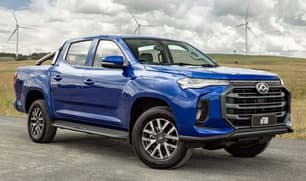
This is it: Australia’s first fully electric ute.
It is telling of the times that the eT60, a dual-cab, no less, doesn’t come from a traditional titan of Australia’s car market like Ford, Nissan or Toyota.
Instead, it comes from Chinese upstart, LDV. The brand has already made a name for itself importing affordable alternatives to these mainstream rivals.
The combustion version of the T60 is chipping away at the market share of established names, commanding nearly six per cent of the light commercial market, placed fifth behind Mitsubishi.
Can the brand be more than a cut-price option, though? Does it have what it takes to be a first-mover with its all-electric dual-cab? We drove a pre-production example at its Australian launch to find out.
Long before Tesla EVs, there were electric golf buggies.
From the first half of last century, they began quietly ferrying birdie and eagle enthusiasts around their favourite courses.
For many, these have been their first (and only) experience of electric vehicles (EVs) at work.
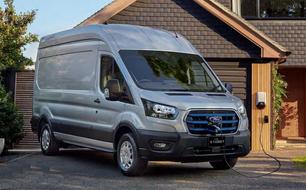
Now, the blue-collared Blue Oval mob has this – the all-new E-Transit Custom.
Designed to take on other electric mid-sized vans such as the LDV eDeliver7, Peugeot E-Expert and the Mercedes-Benz Vito Electric, it is the brand’s second – and more affordable – foray into van electrification.
Does the E-Transit Custom score above par? Let’s dive straight in!
The eT60 presents as an electric vehicle clearly converted from a combustion vehicle to take advantage of being first in our market.
It comes with some significant downsides, from the lack of key specifications and safety equipment to the downright average drive experience, but in other areas it’s specified right, with decent charging specs, and surprisingly good software on that centre multimedia screen.
In some ways, these impressions are a reflection of how far the ute market has come in Australia in the last few years, with many commercial offerings now feeling just as complete as passenger cars in terms of specification and driving prowess.
LDV has left open the door for future tweaks and improvements to the eT60’s spec, ride, and features, and we’re keen to get it in for a longer test in the near future. Either way, though, the brand says it has no shortage of buyers lining up to be a part of the zero emissions future of commercial vehicles.
Wow. This is state-of-the-art EV van engineering – complete with sporty handling and an excellent ride – yet it maintains all the usual Transit attributes.
The Tesla of electric vans? Maybe.
The only thing remains is pricing and how the E-Transit Custom behaves and drives on Australian roads… and we’ll have the answer to those by the end of this year.
But as it stands, Ford's European mid-sized van is keeping the innovative spirit of the original alive.
Note: CarsGuide attended this event as a guest of the manufacturer, with travel, accommodation and meals provided.
The eT60 is hard to tell apart from its combustion equivalents from the outside. If you were expecting a blanked-out grille, aerodynamic wheels, or some other special EV-specific design flair, you’ll be surprised to find there are none.
To that end, the eT60 shares the exterior appeal of the combustion range, with a big, tough-looking grille, modern LED DRLs, sturdy looking alloy wheel designs, and enough chunky personality from the wide stance and additional bits like the sidesteps and sports bar.
Peeking underneath reveals the housing for the batteries, notably no spare wheel, and the tray is utilitarian with the spray-in tubliner. At least the ute scores colour-matching bodywork all around.
The same goes for the inside, which certainly feels like a commercial offering. Again, all the items in there mirror its base combustion equivalent, with the only giveaway of its electric nature being the dial-shifter which replaces the lever on the centre console.
The cabin surroundings are largely hard-wearing plastics, including the steering wheel, making the swish touchscreen with surprisingly fast software look somewhat out-of-place.
The analogue dash cluster, for example, looks a bit old-school for an EV, and in terms of look and feel, the T60 generally feels a bit behind the pace compared to its traditionally more expensive rivals.
While it lacks in some areas, though, it is worth something that this dual-cab flies under-the-radar. Fleet operators won’t need to worry about a strange-looking ute with unnecessary frills, and common body panels with combustion versions will make repairs easy, too.
It may look like the old Transit Custom but the new one has been completely redesigned and rides on an all-new platform.
It’s more aero efficient and the wheelbase has been stretched with the front wheels pulled forward to liberate more leg and foot room.
The roof remains under 2.1-metres high for easier car park clearance, but there’s more space inside due to a lower floor that’s aided by new side steps. This, along with wider side apertures, make for easier loading and unloading.
The E-Transit’s traction battery is integrated into the lower-floor structure, adding significant rigidity as well as a lower centre of gravity, benefitting dynamics and control, as does the switch to an independent rear suspension set-up that conversely improves packaging.
Key cargo-capacity facts are: 3450mm (maximum load length), 6.8 cubic metres (Standard Roof load volume), 9.0 cubic metres (High Roof load volume, up to 1011kg (payload), 3225kg (Gross Vehicle Mass) and 2300kg (maximum braked towing capacity).
More info pertaining to the Australian-market E-Transit Custom will be revealed later in 2024.
Your burning question here will be how much the eT60 can tow and haul. With the same suspension set-up as the Pro version, this ute is capable of carrying a 1000kg payload, or tow 1000kg braked.
This is limited, but when you consider its 2300kg kerb weight due to the addition of those batteries, reasonable.
Operators should keep in mind that the 330km driving range is unladen, so you can expect half of that or less when loaded to capacity.
Tray dimensions come in at 1510mm wide (1129 between the arches), 1485mm long, and 530 high. Axle load capacity at the rear is 2100kg, and the eT60 has a GVM of 3300kg.
The approach and departure angles, as well as the clearance are mostly the same as the combustion version, coming in at 27 degrees, 24 degrees, and 187mm respectively.
Technical stuff aside, the cabin is as hard-wearing and practical as you would hope for a working ute, with a total of six cupholders and four bottle holders, a glove compartment, and sunglass holder, two USB 2.0 ports, two 12V outlets, and the welcome addition of a full-size 220V household power outlet.
The synthetic seat trim is so-so for comfort, and the seat bases are quite high, leaving someone at my 182cm height quite close to the roof.
The lack of telescopic adjust for the steering wheel is a shame, but not unusual for products from LDV’s SAIC parent company (this problem is shared with the MG ZS, for example).
The rear seat continues to offer comparatively good space for this segment, even behind my own driving position, although it would be predictably quite tight with three abreast.
As this was a brief test, we can’t tell you what it looks or feels like when loaded up, but the spray-in tubliner is better than offering the eT60 with simply a painted tray, as it’s good-to-go from day one.
It isn’t just parcels and packages that benefit from all the engineering advances made in the new-gen Transit Custom.
Big doors open to a new, lower and larger cabin. With the front wheels pushed forward, it’s flatter, with more space for three-abreast seating. And, now, the driver enjoys better cross-cabin access right to the opposite door with fewer obstacles.
To aid entry and egress due to its flat base, the E-Transit Custom scores a “squircle” (squarish) steering wheel. It’s one of the few visual distinctions in an otherwise fairly mundane, though well-made, interior. Material quality is of the hardy but pleasant variety.
Our test van was the optional Sport model as-yet not confirmed for the EV (though it’s coming for the diesel), with darker hues, upholstery stripes and a few more luxury features.
Australian-bound E-Transit Customs will be closer to the European Trend spec, which we factored in strongly when assessing the electrified newcomer.
Both grades sampled included Ford’s optional ‘Mobile Office’ that will be made available in Australia. Among other things, it provides a three-position wheel, from the regular position to roughly 45- and 90-degree angles.
The thinking here is for drivers to respectively either rest a laptop or have an in-situ table – complete with a squircle-shaped tray – tilt all the way forward for meal times. A lockout device prevents vehicle operation in anything but the home position.
Handy, though note that two of the three vans we drove with this feature had a rattly wheel in the normal driving position. Ford promises a fix for production is coming.
Other Mobile Office additions include various mounting points for accessories.
The driving position is 4WD-high, with the vast windscreen and very deep side windows providing panoramic views. Because of the rear bulkhead behind the seats, a camera-fied rear-vision mirror, along with the sizeable exterior mirrors, provide sufficient side/rear vision.
The driver’s seat is supportive and comfy if not that shapely, and it seems more fully padded than the flimsy cushions of the (narrower) centre and passenger seats.
The latter both hinge forward to reveal a massive storage cavity (ideal for charging cables) as well as the load-through hatch as per the previous-gen Transit where fitted.
Speaking of storage, Ford’s engineers have repositioned the passenger front airbag from its traditional dashtop home to above the windscreen header, liberating a second glove box fit for housing laptops.
The dashboard’s 13-inch touchscreen is perfectly sized and driver-angled. It uses Ford’s excellent SYNC 4 multimedia system, is powered by a 5G modem for OTA software updates for around 30 modules, and is functional, fast and intuitive. It also comes with Alexa voice commands.
Ample ventilation, big grab handles, massive door pockets for bottles, additional storage areas including behind the configurable digital instrumentation pod, several cupholders, USB-A and -C outlets near shelving areas for minimal cable entanglements, plenty of LED light sources and an armrest/tray, highlight Ford’s many decades of experience building mid-sized vans.
On the launch drive's smooth German roads, wind and road noise intrusion were impressively subdued for a van (especially so given the quiet e-motor operation compared to the clatter of a diesel), though the large frontal area means at speed you won’t mistake this for a luxury EV.
Still, being roomy yet cosy, practical yet thoughtfully presented and solidly built without feeling cheap, the E-Transit Custom's cabin is right on the money – a secure and inviting workhorse first and foremost.
Keep in mind, too, that the cargo area will likely include Ford’s 'Load Area Protection Kit', bringing a moulded load floor liner and protection for the sides and rear doors. Because, this is a workhorse, after all.
The eT60 is expensive. Shockingly expensive. The single variant which will initially arrive in Australia wears a before on-road costs price tag of $92,990.
To put that in perspective, its specification is equivalent to that of the base-model ‘Pro’ combustion version, which now wears a price-tag of $43,148.
Do the math. You could literally have two T60 Max Pros for the same cost as one of these electric versions, given the latter's price premium of $49,842.
To make matters worse, the eT60 is rear-drive only, and with its nearly 90kWh battery pack offers just 330km of driving range, and that’s without being loaded-up.
This price is puzzling for more than one reason, however. For a start, 90kWh of batteries certainly doesn’t cost nearly $50,000 (if you take the average price of a lithium cell per kWh in 2022, the battery should cost closer to $20,000).
In fact, even the electric Mercedes-Benz Vito van with a similarly-sized battery comes in at $85,353 before on-road costs.
To this you could argue many things, but perhaps the most salient point is the fact that big corporate commercial fleets with zero emissions targets are seemingly obliged to pay up given the eT60 has become the only zero-emissions option in the ute space.
Standard gear is mostly shared with the Pro grade of the combustion T60, but there are some real oddities.
Good things include 17-inch alloy wheels and a slick 10.25-inch multimedia touchscreen with Apple CarPlay connectivity, synthetic leather interior trim with six-way electric adjust for the front passengers, LED DRLs, and a sports bar over the tray, which itself has a spray-on tub liner pre-applied, and side-steps to make it easier to hop in and out.
A big bonus is the household-sized 220V power outlet on the back of the centre console, which can be used to power tools and charge devices.
Then things get a bit strange. For example, this is the only fully electric car I’ve ever driven which has a turn-key ignition (as opposed to a push-start system).
It also has an analogue dial cluster, a plastic steering wheel with no telescopic adjust, halogen headlights (in 2022, really?), a manual handbrake, and the example we drove didn’t even have a dedicated park gear. To exit the vehicle, you leave it in drive or neutral, rip the handbrake on, and turn it off. Very odd.
There’s some welcome items here, and it’s also nice that despite LDV’s clear focus on commercial buyers, the eT60 is a dual-cab, so you can actually use it for more than just hauling stuff, but there are just some things (the lack of a park gear in particular) which make it feel a bit pieced together on a tight budget. Rough for a vehicle which costs nearly $100K.
So, how much does the V710-series E-Transit Custom cost? Nobody at Ford is saying right now.
However, with the LDV kicking off from under $65,000, the Peugeot from $80K and the Mercedes from about $91K, our money is on cost-of-entry at around $75K when sales commence at the end of this year.
Whichever way it goes, the E-Transit Custom will cost substantially less than the much-larger (V363) E-Transit full-sized van launched here last year at a whopping $104,990, before on-road costs – though that’s since been slashed to $89,990.
Note, too, that we’re only getting the long-wheelbase version, in standard or high-roof specifications for the time being.
Aimed at small to medium-sized businesses, Ford’s Turkish-built EV should be generously-equipped, with adaptive cruise control, a new patented heat pump for significantly reduced battery drain, heated front seats, a reversing camera, a 13-inch touchscreen offering Ford’s excellent 'SYNC 4' multimedia system powered by a 5G modem for OTA software updates, Alexa voice-control assistance and wireless Apple CarPlay/Android Auto.
Plus, the E-Transit Custom has achieved a record-high Euro NCAP rating for a medium-sized van. More details are outlined in the safety section below.
Note, though, there is no spare wheel, just a tyre inflation kit, sadly.
And while you can option up an outlet to power your tools, there is no bi-directional charging, so you cannot power your home in a blackout with this EV.
That said, the E-Transit Custom’s real value is to be found in the imbedded design and engineering features that distinguish this from other electric vans, maintaining a legacy of innovation that started with the original Transit way back in 1965.
The UK’s bestselling vehicle period in 2021 and 2022, the regular Transit Custom is absolutely vital to Ford’s health globally, and it’s not about to drop the ball with the electric version.
Here’s how.
The eT60 is rear-wheel drive only, with an electric motor producing 130kW/310Nm. That’s nowhere near as punchy as the 160kW/500Nm outputs of its punchy twin-turbo 2.0-litre combustion equivalent.
There are three driving modes - 'Power', 'Normal', and 'Eco', and driving performance seems tame. Again, as this was a quick spin in what was described as a pre-production vehicle, we didn’t have a chance to try it out with extra weight in the tray.
Suspension is the same as the combustion T60 Pro, consisting of ‘heavy duty’ coils at the front, and a leaf-sprung set-up in the rear. There are disc brakes all-round.
Mated to a large battery pack sharing tech with the Ford F-150 Lightning truck, the E-Transit Custom's single, front-mounted electric motor delivers 160kW of power and 415Nm of torque to the rear wheels via a single-speed auto.
As usual, 'Eco', 'Normal' and 'Sport' modes are included to suit the driver’s mood.
One of the reasons Australia won't bother with the 100kW version is its electronically-limited 117km/h top speed; the 160kW can manage all of 133km/h.
Keeping all that performance in check are a strut/leaf spring arrangement up front and a semi-trailing arm independent rear suspension borrowed from its larger sibling.
Full technical specifications will be revealed closer to the E-Transit Custom’s local launch at the end of this year.
The eT60’s WLTP-rated energy consumption figure comes in at 21.3kWh/100km, which for a passenger car wouldn’t be great, but seems about right for a commercial vehicle of its size and aerodynamics. As already mentioned, this gives it an official driving range of 330km.
LDV says the fleet buyers it has lined up for the eT60 understand its range is “more than adequate for their daily requirements”.
There is some good news on the charging front, with the eT60 being sensibly specified from the factory. The DC charge rate maxes out at 80kW, for a claimed 20-80 per cent charge time of 45 minutes on a compatible charger, while the slower AC charging rate (important for back-to-base operators) is 11kW, meaning a nine-hour 5.0-100 per cent charge time.
On a single-phase charger (maxing out at 7.2kW, but cheaper to install) the 5.0-100 per cent charge time is a claimed 13 hours. Expect more like a 40-hour charge time on a standard wall socket.
Ford's official energy consumption figure for the E-Transit Custom is 21.8kWh/100km and the trip computer in our Sport grade test vehicle read 21.6kWh/100km, which is about on the money for this size of van.
With the 64kWh Nickel Cobalt Manganese battery pack that’s 'shrink-wrapped' low down under the load area to help achieve that low floor, the WLTP range figure is 308km for the 160kW (and 337km for the 100kW E-Transit Custom Australia is likely to miss out on).
Ford reckons these numbers are roughly four times the average-daily mileage for van drivers in Europe.
Brake-by-wire regenerative-braking tech allows for one-pedal braking, which in turn helps recharge the battery pack. If you lash out for a big 11kW Wallbox accessory, the standard 11kW AC on-board charge allows a full overnight top-up.
As the E-Transit has a 124kW DC fast-charge capacity, a high-capacity station can replenish the battery from 10-80 per cent full in under 45 minutes.
I said some of the standard equipment on this car is odd. This continues through to the drive experience. Keep in mind that LDV reminded us that there were some pre-production quirks about the vehicle we briefly drove on this launch.
Setting off, the eT60 emits a rather unappealing artificial buzzing sound to alert nearby pedestrians of its presence. While the audible aid is welcome, particularly for a commercial vehicle which may be frequently operating in areas shared with pedestrians, does it have to be so grating?
Even the Mifa 9 electric people mover makes a more appealing science-fiction-inspired noise. Perhaps the eT60’s noise was designed to mirror the tone of a diesel engine?
The seating position leaves a lot to be desired for someone of my height and I would also love to have telescopic wheel adjust, although visibility out of the cab is good all-around, and the reversing camera is relatively high-quality.
Manoeuvring at low-speeds is only tarnished, then, by heavy steering, which annoyingly, also gets a bit vague at higher speeds.
Higher speeds also reveal this ute’s main weakness which appears to be its ride. Keep in mind we’re driving a completely unladen pre-production example. But the ride was harsh, busy, and unsettled in our short drive, which covered a portion of freeway and some bumpy side roads.
The suspension from the combustion T60 Pro appears to struggle with the additional weight of the batteries in the eT60. Harsh bumps were easily transmitted to the cabin, whilst undulations had it jiggling and bouncing around side-to-side.
Power from the electric motor seemed sufficient, but not exciting, with tame acceleration off-the line. The obvious benefit being instantaneous response without the need for a transmission.
It is hard to tell whether the 310Nm on offer will feel too heavily burdened when the ute is loaded up. In some instances, electric motors don’t feel additional heft at all, so stay tuned for a follow-up load test.
Unlike this car’s Mifa 9 or eDeliver 9 relations (which use an electric motor with identical outputs), the eT60 does not have adjustable regenerative braking, with a single strong tune, which cannot even be turned off.
While it is welcome for extending the ute’s range and reducing the stress on the disc brakes, it is not a single-pedal driving mode.
The three driving modes don’t alter the experience much, with the Power mode making the electric motor more responsive, and Eco mode taking the wind out of its sails.
Its maximum speed is limited to 120km/h which is more than can be said for the eDeliver 9 which is limited to 90, a recipe for freeway frustration.
We’re keen to spend more time with the eT60 in the future to better evaluate its range claim and how it deals with more commercial duties. Hopefully it can shape up a little better than it did our quick and less-than-ideal testing environment.
For every one of its four generations since 1965, the Transit has set the pace for driveability, as if Ford of Europe was determined to stamp its dynamic authority in the commercial vehicle space.
The original broke the van mould by being far more car-like than any that came before, offering the availability of a powerful engine, responsive steering and safe handling.
That the E-Transit Custom maintains the philosophy is no surprise; that it ended up being so fresh and rewarding to drive – albeit on German roads carefully chosen by Ford – should be a warning for rivals to raise their standards.
Let’s start with the lofty yet cocooning driver environment, which immediately sets you at ease and in the mood. Nothing awkward or uncomfortable to report here.
Shift the natty little column wand into D, and the instant throttle response of a good EV seems slightly too good to be true in what is a boxy workhorse. Acceleration is urgent yet smooth, humming away as the speed builds in a big yet measured way.
That’s all good and well, but given the sheer mass of this mid-sized van, the second big test is how measured and controlled the handling is, especially at speed.
Again, there’s ample feel from the squircle wheel, as the E-Transit tips crisply into corners, glides through fast curves and generally maintains its composure when turning up the pace.
Credit, no doubt, to the new trailing link independent rear suspension system, which must take a lot of the credit in making the Ford van handle so confidently.
It also does a great job absorbing bumps and isolating the occupants from the road surface underneath.
We tried the standard Trend-spec 15-inch wheeled version, as well as the 17-inch Sport version, which does have a slightly firmer edge, but then seems ever keener through corners.
One of the E-Transit Custom’s true achievements is that – with no diesel engine to drown other noises out – the lack of wind, road and tyre noise intrusion is just so relaxing. Its refinement and ability to combat fatigue augers well for EV van drivers of the future.
Again, keep in mind that we’re on slick Euro roads in specially-prepared launch vehicles, equipped with ballast in the back to emulate a load (and hunker down the rear).
Ultimately, the true test will come when behind the wheel of the E-Transit in Australia. But, our first drive revealed what is surely the most modern and enjoyable van we’ve yet to experience: fast, fun, secure and comfortable.
The eT60 lags behind the competition here with a notable lack of active safety equipment, now considered industry-standard.
There’s no auto emergency braking, lane support equipment, active cruise, or blind spot support. Instead, this ute has the standard array of six airbags, electronic stability and traction controls, with the addition of hill start assist, roll movement intervention, and hill descent control.
While combustion versions of the T60 have a five-star ANCAP rating from 2017 (before active items like AEB were considered necessary), don’t expect the same from the eT60.
Ford Australia has yet to confirm the E-Transit Custom’s final safety spec, but the regular diesel version provides many of the answers.
Euro NCAP has awarded the broader V710 Transit Custom range a maximum five-star 'Platinum' rating. A best-in-class result thanks to a broad array of driver-assist safety.
This includes AEB with passenger and cyclist detection as well as intersection-assist (all operable from 0km/h), lane-keep systems (from 60km/h), blind-spot monitor, rear cross-traffic alert, full stop/go adaptive cruise control and exit-warning alert.
A full suite of airbags is also fitted.
We’ll find out more closer to the E-Transit Custom’s Australian launch.
Ownership is a better story. The eT60 is offered with an industry competitive five-year/160,000km warranty, with five years and 130,000km of roadside assist. There is also a separate eight-year and 160,000km warranty for the battery (supplied by CATL).
The service intervals might be the most appealing attribute, with the eT60 only needing to visit a workshop once every 24 months or 30,000km.
Even better is the cost, which will set owners back an approximate average of just $145.80 per year for the first 10 years of ownership.
As with all Fords, a five-year/unlimited-kilometre warranty with (a conditional) seven years of roadside assistance is anticipated. All high-voltage components including the battery are subject to an eight-year/160,000km warranty.
With dramatically fewer moving parts, Ford reckons operating costs can be reduced by up to 40 per cent compared to the diesel-powered Transit Custom equivalent with service intervals likely to match its big EV bro’s at 12 months/30,000km.
The time-saving convenience this brings is one way Ford reckons helps to justify the circa-30 per cent premium the EV commands.
Note, though, that these figures are based on European data and may take in regional EV subsidies and incentives not available in Australia.
Expect capped-price servicing to be another incentive.
All that info and more will drop closer to the EV’s launch closer to the end of this year.