What's the difference?
The Honda Accord is now in its 11th generation and there was a time when the Accord, and rivals like the Skoda Superb and Toyota Camry were the perfect family cars.
But if you head to a car park, it's obvious they're no longer the choice when it comes to family hauling.
We’re family testing the new Accord, now offered in one highly-specified variant, to see if its new hybrid powertrain and design are worth a look in a world where the SUV is king.
Despite the similar naming conventions, the new Mazda CX-80 large SUV isn’t a revamped version of the popular CX-8 model even though it technically replaces it.
The CX-80 is actually a seven-seat version of the mid-size CX-60. If you're confused, you're not the only one. The CX-80 joins a loooong list of SUVs that Mazda has brought to our market (including the CX-80 and 90) and while it offers more passenger space than its predecessor, does bigger mean better when it comes to family hauling?
My family of three have spent three weeks with the one-up-from-entry grade Touring G40e to find out for you.
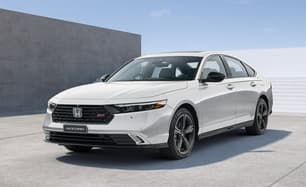
Will the new Honda Accord e:HEV RS topple the SUV throne? Unlikely, but it proves sedans can still haul the family around in relative comfort and style.
The new Accord drives stupidly well and offers great ongoing ownership costs, even if it's price tag is a little steep. It's hybrid powertrain also offers fantastic efficiency and that's a big win.
The Mazda CX-80 Touring G40e will do everything you ask of it and outside of pricey ongoing costs, there’s not much to annoy. It’s too large for my small family of three and if it’s kid stowage that you’re looking for, a people mover might offer better practicality and comfort than what this does. Would it be a model that you jump through hoops to get? Maybe not, but it still has a place as family hauler and is easy to drive.
The design for the new Accord is powerful with a sexy silhouette that features a rear spoiler, black accents and sporty 18-inch alloy wheels.
The old chunky grille is long gone and at certain angles you almost get a Nissan 200 SX vibe, which is gorgeously retro and a refreshing take for Honda - which has been playing it safe for the last few years.
The interior is simply styled but looks timeless. The dashboard has clean lines and a featured honeycomb mesh that hides the air-vents. It's a feature which might not land with everyone but it adds personality.
The black upholstery looks plush and there are enough soft-touchpoints to make the cabin feel like it deserves a premium tag.
I've said it before but Mazda SUVs all look like scaled versions of each other to me and the CX-80 looks ridiculously similar to every other larger SUV model in the Mazda stable with the long pronounced nose that features sharp LED lighting and its general robust size.
The rear is where it differs with the proportions becoming a little bulbous but it’s practically shaped and overall is a nice-looking family SUV at the kerb side.
Head inside and the interior is pleasant with its high-quality trims and heavy-handed styling that matches the exterior dimensions with big panelling and air-vents up front to balance out the long width of this dashboard.
However, the whole car tends to lack personality for a model that’s a part of Mazda’s ‘premium SUV’ range. It's nice but doesn't add anything new.
Access to the cabin is great thanks to wide door apertures but the Accord is a low car to get in and out of with its 134mm ground clearance. Expect a couple of grunts when parked on a hill!
Both rows offer ample legroom but the front enjoys the best of the headroom. A 183cm (6.0ft) friend was lumped with the middle seat and spent the trip dreadfully hunched over and uncomfortable. Save the middle seat for kidlets.
The electric front seats offer decent comfort for a longer trip but it's disappointing that only the driver’s side gets lumbar support.
The rear row enjoys well-padded seats and amenities, like retractable sunblinds, reading lights, two USB-C ports and directional air vents but it took a while for the back to cool down on hot days which my kid made known. Loudly.
Storage consists of a large glove box and middle console (which can accommodate a small handbag), a sunglasses holder, four cupholders, four drink bottle holders and two map pockets. There is also a dedicated phone tray but a few extra cubbies up front would be welcomed.
The boot offers plenty of space with its 570-litre capacity, which is great for the class, and you can also open up storage options with the ski-port door, if need be. The powered boot release is a handy feature.
The touchscreen multimedia system looks nice but is a pain in the butt to use until you set some time aside to get to know it. It’s just not intuitive but the screen is responsive and it's a bonus that you get the built-in sat nav and Google apps.
The new Accord gets wired and wireless Apple CarPlay and Android Auto but it took a few beats to get the wireless CarPlay to work.
The charging options are good throughout the car with four USB-C ports, two 12-volt sockets and a wireless charging pad to choose from.
Seven-seat SUVs tend to really be a 5+2 combo, where the rear two seats are for kid- or emergency-use only. You'll be pleased to find that all passengers enjoy a decent amount of space in each row in the CX-80. The third row is still a little cosy for an adult but my 6ft2 brother managed to get back there without too many grumbles. However, we all giggled as he sort of fell in due to the lack of handholds (sorry, Mack).
Otherwise, the 170mm ground clearance and wide door apertures make it an easy SUV to get in and out of. The doors are heavy and sometimes miss their 'hold' position if you open them too quickly, making them swing back. My eight-year-old got whacked a few times because of it!
Amenities and storage are best in the first and second rows with front occupants enjoying those heated seats, two USB-C ports, a 12-volt socket and wireless charging pad. You also get dual-zone climate control, and powered seats with adjustable lumbar support. The seats are well-padded but fairly narrow and short in the base, making it easy to fatigue on longer journeys.
Storage includes a large glovebox that can hold a manual and a fair bit more, a shallow but handy middle console because of its dual-opening lid and a total of four drink holders. There's a sunglasses holder but not much else for smaller loose items.
In the second row you get two map pockets, a small storage bin in each door and a total of six drink holders. There's also individual reading lights, two USB-C ports, climate control, directional air vents, a fold-down armrest and retractable sunblinds (always a winning feature in my house).
The third row gets four drink holders, two USB-C ports and two directional air vents.
Feedback from my passengers (kids and adults alike) hasn't been great for the air-conditioning system with all complaining how long it took for the rear two rows to cool down. The low and awkward positioning of the air vents also prevents direct air flow to passengers. The third row is impacted by this as the passenger's legs cover them.
The rest of the technology is solid with the multimedia system offering a rotary dial operation. The system hasn't seen any recent updates, so if you're familiar with the Mazda system, you'll get along just fine.
The built-in satellite navigation is simple enough to use and the wireless Apple CarPlay is easy to connect to. There's also wireless Android Auto. Call connections remained consistent but feedback was that there seemed to be a fair bit of background noise on my end during calls.
Rounding out the interior is the boot space which offers a level loading space, retractable cargo blind and underfloor storage which houses the tyre repair kit. There's also a 12-volt socket and 220-volt/150W AC socket housed on a side panel.
With all three rows up, you get 258L of capacity and that figure jumps up to 566L when the third row is stowed. The CX-8 offered more boot space but the CX-80 is still respectable for the annual family road trip. Plus you get a powered tailgate function in the Touring model, which is always appreciated.
The model line-up has been streamlined for the new Accord and there’s only one variant available, the e:HEV RS model.
The new Accord is well-specified but misses out on some luxurious extras most of its rivals sport, like heated and cooled front seats, a heated steering wheel and heated rear outboard seats.
Which might all seem superfluous at first but maybe not when you consider the new Accord's $64,900, before on-road costs, price tag sits just shy of the more expensive Skoda Superb top model, which is $65,590, before on-roads.
The next two rivals are more affordable with the Mazda 6 Atenza priced at $52,590 MSRP and the new Toyota Camry SL at $53,990 MSRP.
The standard equipment list for the new Accord includes leather-appointed upholstery, electric front seats, lumbar support for the driver's side and a panoramic sunroof.
There's also keyless entry and start, adaptive LED headlights, a powered tailgate and a host of high-end technology throughout.
That includes a new 12.3-inch touchscreen multimedia system with satellite navigation and built-in Google apps, wired/wireless Apple CarPlay and Android Auto, the Honda app (with over-the-air updates), a 10.2-inch digital instrument cluster, dual-zone climate control, a wireless charging pad and a 12-speaker Bose sound system.
Mazda offers a choice of five CX-80 grades and for almost all of them, you get the option of a new mild hybrid petrol or diesel, or a plug-in hybrid powertrain.
The Touring G40e model on test for this review is second-from-the-bottom and has a petrol mild-hybrid powertrain. It is priced from $61,950 before on-road costs and the Artisan Red Metallic paintwork our test model has adds $995 to the price tag.
The Touring is more affordable than some of its rivals, including the Toyota Kluger GXL at $70,440 MSRP and Hyundai Santa Fe Elite at $62,500 MSRP. However, these two models are full hybrids and the Santa Fe has a slightly longer features list for only a little bit more money which makes it better value overall.
The great thing about Mazda is once you move up from the entry grade, you often benefit from a host of great standard features that would usually come as part of a package or cost extra with other brands. For example the Touring gets leather upholstery, heated and powered front seats and a wireless charging pad, which isn't too bad for a grade that sits towards the start of the range.
There are some solid practical features like the keyless entry and start, rain-sensing wipers, dusk-sensing headlights, powered tailgate, three-zone climate control, retractable sunblinds (second row) and 360-degree view camera system.
Tech feels well-rounded with a 10.25-inch multimedia system, six USB-C ports, two 12-volt sockets, a 220-volt/150W AC socket, satellite navigation and wireless/wired Apple CarPlay and Android Auto.
In terms of value within the CX-80 range, the Touring G40e is the pick of the litter.
Our test vehicle has an electric continuously variable transmission and features a new self-charging hybrid powertrain that couples two electric motors with a 2.0L, four-cylinder petrol engine that combine to produce 135kW of power and 335Nm of torque.
Only being available in one powertrain may limit its audience but the combo delivers decent performance for a sedan of this size.
The CX-80 Touring G40e model has an eight-speed auto transmission and all-wheel drive via a 3.3L turbo-petrol in-line six-cylinder engine coupled with a 48-volt mild hybrid system that produces up to 209kW of power and 450Nm of torque.
It’s not ridiculously powerful but pick up is great and there's more than enough to move the CX-80's big body around and support a 2500kg braked towing capacity.
The new hybrid powertrain means lower outputs and the official combined fuel cycle figure is just 4.3L/100km! Which is only beaten by the Toyota Camry's 4.0L/100km.
The on-test figure pops out at 5.1L/100km after doing a some urban stuff but mostly open-road driving. Which is where hybrids tend to be the least efficient, so the fuel usage is excellent.
Based on the official combined (urban/extra-urban) fuel cycle and 48L fuel tank, you should see a theoretical driving range of up to 1116km, which is a little less than the Toyota Camry but still an amazing range for a family car.
That range figure drops to around 940km using our real-world average consumption number.
The Touring G40e model has a 74-litre fuel tank and an official combined fuel cycle usage of 8.4L/100km, which gives you a theoretical driving range of up to 880km.
The mild-hybrid system works well enough that I didn’t hit double digits for fuel usage despite not being shy on using the power while hauling cargo and people on a mix of open road and urban trips.
My real-world use popped out at 9.3L/100km and while the diesel variant has much more efficient outputs and range, this result is pretty good for such a massive SUV.
Power delivery for the new Accord is pretty punchy and, in most scenarios it’s responsiveness is great. But occasionally, when you’re getting up to speed, there can be a small lag before things kick in.
The Accord handles like a dream and feels firmly planted on the road in corners. Even in high winds, the car feels stable and sure of itself. Delightful.
The cabin is quiet and engine noise is at a minimum most of the time. Around town, the Accord sounds and behaves like an EV. Only once you hit the open road do you get some road noise but it never intrudes on chatting.
It might also be one of the easiest sedans to park and it's got a lot to do with the top-notch 360-degree view camera system and direct steering.
The Touring G40e model is pleasant, if a little boring, to bum around in. Boring may be too strong a word but there's not much that gets you excited about the driving experience. The Touring performs and has decent power through most situations but it lacks a certain edge. It's not particularly sporty, nor does it sound mean when you put your foot down.
It's nice and does what you expect it to do.
The ride comfort is good with cushioned suspension with enough road feedback but people in the back will jostle a bit over the worst of the bumps.
Road noise can creep in at higher speeds and third rowers will struggle to be a part of the conversation but overall the cabin is refined for longer journeys.
Visibility is mostly good because of the big windows but the wider pillars mean I check my blind spots very carefully, as the side mirrors seem a tad too small for the bulk of the car.
The CX-80 has a small turning circle of 11.6m and most of the time it never feels like it lumbers, but when you’re manoeuvring it in a tight car park the steering can feel heavy and a three-point turn starts to feel clumsy.
A saving grace is the excellent quality of the 360-degree camera system which takes out some of the puff from parking it. The CX-80 fills a space and it’s one you'd be careful to park so you don't get crowded.
The new Honda Accord hasn’t been assessed by ANCAP yet, but it has eight airbags, which includes a knee airbag for the front passenger, but you miss out on a front centre airbag.
Standard active (crash avoidance) safety tech includes blind-spot monitoring, driver attention alert, rear occupant alert, forward collision warning, tyre pressure monitoring, rear cross-traffic alert, lane departure alert, lane keeping aid, traffic sign recognition, intelligent seatbelt warning, a head-up display, adaptive cruise control and a 360-degree camera system as well as front and rear parking sensors.
There are two ISOFIX child seat mounts and three top tethers. The rear seat is wide enough to easily accommodate two big booster seats but you might get lucky with three smaller seats.
At the time of this review the new Mazda CX-80 hasn’t been tested with ANCAP and is thus unrated but it has 10 airbags which is great for a big family SUV and includes side-chest airbags for the second row and curtain airbags that extend to the third row.
The Touring G40e model features a robust list of standard safety features including auto emergency braking (AEB), safe exit assist, front and rear cross-traffic alerts, blind-spot monitoring, driver attention alert and monitoring, forward collision warning, lane keeping aid/departure, front and rear parking sensors, a 360-degree camera system, traffic sign recognition, intelligent seatbelt warning and a tyre pressure monitoring system.
The adaptive cruise control is one of the most user-friendly I’ve sampled recently and other than a sensitive lane keeping aid, all systems follow that user-friendly vibe.
There are a total of five top-tether points and two ISOFIX child seat mounts. The width of the middle seat means you should be good to fit three child seats side by side if they're not too large.
The Accord comes with a five-year/unlimited km warranty, and an eight-year battery warranty, which are now normal terms for the class.
You get a five-year capped priced servicing program and it costs just $199 per service, which is very competitive.
Servicing intervals could get annoying if you put a lot of kays on your car as they're set at every 12-months or 10,000km, whichever occurs first.
The CX-80 is let down a bit by its ongoing costs.
Mazda offers the CX-80 with a five-year/unlimited kilometre warranty which is fairly standard. A number of its rivals are offered with up to seven-year terms these days.
You get a five-year servicing program with services averaging $694, which makes it on the more expensive side, but servicing intervals are reasonable at every 12 months or 15,000km, whichever occurs first.