What's the difference?
The Honda Accord is now in its 11th generation and there was a time when the Accord, and rivals like the Skoda Superb and Toyota Camry were the perfect family cars.
But if you head to a car park, it's obvious they're no longer the choice when it comes to family hauling.
We’re family testing the new Accord, now offered in one highly-specified variant, to see if its new hybrid powertrain and design are worth a look in a world where the SUV is king.
Ford has given its Ranger ute range a mild facelift. And mild is the word. If you look closely, you might notice some small visual changes, but the real news is under the bonnet where a new entry-level powerplant lives.
And however you look at it, this new engine that addresses the ownership issues experienced by some Ranger buyers since the bi-turbo diesel engine was released back in 2018, was probably overdue.
But the new powerplant comes at a cost; in terms of power and torque, even though the vital towing statistics remain for the Ranger.
The other changes that come with this facelift include some new tech, and the availability of the V6 turbo-diesel (which is unchanged) across the entire Ranger 4X4 dual-cab line-up.
For this review, we’ve concentrated on the new engine as being the major point of difference, and we’ve driven it the base-version XL trim specification. That means this is potentially the lightest variant, and heavier specifications might blunt the performance a little. But overall, this is representative of the new powertrain and represents the biggest point of difference in what is otherwise a very minor facelift.
Will the new Honda Accord e:HEV RS topple the SUV throne? Unlikely, but it proves sedans can still haul the family around in relative comfort and style.
The new Accord drives stupidly well and offers great ongoing ownership costs, even if it's price tag is a little steep. It's hybrid powertrain also offers fantastic efficiency and that's a big win.
Our time with the new Ranger was limited in terms of distance driven and the number of variants we could sample. We were also unable to test the vehicle with a trailer attached, so we’re unsure as to how well the new, lower-powered engine will cope with towing duties.
We do know the new engine is being welcomed by owners and fleets who held concerns over the technical layout of the previous 2.0-litre powerplant, but only time will tell if the reduced performance is seen as being balanced by the technical upgrades.
We can also tell you there’s nothing inherently wrong with the new 2.0L in the context of normal driving on normal roads and its refinement is still an improvement on a lot of its competitors’ offerings.
Note: CarsGuide attended this event as a guest of the manufacturer, with meals provided.
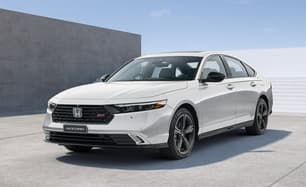
The design for the new Accord is powerful with a sexy silhouette that features a rear spoiler, black accents and sporty 18-inch alloy wheels.
The old chunky grille is long gone and at certain angles you almost get a Nissan 200 SX vibe, which is gorgeously retro and a refreshing take for Honda - which has been playing it safe for the last few years.
The interior is simply styled but looks timeless. The dashboard has clean lines and a featured honeycomb mesh that hides the air-vents. It's a feature which might not land with everyone but it adds personality.
The black upholstery looks plush and there are enough soft-touchpoints to make the cabin feel like it deserves a premium tag.
Here’s a classic case of leaving well enough alone. Having figured out for sure that the Ranger’s looks weren’t costing it any sales whatsoever, Ford wisely decided to spend the facelift money where it counted most; under the bonnet.
If you have sharp eyes, you might pick the dark highlights replacing the chrome finish on some models, the new wheel designs and a couple of new hero colours for specific variants.
Beyond that, those big, bold, bluff looks continue with more than the odd nod to the US-market pick-ups that seem to inspire so many ute buyers in this country.
Inside it’s the same story, with those fabulous interior door handles that are so easy to use continuing and everything else remaining very, very Ranger-ish.
Access to the cabin is great thanks to wide door apertures but the Accord is a low car to get in and out of with its 134mm ground clearance. Expect a couple of grunts when parked on a hill!
Both rows offer ample legroom but the front enjoys the best of the headroom. A 183cm (6.0ft) friend was lumped with the middle seat and spent the trip dreadfully hunched over and uncomfortable. Save the middle seat for kidlets.
The electric front seats offer decent comfort for a longer trip but it's disappointing that only the driver’s side gets lumbar support.
The rear row enjoys well-padded seats and amenities, like retractable sunblinds, reading lights, two USB-C ports and directional air vents but it took a while for the back to cool down on hot days which my kid made known. Loudly.
Storage consists of a large glove box and middle console (which can accommodate a small handbag), a sunglasses holder, four cupholders, four drink bottle holders and two map pockets. There is also a dedicated phone tray but a few extra cubbies up front would be welcomed.
The boot offers plenty of space with its 570-litre capacity, which is great for the class, and you can also open up storage options with the ski-port door, if need be. The powered boot release is a handy feature.
The touchscreen multimedia system looks nice but is a pain in the butt to use until you set some time aside to get to know it. It’s just not intuitive but the screen is responsive and it's a bonus that you get the built-in sat nav and Google apps.
The new Accord gets wired and wireless Apple CarPlay and Android Auto but it took a few beats to get the wireless CarPlay to work.
The charging options are good throughout the car with four USB-C ports, two 12-volt sockets and a wireless charging pad to choose from.
Despite the lower-tech new engine and its power losses compared with its predecessor, the 2.0-litre Ranger in dual-cab 4X4 form retains its full 3.5-tonne towing capacity.
Sticking with towing, if you option up the Touring Pack, the Ranger gets Ford’s 'Trailer Reversing Guidance' which uses cameras and the rotary drive-mode dial to allow the driver to take the hassle out of trailer reversing. Up to a point, anyway. But there’s also a great check-list menu on the info-screen to detect failed trailer lighting and other problems. The Touring Pack is now standard on many versions but still optional of cheaper variants.
Which ever version you buy, any dual-cab 4X4 Ranger styleside has a tub measuring 1547mm long, 1584 wide, 1224mm between the wheel arches (to accept a standard pallet) and a loading height of 816mm. The tub also features inner tie-down rails, a light, a tailgate-lift assist ram and cupholders moulded into the tailgate’s inner side.
Payloads for the various Ranger models are determined by kerb mass, which means the lightest variant, the XL can carry 1135kg, while the heaviest, the Platinum, is restricted to 981kg. Still a decent figure, to be honest.
Inside, the Ranger’s cabin ranges from the starkly utilitarian in the XL (vinyl floor mats and cloth seats to name just a couple of features) to extremely plush in the case of the Platinum with its four USB ports, wireless phone charging and even a row of six switch blanks ready for aftermarket accessories.
The front seating is definitely superior to the rear seat in the Ranger, and the latter features a fairly flat cushion and a backrest.
Lesser versions of the Ranger also get a conventional park-brake compared with the electronic one on more expensive models. We’ll take the manual version any day.
The model line-up has been streamlined for the new Accord and there’s only one variant available, the e:HEV RS model.
The new Accord is well-specified but misses out on some luxurious extras most of its rivals sport, like heated and cooled front seats, a heated steering wheel and heated rear outboard seats.
Which might all seem superfluous at first but maybe not when you consider the new Accord's $64,900, before on-road costs, price tag sits just shy of the more expensive Skoda Superb top model, which is $65,590, before on-roads.
The next two rivals are more affordable with the Mazda 6 Atenza priced at $52,590 MSRP and the new Toyota Camry SL at $53,990 MSRP.
The standard equipment list for the new Accord includes leather-appointed upholstery, electric front seats, lumbar support for the driver's side and a panoramic sunroof.
There's also keyless entry and start, adaptive LED headlights, a powered tailgate and a host of high-end technology throughout.
That includes a new 12.3-inch touchscreen multimedia system with satellite navigation and built-in Google apps, wired/wireless Apple CarPlay and Android Auto, the Honda app (with over-the-air updates), a 10.2-inch digital instrument cluster, dual-zone climate control, a wireless charging pad and a 12-speaker Bose sound system.
The Ranger line-up is vast, so we’ve stuck with the dual-cab 4X4 versions in the range for the purposes of this review, mainly because that’s what people are buying in the greatest numbers.
The line-up kicks off with the XL dual-cab at $51,400 in 2.0-litre form ($57,990 for the V6 version), before working through the Black Edition 2.0-litre at $53,000 drive-away ($60,000), XLT at $67,990, the Wolftrak at $73,000 drive-away, Tremor at $75,090, Wildtrak at an identical $75,090 and finally the Ranger Platinum at $80,890. We’ve left the Raptor and Super Duty variants out of this as they’re completely separate vehicles despite sharing basic architecture.
Within that line-up, of course, there are some new models making a debut, some old ones disappearing and other familiar names making a return. The variant saying goodbye is the Sport, which is being replaced by the Wolftrak with a slightly more off-road focus. It includes the 'Touring Pack' that features the 360-degree camera.
The Tremor which was a special edition, has now joined the fleet permanently, and it gets all-terrain tyres and a 26mm lift to its ride height. The Tremor is now also available for a limited time with the V6 engine.
The main changes to the across-the-board specification include the 12-inch screen, a 400-watt inverter and dual-zone climate-control. Other notable additions include matrix LED headlights and a Bang & Olufsen stereo system for the Wildtrak variant.
Across the fleet, all versions that come standard with the 2.0 litre turbo-diesel can be optioned with the V6 turbo-diesel, and the Ranger now also has a standard 12 inch info-screen, a trailer alarm and front and rear parking sensors.
Our test vehicle has an electric continuously variable transmission and features a new self-charging hybrid powertrain that couples two electric motors with a 2.0L, four-cylinder petrol engine that combine to produce 135kW of power and 335Nm of torque.
Only being available in one powertrain may limit its audience but the combo delivers decent performance for a sedan of this size.
While the V6 turbo-diesel remains unchanged with its 184kW and mighty 600Nm of torque. It remains paired with the 10-speed automatic transmission and the availability of a '4-Auto' setting for the drive system which allows for the use of all-wheel drive on dry bitumen.
The big change to the V6’s status is that it’s now available across the entire dual-cab 4X4 range, right down to the XL version with its rubber floor mats and steel wheels.
Now, if you were cynical, you might suggest Ford has made the V6 more widely available, because the four-cylinder engine option (once the only one available on lesser versions like the XL) has lost a bit of mojo in the transition to Ranger 2026.5.
The thought of a carmaker going backwards on specification and output for an engine goes against the grain somewhat, but in this case, the move to a simpler, potentially more robust engine design makes some sense in the context of long-term ownership costs.
Opinions are divided on how many of the previous 2.0-litre engines posed problems for their buyers, but the fact remains that the wet timing belt (where the rubber belt runs in an oil bath) design had a less-than-perfect track record here and abroad. And even if failures were only a small percentage of units sold, when that failure happens to you, it’s a 100 per cent failure rate…
So, Ford has re-engineered the 2.0-litre unit to use an utterly conventional timing chain, designed new pistons, a different fuel-injection system and reduced the turbocharger count from two to one. The theory is the more robust timing chain will reduce problems, while the single-turbo installation will save money at a production level. In the process, however, both power and torque outputs have fallen. In this case, the bi-turbo engine’s 154kW and 500Nm have fallen to 125kW and 405Nm respectively in the new engine.
Payloads and towing capacity have not been affected (the Ranger can still tow 3500kg) but there’s speculation that 125kW won’t drag a huge trailer around with the same ease as the old engine, even with the 10-speed automatic that’s fitted. Hence the V6 being made available across the board. Allegedly.
The counterpoint is that Ford has dropped the final-dive ratio of the 2.0-litre Rangers which should help with in-gear flexibility and acceleration.
The 2.0-litre-engined Rangers also lack the 4-Auto setting and operate in two-wheel drive mode exclusively on bitumen.
The new hybrid powertrain means lower outputs and the official combined fuel cycle figure is just 4.3L/100km! Which is only beaten by the Toyota Camry's 4.0L/100km.
The on-test figure pops out at 5.1L/100km after doing a some urban stuff but mostly open-road driving. Which is where hybrids tend to be the least efficient, so the fuel usage is excellent.
Based on the official combined (urban/extra-urban) fuel cycle and 48L fuel tank, you should see a theoretical driving range of up to 1116km, which is a little less than the Toyota Camry but still an amazing range for a family car.
That range figure drops to around 940km using our real-world average consumption number.
Ford claims a combined cycle (urban/extra-urban) fuel economy figure of 6.8 litres per 100km for the new 2.0-litre engine. We didn’t get too close to that, but that’s hardly surprising given real-world figures almost never match the official test figure. Rather, we managed 8.2L/100km in mainly relaxed country driving and about 9.5L/100km with a little peak hour traffic thrown into the mix. Either way, the Ranger should be pretty frugal.
The real question mark crops up when you hook a bobcat and tandem trailer to the tow-bar. We’ll have to wait and see how that affects economy on the 'little' Ranger engine.
Meantime, those real-world figures, combined with the Ford’s 80-litre fuel tank, mean a typical range of something like 800 to 900km between visits to the service-station.
And while you might be thinking a newly-developed, modern turbo-diesel would need AdBlue, the 2.0-litre as fitted to the Ranger line-up does not.
Power delivery for the new Accord is pretty punchy and, in most scenarios it’s responsiveness is great. But occasionally, when you’re getting up to speed, there can be a small lag before things kick in.
The Accord handles like a dream and feels firmly planted on the road in corners. Even in high winds, the car feels stable and sure of itself. Delightful.
The cabin is quiet and engine noise is at a minimum most of the time. Around town, the Accord sounds and behaves like an EV. Only once you hit the open road do you get some road noise but it never intrudes on chatting.
It might also be one of the easiest sedans to park and it's got a lot to do with the top-notch 360-degree view camera system and direct steering.
Since Ford has made no changes to suspension, steering, tyre specifications or braking hardware, it’s no surprise to find that the new version feels very familiar.
The V6 variants remain something of a revelation after some of the competitors’ four-cylinder engines, and the sophistication and refinement comes through immediately with the V6 slurring away at its upshifts and generally feeling like a high-end solution to a dual-cab propulsion problem.
But of course, we knew that, didn’t we? Exactly, so the big questions surround the new 2.0-litre four-cylinder turbo-diesel with its new specification and downgraded outputs. Specifically, can 125kW and 405Nm cut it in this cut-throat market?
The initial answer appears to be yes. In fact, when you consider that not every dual-cab owner tows three-and-a-half tonnes with one, you can see why a smaller, more frugal engine might do the job. And there’s always the optional V6 if the job demands it, right?
Acceleration is nothing like the V6’s of course, but the new four-cylinder rolls along at highway speeds without a problem and can still accelerate to overtake. That’s largely a function of having 10 gears and a lower final-drive ratio, but the latter doesn’t seem to have made the engine feel manic or short-geared in any way.
Normal overtaking ranges, say, 70km/h to 100km/h feature lots of mid-range and it’s only when you wring the new engine out that it starts to feel a little puny at the top end. But it never fails to impress with its refined feel and fairly low noise levels and, if nothing else, it proves that smaller capacity four-cylinder engines have an inherent advantage in being smoother and silkier to rev than some of the big bangers out there.
Perhaps if you jumped straight from the outgoing bi-turbo variant into the new single-turbo Ranger, you might notice a decent fall-off in performance, but if you’d never driven a bi-turbo, you’ll never dismiss the new engine as anything other than completely adequate.
The caveat to all that is when we get to hitch a big load to the new Ranger and see what a couple or three tonnes does to that apparent adequacy.
The new Honda Accord hasn’t been assessed by ANCAP yet, but it has eight airbags, which includes a knee airbag for the front passenger, but you miss out on a front centre airbag.
Standard active (crash avoidance) safety tech includes blind-spot monitoring, driver attention alert, rear occupant alert, forward collision warning, tyre pressure monitoring, rear cross-traffic alert, lane departure alert, lane keeping aid, traffic sign recognition, intelligent seatbelt warning, a head-up display, adaptive cruise control and a 360-degree camera system as well as front and rear parking sensors.
There are two ISOFIX child seat mounts and three top tethers. The rear seat is wide enough to easily accommodate two big booster seats but you might get lucky with three smaller seats.
The Ranger’s safety systems are among the better ones in the dual-cab market, in terms of their number and depth, but also their calibration and transparency.
All Rangers now have front and rear parking sensors and an alarm system that alerts the driver if the Ranger’s trailer is disconnected. There are also driver aids including adaptive cruise-control, traffic sign recognition, blind-spot monitoring, autonomous emergency braking, trailer-sway control, lane keeping assistance and pre-collision warning.
There are nine airbags including full-length side-curtain airbags for both rows of seats.
A little disappointingly for such a towing-biased vehicle, tyre pressure monitoring isn’t available until you get to the XLT trim level. It should be standard across the range on a vehicle like this.
The Ranger was locally crash tested by ANCAP back in 2022 where all dual-cab variants scored the maximum five stars.
The Accord comes with a five-year/unlimited km warranty, and an eight-year battery warranty, which are now normal terms for the class.
You get a five-year capped priced servicing program and it costs just $199 per service, which is very competitive.
Servicing intervals could get annoying if you put a lot of kays on your car as they're set at every 12-months or 10,000km, whichever occurs first.
Ford’s standard factory warranty for the Ranger is five years/unlimited kilometres.
There’s also the option of pre-paid servicing, available when you purchase the vehicle brand-new. By locking in the servicing cost, you can pay for the first four scheduled services up to 60,000km or four years, whichever comes first. That’s worked out in accordance with the vehicle’s 12 month/15,000km service intervals.
The Ford Australia website also has a service-cost calculator function where you can input your vehicle’s details and a fixed-price service cost will be worked out for you.
Ford Australia also has a huge dealer network, so parts and servicing should not represent a problem anywhere in the country.