What's the difference?
The Honda Accord is now in its 11th generation and there was a time when the Accord, and rivals like the Skoda Superb and Toyota Camry were the perfect family cars.
But if you head to a car park, it's obvious they're no longer the choice when it comes to family hauling.
We’re family testing the new Accord, now offered in one highly-specified variant, to see if its new hybrid powertrain and design are worth a look in a world where the SUV is king.
Hyundai has established a reputation for quality light commercial vans in Australia, thanks largely to the solid foundations laid by the iLoad one-tonner launched locally in 2007.
For more than a decade it proved to be a popular alternative to Toyota’s dominant HiAce in the 2.5-3.5-tonne GVM van segment, building strong customer loyalty with competitive pricing, solid build quality, robust reliability, good fuel economy and driver comfort.
When iLoad production ceased in 2021 it was replaced by the all-new Staria Load, which switched from rear-wheel drive to front-wheel drive and introduced boldly futuristic styling.
In 2024 the Staria Load, like its iLoad predecessor, is only outsold by the HiAce. So, we recently spent a week aboard the top-shelf model to see if it has what it takes to close the sales gap to its dominant Toyota rival.
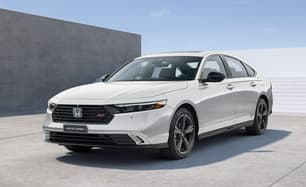
Will the new Honda Accord e:HEV RS topple the SUV throne? Unlikely, but it proves sedans can still haul the family around in relative comfort and style.
The new Accord drives stupidly well and offers great ongoing ownership costs, even if it's price tag is a little steep. It's hybrid powertrain also offers fantastic efficiency and that's a big win.
The Staria Load has good build quality, refinement, performance and pricing. In Premium specification, it also offers numerous desirable goodies that make it one of the best-equipped and sharpest-looking one-tonne vans on the market. For some buyers, depending on their requirements, it offers a compelling alternative to the ubiquitous HiAce.
The design for the new Accord is powerful with a sexy silhouette that features a rear spoiler, black accents and sporty 18-inch alloy wheels.
The old chunky grille is long gone and at certain angles you almost get a Nissan 200 SX vibe, which is gorgeously retro and a refreshing take for Honda - which has been playing it safe for the last few years.
The interior is simply styled but looks timeless. The dashboard has clean lines and a featured honeycomb mesh that hides the air-vents. It's a feature which might not land with everyone but it adds personality.
The black upholstery looks plush and there are enough soft-touchpoints to make the cabin feel like it deserves a premium tag.
The Premium shares the same 3273mm wheelbase, MacPherson strut front suspension and leaf-spring beam axle rear suspension as all Staria Loads, along with power-assisted rack and pinion steering and four-wheel disc brakes. The Premium is available only with a swing-up tailgate.
Its 5253mm length and 1997mm width allows a turning circle of 11.94 metres (HiAce LWB is 11 metres) and its 2000mm height ensures access to height-restricted multi-storey carparks and underground loading docks.
The two-seat interior design, with its absence of physical dials and scarcity of buttons on the dash, provides a spacious and uncluttered workspace. However, adjustments like cabin temperature, fan speed, audio volume control etc using touch-sensitive prompts can be distracting while driving.
Even so, the brightly illuminated instrument display with its ‘virtual’ analogue speedo/tacho is mounted a long way ahead of the driver and quite high, so it almost works like a head-up display given its optimal positioning in the driver’s eyeline.
The height of the cabin doors is also conspicuously low, which has practical benefits given they are not far above knee height (like a LandCruiser 70 Series) which provides excellent side and forward-angle vision.
Access to the cabin is great thanks to wide door apertures but the Accord is a low car to get in and out of with its 134mm ground clearance. Expect a couple of grunts when parked on a hill!
Both rows offer ample legroom but the front enjoys the best of the headroom. A 183cm (6.0ft) friend was lumped with the middle seat and spent the trip dreadfully hunched over and uncomfortable. Save the middle seat for kidlets.
The electric front seats offer decent comfort for a longer trip but it's disappointing that only the driver’s side gets lumbar support.
The rear row enjoys well-padded seats and amenities, like retractable sunblinds, reading lights, two USB-C ports and directional air vents but it took a while for the back to cool down on hot days which my kid made known. Loudly.
Storage consists of a large glove box and middle console (which can accommodate a small handbag), a sunglasses holder, four cupholders, four drink bottle holders and two map pockets. There is also a dedicated phone tray but a few extra cubbies up front would be welcomed.
The boot offers plenty of space with its 570-litre capacity, which is great for the class, and you can also open up storage options with the ski-port door, if need be. The powered boot release is a handy feature.
The touchscreen multimedia system looks nice but is a pain in the butt to use until you set some time aside to get to know it. It’s just not intuitive but the screen is responsive and it's a bonus that you get the built-in sat nav and Google apps.
The new Accord gets wired and wireless Apple CarPlay and Android Auto but it took a few beats to get the wireless CarPlay to work.
The charging options are good throughout the car with four USB-C ports, two 12-volt sockets and a wireless charging pad to choose from.
With its relatively light 1938kg kerb weight and 3020kg GVM, our test vehicle has a genuine one-tonne-plus payload rating of 1082kg (HiAce LWB is 1060kg) of which up to 100kg can be carried on roof racks.
It’s also rated to tow up to 2500kg of braked trailer (HiAce LWB is 1500kg) and with its 5520kg GCM (or how much it can legally carry and tow at the same time) that means it can legally tow its maximum trailer weight while hauling its maximum payload.
On face value, that’s a handy set of numbers. However, with a tow-ball download (TBD) limit of only 100kg it would be a challenge not to exceed that with 2500kg of trailer, given TBD is usually around 10 per cent of trailer weight.
The Premium’s solid-walled cargo bay, with 4.94 cubic metres of load volume (HiAce LWB has 6.2), is accessed through sliding doors on each side and a swing-up tailgate (no rear barn-door option is available for the Premium).
The doors and walls are lined to mid-height and although there’s internal lighting it could be brighter (preferably LED), particularly given the dark colour of our test vehicle.
The cargo bay is 2607mm long and 1640mm wide with 1250mm between the rear-wheel housings, which means it can (theoretically at least) carry up to two standard 1165mm-square Aussie pallets or up to three 1200 x 800mm Euro pallets, secured by a choice of eight load-anchorage points.
We say ‘theoretically’ because the raised tailgate effectively blocks rear access for forklifts not equipped with extendable tynes and the side-door openings are too narrow for an Aussie pallet to pass through.
So, if pallet-loading is important, a base model Staria Load with rear barn-doors would be a better choice than the Premium. However, for many other working roles a swing-up tailgate can be beneficial, particularly when serving as a large ‘umbrella’ during wet weather.
The cabin offers three tiers of storage in each door, with the lowest level providing a large-bottle holder and generously-sized bin.
There’s also a small-bottle/cupholder in the dash-pad to the driver’s right plus a handy compartment with clamshell lid in the centre, single glove box, full-width overhead shelf and pop-out cupholder.
The model line-up has been streamlined for the new Accord and there’s only one variant available, the e:HEV RS model.
The new Accord is well-specified but misses out on some luxurious extras most of its rivals sport, like heated and cooled front seats, a heated steering wheel and heated rear outboard seats.
Which might all seem superfluous at first but maybe not when you consider the new Accord's $64,900, before on-road costs, price tag sits just shy of the more expensive Skoda Superb top model, which is $65,590, before on-roads.
The next two rivals are more affordable with the Mazda 6 Atenza priced at $52,590 MSRP and the new Toyota Camry SL at $53,990 MSRP.
The standard equipment list for the new Accord includes leather-appointed upholstery, electric front seats, lumbar support for the driver's side and a panoramic sunroof.
There's also keyless entry and start, adaptive LED headlights, a powered tailgate and a host of high-end technology throughout.
That includes a new 12.3-inch touchscreen multimedia system with satellite navigation and built-in Google apps, wired/wireless Apple CarPlay and Android Auto, the Honda app (with over-the-air updates), a 10.2-inch digital instrument cluster, dual-zone climate control, a wireless charging pad and a 12-speaker Bose sound system.
Our test vehicle is the Staria Load Premium, which as its name suggests is a cut above the base model Staria Load Van. It comes equipped with the same 2.2-litre four-cylinder turbo-diesel and eight-speed automatic transmission shared by all variants, for a list price of $51,740.
Although that’s a sizeable $5000 more than the base model, it's lineball with the Toyota HiAce LWB in premium GL specification ($51,886). Our example is also fitted with some items from Hyundai’s impressive genuine accessories range, including the mesh-type cargo barrier ($916.75) and heavy-duty rubber cargo bay floor mat ($762.75).
Although our test vehicle is an MY24 build, it’s mechanically and (almost) visually identical to the latest MY25 Premium, which adds Hyundai’s ‘Bluelink’ connected car services, rain-sensing wipers and next-generation key fob.
That’s in addition to the Premium’s desirable standard features including 17-inch alloys with a full-size alloy spare, smart power tailgate, LED MFR (Multi Face Reflector) headlights, LED front light bar and LED tail-lights, high-beam assist, smart key with push-button start, big 10.25-inch instrument cluster and same-sized multimedia touchscreen, blind-spot-view monitor and automatic climate control.
It’s also enhanced by MY25 upgrades shared by all Staria Load variants including new 2D aluminium body-badging and additional USB-C ports, plus replacement of 'Blind-Spot Collision Avoidance Assist' with 'Blind-Spot Collision Warning' (see Safety).
Our test vehicle has an electric continuously variable transmission and features a new self-charging hybrid powertrain that couples two electric motors with a 2.0L, four-cylinder petrol engine that combine to produce 135kW of power and 335Nm of torque.
Only being available in one powertrain may limit its audience but the combo delivers decent performance for a sedan of this size.
The Euro 5-compliant 2.2-litre four-cylinder turbo-diesel produces 130kW of power at 3800rpm and 430Nm served across a 1000rpm-wide torque band between 1500-2500rpm.
This is paired with an eight-speed torque converter automatic, which offers the choice of more direct engine control using sequential manual-shifting. It also has overdrive on its seventh and eighth gears to optimise fuel economy at highway speeds.
Plus, there are four selectable drive modes comprising Normal, Eco, Sport and Smart, with the latter automatically switching between the other three to optimise performance and economy depending on variables like driving styles, road conditions, payloads etc.
The new hybrid powertrain means lower outputs and the official combined fuel cycle figure is just 4.3L/100km! Which is only beaten by the Toyota Camry's 4.0L/100km.
The on-test figure pops out at 5.1L/100km after doing a some urban stuff but mostly open-road driving. Which is where hybrids tend to be the least efficient, so the fuel usage is excellent.
Based on the official combined (urban/extra-urban) fuel cycle and 48L fuel tank, you should see a theoretical driving range of up to 1116km, which is a little less than the Toyota Camry but still an amazing range for a family car.
That range figure drops to around 940km using our real-world average consumption number.
Hyundai claims official combined consumption of only 7.0L/100km. The dash display was showing 8.3 when we stopped to refuel at the end of our 270km test, which comprised a mix of city, suburban and highway driving, with about one third of that distance hauling a heavy payload. We also regularly switched between drive modes.
Our own consumption figure, calculated from fuel bowser and tripmeter readings, came in at 10.9, which was considerably higher than the dash was claiming. So, based on our ‘real world’ numbers, you could expect a driving range of around 680km from its 75-litre tank.
Power delivery for the new Accord is pretty punchy and, in most scenarios it’s responsiveness is great. But occasionally, when you’re getting up to speed, there can be a small lag before things kick in.
The Accord handles like a dream and feels firmly planted on the road in corners. Even in high winds, the car feels stable and sure of itself. Delightful.
The cabin is quiet and engine noise is at a minimum most of the time. Around town, the Accord sounds and behaves like an EV. Only once you hit the open road do you get some road noise but it never intrudes on chatting.
It might also be one of the easiest sedans to park and it's got a lot to do with the top-notch 360-degree view camera system and direct steering.
The driving position feels spacious and comfortable for someone my height (186cm). However, given its Premium status, the driver's seat should have adjustable lumbar support for longer hauls. A fold-down inboard armrest would also be welcome.
The large doors mirrors, combined with blind-spot monitoring and different camera views (including the excellent blind-spot views that appear on the instrument panel) ensure good all-round vision.
This is one of the Staria Load’s strengths, given the huge blind-spot over the driver’s left shoulder created by all solid-walled commercial vans.
The steering is nicely weighted with a mild self-centre effect that ensures it tracks nice and straight over road surface irregularities.
Its unladen handling is stable and sure-footed, with a disciplined ride quality that’s supple enough to soak up the bumps without the lightly-loaded rear suspension bouncing around as you might expect in an empty one-tonner.
Engine response is energetic, as the eight-speed auto does a good job of keeping the turbo-diesel operating within its 1500-2500rpm maximum torque band most of the time. And it requires less than 2000rpm to maintain highway speeds.
Of the four drive modes available, we found ‘Sport’ the most engaging and enjoyable to use, with the instrument panel changing to a red colour and revised shift calibrations providing sharper engine response. This sporty effect is enhanced when using the sequential manual-shift function.
To test its payload rating, we used a forklift to load 650kg into the cargo bay through the side doors, which were just wide enough to allow this.
Combined with our crew of two, this was a total payload of 850kg (about 200kg under its limit). The rear suspension only compressed about 10mm, so there was no chance of its bottoming-out on our test route.
It felt even more planted on the road hauling this payload and coped well with our 13 per cent gradient, 2.0km-long set climb at 60-km/h in ‘Normal’ drive mode, self-shifting down to fourth gear to easily haul this load to the summit.
However, when testing engine-braking on the way down, in a manually-selected second gear, road speed was approaching the 60km/h limit when the transmission overrode our manual selection and shifted up to third gear when the engine reached 3750rpm.
These engine-protecting shift calibrations are common in light commercial vans, which is great for mechanical longevity but not much use when you’re leaning on the engine to assist with braking on steep descents. Fortunately, the four-wheel disc brakes easily coped with the increased workload.
We should also mention the internal noise levels when travelling at highway speeds, given the lack of a solid bulkhead between cabin and cargo bay. Tyre roar emanating from the rear-wheel housings, not helped by the unlined upper walls and roof, can become intolerable over long distances. Fortunately, Hyundai offers a solution with a solid bulkhead ($1825.63) in its genuine accessory range.
The new Honda Accord hasn’t been assessed by ANCAP yet, but it has eight airbags, which includes a knee airbag for the front passenger, but you miss out on a front centre airbag.
Standard active (crash avoidance) safety tech includes blind-spot monitoring, driver attention alert, rear occupant alert, forward collision warning, tyre pressure monitoring, rear cross-traffic alert, lane departure alert, lane keeping aid, traffic sign recognition, intelligent seatbelt warning, a head-up display, adaptive cruise control and a 360-degree camera system as well as front and rear parking sensors.
There are two ISOFIX child seat mounts and three top tethers. The rear seat is wide enough to easily accommodate two big booster seats but you might get lucky with three smaller seats.
The Staria boasts a maximum five-star ANCAP rating achieved in 2021 (expires 2027). It comes with seven airbags and comprehensive ‘SmartSense’ active safety and driver assistance technologies.
MY25 safety upgrade includes replacement of 'Blind-Spot Collision Avoidance Assist' (BCA) with 'Blind-Spot Collision Warning' (BCW) across the range. BCW monitors for vehicles in the blind-spot areas to give the driver audible and visual warnings as required.
The Accord comes with a five-year/unlimited km warranty, and an eight-year battery warranty, which are now normal terms for the class.
You get a five-year capped priced servicing program and it costs just $199 per service, which is very competitive.
Servicing intervals could get annoying if you put a lot of kays on your car as they're set at every 12-months or 10,000km, whichever occurs first.
Hyundai covers the Staria with a five-year/unlimited km warranty.
Scheduled servicing is every 12 months/15,000km whichever occurs first. Capped-price servicing for the first five scheduled services up to five years/75,000km totals $2375 or an average of $475 per year.