What's the difference?
The Honda Accord is now in its 11th generation and there was a time when the Accord, and rivals like the Skoda Superb and Toyota Camry were the perfect family cars.
But if you head to a car park, it's obvious they're no longer the choice when it comes to family hauling.
We’re family testing the new Accord, now offered in one highly-specified variant, to see if its new hybrid powertrain and design are worth a look in a world where the SUV is king.
Chinese automotive brand GWM (aka Great Wall Motors) has been making headlines, given that in 2024 it was the first manufacturer to launch an HEV (Hybrid Electric Vehicle) ute in Australia. And in 2025 it's replaced that short-lived model with a PHEV (Plug-in Hybrid Electric Vehicle) version.
The decision to axe the original Alpha Hybrid was a no-brainer for GWM, given its PHEV successor offers not only short-haul pure-electric driving but also superior power, torque and driving range plus the enhanced ride comfort and handling of four-coil suspension.
We were recently handed the keys to the latest iteration of this lavishly-equipped 4x4 dual-cab ute to assess its workhorse credentials from a tradie’s perspective.
Will the new Honda Accord e:HEV RS topple the SUV throne? Unlikely, but it proves sedans can still haul the family around in relative comfort and style.
The new Accord drives stupidly well and offers great ongoing ownership costs, even if it's price tag is a little steep. It's hybrid powertrain also offers fantastic efficiency and that's a big win.
The Cannon Alpha Ultra PHEV combines five-star safety, a confident warranty, lavish luxury and short-haul electric driving for a competitive price. However, from a pure workhorse perspective, its class-benchmark 3500kg tow rating is offset by a modest payload limit, plus an awkward spare tyre location which could be a deal-breaker for some tradies as it compromises working floor space and the securing of loads.
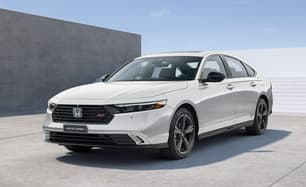
The design for the new Accord is powerful with a sexy silhouette that features a rear spoiler, black accents and sporty 18-inch alloy wheels.
The old chunky grille is long gone and at certain angles you almost get a Nissan 200 SX vibe, which is gorgeously retro and a refreshing take for Honda - which has been playing it safe for the last few years.
The interior is simply styled but looks timeless. The dashboard has clean lines and a featured honeycomb mesh that hides the air-vents. It's a feature which might not land with everyone but it adds personality.
The black upholstery looks plush and there are enough soft-touchpoints to make the cabin feel like it deserves a premium tag.
Our test vehicle shares the same body-on-frame chassis design, twin A-arm/coil-spring front suspension, four-wheel disc brakes and electric power-assisted steering as the model it replaces, but the previous leaf-spring live rear axle has been replaced by a multi-link coil-spring arrangement. External chrome has also been greatly reduced.
Its luxurious leather-accented interior has a spacious and classy feel with a panoramic sunroof and opulent mix of surface finishes, but some tradies might consider such indulgences too fancy for carting muddy-booted crews.
The PHEV’s larger rechargeable battery pack uses up all the underfloor space behind the rear axle usually occupied by a full-size spare tyre. As a result, the steel-rimmed spare has been moved to a conspicuous location in the load tub, which not only looks like an afterthought but is far from ideal for workhorse duties (see Practicality).
Access to the cabin is great thanks to wide door apertures but the Accord is a low car to get in and out of with its 134mm ground clearance. Expect a couple of grunts when parked on a hill!
Both rows offer ample legroom but the front enjoys the best of the headroom. A 183cm (6.0ft) friend was lumped with the middle seat and spent the trip dreadfully hunched over and uncomfortable. Save the middle seat for kidlets.
The electric front seats offer decent comfort for a longer trip but it's disappointing that only the driver’s side gets lumbar support.
The rear row enjoys well-padded seats and amenities, like retractable sunblinds, reading lights, two USB-C ports and directional air vents but it took a while for the back to cool down on hot days which my kid made known. Loudly.
Storage consists of a large glove box and middle console (which can accommodate a small handbag), a sunglasses holder, four cupholders, four drink bottle holders and two map pockets. There is also a dedicated phone tray but a few extra cubbies up front would be welcomed.
The boot offers plenty of space with its 570-litre capacity, which is great for the class, and you can also open up storage options with the ski-port door, if need be. The powered boot release is a handy feature.
The touchscreen multimedia system looks nice but is a pain in the butt to use until you set some time aside to get to know it. It’s just not intuitive but the screen is responsive and it's a bonus that you get the built-in sat nav and Google apps.
The new Accord gets wired and wireless Apple CarPlay and Android Auto but it took a few beats to get the wireless CarPlay to work.
The charging options are good throughout the car with four USB-C ports, two 12-volt sockets and a wireless charging pad to choose from.
Our test vehicle’s substantial 2810kg kerb weight is 235kg heavier than its hefty Alpha Hybrid predecessor, due largely to the bigger battery and electric motor. That makes it about half a tonne heavier than numerous conventional turbo-diesel 4x4 dual cab utes.
This substantial kerb weight contributes to a sizeable 3495kg GVM, yet results in a 685kg payload rating which is modest compared to some turbo-diesel rivals with genuine one-tonne capabilities.
It’s also rated to tow up to the class-benchmark 3500kg of braked trailer, but with its 6745kg GCM (or how much it can legally carry and tow at the same time) that would require a 250kg reduction in payload (from 685kg to 435kg) to avoid exceeding the GCM.
While it’s unlikely owners would need to tow at the 3500kg maximum, it’s important to be aware of these numbers if the need arises, as that 435kg of payload could easily be used up by a crew of tradies before you could load any of their tools.
The vertical mounting of the spare wheel in the load tub not only reduces floor space and load volume but also restricts the securing of loads, given there’s no anchorage point accessible in the right rear corner of the tub.
So, all load straps extending rearwards must share the same left-side anchorage point, which is far from the ideal even spread provided by four-corner load restraint. This spare wheel location needs a rethink (perhaps a swing-away carrier favoured by 4x4 wagon owners would be better).
We also noted the big button on the two-way tailgate, which enables it to split into a pair of hinged doors, stopped working during our test. Fortunately, it could still open the tailgate as a conventional single unit.
There’s ample interior space, not only for front seat occupants but also those in the back. That includes tall people, given I’m 186cm and have at least 40mm of knee room when sitting behind the driver’s seat when set in my position.
There’s also about 80mm of rear headroom, despite the presence of a full-length sunroof which can often compromise this dimension. However, shoulder-room is tight for three adults, so two would be preferable for long trips.
Front-of-cabin storage includes a large-bottle holder and bin in each front door, plus a large glove box, overhead glasses holder and a pull-out compartment for the driver in the lower dash.
The centre console offers wireless phone-charging and a lidded box (with internal air-con flow available) and two small-bottle/cupholders. Another storage nook in the lower right-side of the console offers two USB ports, a 12-volt socket and enough space for a phone.
Rear passengers get a large-bottle holder and bin in each door, pockets on the rear of both front seat backrests and small pull-out drawers under each outer seat. The rear of the centre console also offers adjustable air-vents, a pair of USB ports plus controls for seat heating/cooling and the sliding rear window.
The fold-down centre armrest offers another wireless phone-charging pad, pop-out twin cupholders and a hidden compartment for storage of phones or other slimline items.
The model line-up has been streamlined for the new Accord and there’s only one variant available, the e:HEV RS model.
The new Accord is well-specified but misses out on some luxurious extras most of its rivals sport, like heated and cooled front seats, a heated steering wheel and heated rear outboard seats.
Which might all seem superfluous at first but maybe not when you consider the new Accord's $64,900, before on-road costs, price tag sits just shy of the more expensive Skoda Superb top model, which is $65,590, before on-roads.
The next two rivals are more affordable with the Mazda 6 Atenza priced at $52,590 MSRP and the new Toyota Camry SL at $53,990 MSRP.
The standard equipment list for the new Accord includes leather-appointed upholstery, electric front seats, lumbar support for the driver's side and a panoramic sunroof.
There's also keyless entry and start, adaptive LED headlights, a powered tailgate and a host of high-end technology throughout.
That includes a new 12.3-inch touchscreen multimedia system with satellite navigation and built-in Google apps, wired/wireless Apple CarPlay and Android Auto, the Honda app (with over-the-air updates), a 10.2-inch digital instrument cluster, dual-zone climate control, a wireless charging pad and a 12-speaker Bose sound system.
Our Ultra test vehicle, which sits above the entry-level Lux as the premium PHEV model grade, comes in only one specification comprising a 4x4 hybrid drivetrain with four-cylinder turbo-petrol engine, electric motor and plug-in rechargeable battery for a list price of $64,990.
That pricing sits between its local PHEV ute rivals including the BYD Shark 6 ($57,900) and Ford's entry-level XLT Ranger PHEV ($71,990). Our example’s 'Crystal Black' premium paint is a $595 option.
Its generous standard equipment includes 18-inch alloys with 265/60R18 tyres and a full-size steel spare, LED headlights/DRLs/fog lights/tail-lights, two-way 60/40-split tailgate with electronic lock, roof rails, side-steps, rear privacy glass with electric-sliding rear window, a panoramic sunroof, front and rear diff locks, tyre pressure monitoring, front/rear parking sensors and lots more.
The luxurious interior offers sumptuous leather-accented seating, with the front buckets having multiple power adjustments, heating/cooling and a massage mode. The outer rear seats also have heating/cooling, plus powered backrest recline and a ‘welcome’ function for easier passenger access.
There’s also a synthetic leather-wrapped steering wheel with heating, multiple 'feel' modes and functions, plus an electronic parking brake, head-up display, dual-zone climate, 64-colour ambient interior lighting and wireless phone charging/USB ports front and rear.
Cabin tech includes a 12.3-inch driver’s digital instrument cluster and premium 10-speaker ‘Infinity’ sound system, controlled by a big 14.6-inch multimedia touchscreen with Apple/Android connectivity, voice commands and a vast choice of settings which allow a high degree of personalisation.
Our test vehicle has an electric continuously variable transmission and features a new self-charging hybrid powertrain that couples two electric motors with a 2.0L, four-cylinder petrol engine that combine to produce 135kW of power and 335Nm of torque.
Only being available in one powertrain may limit its audience but the combo delivers decent performance for a sedan of this size.
The Alpha PHEV drivetrain consists of a 2.0-litre, four-cylinder, turbo-petrol engine that produces 180kW of power and 380Nm of torque. This is paired with an electric motor that adds another 120kW/400Nm, so combined they officially produce 300kW and 750Nm.
The electric motor draws its energy from a 37.1kWh lithium-ion rechargeable battery. GWM claims it can be charged from 30 to 80 per cent in less than 30 minutes using 50kW DC charging, or around 6.5 hours using AC charging.
It also has up to 6.0kW of V2L (Vehicle to Load) functionality, using a dedicated adapter cable which plugs into the vehicle’s charging port and provides a standard three-pin AC outlet for numerous electric tools and appliances.
The nine-speed torque converter automatic, which offers sequential manual-shifting using steering wheel-mounted paddles, is paired with the familiar Borg Warner ‘Torque on Demand’ 4x4 system.
For road use, this has three selectable drive modes ('Standard'/'Sport'/'Eco') with the centre differential remaining unlocked to automatically adjust torque delivery between the front and rear wheels in response to any loss of traction.
For off-road use, selecting '4H' (4x4 High Range) or '4L' (4x4 Low Range) locks the centre differential to provide an even 50:50 torque split between the front and rear wheels. 4L traction can be optimised by engaging the front and rear diff-locks.
The new hybrid powertrain means lower outputs and the official combined fuel cycle figure is just 4.3L/100km! Which is only beaten by the Toyota Camry's 4.0L/100km.
The on-test figure pops out at 5.1L/100km after doing a some urban stuff but mostly open-road driving. Which is where hybrids tend to be the least efficient, so the fuel usage is excellent.
Based on the official combined (urban/extra-urban) fuel cycle and 48L fuel tank, you should see a theoretical driving range of up to 1116km, which is a little less than the Toyota Camry but still an amazing range for a family car.
That range figure drops to around 940km using our real-world average consumption number.
GWM claims official combined average consumption of only 1.7L/100km when the highly-charged battery allows most driving to be done in pure electric mode. GWM also claims an official ‘low charge’ figure of 7.9L/100km, when the battery is depleted and the petrol engine is doing most of the work.
It has an NEDC electric-only driving range of up to 115km and a ‘hybrid’ driving range (petrol engine and electric motor combined) of up to 1060km. The petrol engine drinks standard 91 RON unleaded.
The dash display was showing average petrol consumption of 6.4L/100km at the completion of our 324km test, which comprised a mix of suburban, city and highway driving of which about one third was hauling a heavy payload. This was lineball with our own figure of 6.2 based on fuel bowser and tripmeter readings.
Starting with 90 per cent battery charge, we completed 72km of electric-only driving before it automatically switched to hybrid mode when the charge reached 14 per cent. The system would not allow charge to drop lower than that for the remainder of our test, which was conducted in hybrid mode.
So, based on our own test figures, GWM’s claim of more than 1000km of hybrid driving range is credible from its combined 37.1kWh battery and 75-litre fuel tank capacities.
Power delivery for the new Accord is pretty punchy and, in most scenarios it’s responsiveness is great. But occasionally, when you’re getting up to speed, there can be a small lag before things kick in.
The Accord handles like a dream and feels firmly planted on the road in corners. Even in high winds, the car feels stable and sure of itself. Delightful.
The cabin is quiet and engine noise is at a minimum most of the time. Around town, the Accord sounds and behaves like an EV. Only once you hit the open road do you get some road noise but it never intrudes on chatting.
It might also be one of the easiest sedans to park and it's got a lot to do with the top-notch 360-degree view camera system and direct steering.
It has good steering feel with sophisticated ride quality, the latter thanks to four-coil suspension and substantial sprung weight which helps iron out the bumps and deliver a ride that’s more SUV than ute.
Flatten the accelerator from a standing start and up to 750Nm of torque responds with impressive force, even though you can feel that every one of those Newton metres is required to overcome more than 2.8 tonnes of inertia to get this jigger moving swiftly.
Although the option of sequential manual-shifting is available using the steering wheel paddles, we spent most of the test in auto mode as it felt like it was getting the best out of this complex drivetrain.
It’s a competent highway cruiser, too, with the petrol engine requiring 2200rpm to maintain 110km/h with low noise levels.
To test its GVM rating we forklifted just over half a tonne (505kg) into the load tub, which with driver equalled a 600kg payload that was less than 90kg under its limit. The rear coil springs compressed about 50mm, but there was no evidence of bottoming-out on our test route.
Ride, handling and braking were largely unaffected, along with the drivetrain which made light work of our 13 per cent gradient, 2.0km set climb at 60km/h.
Engine-braking on the way down, in a manually-selected second gear, was equally impressive. It never exceeded the 60km/h speed limit, even though its total vehicle weight of around 3.5 tonnes was being restrained by only a 2.0-litre four and regenerative braking.
The new Honda Accord hasn’t been assessed by ANCAP yet, but it has eight airbags, which includes a knee airbag for the front passenger, but you miss out on a front centre airbag.
Standard active (crash avoidance) safety tech includes blind-spot monitoring, driver attention alert, rear occupant alert, forward collision warning, tyre pressure monitoring, rear cross-traffic alert, lane departure alert, lane keeping aid, traffic sign recognition, intelligent seatbelt warning, a head-up display, adaptive cruise control and a 360-degree camera system as well as front and rear parking sensors.
There are two ISOFIX child seat mounts and three top tethers. The rear seat is wide enough to easily accommodate two big booster seats but you might get lucky with three smaller seats.
The Cannon Alpha has a maximum five-star ANCAP rating (tested 2024) that includes seven airbags, 360-degree camera with multiple views and the active features you’d expect including AEB, front/rear parking sensors, front/rear cross-traffic alert with autonomous braking, speed sign recognition and more. The rear seat has three top-tethers plus ISOFIX child-seat anchorages for the outer seating positions.
The Accord comes with a five-year/unlimited km warranty, and an eight-year battery warranty, which are now normal terms for the class.
You get a five-year capped priced servicing program and it costs just $199 per service, which is very competitive.
Servicing intervals could get annoying if you put a lot of kays on your car as they're set at every 12-months or 10,000km, whichever occurs first.
Warranty cover is seven years/unlimited km with an eight years/unlimited km traction battery warranty and seven years of roadside assist.
Scheduled servicing is every 12 months/15,000km whichever occurs first. GWM offers seven years of capped-price servicing totalling $4615, or an average of $659 per service.