What's the difference?
The Honda Accord is now in its 11th generation and there was a time when the Accord, and rivals like the Skoda Superb and Toyota Camry were the perfect family cars.
But if you head to a car park, it's obvious they're no longer the choice when it comes to family hauling.
We’re family testing the new Accord, now offered in one highly-specified variant, to see if its new hybrid powertrain and design are worth a look in a world where the SUV is king.
Audi’s flagship is the A8, a long, luxurious sedan where being driven is often as important as doing the driving.
To put this ultra-premium machine in context, it competes with other German heavyweights like BMW’s 7 Series and, of course, the Mercedes-Benz S-Class as well as Porsche’s Panamera. Not to mention the Lexus LS or Maserati’s Quattroporte.
What’s life like at the top of the Audi pyramid? Stay with us to find out.
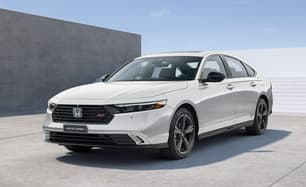
Will the new Honda Accord e:HEV RS topple the SUV throne? Unlikely, but it proves sedans can still haul the family around in relative comfort and style.
The new Accord drives stupidly well and offers great ongoing ownership costs, even if it's price tag is a little steep. It's hybrid powertrain also offers fantastic efficiency and that's a big win.
The Audi A8 swims in a luxury car shark tank where those paying the big dollars expect top-shelf everything. It delivers a serene driving experience whether you’re in the front or the back, in a superbly engineered and executed luxury sedan package. Not perfect, but very, very impressive.
The design for the new Accord is powerful with a sexy silhouette that features a rear spoiler, black accents and sporty 18-inch alloy wheels.
The old chunky grille is long gone and at certain angles you almost get a Nissan 200 SX vibe, which is gorgeously retro and a refreshing take for Honda - which has been playing it safe for the last few years.
The interior is simply styled but looks timeless. The dashboard has clean lines and a featured honeycomb mesh that hides the air-vents. It's a feature which might not land with everyone but it adds personality.
The black upholstery looks plush and there are enough soft-touchpoints to make the cabin feel like it deserves a premium tag.
The A8 is close to 5.2 metres long, yet instantly recognisable as an Audi thanks mainly to its evenly weighted proportions, gently curved roofline and overall high-waisted design. Worth noting its drag coefficient (Cd) is an impressively slippery 0.25.
The characteristic look is accentuated by the brand’s signature, six-sided grille, in this instance highlighted by a matrix of high-relief chrome accents. And typically angular LED Matrix headlights sit either side.
Check out our video review for the carefully orchestrated animation they run through when the car is unlocked.
The car looks equally svelte and contemporary from the rear, with just the right amount of chrome lifting the tone and multi-spoke 20-inch rims filling the wheel arches nicely.
As you’d expect, the top-shelf look and feel continues inside with the seats trimmed in aniline leather, perforated on the front and outer rear positions, with genuine hide also covering the centre console, door rails and armrests, steering wheel and upper dashboard.
Fine grain ash wood inserts sit alongside brushed metal elements and a meticulous attention to detail is obvious… everywhere.
For example, the interior door handle design has been thoroughly thought through, requiring a simple underhand tap to open the door, rather than the more conventional, and ergonomically convoluted, ‘over the top’ movement.
Three sleek screens dial up the tech - a 10.1-inch multimedia interface at the top of the centre stack, an 8.6-inch display below it for heating and ventilation, and a 12.3-inch version of Audi’s ‘Virtual Cockpit’ in the instrument binnacle.
And the spacious rear is the epitome of cool, calm Teutonic form and function. You feel relaxed the moment you get in, and isn’t that the primary aim of a car like this?
Access to the cabin is great thanks to wide door apertures but the Accord is a low car to get in and out of with its 134mm ground clearance. Expect a couple of grunts when parked on a hill!
Both rows offer ample legroom but the front enjoys the best of the headroom. A 183cm (6.0ft) friend was lumped with the middle seat and spent the trip dreadfully hunched over and uncomfortable. Save the middle seat for kidlets.
The electric front seats offer decent comfort for a longer trip but it's disappointing that only the driver’s side gets lumbar support.
The rear row enjoys well-padded seats and amenities, like retractable sunblinds, reading lights, two USB-C ports and directional air vents but it took a while for the back to cool down on hot days which my kid made known. Loudly.
Storage consists of a large glove box and middle console (which can accommodate a small handbag), a sunglasses holder, four cupholders, four drink bottle holders and two map pockets. There is also a dedicated phone tray but a few extra cubbies up front would be welcomed.
The boot offers plenty of space with its 570-litre capacity, which is great for the class, and you can also open up storage options with the ski-port door, if need be. The powered boot release is a handy feature.
The touchscreen multimedia system looks nice but is a pain in the butt to use until you set some time aside to get to know it. It’s just not intuitive but the screen is responsive and it's a bonus that you get the built-in sat nav and Google apps.
The new Accord gets wired and wireless Apple CarPlay and Android Auto but it took a few beats to get the wireless CarPlay to work.
The charging options are good throughout the car with four USB-C ports, two 12-volt sockets and a wireless charging pad to choose from.
Space is luxury, be it a large house, a first class seat or a spacious car, and at nearly 5.2 metres long with a close to 3.0m wheelbase the Audi A8 measures up.
Even before you get in, the doors have an amazing sense of solidity and quality. It’s like opening and closing a bank vault… if that huge circular door had a power-assisted soft-close function.
There’s copious amounts of space for the driver and front passenger with lots of storage including a lidded box between the front seats, complete with a two-piece longitudinally split top design, so you can sneak your half’s open without displacing your neighbour’s elbow.
The door bins are decent but there isn’t a specific cut-out for bottles, so it’s more a case of laying them down than standing them up. There’s also a handy covered cubby at the end of the door armrests.
The glove box is a good size and there are two cupholders under a pop-up cover in the centre console.
Of course, the back is where space really counts, and there’s as much room as you’d find in, well… a limo.
Sitting behind the driver’s seat, set for my 183cm position, I enjoyed copious amounts of head, shoulder and legroom.
There are electric sunblinds for the rear and rear side windows, controlled by buttons in the door as well as the rear seat remote, a 5.7 inch OLED display housed in the beautifully trimmed fold-down centre armrest (which also has a soft close function!). The remote also allows adjustment of the lighting and climate control. Classy.
There’s a shallow storage box and twin cupholders in the armrest, medium size door bins and hard shell pockets on the front seat backs. The rear armrests also feature a small lidded cubby.
In terms of connectivity and power options there’s wireless Android Auto and Apple CarPlay, a USB-A and USB-C in the front, and an identical pair in the rear, as well as a 12-volt socket in the front and two in the back.
Boot volume is a useful 505 litres (VDA) and the lid is electric, with gesture control. It’s able to easily swallow our three-piece luggage set or the bulky CarsGuide pram. And while the rear seats don’t fold there’s a ski port door to accommodate long items. Just make sure you use the tie-down anchors in the boot to ensure they’re properly secured. There’s a handy netted section behind the left wheel well and a cargo net is included.
Maximum towing capacity, for a braked trailer, is 2.3 tonnes (750kg unbraked) and in more good news, the spare is a space-saver rather than the increasingly prevalent inflator/repair kit.
The model line-up has been streamlined for the new Accord and there’s only one variant available, the e:HEV RS model.
The new Accord is well-specified but misses out on some luxurious extras most of its rivals sport, like heated and cooled front seats, a heated steering wheel and heated rear outboard seats.
Which might all seem superfluous at first but maybe not when you consider the new Accord's $64,900, before on-road costs, price tag sits just shy of the more expensive Skoda Superb top model, which is $65,590, before on-roads.
The next two rivals are more affordable with the Mazda 6 Atenza priced at $52,590 MSRP and the new Toyota Camry SL at $53,990 MSRP.
The standard equipment list for the new Accord includes leather-appointed upholstery, electric front seats, lumbar support for the driver's side and a panoramic sunroof.
There's also keyless entry and start, adaptive LED headlights, a powered tailgate and a host of high-end technology throughout.
That includes a new 12.3-inch touchscreen multimedia system with satellite navigation and built-in Google apps, wired/wireless Apple CarPlay and Android Auto, the Honda app (with over-the-air updates), a 10.2-inch digital instrument cluster, dual-zone climate control, a wireless charging pad and a 12-speaker Bose sound system.
With an entry price of $202,700, before on-road costs, the A8 is in the thick of it amongst its full-size primo sedan competitors from Europe and Japan. Specifically, BMW’s 740i MHEV ($272,900), the Lexus LS500h ($195,920), Maserati Quattroporte GT ($210,990), Mercedes-Benz S450 ($244,700) and Porsche’s Panamera ($207,800).
By definition, a luxury car should be loaded to the gunwales with features that make life on the road that little bit easier. And aside from the performance and safety tech we’ll cover shortly, the highlights from a very lengthy standard equipment list are - 20-inch alloy rims, metallic paint, adaptive cruise control, digital matrix LED headlights, digital OLED tail-lights, full keyless entry and start, power-assisted door closing, power boot lid (with gesture control), a panoramic sunroof, heated, ventilated and massaging electrically adjustable front seats, heated front armrests and extended leather trim (centre console, door rails and armrests, steering wheel and upper dashboard).
Also included are ambient interior lighting (with 30 colours and six colour profiles), four-zone climate control, electric sunblinds for the rear and rear side windows, ‘Audi Connect’ navigation and multimedia (with voice and handwriting recognition), wireless Android Auto and Apple CarPlay, 17-speaker 730-watt Bang & Olufsen audio (with digital radio) and a colour head-up display.
There’s a lot more, and the A8 can hold its head high in terms of pricing and features relative to its $200K price tag and the competition.
Our test vehicle has an electric continuously variable transmission and features a new self-charging hybrid powertrain that couples two electric motors with a 2.0L, four-cylinder petrol engine that combine to produce 135kW of power and 335Nm of torque.
Only being available in one powertrain may limit its audience but the combo delivers decent performance for a sedan of this size.
The Audi A8 50TDI is powered by a 3.0-litre turbo-diesel V6 engine sending 210kW (from 3500-4000rpm) and 600Nm (from 1750-3250rpm) to all four wheels via an eight-speed automatic transmission (with ‘Tiptronic’ sequential manual shift function) and Audi’s quattro constant all-wheel drive system using a self-locking centre differential.
It also features a 48-volt electrical set-up for mild hybrid functionality built around a belt connected starter/generator, AC to DC converter and a 48-volt lithium-ion battery.
With energy recovery of up to 12kW from regenerative braking, it enables the A8 to regularly coast with the engine switched off and helps the extended stop-start system to operate smoothly.
The new hybrid powertrain means lower outputs and the official combined fuel cycle figure is just 4.3L/100km! Which is only beaten by the Toyota Camry's 4.0L/100km.
The on-test figure pops out at 5.1L/100km after doing a some urban stuff but mostly open-road driving. Which is where hybrids tend to be the least efficient, so the fuel usage is excellent.
Based on the official combined (urban/extra-urban) fuel cycle and 48L fuel tank, you should see a theoretical driving range of up to 1116km, which is a little less than the Toyota Camry but still an amazing range for a family car.
That range figure drops to around 940km using our real-world average consumption number.
Audi’s official fuel economy number for the combined (ADR 81/02 - urban, extra-urban) cycle is 6.6L/100km, the 3.0-litre turbo-diesel V6 emitting 175g/km of CO2 in the process.
Over a week of city, suburban, and some freeway running we averaged 11.1L/100km, which is acceptable for a 2.1-tonne luxury sedan.
Also worth noting the standard stop-start system works beautifully thanks to the 48-volt starter/generator.
You’ll need 82 litres of diesel to fill the tank and using the official number, that translates to a range of just over 1240km, which drops to around 740km using our real-world figure.
Power delivery for the new Accord is pretty punchy and, in most scenarios it’s responsiveness is great. But occasionally, when you’re getting up to speed, there can be a small lag before things kick in.
The Accord handles like a dream and feels firmly planted on the road in corners. Even in high winds, the car feels stable and sure of itself. Delightful.
The cabin is quiet and engine noise is at a minimum most of the time. Around town, the Accord sounds and behaves like an EV. Only once you hit the open road do you get some road noise but it never intrudes on chatting.
It might also be one of the easiest sedans to park and it's got a lot to do with the top-notch 360-degree view camera system and direct steering.
Despite extensive use of aluminium in the ‘ASF’ platform and body panels, the A8 tips the scales at a sturdy 2095kg, yet Audi says the A8 will accelerate from 0-100km/h in just 5.9 seconds. And with 600Nm of peak torque available across a flat plateau from 1750-3250rpm this big four-door gets up and goes hard when asked to.
At more sedate speeds you’re occasionally reminded there’s a diesel engine under the bonnet, with that characteristic engine and exhaust noise only making their presence felt under pressure.
In fact, under normal circumstances, noise, be it the engine, tyres or wind is minimal, thanks to a combination of the car’s aero-efficient shape, thick acoustic glass and other sound-deadening measures throughout the car.
The eight-speed auto transmission is suitably smooth, with the central shifter or wheel-mounted paddles able to make snappy sequential ‘manual’ shifts.
There are four drive modes in the ‘Drive Select’ system - ‘Comfort’, ‘Auto’, ‘Dynamic’ and ‘Individual’ - enabling tweaks to the steering, transmission, throttle and suspension. Comfort felt most appropriate most of the time, although dialling up the throttle and transmission to more aggressive modes in Individual adds an enjoyable edge.
The suspension is five-link front and rear with an adaptive air system smoothing even high-frequency bumps and ruts amazingly well.
Push into a corner and the A8 feels nicely balanced, its wide track, sophisticated suspension, plus the quattro AWD system seamlessly distributing drive between the front and rear axles, keeping the big body under control. In fact, you feel the ‘big car shrinking around you’ syndrome from the get-go.
The steering is precise without being overly sharp and road feel is good. Again, with that 2.1-tonne kerb weight in mind, braking is appropriately powerful with big ventilated discs front (350mm) and rear (330mm).
It pays to remember the turning circle is 12.5m, and it’s worth picking your spot for a U- or three-point turn.
Although there’s a lot going on for the driver in terms of screens, buttons and switches it all makes sense ergonomically. The head-up display is helpful and there’s a common sense mix of digital and physical controls, the latter including an audio volume knob. Yes.
The new Honda Accord hasn’t been assessed by ANCAP yet, but it has eight airbags, which includes a knee airbag for the front passenger, but you miss out on a front centre airbag.
Standard active (crash avoidance) safety tech includes blind-spot monitoring, driver attention alert, rear occupant alert, forward collision warning, tyre pressure monitoring, rear cross-traffic alert, lane departure alert, lane keeping aid, traffic sign recognition, intelligent seatbelt warning, a head-up display, adaptive cruise control and a 360-degree camera system as well as front and rear parking sensors.
There are two ISOFIX child seat mounts and three top tethers. The rear seat is wide enough to easily accommodate two big booster seats but you might get lucky with three smaller seats.
Even though the A8 hasn't been assessed by ANCAP, as you might expect, it goes to town when it comes to active safety tech, the car’s standard crash-avoidance features including auto emergency braking (AEB) (pedestrians/cyclists - 5.0-85km/h, vehicles - to 250km/h), ‘Active Lane Assist’, blind-spot monitoring, a reversing camera and 360-degree view (including kerb view function), front and rear parking sensors, ‘Collision Avoidance Assist’ (steering assistance in critical situations), ‘Turn Assist’ (monitors incoming traffic when turning right), and rear cross-traffic alert.
There’s also ‘Intersection Crossing Assist’, ‘Attention Assist’, tyre-pressure monitoring and an ‘Exit Warning System’ (detects cars and cyclists when opening doors).
If all that isn’t enough to avoid a crash the airbag count runs to nine, including front and side bags for the driver and front passenger, side airbags covering the outer rear passengers, full length curtains and a front centre airbag to minimise head clash injuries in a side impact. A first aid kit, warning triangle and high visibility vests are also on-board.
There are three top tethers for baby capsules/child seats across the back seat with ISOFIX anchors on the outer positions.
The Accord comes with a five-year/unlimited km warranty, and an eight-year battery warranty, which are now normal terms for the class.
You get a five-year capped priced servicing program and it costs just $199 per service, which is very competitive.
Servicing intervals could get annoying if you put a lot of kays on your car as they're set at every 12-months or 10,000km, whichever occurs first.
The A8 is covered by Audi Australia’s five-year/unlimited km warranty, which is now par for the luxury market course, and 24-hour roadside assistance is included for the duration.
Paint defects are also covered for five years, with rust (to the point of perforation) covered for 12. Nice.
Service is required every 12 months or 15,000km with a five-year capped-price plan for the A8 coming in at $3830, or $766 per year. That’s a fair wedge but not outrageous for the category.