What's the difference?
Sometimes it really is all a matter of timing.
GWM was always going to offer up the plug-in hybrid version of its Tank 300 4X4, but for it to arrive in showrooms right now must be being looked on as some kind of blessing at GWM HQ.
Consider the circumstances: The Tank 300 Hi4-T PHEV (to give it its full name) not only saves fuel by making use of plug-in hybrid tech, but the fossil stuff it does use is petrol, not diesel with that fuel’s buck-a-litre cost penalty right now.
And with the planet on a knife’s edge waiting for the next increase in brinkmanship from those referred to as our world leaders, overseas travel has never seemed sketchier to the average Aussie. Which is when keeping it local and hitting the outback in a four-wheel drive suddenly looks really, really good. Except for the cost of fuel, that is, which is where we circle back to square one.
All of which means the GWM Tank 300 Plug-in hybrid concept could not really have come at a better time. But does the reality match the promise?
Mazda has a tendency to have a lot of similar looking horses in the stable; blink and you'll miss the (very) subtle differences between the CX-8 and the CX-9 but if you're not super keen on the bulk of the CX-9 and you've outgrown the space of the CX-5... this one's for you.
Especially, if you've been considering its competition - the Hyundai Santa Fe Elite CRDi AWD and Toyota Kluger GXL AWD. Both of which have become known for their features and space.
So, how does it compare? The CX-8 GT SP diesel all-wheel drive seats seven, has a decent boot space (albeit, when the third row isn't in use) and handles like a dream.
Perfect combination? Maybe. I've been driving it for the last week with my family to find out for you.
There’s a lot to like here. The GWM Tank 300 in any of its forms is a competent vehicle from the helm and backs up its off-road claims with real ability. The ride quality, in particular, is a highlight, and it’s a good size for couples or young families. Its value for money is also quite brilliant.
Add this plug-in hybrid driveline to the mix and the performance is quite astounding, while the petrol engine and EV potential have arrived at a critical point in history where such things carry more weight than ever before. It remains to be seen what happens globally and what effect that has on fuel prices, specifically the price gap between petrol and diesel. There’s also the question of what happens electronically when you dunk the Tank into Nolan’s Brook on the track to Cape York. But for now, this is a car whose time appears to have come.
But while the overall concept deserves praise, there’s still some work required in terms of the way the car drives and in its attempts at keeping its occupants safe. The calibration of both the throttle response and some of the driver aids is, frankly, in need of some final polish. And though it sounds odd, the Tank 300 would be a better thing to live with if GWM ditched the contentious driver aids and took the points hit on its ANCAP rating. Even better would be to stick with the tech but refine it to the point where it works in the background and not as an irritant.
So, what did my family think about the Mazda CX-8 GT SP diesel all-wheel drive? I love how it performs on the road - it's super easy to drive and you don't notice how large it is in a car park.
There are some great family-friendly features scattered throughout and I like how practical this is too with the extra seats and top-tether points. The multimedia system isn’t my favourite and I would have preferred to have seen a few extra airbags and a 360-degree view camera, but overall, it’s a good family car and gets an 8.0/10 from me.
My son loved the sun blinds and the cool colour of the seats. He also gives it an 8.0/10.
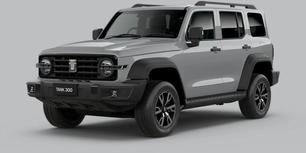
Derivative is a strong word, but from most angles there’s a little bit of something else in the Tank 300’s exterior. We can easily see a bit of Suzuki Jimny in profile, and a dash of new Ford Bronco in the lights and grille. And if you squint there’s a blob of Jeep Wrangler in the wheel-arch extensions.
Which should mean it’s just a mash-up. Yet somehow, it isn’t, and the Tank has its own vibe.
Inside, that vibe suddenly becomes a bit overdone, and the plastic garnish above the glove box, in particular, looks like it will date pretty quickly (if it hasn't already). There's also a lot going on in here; this is a busy place and even the gear selector looks like a prop form the Star Wars franchise.
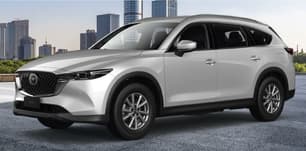
To be honest, I can't really tell the CX-8 and CX-9 apart on the road. They're both large SUVs that sport the classic Mazda bonnet - sharp and long. Up close, the CX-9 has a bulkier shape but otherwise they are remarkably similar.
The CX-8's darkened grille generates some interest with its lattice-work and there are enough shiny chrome accents scattered about the car that it looks pretty.
Yet, the sporty sharpness that Mazda is known for is still hinted at with its shaping and the 19-inch black alloy wheels.
Our model is finished in 'Platinum Quartz Metallic' and it is the highlight for the exterior styling for me. I think because it's such an interesting colour to look at - it varies a lot depending on lighting conditions. Sometimes, it almost has a sheen of pink to it and at others, it looks like pearly sand.
The interior looks polished and refined with its burgundy leather trim and soft-touchpoints. Again, there is a lot of chrome inside to make otherwise dull features, like air vents, pop out.
While GWM is by no means the worst offender, we still reckon the Tank’s interior would be better without such a degree of reliance of touchscreens and menu-driven functionality. While it’s obvious that there’s a lot going on in the cabin, it still seems odd that important functions such as shifting from conventional hybrid mode to EV mode would require a dive through the on-screen menus when a simple switch would be faster, easier and simpler.
And even when GWM has provided switches, the end result is muddy. Take the volume controls for an example. There’s no central volume knob accessible by both front seat occupants, so you rely on the steering wheel mounted up and down buttons to change the volume. Except they’re not marked as volume controls in any specific way. Okay, if you know, you know. But if you don’t know, you’ve just missed the news headlines.
Overall, it's disappointing. And I resent the fact that GWM (or anybody else) thinks it’s okay for me to have to learn to operate a car all over again. The dashboard is also full of tiny symbols and lettering making things difficult to decipher if you normally wear glasses to read, but not to drive.
We’ll take issue with the indicator stalk, too, which has an indistinct feel when trying to discern whether you turned the indicators on for an intersection, or just tipped them on for three flashes for a lane change. And if you have accidentally gone too far and they’re still flashing away merrily after the lane change, turning them off manually is a lottery that might see you succeed, or mistakenly turn on the other side flashers.
The rest is better with proper buttons for the various off-road drive modes, diff locks and hill holder. There’s even an analogue clock for some real nostalgia. You’ll also find a single USB-A and USB-C charge port in the dash, and a pair of cupholders buried deep in the centre console which also has a lid and sliding drawer.
It’s obvious that this is a smaller vehicle than some, and the four-door layout dictates shorter doors. But that doesn’t alter the fact that the driver’s seat slides back a few centimetres every time you shut the car down. The trouble with that if you’re tall, is that the seat is now tucked back in behind the B-pillar, meaning you have to climb out and around it to exit the car. Perhaps you can switch off this slide-back function, but I didn’t have the spare hour to troll through the menus to do so. Oh, and there should be a driver’s grab handle on the A-pillar, too. There isn’t.
The rear seat is better with an adjustable backrest that provides proper comfort, and leg and knee room that hides the 300’s smaller dimensions well. There’s lots of glass and light and a pair of USB charge points. You also get a pair of rear reading lights and central vents, but no climate controls.
Even the cargo area is a decent size with the five seats in place (360 litres, up to 1520L with 60/40 rear seats lowered) but the under-floor storage space has been consumed by the hybrid battery, meaning the jack and tools and charging cable live in the cargo area and the spare tyre is bolted to the tailgate.
The single-piece tailgate is hinged at the side, and needs a fair bit of real estate to be swung open fully.
The Tank features vehicle-to-load capability, too, which means you can operate your power tools using the vehicle as the power source, and there’s a 220-volt socket in the luggage area to do just that. But when camping, too, this feature can also power induction cookers, microwaves, and all the other stuff you probably should have left at home. And if the hybrid battery runs out of charge, the Tank can run its petrol engine to act as a generator (your camping neighbours are going to love that).
The real gadget freaks out there can also download the Tank app which allows you to operate functions such as power windows, climate control, seat heaters, central locking and check your charging status all from the comfort of your smartphone. You can also use this functionality to flash the hazard lights to help spot your Tank from everybody else’s in the carpark.
The CX-8 is a very practical family hauler because there's ample room in all three rows. Yes, even adults will be able to squeeze into that third row without too many complaints!
All rows enjoy well-cushioned seats and up front they are electrically adjustable, but unfortunately, only the driver's side has lumbar support.
The middle row can slide forward manually or by using the electric button found on the side of the seats... but doing it yourself is way faster.
They do slide far enough forward that you won't embarrass yourself too much when you have to clamber into the third row. Where the seats have a 50/50 split-fold and manual adjustments (accessed via the boot).
In the first two rows there are lots of individual storage options but the front enjoys the most. The middle console is deep enough to be useful and I like the dual opening lid. Each row gets a couple of cupholders and drink bottle holders, too.
The charging options are great, with each row getting two USB-C ports and the front getting a wireless charging pad and 12-volt socket.
All of the controls and dials feel within easy reach and the 10.25-inch touchscreen multimedia system graphics are clear.
You can use it as a touchscreen or opt for the rotary dial but switching between the two was awkward for me. Especially, since the touchscreen function is disabled when you are using the wireless Apple CarPlay. This also has wired Android Auto, for those users.
The amenities are practical throughout with a dark headliner, three-zone climate control and heated outboard seats and retractable sun-blinds in the middle row.
Good news for families because there are five top-tether points across the back rows and ISOFIX child seat mounts on the outboard seats in middle row, in case you need them.
You can fit a 0-4 rearward facing child seat and it shouldn’t impact on front passenger comfort.
My six-year old found it super easy to get in and out of this car because of the 205mm ground clearance and wide door apertures. He enjoyed the high seating position, too, but was disappointed he couldn’t see out of the sunroof!
The boot space is a bit cramped with all three rows are in use at 209L but folding the third row opens up a more respectable 775L - perfect for the average family and its stuff!
The loading space is level, with the temporary spare tyre and clever storage compartments housed underneath. There is a retractable cargo blind and net, luggage anchor points and a 12-volt port, too.
And, as always, I love a powered tailgate, which this has!
The Tank 300 PHEV is available in two trim levels, starting with the Lux at $55,990 drive-away. That gets you 18-inch alloy wheels, roof rails and side steps and, perhaps a little surprisingly, a sunroof.
There’s also power folding mirrors, keyless entry and start, paddle shifters, adaptive cruise-control and a rear differential lock.
Inside, there are leather accents for the seats, a pair of 12.3-inch multimedia, ambient lighting, digital radio, wireless connectivity, wireless phone charging, wireless Apple CarPlay and Android Auto, automatic headlights, full LED lighting, and dual-zone climate control. That’s quite a bit of gear for the money.
But throw another four grand on the sales rep's desk, and you into the Ultra grade which adds heated, cooled and massaging front seats, eight-way power adjustment for the driver’s chair, Nappa leather inserts, underbody protection, a front differential lock and no less than 64 colour choices for the expanded ambient lighting package.
Fundamentally, then, your extra $4000 is buying the clever front seats and front diff lock, but that’s easily worth the money anyhow. That said, the entry-level variant is one of the better equipped at that price-point, so either way, you won’t be slumming it.
The GT SP diesel AWD is one of the premium models, sitting third from the top and will cost you $65,560, before on road costs.
However, its price tag positions it as the most expensive compared to its rivals. With the closest rival being the Kluger at $65,310 and the most affordable being the Santa Fe at $60,000.
You do get a stylish-looking package with lots of features for your cash, like heated front seats, heated rear outboard seats, a tilt and slide sunroof, and premium leather interior trim.
There's some great tech scattered throughout, too, like the 10.25-inch touchscreen multimedia system, wireless charging pad, USB-A ports in the third row, Bose Premium sound system with 10 speakers, wireless Apple CarPlay and wired Android Auto.