What's the difference?
GWM’s Tank 300 struck a chord with Australian buyers when it launched in 2023. The rugged, boxy design, serious off-roading ability and unbeatable value for money - especially compared with similar models like the Jeep Wrangler - won it a number of new fans.
But something was missing. With an uninspiring petrol engine and a patchy hybrid powertrain the only options, the Tank 300 was sorely missing a diesel.
GWM itself says about 75 per cent of models in the off-road-focused large and upper-large SUV segments are made up of diesel-powered SUVs, so it was missing out on a chunk of sales.
Thanks to some serious nudging from GWM Australia and New Zealand, the Chinese parent company saw the potential and have added a diesel engine to the mix. This is the same diesel unit found in the GWM Cannon and Cannon Alpha utes.
Is the diesel now the pick of the Tank 300 range? Or should you look at another oil-burning 4x4?
The Jaecoo J8 is an odd car.
It’s hard to place exactly where it sits in the market. It’s premium, but very affordable. It's very big but only has five seats. And it’s petrol only, at least for now, in a world that is obsessed with hybrid or electric power.
You’ve probably never heard of Jaecoo. That’s alright it’s only new, but it’s a fresh Chinese brand with big ambitions. A more accurate description is it’s Chery’s premium sub-brand.
And the J8 is its new flagship SUV that has found a little niche that's been left in Australia’s overflowing SUV segment.
It’s about the same size as the Kia Sorento or Hyundai Santa Fe family SUVs, but the J8 is five seats only and ditches the third row for a big boot.
The interior wouldn’t look out of place if it had a three-pointed star on the bonnet but the price tag will have you thinking you can buy two for the price of one.
The diesel is now the pick of the Tank 300 range. It’s the best fit for this vehicle and offers greater driver engagement than the petrol or hybrid.
It also has genuine off-road chops while still managing to suit family life.
While it could benefit from further refinements to on-road behaviour, cabin noise and the ADAS systems, none of these are deal breakers.
The fact that it is priced so keenly against some excellent competitors and is stacked with standard gear adds to the Tank 300’s appeal.
Note: CarsGuide attended this event as a guest of the manufacturer, with meals provided.
It is hard to argue with the sheer amount of stuff you get in the J8 for the price. And that long warranty and capped price servicing program remove the stress of buying into a new brand.
The J8 might be more car than most people need due to its size and lack of third row seating.
It’s okay to drive but isn’t class leading and no hybrid option will count it out for the ever increasing number of Aussies looking to petrol-electric power.
The J8 is a solid machine and well worth a look if you are after glitz and glamour on a budget.
Note: CarsGuide attended this event as a guest of the manufacturer, with meals provided.
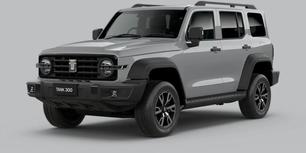
The only visible difference between the diesel and the petrol or hybrid 300s is a 2.4T badge. So you get the same boxy exterior as before.
It’s somewhat derivative and gives more than a nod to Jeep, but the design has intent - it looks capable off-road and for most people that’s enough. Luckily it is capable off-road. More on that later.
Inside the upright, shelf-like dash is appealing. I like that everything is nicely integrated, like the dual 12.3-inch screens which flow nicely into one another.
The big T-shaped three-spoke steering wheel looks cool and the aeronautical air vents are clearly inspired by Mercedes-Benz.
The chunky metal-look plastic glove box cover adds extra visual flair and the stitching throughout elevates the cabin further.
However, the futuristic looking gear shifter is chunky, takes up too much space and is unnecessary.
The J8 looks familiar but it's hard to remember where you’ve seen it before. There are shades of Mazda, Mercedes-Benz and Range Rover scattered throughout.
The J8 looks more native Jaecoo than the smaller J7, but either way it's a handsome machine in the metal.
Its large, prominent front grille with thick vertical slats gives it presence on the road. This is paired with a big JAECOO badge on the grille and dynamic LED headlights and DRLs.
It has a sleek side profile and does away with gaudy panel creases and sharp edges, which helps project its premium persona. This design is highlighted by its hidden door handles, well integrated roof rails and rear spoiler.
There is a rear light bar, which is the current must have styling item, and connects the tail-lights
Inside is where the action is.
It looks proper luxe, with soft touch and textured inserts all over. We spent the majority of our time in the Ridge AWD and on top of the dash is a type of soft synthetic suede and there are wood veneer-type inserts that give it a touch of class as well as some piano black highlights and plenty of premium feeling materials.
Even in the back seat, where some brands can cut costs, the J8 has a quality feel to it.
It is an impressive space for circa-$50,000.
Up front the Tank 300 offers a commanding view of the road and it’s easy to find your perfect driving position thanks to the power-adjustable seats.
Those seats have good side bolstering but could do with a little extra cushioning for the thighs. The Nappa leather-appointed seats in the Ultra look and feel lovely.
Storage is average for the segment with room for larger bottles and additional flat items in the door pockets, and a well-sized central bin that also houses two cupholders, although they sit low in the cavity and two coffees sit awkwardly together.
The Tank has one USB-C port for charging only but another USB-A port up front for connectivity. You shouldn’t need that given Apple CarPlay and Android Auto is wireless.
Keen off-roaders will have fun with the extensive Tank Expert Mode in the multimedia screen, which allows you to individualise your 4WD experience.
Beyond that the screen is neatly laid out, responsive and easy to use. GWM has come a long way when it comes to in-car tech. The icons on the digital instrument cluster, however, are still too small.
There’s ample leg room in the rear, with space between my knees (I am 184cm tall) and the rear of the front seat, and enough toe room. It doesn’t feel enormously spacious across the rear row but three kids should be comfy. Headroom is enhanced by a scalloped section of the roof specifically for rear-seat passengers, but it doesn’t leave a huge amount of space for taller people.
The rear seat bench is flat but the backrests have some support and overall the seats back there are comfortable.
You’ll find lower rear-seat air vents, map pockets, a fold-down central arm rest with two cupholders, room for small bottles in the doors and two USB-A ports.
The boot can take 400 litres with all seats up and 1635L with the rear seats folded. That figure is measured from the floor to the top of the rear seats.
Jeep says the Wrangler has 898L capacity with all seats in place but that is measured from the floor to the roofline.
There is no under-floor storage in the 300’s boot and the full-size spare wheel is housed in traditional 4x4 fashion on the tailgate.
Having only five seats in a car this big feels like a waste of space, and in reality it is. You’re now driving a very big and bulky car without the people carrying pros.
Very rarely will you need to use the giant 738-litre boot, but the ability to carry children’s friends or extended family is probably a more useful and regular scenario.
Up front there are plenty of storage options with lots of nooks and crannies in the centre console, including a sizeable and deep bin and good size pockets on the doors. Cupholders for both rows are a plus, too.
USB charging points for both rows are great. If you like to connect to Apple CarPlay via a cord and not wirelessly the port is down near the front seat passengers right foot, which is hard to access.
Additionally the wireless device charger is on the passenger side of the console. Both are hallmarks of a car originally designed to be driven on the other side of the road.
The back seat is huge, there is ample leg, shoulder and head room and it can easily accommodate adults or large teenagers.
One of the key selling points across GWM’s entire range is value for money, and the Tank 300 has always had that in spades.
As with the petrol and hybrid 300, the diesel is offered in two well-specified model grades - Lux and Ultra.
At $47,990 drive-away, the Lux diesel is $2000 more than the Lux petrol, but $3000 cheaper than the Lux hybrid.
The Ultra diesel, at $51,990, is $1000 pricier than the petrol equivalent and $5000 more affordable than the hybrid Ultra.
The GWM Tank 300 diesel Lux is also more affordable than equivalent grades of a number of ladder-frame 4x4 SUV rivals like the Isuzu MU-X, Toyota Fortuner, SsangYong Rexton and the Ford Everest.
It’s also significantly more affordable than the Jeep Wrangler, with the Tank 300 Lux costing about $30,000 less than a Wrangler Unlimited Sport S.
Note however that many of those models - except the Wrangler - have the option of seven seats, whereas the Tank is strictly a five-seat proposition. If you want a third row, check out GWM’s Tank 500.
There are cheaper off-road large SUVs out there – the LDV D90 and Mahindra Scorpio. But the Tank 300 is a more refined and higher-quality offering than those models.
Standard gear in the Lux includes 17-inch alloy wheels, synthetic leather seats and steering wheel, power-adjustable front seats, dual-zone climate control, seven-colour ambient lighting, keyless entry and start, a sunroof, power-folding mirrors, paddle-shifters, a nine-speaker audio system with digital radio, built-in sat-nav, and a pair of 12.3 inch digital displays with wireless Apple CarPlay and Android Auto.
It also gets roof rails, side steps, privacy glass, all-terrain mode selection and a rear diff lock.
The Ultra upgrades to 18-inch wheels, Nappa leather-accented seats, heated and ventilated front seats, a heated steering wheel, more adjustment for the front seats and a memory setting, a massage function for the driver’s seat, a wireless phone charger, 64 colours in the ambient lighting suite, and a nine-speaker premium audio system.
There is nothing obvious missing from the standard features list, but I don’t know why a wireless device charger is limited to the top grade.
The J8 comes in two grades: the two-wheel drive Track variant and the all-wheel drive Ridge. The variant names are tied into the brand’s adventurous image.
The Track is priced at a national $49,990 drive-away, which is about $5000 and $8000 cheaper respectively than the base Kia Sorento or Hyundai Santa Fe.
Jaecoo has thrown everything at the J8, except a third row of seats.
The Track grade has 20-inch alloy wheels, heated and ventilated front seats wrapped in real leather and topped off with a massage function.
There are dual 12.3-inch displays, one for the multimedia and the other for the driver. Apple CarPlay and Android Auto, sat nav and a 12-speaker Sony stereo are other highlights.
There are some clever functions too. When on a phone call it projects sound only through the two headrest speakers giving more privacy.
Three different scents can be diffused through the cabin, which might help override the drive-through food or old sports bag aroma in the boot.
It also has a panoramic sunroof, dual-zone climate control, power adjustable steering wheel, a head-up display (that projects vital information such as your travelling speed on to the windscreen in front of the driver) and a wireless device charger.
There isn’t much room left on the $54,990 drive-away Ridge AWD’s equipment sheet, but it manages to squeeze in a suede headliner, heated and ventilated rear window seats, privacy glass and electric door handles.
The Ridge also adds all-wheel drive grip with multiple drive modes such as 'Sport', 'Eco' and 'Normal' as well as 'Mud', 'Snow', 'Sand' and 'Off-Road' to best handle different conditions.
A more advanced active suspension system adjusts each wheel independently according to driving conditions to smooth out the ride.
In a win for buyers, both variants have a full size spare tyre hidden under the boot floor.
The big news with the Tank 300 is, of course, the new engine.
It is a 2.4-litre four-cylinder turbocharged diesel engine borrowed from the GWM Cannon and Cannon Alpha utes.
It pumps out 135kW of power and 480Nm of torque. That’s more torque than an MU-X but not as much as an Everest.
It is paired with a nine-speed automatic transmission and has part-time four-wheel drive.
If you need to tow, the diesel has a 3000kg towing capacity, which is 500kg more than the hybrid and petrol. It can’t beat the 3.5-tonne towing capacity of the MU-X and the Everest.
Payload has also increased compared with the petrol and hybrid, up from 400kg to 600kg.
GWM says it conducted extensive testing internationally but also in Australia to improve towing performance. There are approximately 20 different parts compared with the other powertrain variants to get the best out of towing in the diesel.
A rear diff lock is standard on both grades while the Ultra gains a front diff lock.
Power comes from a 2.0-litre, four-cylinder, turbo-petrol engine that makes 183kW and 385Nm, which is matched to an eight-speed automatic driving either the front or all four wheels.
That’s a decent amount of grunt and is on par with a Volkswagen Golf GTI, but the J8 weights about 1800kg in 2WD guise with AWD adding 100kg.
Those numbers are also short of the 206kW/422Nm delivered by the Santa Fe’s turbo-petrol motor but are better than the 200kW and 333Nm made by the Sorento’s non-turbo V6.
The lack of a hybrid option at launch, which is popular in rival machines, could prove to be a misstep.
Jaecoo said a plug-in hybrid version was under consideration, but is likely to come at a decent premium.
The diesel Tank 300 consumes 7.8 litres of fuel per 100 kilometres on the official combined cycle, which is better than the 9.5L figure for the petrol and the 8.4L quoted for the hybrid.
That figure also sits somewhere between a 2.0-litre bi-turbo Everest (7.1L/100km) and a 3.0L MU-X (8.3L/100km).
It has a 75-litre fuel tank and GWM claims an NEDC range of about 950 kilometres. GWM says the Euro 5 engine does not require Adblue.
Given the restrictions of a media launch, we did not obtain real-world fuel use figures.
Jaecoo claims on the combined (urban/extra-urban) cycle the J8 Track 2WD will drink 8.3L/100km and the Ridge AWD will gulp 8.6L/100km, which is better than its similar sized rivals. But those rivals also have hybrid options that are more powerful and drink less fuel.
It also requires premium unleaded fuel, while the others drink the cheaper stuff.
A 65-litre fuel tank gives it a theoretical driving range of 755km in its thirstiest guise.
We didn’t get to spend enough time behind the wheel to do a thorough real-world test, and the majority of our drive was spent on high-speed arterial roads or motorways where petrol cars are at their most efficient. So we’ll reserve judgement until we undertake a more comprehensive test drive.
I last drove a Tank 300 in late 2023 and it was the hybrid variant. While the hybrid has some positives, its driving characteristics were not high on that list.
It had an erratic throttle response, hesitation on take-off and it felt underdone.
In contrast, this new diesel variant just feels like the right fit for this SUV.
There is slight lag accelerating from a standing start, but the powertrain is torquey and there’s plenty on tap when overtaking or just increasing speed when already on the go. GWM has not provided a 0-100km/h time.
It is clear you’re in a diesel as soon as you turn on the ignition - it has that typical diesel rattle, but it is not as unsophisticated as some oil-burners I have driven.
The cabin could do with some extra insulation with wind and tyre noise detected, but it’s hardly a deal breaker.
Given the vehicle’s size, heft (nearly 2.3-tonne kerb weight) and the fact it’s shaped like a brick, the 300 holds its nerve on winding stretches of road with only a little body roll. In saying that, best not to treat it like a Mini Cooper on your favourite twisty road.
Ride quality is a bit mixed. We only drove the Ultra on 18-inch wheels and while it manages to soak up bumps, the ride is jittery, and that’s even more evident on uneven road surfaces.
Steering is heavily weighted and a little vague, but fine for a big off-roader, and the brakes need to be pushed hard.
One quirk is the indicator - it appears to be a one-touch setup for indicating to change lanes, but then the indicator stays on. I tried several times to test this, even flicking it to the opposite side to turn it off and it was very stubborn.
The good news is it appears GWM has toned down the awful indicator sound of its earlier models and is now much more subtle.
So on-road the Tank 300 is more than competent, and a much nicer vehicle to drive in an urban setting than a Jeep Wrangler, for example.
We also drove it briefly on an off-road trail, and in low range the Tank 300 proved that it can do what it says on the box.
I’m no off-roading expert and there are much more challenging trails out there, but I had confidence that the Tank 300 would not let me down traversing the many chunky rocks, massive holes and fallen tree limbs.
There is a clear line of demarcation between the Chery brand and Jaecoo, and the J8 drives substantially better than Chery’s line of budget-friendly Tiggo SUVs.
We spent most of our time in the Ridge AWD and the fancy active suspension makes a huge impact. It keeps the vehicle in check through corners, exerting excellent body control. It's a bit unnerving how flat the car sits through the bends with next to no body roll.
Despite riding on giant 20-inch wheels the J8 soaks up bumps and road imperfections with ease.
The Track 2WD falls off noticeably in this regard without the active damping.
The steering is light and a bit floaty, which saps confidence when entering corners as there isn’t a lot of feedback on what is happening underneath you.
The steering ratio seems a bit wide of the mark, the wheel needing more input than we'd like.
The engine delivers decent grunt and it's tuned for leisurely acceleration rather than performance.
There was the odd occasion when the transmission and the motor weren't quite in sync and you might get a bit of hesitation and then too much oomph all at once.
It has no problems getting up to speed on the motorway and handles overtaking with ease.
Jaecoo, and its parent company Chery, have worked hard on the safety tech calibration and it's much less intrusive on the J8 than some earlier models. This applies especially to the lane keep assist, which only steps in when needed. There are far fewer bings and bongs than before.
You sit up nice and high in the J8, which gives you a good view of the road ahead, but the sloped rear window restricts vision out the back compared to boxier shaped SUVs.
It is a big rig and you feel that on the road, even the Jaecoo team said you’d notice the width of the J8 on the road, which might be an issue if you live in compact inner city areas or deal with cramped car spaces.
ANCAP awarded the Tank 300 a five-star crash safety rating from testing done in 2022, scoring highly across all four of the major test categories.
GWM says it is waiting to hear from ANCAP but expects the diesel to be covered by the same rating.
As well as seven airbags including a front centre bag, the Tank 300 has a long list of safety gear covering both the Lux and Ultra.
There’s a suite of collision mitigation systems that includes auto emergency braking (AEB), lane departure warning, lane-keep assist, emergency lane keep, lane centring, front and rear collision warning, front and rear cross-traffic alert and lane change assist.
It also has driver fatigue monitoring, a rear seat child monitor, door opening warning, adaptive cruise, traffic sign recognition and hill-descent control.
I noted this in my recent GWM Haval H6 GT PHEV review, but GWM has made consistent tweaks to improve its advanced driver-assist systems (ADAS) and as a result they are less intrusive than they were when the Tank 300 launched in 2023.
There is still the occasional tugging of the wheel but it’s much less of a tug-of-war than it once was.
For the first 45 minutes of our test drive there was an annoying beep every 10 seconds that my co-driver and I could not identify. There was no icon on the driver display to indicate that it was a lane departure warning or speed limit alert, but eventually it just stopped. We still have no idea what it was but it was, thankfully, not present in the vehicle we drove in the second half of the launch drive.
The J8 hasn’t been tested by ANCAP yet, but it is expected to get the same five-star score as the J7.
One thing that jumps out is the AWD version gets two more airbags than the 2WD variant.
The Ridge AWD adds two side airbags to the rear row, while the Track 2WD makes do with curtain airbag protection only in the back seat.
It covers all the bases for active safety with auto emergency braking, lane keep assist, lane departure warning, rear cross-traffic alert with auto braking, blind-spot detection, speed recognition, active cruise control and door opening alert.
GWM covers the Tank 300 with its seven-year/unlimited-kilometre new-vehicle warranty, which is an impressive offer.
You are covered for seven years of roadside assist and the Tank is offered with a seven-year capped-price servicing program.
GWM is yet to confirm the Tank 300 diesel’s servicing offer (including pricing), but expect a service schedule similar to the Cannon ute with the same powertrain.
That means the first service might be required at 5000km or six months and beyond that it will need a service every 12 months or 10,000km, whichever occurs first.
Jaecoo backs its cars for eight years and unlimited km, which is one of the most comprehensive in the business. MG, Mitsubishi and Nissan all have 10 year warranties but are not unlimited km and Mitsubishi and Nissan need you to only service at their dealerships.
Jaecoo backs this up with an eight-year capped priced servicing program, which costs $2952 for the Track 2WD and $3452 for the Ridge AWD. That’s slightly on the expensive side but better than being at the whim of the mechanic after five years.
Keep in mind the fourth and eight year services are biggies, costing $699 and $799 in the Ridge AWD and $499 and $599 in the Track 2WD.
You also get eight years of roadside assistance if you service your car at the dealership.