What's the difference?
Sometimes it really is all a matter of timing.
GWM was always going to offer up the plug-in hybrid version of its Tank 300 4X4, but for it to arrive in showrooms right now must be being looked on as some kind of blessing at GWM HQ.
Consider the circumstances: The Tank 300 Hi4-T PHEV (to give it its full name) not only saves fuel by making use of plug-in hybrid tech, but the fossil stuff it does use is petrol, not diesel with that fuel’s buck-a-litre cost penalty right now.
And with the planet on a knife’s edge waiting for the next increase in brinkmanship from those referred to as our world leaders, overseas travel has never seemed sketchier to the average Aussie. Which is when keeping it local and hitting the outback in a four-wheel drive suddenly looks really, really good. Except for the cost of fuel, that is, which is where we circle back to square one.
All of which means the GWM Tank 300 Plug-in hybrid concept could not really have come at a better time. But does the reality match the promise?
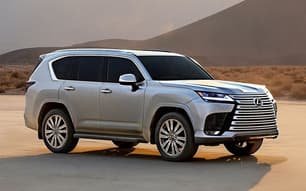
The march away from diesel power and towards a petrol-hybrid future in off-roaders continues. Okay, so it’s a full-sized Lexus we’re talking about, but the off-road credentials of the Toyota LandCruiser 300 Series-based Lexus LX have never been in question, have they?
The full-sized, super-lux Lexus LX might never see the Simpson Desert or the Old Telegraph Track, but that doesn’t mean it couldn’t tackle either with a fair degree of ease. So there’s no way Lexus would allow a new hybrid driveline to compromise any of that. Besides, this is the same driveline that will take the LandCruiser on its next step, so you better believe it’s the real deal.
Of course, the Lexus badge and somewhat frightening price tag also infer a high degree of plush and tech, and, let’s be honest, those elements are more likely to get a leading role in the LX’s day-to-day strut, as opposed to the walk-on part played by the off-road stuff.
So does all this make the LX one huge, high-tech mash up of conflicting priorities, then? That probably depends on how pragmatically you view motor vehicles generally, but one thing’s for sure, if the hybrid LX is paving the way for the next generation of LandCruiser powerplants and drivelines, then we’re all ears.
There’s a lot to like here. The GWM Tank 300 in any of its forms is a competent vehicle from the helm and backs up its off-road claims with real ability. The ride quality, in particular, is a highlight, and it’s a good size for couples or young families. Its value for money is also quite brilliant.
Add this plug-in hybrid driveline to the mix and the performance is quite astounding, while the petrol engine and EV potential have arrived at a critical point in history where such things carry more weight than ever before. It remains to be seen what happens globally and what effect that has on fuel prices, specifically the price gap between petrol and diesel. There’s also the question of what happens electronically when you dunk the Tank into Nolan’s Brook on the track to Cape York. But for now, this is a car whose time appears to have come.
But while the overall concept deserves praise, there’s still some work required in terms of the way the car drives and in its attempts at keeping its occupants safe. The calibration of both the throttle response and some of the driver aids is, frankly, in need of some final polish. And though it sounds odd, the Tank 300 would be a better thing to live with if GWM ditched the contentious driver aids and took the points hit on its ANCAP rating. Even better would be to stick with the tech but refine it to the point where it works in the background and not as an irritant.
Huge specification in terms of convenience and safety gear are matched by an equally huge range of abilities in this vehicle. As well as rock hopping with the best of them, this is also a phenomenal touring rig and a more-than-capable off-roader. Of course, whether you can see yourself clambering up the side of a muddy creek crossing in $202,000 worth of vehicle is a personal matter, but rest assured, the Lexus will do it if you ask it to.
In the case of the hybrid LX, however, the vehicle now has an extra dimension to cover off, and from what we can see, it does take the efficiency and running costs of the big wagon to a new, better place. Mind you, that may only be the case if diesel continues to cost a dollar-a-litre more than petrol at the bowser.
The shift to petrol power also brings with it a level of mechanical background noise that we’re not entirely sure fits the Lexus legend, while additions such as the camera-based rear-view mirror system seems to be a conversation starter rather than an actual improvement.
Derivative is a strong word, but from most angles there’s a little bit of something else in the Tank 300’s exterior. We can easily see a bit of Suzuki Jimny in profile, and a dash of new Ford Bronco in the lights and grille. And if you squint there’s a blob of Jeep Wrangler in the wheel-arch extensions.
Which should mean it’s just a mash-up. Yet somehow, it isn’t, and the Tank has its own vibe.
Inside, that vibe suddenly becomes a bit overdone, and the plastic garnish above the glove box, in particular, looks like it will date pretty quickly (if it hasn't already). There's also a lot going on in here; this is a busy place and even the gear selector looks like a prop form the Star Wars franchise.
In a styling sense, that big, bold, deep grille at the front won’t be to everybody’s liking, but we reckon it’s pretty well matched with the otherwise taut skin of the LX’s body.
Inside, the plush look and feel is the dominant factor, but if you look really closely, there’s a fair bit of generic Lexus stuff on show. Is that a criticism? Hardly. The leather looks and feels luxe and only some hard plastics (such as on the door cappings) belie the car’s LandCruiser origins.
While GWM is by no means the worst offender, we still reckon the Tank’s interior would be better without such a degree of reliance of touchscreens and menu-driven functionality. While it’s obvious that there’s a lot going on in the cabin, it still seems odd that important functions such as shifting from conventional hybrid mode to EV mode would require a dive through the on-screen menus when a simple switch would be faster, easier and simpler.
And even when GWM has provided switches, the end result is muddy. Take the volume controls for an example. There’s no central volume knob accessible by both front seat occupants, so you rely on the steering wheel mounted up and down buttons to change the volume. Except they’re not marked as volume controls in any specific way. Okay, if you know, you know. But if you don’t know, you’ve just missed the news headlines.
Overall, it's disappointing. And I resent the fact that GWM (or anybody else) thinks it’s okay for me to have to learn to operate a car all over again. The dashboard is also full of tiny symbols and lettering making things difficult to decipher if you normally wear glasses to read, but not to drive.
We’ll take issue with the indicator stalk, too, which has an indistinct feel when trying to discern whether you turned the indicators on for an intersection, or just tipped them on for three flashes for a lane change. And if you have accidentally gone too far and they’re still flashing away merrily after the lane change, turning them off manually is a lottery that might see you succeed, or mistakenly turn on the other side flashers.
The rest is better with proper buttons for the various off-road drive modes, diff locks and hill holder. There’s even an analogue clock for some real nostalgia. You’ll also find a single USB-A and USB-C charge port in the dash, and a pair of cupholders buried deep in the centre console which also has a lid and sliding drawer.
It’s obvious that this is a smaller vehicle than some, and the four-door layout dictates shorter doors. But that doesn’t alter the fact that the driver’s seat slides back a few centimetres every time you shut the car down. The trouble with that if you’re tall, is that the seat is now tucked back in behind the B-pillar, meaning you have to climb out and around it to exit the car. Perhaps you can switch off this slide-back function, but I didn’t have the spare hour to troll through the menus to do so. Oh, and there should be a driver’s grab handle on the A-pillar, too. There isn’t.
The rear seat is better with an adjustable backrest that provides proper comfort, and leg and knee room that hides the 300’s smaller dimensions well. There’s lots of glass and light and a pair of USB charge points. You also get a pair of rear reading lights and central vents, but no climate controls.
Even the cargo area is a decent size with the five seats in place (360 litres, up to 1520L with 60/40 rear seats lowered) but the under-floor storage space has been consumed by the hybrid battery, meaning the jack and tools and charging cable live in the cargo area and the spare tyre is bolted to the tailgate.
The single-piece tailgate is hinged at the side, and needs a fair bit of real estate to be swung open fully.
The Tank features vehicle-to-load capability, too, which means you can operate your power tools using the vehicle as the power source, and there’s a 220-volt socket in the luggage area to do just that. But when camping, too, this feature can also power induction cookers, microwaves, and all the other stuff you probably should have left at home. And if the hybrid battery runs out of charge, the Tank can run its petrol engine to act as a generator (your camping neighbours are going to love that).
The real gadget freaks out there can also download the Tank app which allows you to operate functions such as power windows, climate control, seat heaters, central locking and check your charging status all from the comfort of your smartphone. You can also use this functionality to flash the hazard lights to help spot your Tank from everybody else’s in the carpark.
Like many hybrids, cargo capacity takes a bit of a blow. In this case, placement of the battery under the cargo floor means a reduction in luggage capacity from 1109 litres to 899 litres. In the seven-seat variant, capacity is 883 litres with the rearmost row folded flat. The rear seat folds 60:40 and there are good, solid tie-down points in the rear. There’s no under-floor storage, however, apart from a small compartment just behind the rear seat which locates the tools and safety triangle.
The tailgate is powered (if a bit slow in its action) and there are cup-holders atop each suspension tower, clearly a hang-over from the seven-seat variant which is not available in F Sport trim. The cargo blind is a good addition, as is the 1500-Watt power socket in the cargo bay.
In the cabin, there are plenty of grab handles and the side steps give shorter folk a leg up when entering or leaving. Once you’re in, the front seats are terrifically comfortable as well as featuring a massage function on top of the heating and cooling functions. The steering wheel is also heated.
Paddle shifts might seem odd in a vehicle like this, but they are brilliant in off-road situations, although you need to first select manual mode on the shifter to have the paddles hold each gear for more than a few seconds in most of the on-road driving modes.
Speaking of the shifter, Lexus has seen fit to once again reinvent this simple control. You now need to pull the handle towards you and up for Reverse, across and down for Drive while Park remains a separate button even though it looks like just another icon on the lever.
A pair of cup holders live over to the passenger’s side of the centre console, and there are a pair of USB charge ports as well as an HDMI port in the dashboard. But the switches for the power windows are located almost directly under the driver’s interior door pull, forcing some unorthodox wrist geometry.
At least the buttons for the climate control and off-road functions such as diff locks and ride height are, indeed, buttons and not menu items. The simple knob to control the stereo on-off and volume is a great touch, too. So is the cooled centre console under a cover that opens from either side.
The rear seat is big and wide but the high floor dictated by the body-on-frame construction means those with long legs will have their knees bent while ever they’re in the back seat. The seat cushion itself is pretty flat, too, but the backrest does recline through a wide range of angles.
Reading lights, lots of air vents and a full set of climate controls ease the pain of riding in the back, but if you want cup holders, you need to keep the centre rear seat free so the armrest that houses the holders can be lowered and snapped open. Adding to the impression that plenty of thought has gone into the rear seat environment are the pull-up sun blinds on each window. Why don’t all cars have these?
The Tank 300 PHEV is available in two trim levels, starting with the Lux at $55,990 drive-away. That gets you 18-inch alloy wheels, roof rails and side steps and, perhaps a little surprisingly, a sunroof.
There’s also power folding mirrors, keyless entry and start, paddle shifters, adaptive cruise-control and a rear differential lock.
Inside, there are leather accents for the seats, a pair of 12.3-inch multimedia, ambient lighting, digital radio, wireless connectivity, wireless phone charging, wireless Apple CarPlay and Android Auto, automatic headlights, full LED lighting, and dual-zone climate control. That’s quite a bit of gear for the money.
But throw another four grand on the sales rep's desk, and you into the Ultra grade which adds heated, cooled and massaging front seats, eight-way power adjustment for the driver’s chair, Nappa leather inserts, underbody protection, a front differential lock and no less than 64 colour choices for the expanded ambient lighting package.
Fundamentally, then, your extra $4000 is buying the clever front seats and front diff lock, but that’s easily worth the money anyhow. That said, the entry-level variant is one of the better equipped at that price-point, so either way, you won’t be slumming it.
While the LX line-up incorporates off-road oriented versions dubbed Overtrail, that specification is not available in the hybrid variety LX700h. Instead, the LX hybridised line-up kicks off with the Sport Luxury grades in either five or seven-seat layouts and a list price of $196,000 and $199,800 respectively. The F Sport is the new LX flagship model with its $202,000 price-tag (all prices are plus on-road costs) and is only available in five-seat configuration.
As you might imagine for a flagship badge for a maker like Lexus, there’s really nothing missing from the specification. In the case of the hybrid variants, that includes 22-inch alloy wheels, power sunroof, full leather trim and a hands-free tailgate. Those feature are part of the Enhancement Pack on lesser versions, but have been added to all hybrid LXs.
You also get four-zone climate-control, heated, cooled and massaging front seats, keyless entry and start, steering wheel-mounted controls, paddle shifters, automatic headlights and wipers, heated mirrors, soft-close doors, 12.3-inch touchscreen, digital radio, embedded sat-nav, wireless Apple CarPlay and Android Auto, head-up display, premium audio system and pretty much everything else you’ve ever seen fitted to a car.
The F Sport variant we’ve tested here is the big daddy and adds four-way adjustable head rests in the front, a heated steering wheel, specific aluminium trim, aluminium pedals, F Sport-specific gear knob, ventilated and heated rear seats, and a digital rear-view mirror.
The Tank’s plug-in driveline, starts with a petrol engine measuring 2.0-litres and contributing 180kW to the overall picture. But then there’s a single electric motor, sandwiched between the petrol engine and the nine-speed transmission. That means the Tank is still a mechanical four-wheel-drive platform, and when both powerplants are singing together, there’s an eye-opening 300kW and 750Nm of torque on tap.
The four-wheel-drive system operates as a rear-wheel drive on dry bitumen, and there’s the usual 4WD high range and 4WD low range. What there isn’t, is a 4WD-auto setting that allows you to use four-wheel drive in the dry on a paved road. That sounds minor, but for towing in particular, having all four wheels doing the driving is a major safety bonus.
All Tank 300s get a rear differential lock, but this version, the Ultra, also gets a locking front diff as well. Typically, the Tank also features a range of driving modes (no less than nine of them!) for the four-wheel-drive function, tailoring throttle, transmission and differential response according to the type of terrain being covered.
The Tank 300 is built the old fashioned way with a ladder-chassis upon which the body is bolted, and it still uses a live rear axle, too. But the front suspension is independent and the GWM uses coil springs rather than old-school leaf springs for much better ride quality.
The hybrid driveline of the vehicle we’re looking at here marks a further expansion of buyer choice when it comes to how their Lexus LX is powered. The twin-turbocharged petrol and diesel variants will continue alongside the newcomer, although you can bet Lexus (and Toyota) will be watching the sales charts closely to see where consumer tastes fall.
The hybrid set-up here starts with the twin-turbocharged 3.4-litre petrol V6 (a lot of people - Toyota included - are calling it a 3.5, but at 3445cc, it’s not) from the Lexus LX600.
But instead of bolting directly to the 10-speed transmission, in this case, there’s a single electric motor and clutch unit sandwiched between the engine and transmission. That means the Lexus retains mechanical four-wheel drive, while the electric motor can provide extra urge for acceleration or towing as well as offering EV-only operation when it’s required (mainly in stop-start traffic).
Crucially, it also means the vehicle retains those traditional off-road qualities of low-range gearing and permanent four-wheel drive. The electric motor also contributes torque to the equation when the driver selects either Rock, Dirt or Deep Snow modes to maintain a steady flow of Newton metres.
The petrol V6 contributes a healthy 305kW and 650Nm to the picture, while the electric motor adds a further 36kW and 250Nm. When all that’s harnessed up, there’s a total of 341kW of power and 790Nm of torque on tap, allowing for a braked towing capacity of 3500kg. It also makes this variant the torquiest Lexus LX ever.
Interestingly, Lexus says the conventional 12-volt starting system and alternator for the petrol engine, means that unit could continue to operate if any part of the EV system failed.
One of the big questions over hybrid drivelines in off-road conditions is what happens if the vehicle suddenly finds itself partly under water. In this case, says Lexus, there are additional waterproofing measures which should prevent any problems mid-creek.
The F Sport grade gets a Torsen (torque-sensing) rear differential and firmer dampers for an overall sportier feel.
At 2780kg, the LX hybrid is heavy, and is at least 100kg more than the LX600 due to the batteries and other hybrid gear.
The headline number here is GWM’s official fuel consumption number of just 1.9 litres per 100km. Or it would be if it had anything to do with the real world. As it is, nobody is going to achieve that, and our mix of urban running netted an average of about 11.0 litres per 100km, with that dropping to 8.5 litres per 100km in country conditions.
The truth is, your consumption in this vehicle can go from zero to, say, 12 litres per 100km depending on how and where you drive and how much battery charge you have available.
Speaking of charging, the Tank 300 can use a commercial fast charger to absorb voltage at a rate of 50kW. At that rate, it can go from 30 to 80 per cent charged in about 24 minutes. A wall box (GWM offers one as a factory option) can take the 37.1kWh battery from 15 per cent to fully charged in 6.5 hours. And, of course, you can also charge the Tank from a domestic wall socket in a claimed 14.4 hours. We managed to add about 6km worth of charge per hour on such an outlet during our time with the car.
As far as range goes, GWM reckons there’s 115km (NEDC) of EV-only range, while starting a journey with a fully charged battery and a full 70-litre fuel tank should see you covering somewhere between 900 and 950km between top ups.
Here’s where the hybrid driveline really comes into its own. On paper, at least.
Despite the added kiloWatts and Newton metres, the 700h manages an official fuel consumption figure of 10 litres per 100km. That compares with 11.9/100km for the 305kW LX600, although it’s still more than the 8.9L of the 227kW diesel-powered LX500d.
But the hybrid’s big advantage will come in city and suburban traffic where the stop-start nature of things will enable the driveline to harvest braking energy and turn that back into electricity for the battery.
Our testing showed an average of 11.2 litres per 100km in mixed conditions which blew out to 13.0 litres with more urban running. That’s pretty handy in the context of a vehicle like this and won’t be far from the real-world numbers of the diesel LX.
The Lexus carries 98 litres of petrol, split between one 68-litre tank and a 30-litre sub tank. That should give it a theoretical range of almost 800km, but again, that will depend largely on where and how it’s used.
GWM claims a 0-100km/h acceleration time of just 6.3 seconds for the Tank 300 PHEV, and that’s impressive. There are two caveats here. The first is that you need at least 40 per cent battery charge on board to extract maximum thrust. And, secondly, even in those circumstances, the Tank never feels that brisk. It’s more effortless than genuinely rapid, although the torque up hills is genuinely impressive.
There’s no getting around the refinement inherent in using volts for some of the time. And when the petrol engine does chime in, it’s all but imperceptible. You’ll eventually hear the engine if you wring it right out, but even then, vibrations are minimal.
All in all, the Tank’s relatively compact dimensions work in its favour in an urban setting, and the range of camera views (including an off-road one showing you the obstacles you’re about to encounter) make parking a lot easier than it might have been. Only a high degree of distortion in the birds-eye-view camera mode takes a bit of getting used to.
On the move the ride quality is quite exceptional, and those coil springs really do make a difference. Even the usual council speed bumps don’t bother the Tank and the short wheelbase pitching we’ve seen in some similar vehicles just never emerges. Well chosen damper rates help, too, and there has been some Australian input into the way the Tank handles. It shows.
Steering, too, feels light and natural, although the almost constant fidgeting at the helm by the lane-keeping assistance program is annoying. And switching it off is not only a multi-button job, it needs to be done every time you start the vehicle.
Far and away the biggest hurdle in living with the Tank, however, is a throttle calibration that is way off the mark. Pressing the accelerator pedal initially doesn’t seem to do much at all, and then suddenly, the power comes in and you discover you’ve input too much throttle as the Tank surges away down the road, threatening to actually spin its tyres if there’s any gravel about. But not until that initial hesitation has caused the driver behind you to wonder aloud (I can lip-read) if you’re ever going to move at all. This needs to be fixed as a running change.
The all-important off-road driving experience is pretty sharp and the Tank 300 is a genuine competitor in this discipline. It’s extremely stable and capable on unsealed roads and tracks and the front and rear diff locks make it a proper adventurer’s rig.
It’s relatively demure dimensions also mean that it fits down the tracks and trails that have been created by decades of vehicles of a similar size, unlike some of the bigger new off-roaders we’re seeing that simply don’t fit in to the terrain so neatly.
Ultimately, the Tank’s stock tyres will be the limiting factor, but there are plenty of alternatives out there for a bit more off-road bite.
At low speeds, threading your way through traffic or parking, the LX feels like it needs a lot of real estate. Which makes sense given the 5.1-metre overall length that puts it on par with a lot of dual-cab utes. The width of almost two metres plays into things, too, and reversing down the average driveway will often have the sensors chirping at you constantly.
What’s interesting, though, is the way the Lexus seems to shrink once you’re up and running in a more open setting. Even a winding road reveals a car that is easy to place in corners and seems to feed back lots of the right sort of information in terms of what the wheels are doing and where they’re placed. The result is that you can actually hustle the LX along quite smartly if you need to.
The ride remains composed yet there’s a level of control that helps keep the big, high LX relatively flat through corners and responding sharply to the helm. Even those huge wheels and tyres and their corresponding unsprung mass don’t intrude. It’s a great trick.
Less easy to appreciate, however, is the driveline, specifically the twin-turbo petrol V6. Frankly, it’s just not as refined as we were expecting. I wouldn’t mind betting Lexus has tuned the exhaust system to make the LX sound like there’s a petrol V8 under that heavily sculpted bonnet. And at low revs, it kind of works with a rhythmic, muted, yet guttural sort of bass coming through.
But rev it harder and the engine soon reveals itself to be a V6 with all the secondary vibration and resonance that implies. Simply, this vehicle is neither as smooth nor as quiet as the Lexus brand would suggest and the harder you rev it, the more it descends into NVH (noise, vibration and harshness) territory. The issue is made worse by the fact that the rest of the package is so darn quiet.
Even the stop-start - a technology that is now well understood - doesn’t seem quite as slick as it should be. Taking off from a green light with the petrol engine stopped, the Lexus often produces a small `sonic bump’ from the driveline as the V6 fires into life. It’s felt more than heard. But it’s still puzzling in the context of this make and model.
The transmission, meantime, is as silky as you’d imagine with upshifts and even downshifts that are barely perceptible. It would be nice, though, if the transmission obeyed the paddles a bit more faithfully. As it is, the chosen gear is only held for a few seconds unless you also pull the shift lever into manual mode.
I’ll also take issue with the rear-view mirror that includes a camera view as well as a conventional mirror option. I can see the point of having a camera-view mirror (when the cargo area is piled high, for instance) but I’ve never yet met one that works properly. The problem is that the camera view that pops up on the mirror’s screen is never as faithful as it should be. Also, if you wear glasses to read, you’ll also need them to focus on the image properly. While a conventional mirror has the same depth of field as looking through the windscreen, the camera-generated view does not. Also, when used through a wet rear window in low light, the camera view is borderline useless. This tech clearly has a ways to go.
The Tank has a strong safety story to tell, especially on paper.
Regardless of what specification you buy, you’ll get seven airbags including full-length side-curtain bags and a centre airbag to reduce head injuries in a side-impact crash.
There are rear parking sensors, a range of camera angles including an overhead view, tyre-pressure monitoring, Isofix child-restraint mounts, and the usual driver aids including autonomous emergency braking, rear cross-traffic alert and braking, blind-spot monitoring, traffic-sign recognition and rear collision warning.
But away from the brochure, features such as the lane-keeping assistance and the driver-fatigue monitor need work on their calibration. GWM is by no means on its own here, but it’s a fact that some other makers do a better job of making this tech transparent and vastly less intrusive.
The original Tank 300 launched in Australia in 2022 scored five safety stars in ANCAP testing, and that rating has been carried over to this car.
It will come as no surprise to learn that the expensive LX range is well equipped safety wise, nor that the flagship version of that range features every driver aid ever dreamed up by engineers.
That includes autonomous emergency braking that incorporates pedestrian and cyclist recognition, intersection turn assist, lane-keeping assistance, lane-departure warning, blind-spot monitoring, road-sign recognition, hill-start assist, front and rear parking sensors, a reversing camera with 360-degree views, rear cross-traffic alert and braking and tyre-pressure monitoring.
On top of that, the LX gains the safety additions revealed at the 2025 facelift of the LX line-up, including emergency driving stop, safe-exit monitoring and a forward-facing camera.
There are no less than 10 airbags in the LX, including rear-seat cushion airbags and side-curtain airbags for every outboard seating position.
What’s perhaps even more impressive is that the driver aids are beautifully calibrated to the point where other carmakers should pay close attention when calibrating their own. Where some cars physically fight the driver for control of the wheel in the name of lane-keeping assistance, the Lexus instead offers a polite suggestion of a better course than the one the driver is currently on.
The Lexus LX series hasn’t been crash tested by ANCAP, but the 300-Series LandCruiser on which it’s based scored the full five safety stars when it was tested in 2022.
GWM offers a seven year/unlimited kilometre warranty on the Tank 300, as well as eight years of cover for the hybrid battery (also with no kilometre limit). There’s also seven years of roadside assistance thrown in, too.
Capped-price servicing is available for the first seven years, with the first service due at 12 months or 10,000km and subsequent services every 12 months of 15,000km after that. Prices for each service (in order) are: $320, $460, $460, $685, $685, $1075, and $370.
GWM has a network of 123 new-car dealerships able to handle servicing, and the company tells us that regional centres have not been forgotten.
Lexus offers a five-year, unlimited-kilometre warranty on its vehicles and throws in three years’ worth of subscription to the Lexus Encore owner privileges and benefits program. Those extras include Lexus on Demand, valet parking, roadside assistance and even complimentary access to Qantas airport lounges.
There’s also five years of capped-price servicing available.
As well as the overall five-year/unlimited kilometre warranty, there’s eight years and 160,000km of cover for the hybrid battery. That can be extended to up to 10 years provided the battery is checked for degradation every year after the fifth year.
Servicing for the LX is every six months or 10,000km which is much more frequent than much of the competition, but reflects the heavy-duty nature of the vehicle.
Lexus has about 30 dealerships in Australia, primarily in urban locations, but for many servicing and repair jobs, a Toyota dealership or service centre should be able to handle things on the LandCruiser 300-Series-based LX.