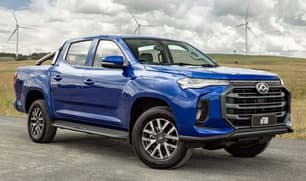
What's the difference?
GWM’s top-spec Cannon, the XSR, is a dual-cab 4WD ute worth checking out.
At a little more than $50,000, drive-away (nationwide), with twin lockers, a snorkel, underbody protection and Cooper Discoverer AT3 all-terrain tyres, this off-road-focussed Cannon variant also now has a 2.4-litre four-cylinder turbo-diesel engine rather than the previous-generation’s 2.0-litre four-cylinder turbo-diesel.
Lower-spec Cannons have undergone a refresh of sorts, including a revised front, but the XSR’s major change is the new engine. No matter, because there’s enough on offer in this top-shelf package for it to retain its value-for-money appeal.
But does the new engine make a difference to the XSR’s off-road performance?
Read on.
This is it: Australia’s first fully electric ute.
It is telling of the times that the eT60, a dual-cab, no less, doesn’t come from a traditional titan of Australia’s car market like Ford, Nissan or Toyota.
Instead, it comes from Chinese upstart, LDV. The brand has already made a name for itself importing affordable alternatives to these mainstream rivals.
The combustion version of the T60 is chipping away at the market share of established names, commanding nearly six per cent of the light commercial market, placed fifth behind Mitsubishi.
Can the brand be more than a cut-price option, though? Does it have what it takes to be a first-mover with its all-electric dual-cab? We drove a pre-production example at its Australian launch to find out.
The GWM Cannon XSR is a twin-locked 4WD ute that’s reasonable on-road (it’s getting better all the time) and very capable off-road.
It certainly has enough gear onboard – including front and rear diff locks, a snorkel and all-terrain tyres – to be taken seriously as a 4WD, but it could still be better and more refined in other aspects, even at this price-point.
There are some issues with the Cannon’s general driveability but ultimately it has plenty going for it, not least its appeal as an impressive value-for-money purchase.
The eT60 presents as an electric vehicle clearly converted from a combustion vehicle to take advantage of being first in our market.
It comes with some significant downsides, from the lack of key specifications and safety equipment to the downright average drive experience, but in other areas it’s specified right, with decent charging specs, and surprisingly good software on that centre multimedia screen.
In some ways, these impressions are a reflection of how far the ute market has come in Australia in the last few years, with many commercial offerings now feeling just as complete as passenger cars in terms of specification and driving prowess.
LDV has left open the door for future tweaks and improvements to the eT60’s spec, ride, and features, and we’re keen to get it in for a longer test in the near future. Either way, though, the brand says it has no shortage of buyers lining up to be a part of the zero emissions future of commercial vehicles.
The XSR is 5439mm long (with a 3230mm wheelbase), 1958mm wide and 1893mm high. Official kerb weight is listed as 2230kg.
This is a substantial ute that resembles an amalgamation of Ford Ranger, Isuzu D-Max and Toyota HiLux.
The wide wheel track gives the XSR a squat stance and its snorkel, sports bar, bash plates, chunky all-terrain tyres and red brake calipers add to this ute’s presence.
Inside, a steering-wheel design tweak (it’s now three spokes) and refreshed dashboard layout help to give the cabin a low-key classy look and feel.
It may lack the all-around polish of something like the Ford Ranger, but the XSR’s much lower price negates that perception.
The XSR holds its own in the looks department across the dual cab ute category.
The eT60 is hard to tell apart from its combustion equivalents from the outside. If you were expecting a blanked-out grille, aerodynamic wheels, or some other special EV-specific design flair, you’ll be surprised to find there are none.
To that end, the eT60 shares the exterior appeal of the combustion range, with a big, tough-looking grille, modern LED DRLs, sturdy looking alloy wheel designs, and enough chunky personality from the wide stance and additional bits like the sidesteps and sports bar.
Peeking underneath reveals the housing for the batteries, notably no spare wheel, and the tray is utilitarian with the spray-in tubliner. At least the ute scores colour-matching bodywork all around.
The same goes for the inside, which certainly feels like a commercial offering. Again, all the items in there mirror its base combustion equivalent, with the only giveaway of its electric nature being the dial-shifter which replaces the lever on the centre console.
The cabin surroundings are largely hard-wearing plastics, including the steering wheel, making the swish touchscreen with surprisingly fast software look somewhat out-of-place.
The analogue dash cluster, for example, looks a bit old-school for an EV, and in terms of look and feel, the T60 generally feels a bit behind the pace compared to its traditionally more expensive rivals.
While it lacks in some areas, though, it is worth something that this dual-cab flies under-the-radar. Fleet operators won’t need to worry about a strange-looking ute with unnecessary frills, and common body panels with combustion versions will make repairs easy, too.
The XSR’s five-seat interior is neat and spacious but there are parts, such as some buttons, dials and switches, that feel a bit flimsy and cheap.
Up front there are two USB ports, a wireless charging pad, a 12V plug and a deep centre console.
The new 12.3-inch touchscreen multimedia system includes wireless Apple CarPlay and Android Auto and has been improved by increments.
The front seats are power adjustable (driver’s six-way, passenger four-way) and both are comfortable without being too plush.
Second-row passengers get a firm but comfortable seat and amenities include USB charge ports, a 220V plug, air vents, and a fold-down centre armrest (with cupholders). There’s plenty of head, knee and legroom, unless you’re stuck in the middle where knee and foot room is pinched.
The second-row seat base can be folded out of the way to make room for more gear if no one’s in the back seat.
The second-row seat has top-tether points and there are ISOFIX anchors on the outboard seats.
The XSR’s load space (1520mm long, 1520mm wide and 540mm deep) has a durable tub liner, four tie-down points, as well as a pop-out step hidden in the top of the tailgate, and a step-up indent at each corner of the rear bumper.
This Cannon offers just as much all-round practicality and load-space flexibility as the likes of Isuzu D-Max, Mitsubishi Triton and Toyota HiLux.
Your burning question here will be how much the eT60 can tow and haul. With the same suspension set-up as the Pro version, this ute is capable of carrying a 1000kg payload, or tow 1000kg braked.
This is limited, but when you consider its 2300kg kerb weight due to the addition of those batteries, reasonable.
Operators should keep in mind that the 330km driving range is unladen, so you can expect half of that or less when loaded to capacity.
Tray dimensions come in at 1510mm wide (1129 between the arches), 1485mm long, and 530 high. Axle load capacity at the rear is 2100kg, and the eT60 has a GVM of 3300kg.
The approach and departure angles, as well as the clearance are mostly the same as the combustion version, coming in at 27 degrees, 24 degrees, and 187mm respectively.
Technical stuff aside, the cabin is as hard-wearing and practical as you would hope for a working ute, with a total of six cupholders and four bottle holders, a glove compartment, and sunglass holder, two USB 2.0 ports, two 12V outlets, and the welcome addition of a full-size 220V household power outlet.
The synthetic seat trim is so-so for comfort, and the seat bases are quite high, leaving someone at my 182cm height quite close to the roof.
The lack of telescopic adjust for the steering wheel is a shame, but not unusual for products from LDV’s SAIC parent company (this problem is shared with the MG ZS, for example).
The rear seat continues to offer comparatively good space for this segment, even behind my own driving position, although it would be predictably quite tight with three abreast.
As this was a brief test, we can’t tell you what it looks or feels like when loaded up, but the spray-in tubliner is better than offering the eT60 with simply a painted tray, as it’s good-to-go from day one.
The XSR is the top-spec variant in the Cannon line-up and as such has a price-tag of $50,990, drive-away (offered nationwide).
Standard features include 18-inch alloy wheels, a chrome sports bar, automatic LED headlights, spray-in tubliner, keyless entry, leather-accented upholstery, 12.3-inch touchscreen multimedia system (with wireless Apple CarPlay and Android Auto), a six-way power-adjustable driver's seat and four-way power-adjustable front-passenger seat, ambient lighting, a black sports bar and matt black exterior trim.
Exterior paint choices for the XSR include the standard 'Pearl White', or 'Crystal Black', 'Lunar Red', 'Stealth Grey', 'Sapphire Blue' and 'Pittsburgh Silver'.
This Cannon compares favourably to rivals such as the Isuzu D-Max, Mitsubishi Triton and Toyota HiLux, in terms of standard features offered for the price.
The eT60 is expensive. Shockingly expensive. The single variant which will initially arrive in Australia wears a before on-road costs price tag of $92,990.
To put that in perspective, its specification is equivalent to that of the base-model ‘Pro’ combustion version, which now wears a price-tag of $43,148.
Do the math. You could literally have two T60 Max Pros for the same cost as one of these electric versions, given the latter's price premium of $49,842.
To make matters worse, the eT60 is rear-drive only, and with its nearly 90kWh battery pack offers just 330km of driving range, and that’s without being loaded-up.
This price is puzzling for more than one reason, however. For a start, 90kWh of batteries certainly doesn’t cost nearly $50,000 (if you take the average price of a lithium cell per kWh in 2022, the battery should cost closer to $20,000).
In fact, even the electric Mercedes-Benz Vito van with a similarly-sized battery comes in at $85,353 before on-road costs.
To this you could argue many things, but perhaps the most salient point is the fact that big corporate commercial fleets with zero emissions targets are seemingly obliged to pay up given the eT60 has become the only zero-emissions option in the ute space.
Standard gear is mostly shared with the Pro grade of the combustion T60, but there are some real oddities.
Good things include 17-inch alloy wheels and a slick 10.25-inch multimedia touchscreen with Apple CarPlay connectivity, synthetic leather interior trim with six-way electric adjust for the front passengers, LED DRLs, and a sports bar over the tray, which itself has a spray-on tub liner pre-applied, and side-steps to make it easier to hop in and out.
A big bonus is the household-sized 220V power outlet on the back of the centre console, which can be used to power tools and charge devices.
Then things get a bit strange. For example, this is the only fully electric car I’ve ever driven which has a turn-key ignition (as opposed to a push-start system).
It also has an analogue dial cluster, a plastic steering wheel with no telescopic adjust, halogen headlights (in 2022, really?), a manual handbrake, and the example we drove didn’t even have a dedicated park gear. To exit the vehicle, you leave it in drive or neutral, rip the handbrake on, and turn it off. Very odd.
There’s some welcome items here, and it’s also nice that despite LDV’s clear focus on commercial buyers, the eT60 is a dual-cab, so you can actually use it for more than just hauling stuff, but there are just some things (the lack of a park gear in particular) which make it feel a bit pieced together on a tight budget. Rough for a vehicle which costs nearly $100K.
The new 2.4-litre four-cylinder turbo-diesel engine produces 135kW at 3600rpm and 480Nm at 1500-2500rpm. It's tractable and well suited to the demands of 4WDing.
Don’t get me wrong, the previous-gen Cannon’s 2.0-litre four-cylinder turbo-diesel engine (120kW/400Nm) was no slouch, either. It’s just that this bigger and more powerful engine is better.
The new engine can easily muster more than enough power and torque on- and off-road when needed. However, there are enough instances of substantial lag at crucial moments – punching off the mark from a complete stop to safely merge into traffic, for example – that when compounded threaten to mar the overall driving experience.
Another thing. The automatic transmission, now a nine- rather than eight-speed, while generally okay, proves patchy in daily driving, not upshifting as slickly as it should and sometimes hunting for the sweet spot, rather than hitting it.
In terms of all-round powertrain performance, the XSR is on par with four-cylinder, turbo-diesel rivals such as the Ford Ranger 2.0L (125kW/405Nm), Isuzu D-Max 2.2L (120kW/400Nm), Mitsubishi Triton 2.4L (150kW/470Nm) and Toyota HiLux 2.8L (150kW/500Nm).
The eT60 is rear-wheel drive only, with an electric motor producing 130kW/310Nm. That’s nowhere near as punchy as the 160kW/500Nm outputs of its punchy twin-turbo 2.0-litre combustion equivalent.
There are three driving modes - 'Power', 'Normal', and 'Eco', and driving performance seems tame. Again, as this was a quick spin in what was described as a pre-production vehicle, we didn’t have a chance to try it out with extra weight in the tray.
Suspension is the same as the combustion T60 Pro, consisting of ‘heavy duty’ coils at the front, and a leaf-sprung set-up in the rear. There are disc brakes all-round.
Listed fuel consumption is 8.4L/100km on a combined (urban/extra-urban) cycle, which is better than the 9.4L/100km offered by the previous 2.0-litre four-cylinder turbo-diesel engine and eight-speed auto.
I recorded on-test fuel consumption of 10L/100km which is ahead of the 11.2L/100km I recorded in a Cannon XSR with the 2.0-litre four and eight-speed.
The XSR has an 78-litre tank, so, going by my on-test fuel figure, you could reasonably expect a driving range of about 780km from a full tank of diesel.
The eT60’s WLTP-rated energy consumption figure comes in at 21.3kWh/100km, which for a passenger car wouldn’t be great, but seems about right for a commercial vehicle of its size and aerodynamics. As already mentioned, this gives it an official driving range of 330km.
LDV says the fleet buyers it has lined up for the eT60 understand its range is “more than adequate for their daily requirements”.
There is some good news on the charging front, with the eT60 being sensibly specified from the factory. The DC charge rate maxes out at 80kW, for a claimed 20-80 per cent charge time of 45 minutes on a compatible charger, while the slower AC charging rate (important for back-to-base operators) is 11kW, meaning a nine-hour 5.0-100 per cent charge time.
On a single-phase charger (maxing out at 7.2kW, but cheaper to install) the 5.0-100 per cent charge time is a claimed 13 hours. Expect more like a 40-hour charge time on a standard wall socket.
As noted above, there are some issues with the Cannon’s general driveability, but all in all it’s not atrocious. And if it’s a potential buy for you, you’ll always come back to the value-for-money rationale.
On- and off-road, the new engine has plenty of punch about it, but patchy delivery through the transmission sometimes works against it.
It’s a not a dynamic vehicle. No surprise, it’s a ute after all. But that point has to be made here because some people still drive these vehicles expecting sports car-like ride and handling.
The good news is the XSR’s touchy throttle and too-loose steering of days gone by have been mostly sorted out. But its thrashy transmission, stiff ride and unwieldy 13.7m turning circle remain.
Its bigger engine doesn’t carry over the previous-gen’s underdone feeling when pushed hard and it has a relaxed feel when you’re cruising along on the highway.
Some concerns have been raised over the years about driver-assist tech in Chinese-built vehicles. To the company’s credit, GWM seems to have addressed those issues… at least to some extent.
Suffice it to say, I’ve experienced a few tricky situations as a result of driver-assist tech in GWM vehicles. From annoyingly intrusive traffic sign recognition and jarring adaptive cruise control through to one particularly hair-raising AEB-related incident. (For more, read my yarn)
Overall, the XSR remains okay on sealed surfaces, but it’s not as refined or compliant as it could or should be.
As for off-roading…
On dirt tracks the XSR is jittery over corrugations and tends to thump through deeper potholes. Otherwise it is reasonably composed.
But with twin differential locks, decent underbody protection and Cooper Discoverer AT3 all-terrain tyres, this Cannon handles low-range 4WDing with ease.
The new bigger engine delivers on promised grunt in the dirt, giving the Cannon plenty of punch when the going gets tough.
Ground clearance of 228mm, wading depth of 700mm and off-road angles of 30 degrees (approach) and 26 degrees (departure; rampover is not listed) don’t hurt its 4WDing potential, either.
Off-road traction control and other driver-assist systems including hill descent control are adequate without being as smooth as the equivalent systems in more expensive vehicles.
It has 'Crawl Mode' (allowing for no-pedal, low-speed driving) and 'Turn Assist' (which brakes the XSR’s inside rear wheel to reduce the ute’s turning circle on traction-compromised surfaces).
While 4WDing, swapping between high- and low-range, changing off-road modes or switching diff locks on or off has been at times a clunky process, with the transition taking on a feeling not unlike shunting trains. No big deal, I reckon, but worth mentioning.
Wheel travel is adequate and this ute’s Cooper Discoverer AT3 all-terrain tyres perform well in the dirt and mud.
The Cannon XSR has towing capacities of 750kg (unbraked trailer) and 3000kg (braked).
All in all, off-roading is the one area in which the Cannon eclipses something like the BYD Shark 6 or Kia Tasman and matches, if not bests the Ford Ranger.
I said some of the standard equipment on this car is odd. This continues through to the drive experience. Keep in mind that LDV reminded us that there were some pre-production quirks about the vehicle we briefly drove on this launch.
Setting off, the eT60 emits a rather unappealing artificial buzzing sound to alert nearby pedestrians of its presence. While the audible aid is welcome, particularly for a commercial vehicle which may be frequently operating in areas shared with pedestrians, does it have to be so grating?
Even the Mifa 9 electric people mover makes a more appealing science-fiction-inspired noise. Perhaps the eT60’s noise was designed to mirror the tone of a diesel engine?
The seating position leaves a lot to be desired for someone of my height and I would also love to have telescopic wheel adjust, although visibility out of the cab is good all-around, and the reversing camera is relatively high-quality.
Manoeuvring at low-speeds is only tarnished, then, by heavy steering, which annoyingly, also gets a bit vague at higher speeds.
Higher speeds also reveal this ute’s main weakness which appears to be its ride. Keep in mind we’re driving a completely unladen pre-production example. But the ride was harsh, busy, and unsettled in our short drive, which covered a portion of freeway and some bumpy side roads.
The suspension from the combustion T60 Pro appears to struggle with the additional weight of the batteries in the eT60. Harsh bumps were easily transmitted to the cabin, whilst undulations had it jiggling and bouncing around side-to-side.
Power from the electric motor seemed sufficient, but not exciting, with tame acceleration off-the line. The obvious benefit being instantaneous response without the need for a transmission.
It is hard to tell whether the 310Nm on offer will feel too heavily burdened when the ute is loaded up. In some instances, electric motors don’t feel additional heft at all, so stay tuned for a follow-up load test.
Unlike this car’s Mifa 9 or eDeliver 9 relations (which use an electric motor with identical outputs), the eT60 does not have adjustable regenerative braking, with a single strong tune, which cannot even be turned off.
While it is welcome for extending the ute’s range and reducing the stress on the disc brakes, it is not a single-pedal driving mode.
The three driving modes don’t alter the experience much, with the Power mode making the electric motor more responsive, and Eco mode taking the wind out of its sails.
Its maximum speed is limited to 120km/h which is more than can be said for the eDeliver 9 which is limited to 90, a recipe for freeway frustration.
We’re keen to spend more time with the eT60 in the future to better evaluate its range claim and how it deals with more commercial duties. Hopefully it can shape up a little better than it did our quick and less-than-ideal testing environment.
All GWM Cannons, except the 'untested' XSR, have had the maximum five-star ANCAP safety rating since 2021.
Standard safety gear on the XSR includes seven airbags (dual front, front centre, front side and full-length side curtain), AEB (with cyclist and pedestrian detection), adaptive cruise control, blind-spot monitoring, lane-departure warning, traffic sign recognition, rear parking sensors, a 360-degree camera and tyre-pressure monitoring.
The top-spec XSR misses out on emergency lane keeping, rear collision warning, blind spot monitor, lane change assist, and rear cross traffic alert (with braking).
The eT60 lags behind the competition here with a notable lack of active safety equipment, now considered industry-standard.
There’s no auto emergency braking, lane support equipment, active cruise, or blind spot support. Instead, this ute has the standard array of six airbags, electronic stability and traction controls, with the addition of hill start assist, roll movement intervention, and hill descent control.
While combustion versions of the T60 have a five-star ANCAP rating from 2017 (before active items like AEB were considered necessary), don’t expect the same from the eT60.
The XSR is covered by a seven-year/unlimited km warranty and five years of free roadside assistance.
The first service is scheduled at the 12 month/10,000km mark, then services are scheduled for every 12 months or 15,000km.
Capped price servicing is available and for a Cannon with a warranty start date on or after January 1, 2026, the costs are $365, $470, $515, $520, and $685 per service. That’s a total of $2555 (and an average of $511 per workshop visit), which is more expensive than some of the Cannon’s rivals on the market.
Ownership is a better story. The eT60 is offered with an industry competitive five-year/160,000km warranty, with five years and 130,000km of roadside assist. There is also a separate eight-year and 160,000km warranty for the battery (supplied by CATL).
The service intervals might be the most appealing attribute, with the eT60 only needing to visit a workshop once every 24 months or 30,000km.
Even better is the cost, which will set owners back an approximate average of just $145.80 per year for the first 10 years of ownership.