What's the difference?
You’re not alone if you’re struggling to grasp the sheer number of new names from China popping up in the Australian new-car market. There’s more than ten and the list is only growing.
Geely is yet another marque with an ambitious plan to break into Australia's top-10 auto brands. It might have a leg-up on rivals, though, because Geely has been dabbling in international marques for some time.
Volvo, Polestar, Lotus and Zeekr are either majority or entirely owned by Geely, and the father brand — like Volkswagen in its eponymous group — therefore benefits from years of engineering know-how from other brands. Clever.
The first car launching here Australia is the EX5, an electric mid-size SUV pitched at families. Think of it as a direct rival to the Tesla Model Y, Kia EV5 and XPeng G6 but (yet unconfirmed) sharp pricing might see buyers cross-shopping with Toyota RAV4s and Mazda CX-5s.
Geely even proclaims Australian-tuned suspension, something Ford, Toyota, Hyundai and Kia have used to huge success. But does that mean the 2025 Geely EX5 is top-10 material? A spin in an early production model should give us some answers.
BYD, Chery, GWM and MG - one of these Chinese car brands is not like the others.
While the first three all enjoyed major growth in 2025, MG had a year to forget. A flood of new models, rushed into the market with little or no fanfare, resulted in a nearly 20 per cent sales decline, when the brand should have been basking in the same growth as its rivals.
So, the old management has been swept away and MG Australia is attacking 2026 with a fresh outlook and a renewed purpose, fully aware that launching an affordable car and hoping the buyers come is not a sound strategy.
Which is why the brand is making a far more concerted effort with this all-new MGS6 (all one word, likely to avoid copyright issues with Audi). It’s an important model to get right, too, as the electric mid-size SUV is becoming an increasingly popular choice for Australian buyers, as witnessed by the success of the BYD Sealion 7 and Tesla Model Y.
But with those two, plus many more mid-size EV SUVs, including the Kia EV5, GAC Aion V, Geely EX5 and Zeekr 7X (to name a few), to compete with, MG will need to put its best foot forward to give the MGS6 its best chance of success.
This one model alone won’t determine the fortunes of MG in the final reckoning of the year, but if MG wants to turn around its sales numbers and enjoy the same growth as its Chinese rivals, having the MGS6 succeed would be an important step.
The Geely EX5 has good bones. It’s well packaged, sturdily built, efficient and jam-packed with technology. But questions remain. The EX5 really needs work on its safety systems and another round of chassis revisions to be competitive.
Pricing, too, will be crucial for the EX5 to succeed in today’s savage new electric car market.
If the list of nagging complaints can be fixed and Geely is able to back up its product with solid aftersales support, it could be a winner. The jury is still out on the EX5.
Note: CarsGuide attended this event as a guest of the manufacturer, with meals provided.
It’s probably a bit much to place the future success or failure of MG as a brand solely on the shoulders of the MGS6. A lot more work behind-the-scenes and customer facing will need to happen to ensure the brand doesn’t repeat its 2025 sales performance.
However, the MGS6 is a step forward and something of a return to form for the brand. It’s a good value, well-equipped and spacious electric SUV, so if that’s what you’re looking for, it should be on your short list.
However, the challenge for MG is that there are several other very similar offerings that have emerged in recent times, namely the BYD Sealion 7, while hybrids like the Toyota RAV4 remain family favourites. Not to mention the other options from GAC, Geely, Hyundai, Kia, Subaru etc as the electric SUV segment continues to grow.
It won’t be easy for MG to recover lost ground but the MGS6 is a good start.
Note: CarsGuide attended this event as a guest of the manufacturer, with accommodation and meals provided.
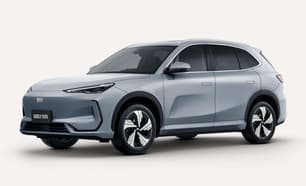
The Geely EX5’s exterior design is conservative verging on anonymous. Perhaps that’s because the brand is unknown here, but forgettable details like the six-rectangle badge rear and haphazard ‘Geely EX5’ badge placement aren’t the height of fashion.
Inside, though, the EX5 improves. The two screens are presented well, as is the cabin with upholstery that isn’t just boring black. The design language is more conventional — in a good way — than, say, a BYD Atto 3 or Tesla Model Y and doesn’t seem to unashamedly copy elements from established carmakers.
Key touch points, such as the rotary volume control, the (wrong way around) window switches and door handles appear to be made of real metal, with knurling in some cases. The dash and door tops are all encased in squishy rubber, too.
As for sizing, the EX5 is the exact same length as a Toyota RAV4, at 4615mm long, though being wider (1901mm) and riding on a longer 2750mm wheelbase should mean more cabin space.
Historically MG has played it safe design-wise, opting for inoffensive but sometimes derivative looks. But with this latest generation the brand is starting to find its own unique style and the MGS6 is another example of that.
The company has hired more European designers, who have brought a more global look and feel to the brand and given it a more clearly defined sense of style. There is a clear visual link to the smaller MGS5, with both models clearly influenced by the brand’s halo model, the Cyberster.
There’s a Cyberster-inspired split grille at the front, plus new signature daytime running lights, while at the rear there are full-width lights, with a 3D light effect with integrated spoiler for better aerodynamics. The exterior look is then finished off with 20-inch aero-designed alloy wheels.
Inside the design is in keeping with previous MG models, which means a simplistic but very modern cabin.
There are two screens, one for the driver’s display and one for the multimedia system, that provide a clean and contemporary look.
MG is offering two interior options, a standard grey-colour cabin with carbon fibre-style inlays or an optional beige look complete with Scandinavian-inspired light wood-style inlays dubbed Nordic Ashwood.
Notably, there are more soft-touch materials used throughout, which adds to a more premium look and feel for the MGS6 compared to some of the brand’s earlier models.
Finding a comfortable driving position is easy in the EX5 Inspire with the octagonal steering wheel tilting and telescoping through a broad range of motion. The seats are supportive and well-bolstered, too — not a given in this class.
While we wish the front passenger seat was height adjustable, the Inspire’s leg rest and ability to lie the seats fully flat while charging is appreciated. The massage function has six modes, three intensity levels and is remarkably powerful.
Between the EX5’s front seats is a floating centre console as gear selection is done via the right-hand stalk. It has two small cup holders on top, while under that is a generous, rubberised storage space perfect for handbags, cameras, or the like. It’s where the USB-A, USB-C and 12-volt socket are located for device charging.
There is a wireless charging pad that sits ahead of a large central storage box cooled by the air-conditioning. The Geely EX5’s door cards will easily accept a 600mL camping bottle.
Where the Geely EX5 falls down is the control layout. It is nice to have four physical switches beneath the touchscreen as shortcuts to switch the air-conditioning on or off, engage air recirculation and the front demister, but where’s the hazard light switch? It's on the ceiling.
Then there’s the large rotary dial which generally functions as a volume knob. Press it down and you can choose to have it adjust the temperature, fan speed, or — for some reason — one of several desktop backgrounds, including a computer-generated kitten playing with some wool. In this mode it also works as cursor for the multimedia screen, but never at any other time. Peculiar.
The convoluted menu structure has a strange control hierarchy. There's a shortcut target for the rear fog light, for example, yet to disable the lane-keep assist or adjust the regenerative braking power you need to jump through at least three sub-menus. And some of the text in the Geely EX5’s digital driver’s display is so small it’s almost illegible.
Then there are the typos and grammatical errors that should have been an easy pre-launch fix. A few include: ‘Distractive. Drive carefully’, ‘Keep safety distance’, ‘Driver is facial detection is missing’ and, a personal favourite: ‘The current battery is low, whether to enable super battery life?’ None of this inspires much confidence. At least the EX5’s processor is responsive for smooth tapping between the many menus.
The Geely EX5’s 1000-watt 16-speaker sound system is punchy and has presets – borrowed from Volvo and Polestar — which promise to emulate the sound quality of a recording studio, concert hall and other locations. Gimmicky in practice, plus, with the volume over 30 per cent, the EX5’s sound quality is disappointingly muddy.
Connectivity promises to be strong in the EX5 but the cars we drove were not fitted with 4G sims for live navigation, app downloads and remote smartphone control. Apple CarPlay will be added via a software update in July and Android Auto before the end of the year, says Geely.
The Geely EX5’s back seat is very generous, at 188cm tall I had plenty of leg room, respectable toe room and excellent head room even underneath the standard panoramic sunroof. The floor is totally flat and, rarely, the middle seat is usable for adults.
Two more USB chargers can be found along with air vents, door pockets and a fold-down central armrest. There’s even a hidden sliding draw for storing valuables out of sight.
The Geely EX5 has ISOFIX child seat connectors on both outboard seats and three top tether anchors on its 40/60 split-fold backrest.
The EX5 Inspire has a standard power tailgate which opens up to a total of 410 litres of boot space. If it looks a little shallow in pictures, that’s because the total space accounts for the large under-floor area (108L on its own) where Geely skipped a spare tyre.
There is one LED boot light, two shopping bag hooks and a wet storage area off to the side but, curiously, no parcel shelf.
While MG has opted for the clean, ‘tech’ look by running all the key functions through the two screens, thankfully the brand has also decided to include more physical buttons. These are for the key controls, specifically the air-conditioning and the audio system, and make it easier to adjust on the move.
MG has placed a big emphasis on user-friendliness, with a reported 38 storage spots scattered around the cabin to help make life easier for occupants. Certainly the cupholders, deep door pockets, large centre console shelf and large lidded console box do make storing your everyday small items convenient.
As for interior space, MG was keen to point out that its battery back is “ultra-thin” and measures just 110mm tall, which has allowed for a more spacious cabin with a flat floor. This translates to a very roomy interior, especially in the second row where there is enough space for two adults to sit comfortably with ample headroom and kneeroom.
In terms of storage, the MGS6 is the brand’s first model to feature under bonnet storage, or a 'frunk' as some people call it, which adds up to 86L of storage space (although that number is reduced to 67L in the AWD).
This is obviously in addition to the boot, which measures 581L with the seats up and 1607L with the second row folded.
The EX5 joins a new Chinese competitor set that’s bringing electric car prices down to — and below — size-equivalent combustion and hybrid-powered cars.
Problem is, we still don’t know the exact price, but Geely has at least provided a guide. The Geely EX5 will be priced between $49,000 and $55,000. It has either 430km (Complete) or 410km (Inspire) WLTP-rated driving range and enough power to get out of its own way.
When you consider high-spec combustion-engined mid-size SUVs like the Toyota RAV4 Cruiser ($51,410, before on-road costs), the Geely EX5 is shaping up to offer stellar on-paper value.
The entry grade EX5 Complete features 18-inch alloy wheels, privacy glass, full LED exterior lighting with auto high-beam, rear parking sensors and roof rails that accommodate up to 50kg.
Inside, a huge 15.4-inch touchscreen with built-in navigation and 10.2-inch digital driver’s display should embarrass any combustion-engined rival. The upholstery is artificial leather, the front seats are heated and power-adjustable, the sound system has six speakers and there’s keyless entry with pop-out door handles.
Moving up to the tested Inspire brings larger 19-inch alloy wheels, a power tailgate, front parking sensors and a sunroof. Cabin niceties improve with illuminated vanity mirrors and 256-colour ambient lighting, though it notably lacks dual-zone climate control.
Veritable luxury features include driver’s seat memory and an ottoman for the front passenger, ventilation and massaging for both front seats, a 16-speaker sound system putting out 1000 watts, 13.4-inch head-up display and optional ‘Cloud’ cream upholstery colour.
With exact pricing still to be revealed, it’s impossible to say whether the Geely EX5 is better value than the Leapmotor C10, Deepal S07, Kia EV5, BYD Sealion 7 or XPeng G6, but it certainly shapes up well against the updated Tesla Model Y that has climbed north of $60,000.
Five paint colours are available; Arctic White is no cost, while Shadow Black, Volcanic Grey, Moonlit Silver and Aquatic Green attract an extra charge.
The Geely EX5 is capable of outputting electricity either to a load like hairdryer, coffee machine or power tools at 3.3kW and to another vehicle at 6kWm adding 40km of driving range in an hour.
MG has taken a ‘keep it simple’ approach, offering just two variants of the MGS6 - the RWD that starts at $49,990 and the AWD priced from $56,990 - on a single specification Essence grade.
Both those prices are drive-away, which means the MGS6 is very competitive, undercutting the likes of the Tesla Model Y by more than $10,000. However, that’s still not enough to make it the most affordable electric SUV, with cheaper options out there, most notably fellow Chinese brands GAC and Geely claiming that honour with their EX5 and Aion V starting in the low-$40K range, although those are arguably at least a half-size smaller than the roomy MGS6.
Standard equipment on both models includes 20-inch alloy wheels, wireless smartphone charging, wireless Android Auto and Apple CarPlay, an 11-speaker sound system and a combination of synthetic leather and synthetic suede trim. The only major specification difference between the RWD and AWD, aside from the powertrain, is a panoramic sunroof for the more expensive model.
Geely claims the EX5’s front axle-mounted 11-in-one motor, transmission and power unit is the lightest and most compact in class. Though power and torque outputs of 160kW and 320Nm are nothing groundbreaking it was perfectly adequate for the EX5’s 1765kg tare mass.
In Eco, Standard and Sport modes the tip-in response is intentionally dulled to minimise wheel spin. Three are three regenerative braking levels; medium felt most natural, though High was acceptable. There’s no one-pedal drive mode in the Geely EX5.
The front-drive Geely EX5 Inspire's claimed 0-100km/h time is 7.1 seconds and its top speed is limited to 175km/h.
The MGS6 is based on MG’s ‘E2’ EV architecture, which is the same as the S5 and compact MG4 hatch - not to be mistaken with the front-wheel drive MG4 Urban, which is on a newer platform.
This particular platform is designed for rear- and all-wheel drive applications, while the 'E3' architecture will be used for front-wheel drive models.
The S6 RWD has a single electric motor which, as the name implies, is mounted on the rear axle and makes 180kW of power.
The AWD option unsurprisingly adds a front-mounted electric motor for all-wheel drive performance and 266kW of power.
Real-world efficiency is one of the EX5’s most impressive attributes, with the Inspire’s WLTP-range being 410km dependent on returning energy consumption of 14.7kWh/100km.
Over a 100km distance taking in suburban, motorway and country roads, the EX5’s dash showed a lower-than-rated energy consumption of 13.5kWh/100km, representing nearly 460km of real-world range from Geely’s 60.22kWh ‘Aegis’ lithium-iron phosphate (LFP) battery pack.
Along with the motor, some of the efficiency can be put down to the Geely EX5 Inspire’s quality 235/50R19 Goodyear EfficientGrip tyres.
Charging is middling for this pack, with the EX5 using a 400-volt architecture that allows DC power up to 100kW. Rejuicing from 20-80 per cent takes 28 minutes, says Geely, which is faster than the Deepal S07 and Leapmotor C10 but a long way short of the XPeng G6 and Model Y.
Three-phase AC charging caps out at 11kW, meaning you can take the EX5 from flat to full in around five and a half hours at home.
The motors are fed by a 77kWh NMC (Nickel Manganese Cobalt) battery, which is enough to provide the MGS6 RWD with 530km of range, while the AWD drops to a still reasonable 485km of claimed range.
According to the company, on a combined (urban/extra-urban) cycle the RWD uses 145Wh/km, while the AWD consumes 160Wh/km, but unfortunately our test drive was too short to verify the real-world use over an extended period of time.
MG claims with a 150kW DC charger, the battery can be recharged from 10 to 80 per cent in just 38 minutes - roughly the same time as its key rivals.
Using an 11kW AC charging it will take approximately seven hours to charge the battery from empty to 100 per cent capacity.
Underpinning the Geely EX5 is the new Global Intelligent Electric Architecture, or GEA for short. It is a newer and lower-cost version of the group’s SEA platform as used in Volvo, Polestar, Zeekr and Smart products and the bones are good.
The Geely EX5’s body doesn’t rattle, creak or shimmy over nasty road surfaces. Some solid knowhow has made its way into the brake pedal calibration which is light but delightfully smooth. It’s impossible to detect where regenerative slowing ends and hydraulic begins.
It has allegedly undergone Australian suspension localisation but don’t expect outright handling excellence, the EX5’s ride is still pillowy — verging on melted marshmallow — soft. Some will find this acceptable, however there’s plenty of potential for improvement.
Over large bumps both in town and at speed it takes the Geely EX5’s rear end between two and four rebound cycles to settle. There’s also a large amount of lateral ‘head toss’, with both attributes key ingredients in making back seat passengers car sick.
I also experienced a low-frequency boom in the EX5's cabin over concrete and rough coarse chip surfaces common on Sydney roads. Otherwise, the EX5’s is a mostly quiet car.
The sharp steering is light around town but weighted up unnaturally through corners. With high quality tyres and stability control that intervenes very early, you’re unlikely to get out of shape in the EX5 on a twisty road at least.
That said, with good bones like McPherson struts up front and multi-link rear suspension we would love to see Geely revise the EX5’s chassis to bestow the sort of fluency that makes the Kia EV5 and combustion equivalents like the Toyota RAV4 and Mazda CX-5 so much more pleasant to drive. Doing so would provide the EX5 a clear point of difference from the XPeng G6, BYD Sealion 7, Deepal S07 and Leapmotor C10.
It’s easy with EVs to fall into the trap of thinking just because it isn’t ludicrously fast it’s a letdown. And certainly, despite having 266kW available, I wouldn’t call the MGS6 particularly fast.
But measure it against its SUV peers, electric, hybrid and petrol powered, and it performs admirably. The natural smoothness of the electric motors only adds to the relaxed driving nature.
The ride and handling is also improved over previous MG models we’ve reviewed. It’s still not class-leading, but in terms of what the brand has produced before it feels like a positive step forward.
Overall the driving experience is very quiet and relaxed, with good insulation from the outside world and the quiet efficiency of the electric powertrain.
The Geely EX5 is yet to be tested by ANCAP or other relevant safety testing body.
The EX5 has seven airbags including a front centre one, a Short Blade battery that has been extensively tested to minimise fire danger along with 16 advanced driver assistance features including auto emergency braking, driver attention monitoring, blind-spot monitoring, lane-keep assist and more.
It is all well and good to tick the safety aid boxes but in practice, the EX5 leaves a little to be desired. Various mysterious beeps and bongs are semi-constant but more soothing than some rivals.
The EX5’s lane-keep assist worked well enough in the morning but was flummoxed by brighter afternoon light and shadows, once grabbing control of the wheel and pointing the car at an upcoming vehicle, another time towards the grass. Sometimes the system simply didn’t work to keep the EX5 in the lane at all.
The adaptive cruise control has an ‘Intelligent’ program that convincingly changes lanes by itself when prompted by the indicator. Unfortunately, like the lane-keep system, shadows on the road caused a few phantom-braking episodes.
Activating the adaptive cruise control is not intuitive because the steering wheel controls are poorly labeled. It’s the left directional and ‘ok’ button set, if you’re wondering, and you cancel cruise by hitting the cross button below the similar looking asterisk customisable hot key.
The standard surround-view camera is high quality with plenty of different angles to minimise kerb strikes.
Like the suspension tuning, Geely ought to send out engineers with a fine tooth comb to iron out issues with the safety systems before hitting start on public sales.
The MGS6 is well-equipped with all the usual passive and active safety features you’d expect in this day and age. These include autonomous emergency braking, lane departure warning, blind spot warning, adaptive cruise control and a 360-degree parking camera view.
Thankfully, MG has managed to tone down some of the sensitivity of these systems, which have been (to be blunt) unbearable in some of its other models. It could still be improved further, the speed limit warning remains a steady presence on every drive, but overall it is a clear improvement for the brand.
As for its safety rating, at the time of publication the MGS6 hadn’t been tested by ANCAP, but was awarded five-stars from Euro NCAP in a late 2025 assessment. That means it will likely carry a maximum five-star rating in Australia, even though it doesn’t adhere to the latest protocols spruiked by the safety agency.
Geely is doing its best to ensure smooth parts supply from launch, having run around for 12 months stocking inventory and partnering with DB Schenker for logistics.
To promote the EX5, Geely’s launching with three years complimentary servicing and one year (or 1000kWh) of free charging on the Evie network for those who order an EX5 before February 28.
Geely has yet to announce warranty details. The brand will want to aim for more than five years, as seven years is fast becoming the minimum standard for new vehicles.
Service pricing is also yet to be confirmed, though maintenance will be due every 12 months or 20,000km.
In a bid to convince buyers of the brand’s reliability and longevity MG is still offering a standard seven-year/unlimited-kilometre warranty with the option to extend to 10-years/250,000km if you get all your servicing done at an MG dealer, which makes it the longest warranty available for a new car in Australia.
Servicing intervals are every 12-months or 25,000km, whichever comes first, and differ slightly depending on the model. For the RWD the five-year service plan totals $1321 and $1877 for the seven year plan, while for the AWD the costs are $1376 and $1987, respectively.
It was noticeable during the brand’s presentation of the new MGS6 to local media that customer experience, both in the new car showroom and service centres, is a top priority. That suggests the anecdotal evidence that MG has been behind key rivals in this department is an accurate reflection. But clearly the new management structure wants to change that.
There are currently around 100 MG dealers across the county.