What's the difference?
Chinese newcomer GAC couldn’t have timed the arrival of its Aion UT in Australia any better.
At the time of writing, we were in the midst of another Middle East-related fuel crisis, and more buyers than ever before were considering switching to their first electric car.
It’s a good thing there hasn’t ever been a better time to buy one, especially with price tags getting lower and lower thanks to keen new players like GAC.
The Aion UT, which is a vaguely Corolla-sized hatchback is now one of the most affordable new EVs on the market, and aims to outfox its primary rivals, like the BYD Dolphin and GWM Ora.
But, as you may have figured out by now, newcomer brands can come with their fair share of quirks. So, is the Aion UT the affordable hatchback it needs to be? We went to its Australian launch to find out.
Anybody who doubts that Hyundai is gunning for the number one in the world has rocks in their head. Big heavy ones. Korean companies do not settle for anything less than number one. The second-generation Genesis (our first taste here in the Antipodes as the gen-one had its steering wheel on the wrong side) is proof.
What's different about Hyundai's unstoppable rise is the way they're going about it. They've always done their own thing in Korea, reinventing themselves time and again when they strayed off the beaten path.
The Genesis is a gamble for a Korean company in foreign markets whose default setting for luxury is marked, Britain or Germany. If Hyundai gets the Genesis wrong there will be howls of derision, or at best patronising pats on the back - "Nice try, you'll get there one day". But if they get it right...
The Aion UT is a cleverly-specified little hatchback and a great entry-point into electric motoring. The software needs a bit of work from a usability perspective, plus the spongy ride and cutesy styling might not be for everyone.
However, with strong points including driving range, cabin space and value, there’s even a pitch for it in some cases to be an only car compared to most of its price rivals, which are more likely to be thought of as a second car runabout in a two-car garage.
The pick of the range is definitely the entry-level Premium. It comes in at a headline-grabbing price with specs to blow rivals out of the water, while only missing out on a few luxuries.
Note: CarsGuide attended this event as a guest of the manufacturer, with accommodation and meals provided.
The Genesis is not quite a match for cars twice its price but it makes you think what's possible. It doesn't have the dynamic brilliance of a BMW or the self-assured faultless execution of a Mercedes. Lexus ought to be worried, though - why would you have an LS when you could have this? The only answer is 'badge'.
The Genesis is an epoch-making car for the Korean manufacturer. As the company has got better, there are fewer excuses for overlooking it. While the Genesis is pitched into a shrinking market, it's not really meant for the average i30 buyer to buy, but to see.
It's bristling with tech and is not only a halo car but a shot across the bows of both Lexus and the Germans. Attached to that shot is a note: "We're coming for you." In other words, Hyundai got it right.
GAC tells us the UT hatch was designed in Milan, Italy, but it also isn’t ashamed of the Chinese influence on its overall appearance, like the ultra-short bonnet and Chinese city-car style face.
Along the side it has a modern, aerodynamic profile, and the ultra-short overhangs and long wheelbase maximise the amount of room for batteries under the floor and interior space.
The rear feels a lot like a modern Mini, with its bulbous tailgate and protruding light clusters, spiced up with a sporty spoiler piece jutting out.
It’s not a bad looking thing and it’s available in an array of fun colours.
On the inside it seems to follow the established rule-book of Chinese automakers, with plush trims, big screens with minimal physical buttons as well as a contemporary two-spoke steering wheel.
There’s a trendy floating console which hosts the cupholders and wireless charger on the Luxury grade, and an array of interesting patterns and textures through the doors and dash which you wouldn’t have once seen on a car at this price-point.
However, it is worth noting that while the seats are quite nice, and the steering wheel is a stand-out touchpoint, the trims on the doors and across the dash-top are hard plastics, more so than some of this car’s rivals.
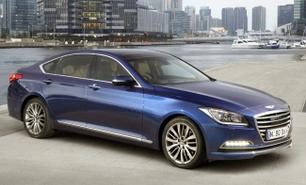
The Genesis is like no other Hyundai. For a start, it's gigantic - it looks easily as big as a BMW 7 Series (it isn't) with the road presence to match. There's a lot of BMW from most directions, but with a sharper approach to the creasing and character of the sheet metal.
Towards the rear it's more BMW 6 Series Gran Coupe and is all the better for it. The style is understated and technocratic.
Inside is also very Germanic, but with a bit more of a Lexus feel
The big wheels from the Ultimate pack help make it look lower and sleeker, too.
Inside is also very Germanic, but with a bit more of a Lexus feel. Our car had the lighter leather which meant that the wood and the metal materials didn't necessarily work well together.
The interior is expertly put together and feels like it will last forever.
The only jarring moment is the gear selector is shared with our long-term Hyundai i30 - it looked a bit cheap in what is otherwise a beautifully executed cabin - it needs more heft.
On Australian-delivered cars there is just one Hyundai badge, sitting proudly on the boot - you get the feeling this was debated long and hard and when the decision was made to go for it, a big one was chosen.
However, the winged Genesis branding takes pride of place everywhere else. When you approach the car at night and the puddle lamps come on, the Genesis logo is projected on to the ground, crisp and clear.
The GAC Aion UT starts from $31,990, before on-road costs, for the entry-level Premium grade, which makes it the third-most affordable EV you can buy in Australia after the city-sized BYD Atto 1 and the entry-level version of the BYD Dolphin.
It sits closer to price-parity with the GWM Ora, but is significantly more affordable than the rear-drive MG4 and more spec-competitive top-grade BYD Dolphin.
The bigger threat to the Aion UT is that a lot of buyers will be willing to spend slightly more to get into one of the most affordable electric small SUVs, like the BYD Atto 2 or Jaecoo J5.
Still, GAC makes a solid pitch for its hatch, which offers a higher spec level than its most direct price rivals.
For example, the Aion UT is more powerful than the entry-level Dolphin and Ora while offering a higher level of interior equipment.
Even the just-arrived front-drive MG4 Urban also starts at $31,990, but that’s for a version with significantly less driving range.
In fact, I’d go so far as to say the entry-level version of the Aion UT (the confusingly-named Premium) is probably the pick of the two variant range.
Standard equipment levels on this car include 17-inch alloy wheels, LED lighting all around, synthetic leather interior trim with heated and power adjust front seats, a 14.6-inch multimedia touchscreen with online connectivity and built-in nav as well as wireless Apple CarPlay and Android Auto.
There’s also an 8.88-inch digital instrument cluster, heated steering wheel and the full array of safety kit.
With the same power and battery size, this leaves only arguably unnecessary luxuries for the Luxury grade, like a wireless phone charger, ventilated driver’s seat, auto dimming rear vision mirror with auto power folding wing mirrors, a powered tailgate and of course, a panoramic sunroof (with shade!).
The only way to describe the Genesis' pricing is aggressive - kicking off at $60,000, it's the most expensive Hyundai money can buy, but with a spec list like this, you won't feel at all short-changed.
Your sixty large buys you a huge cabin with a seventeen speaker stereo, auto headlights and wipers, LED ambient lighting inside and out, dual-zone climate control, keyless entry and start, powered front seats which are heated and cooled, satnav, front and rear parking sensors, and plenty of other bits and pieces.
Our car had the $22,000 Ultimate package, adding 19-inch alloys, blind spot sensor, front and side cameras, around-view display, real leather, more adjustments for the driver's seat, ventilated seats in the front, heated rear seats, panoramic glass sunroof, acoustic glass, heads-up display, powered bootlid and LED foglamps.
The Genesis is like no other Hyundai
You can have a lot of the more useful features in the $11,000 Sensory Pack. It's a good middle ground that, for example, features the excellent heads-up display.
The 9.2-inch screen splits the asymmetric air-conditioning vents. The software is unique to the Genesis and a huge leap forward over the rest of the Hyundai range - classy, smooth graphics, a good responsive screen.
You control the seventeen speaker stereo from here, which kicks out a rich sound and an impressive Bluetooth performance - rear seat passengers can also run the stereo from their armrest. The satnav is detailed and chatty, while the excellent heads-up display shows a configurable information set in strong, clear graphics.
The Aion UT has a front-mounted electric motor producing 150kW/210Nm. That’s plenty punchy for any hatchback at this price, and I like the way the brand hasn’t messed around with a sub-100kW motor in the base variant to push prospects towards the top-spec car.
It’s more powerful than all of its closest rivals and at the time of writing you’ll have to spend four to six thousand dollars more to get into something equivalent from BYD, Chery, Jaecoo, Leapmotor or MG.
It even has a claimed 0-100km/h sprint time as low as 7.3 seconds.
The Genesis is powered by Hyundai's own 3.8-litre V6 developing 232kW and 397Nm, mated to Hyundai's eight-speed automatic transmission.
Despite weighing just under two tonnes, the Genesis completes the dash to 100km/h in 6.5 seconds.
It has a claimed 11.2L/100km on the combined cycle. In what must be a first, we got below that, averaging 10.8L/100km over two weeks. And that's without stop-start fuel-saving to blunt the effect of lot of city driving.
The Genesis is not going to tempt you into a track day, even with rear wheel drive
We'd still like to try the V8 - only available in left-hand drive markets - though.
The drive experience can be where a lot of Chinese cars fall down but I walked away less frustrated by the Aion UT.
That’s not to say it will behave as you might expect a low-slung hatchback to. The suspension, for example, is extremely soft as it maintains its original Chinese-market state-of-tune.
This makes the car waft over imperfections on city roads. And in that sense it offers supreme ride comfort in the scenarios it was designed for. However, at the extremes, like some speed bumps, or particularly deep pot holes there can be a surprisingly violent re-bound sending a thud through the cabin.
The other trade-off for soft suspension is less body control. I was surprised to find that the Aion UT holds it together mostly well on a flat country B-road, but when undulations and big dips introduce themselves, the soft suspension can be too slow to react, making the car lose confidence in higher-speed open road scenarios we’re more used to in Australia.
The steering, like many electric cars in this category, is relatively heavily electrically assisted. This makes it light and easy to adjust at low speeds for easy park and maneuverability in the confines of a city. It loses a little bit of road-feel at higher speeds but the Aion UT’s steering is far from the least connected I’ve experienced recently.
One thing it can’t be criticised for is a lack of power. With 150kW instantaneously available the Aion UT has some serious poke and while the ChaoYang tyre package is tuned more for efficiency than grip, it’s again not one of the worst I’ve driven with.
One thing which helps the whole experience along is this car’s hatchback layout. With the weight of the battery low and squat and the wheels all the way out to the edges of the frame, the Aion UT inherently handles decently compared to an electric crossover or small SUV.
Like all Chinese cars, the UT has a host of occasionally frustrating driver aids, which you can read about in the Safety section below. While I was inclined to turn some of the features off after testing them, the alerts are relatively quiet and non-invasive.
Is the UT any good to drive? It’s not bad for the segment, I was largely pleased with how it handled and the power on offer, and while it still has its annoyances, they’re not big deal-breakers.
The MG4 rear-drive is a better allrounder, while the GWM Ora isn’t as good. I’d say it’s on par with the BYD Dolphin, but they excel in different areas. The Dolphin's a bit sharper in terms of handling but the Aion UT is more comfortable.
At five metres long, with a ride firmly pitched in the luxury camp, the Genesis is not going to tempt you into a track day, even with rear wheel drive.
Blindfold your passengers and swap them between a Lexus, a BMW and a Genesis and the overwhelming impression they'll get is one of incredible smoothness.
If you're wanting sudden movements, this isn't the car for you
Sitting in the back of the Genesis, it's easily as good as the German and luxury Japanese competition. The seats are hugely comfortable, there's ample head, leg and shoulder room and it feels lot nicer than anything within a bull's roar of its price.
No matter where you sit, it's an incredibly quiet car. The engine is a distant whoosh, the tyre noise muted and there's almost no wind or ambient noise. It's supremely comfortable and the excellent stereo will wash away what little noise does invade.
It certainly feels its weight from the driver's seat, with a competent, soft turn-in, but if you're wanting sudden movements, this isn't the car for you.
The Genesis is an epoch-making car for the Korean manufacturer
On fast flowing roads you can have some fun, but things will get floaty and that will quickly kill that fun. The ride and isolation from the rest of the world is completely worth it.
As with many Chinese cars the list of active safety equipment is long but that doesn’t mean it’s particularly well calibrated.
Standard gear includes the key stuff like auto emergency braking (AEB), lane keep assist, blind-spot monitoring, rear cross-traffic alert and adaptive cruise control. There are also rarer features for an affordable car like this including traffic sign recognition, door open warning, auto high beams and front cross-traffic alert.
On the parking front you get a 360-degree parking camera view as well as front and rear proximity sensors.
There's also an annoying driver monitoring system and one I haven’t seen much in the form of an occupant warning system, which seems to imagine you’re not wearing a seatbelt when you are.
It’s not the only safety system I found myself reaching to turn off. The lane keep assist could occasionally be a bit heavy-handed and the traffic sign alert was typically frustrating. This, sadly, is what we’ve come to expect from these types of systems from many Chinese automakers.
It’s not the most annoying system I’ve used, though, and the alerts are quiet enough and far enough apart that they aren't as intrusive as they can be in some rivals. You can also adjust the tolerance of some of the systems in the (needlessly complicated) menus to make them less annoying.
At the launch, the Aion UT was yet to be rated by ANCAP.
Nine airbags, traction and stability control, lane departure warning, forward collision control, ABS, brake force assist and distribution and traction and stability control bring the ANCAP count to five stars.
The Sensory and Ultimate packs add blind spot sensors and around view cameras.